{
"schema_version": "1.1",
"id": 214451,
"slug": "brazil-immigration-law-2026",
"title": "Brazil Immigration Law 2026: Visas, Residency & CRNM",
"excerpt": "Brazil immigration law explained for foreigners: visa types, residency paths, the CRNM card (R$204.77), naturalization, and how to fix irregular status in 2026.",
"content_primary": "markdown",
"available_formats": [
"markdown"
],
"content_markdown": "Here is the short answer. Brazilian immigration is governed by the Migration Law (Lei nº 13.445/2017), one of the most modern and welcoming frameworks in Latin America. It treats migration as a human right, not a privilege. As a foreigner, you can legally live, work, study, and access public health (SUS) and education in Brazil — once you regularize your status.\n\nThe catch is bureaucracy. The law is generous, but the paperwork is slow, the offices are crowded, and a single missing document can reset your timeline by weeks. This guide breaks the whole system down in plain English: visas, residency, the CRNM, naturalization, and how to fix an irregular status.\n\nLeia também:\n[Technical Assistance Visa Brazil 2026: New Simplified Rules](https://www.ribeirocavalcante.com.br/technical-assistance-visa-brazil-2026/)\n\nBrazil uses a Civil Law system, not Common Law. That means written statutes and codes rule everything, and registration at a cartório (notary office) carries real legal weight. By the end of this article, you will know exactly which path fits your situation and what to do next.\n\n\n## Brazil immigration law: Who Can Legally Live in Brazil as a Foreigner?\n\nAlmost any foreigner can legally live in Brazil if they fit a legal category. Under the Migration Law (Lei nº 13.445/2017), the main routes are work, family reunion, investment, study, retirement, refuge, and the Mercosur agreement. Each grants temporary or permanent residency once approved by the Federal Police.\n\nBrazil replaced the old “foreigner statute” with a rights-based model in 2017. The current framework is detailed in [Law 13.445/2017 on the Planalto government portal\r\n\r\n](https://www.planalto.gov.br/ccivil_03/_ato2015-2018/2017/lei/l13445.htm). It guarantees equal treatment, access to justice, and protection against deportation in most situations.\n\nLeia também:\n[How to Apply for Asylum in Brazil 2026: Complete Guide](https://www.ribeirocavalcante.com.br/how-to-apply-for-asylum-in-brazil-2026/)\n\nThe most common legal categories for foreigners are:\n\n- Work residency (job offer or self-employment)\n- Family reunion (Brazilian spouse, partner, or child)\n- Investor residency (typically R$ 500,000 in a company, lower in some sectors)\n- Retirement residency (proof of stable income)\n- Study residency (enrolled in a Brazilian institution)\n- Mercosur residency (citizens of member and associated states)\n- Refuge and humanitarian protection\n\nEach category has different documents and timelines. A Mercosur citizen can regularize in weeks, while an investor case may take months. The good news: nearly everyone has a legal path. For a deeper look at the residency options, see our [complete guide to the residency visa in Brazil](https://www.ribeirocavalcante.com.br/residency-visa-in-brazil-2026/).\n\n\n## Brazil immigration law: What Is the CRNM and Why Do You Need It?\n\nThe CRNM (National Migratory Registration Card / Carteira de Registro Nacional Migratório) is your official ID as a legal resident in Brazil. It proves your immigration status and is required to work, open a bank account, sign contracts, and access services. The 2026 registration fee is R$ 204.77, around US$ 38.\n\nWithout the CRNM, daily life is nearly impossible. Banks refuse accounts, employers cannot register you formally, and landlords hesitate. The card is issued by the [Federal Police](https://www.gov.br/pf/pt-br) after your residency is approved.\n\nTo register, you generally need:\n\n- Valid passport and entry visa (when applicable)\n- Birth certificate (certidão de nascimento), translated and legalized\n- Marriage certificate (certidão de casamento), if applying through marriage\n- Proof of residence (comprovante de residência)\n- Payment receipt of the federal fee (guia de recolhimento — GRU)\n- Passport-style photo and biometrics taken at the Federal Police\n\nThe fee comes in two parts under Federal Police rules: a processing charge plus the card issuance of R$ 204.77. The biometric appointment is scheduled through the Federal Police online system. For the full walkthrough, read our dedicated [CRNM registration guide for 2026](https://www.ribeirocavalcante.com.br/crnm-registration-2026/). Keep every receipt — losing the GRU is one of the most common reasons appointments get rejected.\n\n\n## How Long Does It Take to Regularize Your Status?\n\nRegularizing your status in Brazil typically takes from 30 days to 6 months, depending on the visa type and case complexity. Mercosur and family cases are fastest; investor and refuge cases are slowest. The CRNM card itself is usually delivered 90 to 180 days after your biometric appointment, per Federal Police timelines.\n\nBe honest with yourself about Brazilian bureaucracy. Official deadlines exist, but offices are understaffed and backlogs are real. Always add a buffer. A “30-day” process can stretch when a translation is rejected or a system goes down.\n\nWhile you wait, you are not in limbo. After submitting your residency request, the Federal Police issue a protocol (protocolo) that serves as temporary proof of legal status. This document lets you get your CPF, open a basic bank account, and stay in the country legally until the CRNM arrives.\n\nThe CPF (Cadastro de Pessoa Física), Brazil’s individual taxpayer number, is the real key to daily life. You can request it free through the [Receita Federal (Brazilian IRS)](https://www.gov.br/receitafederal/pt-br), even before residency, at a Brazilian consulate abroad. Without a CPF, you cannot buy a phone plan, rent property, or invest. Get it as early as possible — ideally before you even land.\n\n\n## What Are the Most Common Problems Foreigners Face?\n\nThe most common problems are missing or untranslated documents, expired protocols, and confusion over which residency category applies. Brazilian law guarantees access to health (SUS) and education, but in practice many foreigners hit barriers because offices demand papers that are hard to obtain abroad.\n\n\n*Who can legally live in brazil as a foreigner? — foto: joshuaworoniecki*\n\nSome recurring pain points:\n\n- Foreign documents not legalized or apostilled in the country of origin\n- Sworn translations missing — Brazil requires a tradutor juramentado (sworn translator) for official use\n- Letting the protocol expire before the CRNM is issued\n- Choosing the wrong visa category and having to restart\n- Discrimination or misinformation at counters about your rights\n\nRemember: everyone in Brazil has the right to emergency care at the SUS public health system, documented or not. But continuous access — a clinic, a family doctor, ongoing treatment — is far easier once you hold a CPF and CRNM.\n\nThe Constitution and the Migration Law protect your rights, but enforcement depends on you knowing them. A lawyer registered with the OAB (Brazilian Bar Association) can intervene when an office wrongly denies a service. Many problems that look final are actually solvable with the right legal pressure or a corrected document.\n\n\n## How Do You Become a Permanent Resident or Citizen?\n\nYou become a permanent resident after holding temporary residency, usually for 2 to 4 years depending on the category, then applying for an indefinite-term residency. Naturalization (citizenship) generally requires 4 years of residency, but this drops to 1 year if you have a Brazilian child or spouse, under Law 13.445/2017.\n\nPermanent residency removes the need to renew your status repeatedly. The most common route is the four-year rule, explained in our guide to [permanent residency in Brazil and the 4-year rule](https://www.ribeirocavalcante.com.br/permanent-residency-brazil-requirements-2026/). Family ties shorten the timeline significantly.\n\nNaturalization comes in several types:\n\n- Ordinary: 4 years of residency, Portuguese proficiency, no recent criminal record\n- Reduced (1 year): with a Brazilian child, Brazilian spouse, or a notable contribution\n- Extraordinary: after more than 15 years of uninterrupted residency, without certain ordinary requirements\n\nThe extraordinary route is powerful and underused. If you have lived in Brazil for over 15 years, you may qualify almost automatically — see our breakdown of the [extraordinary naturalization 15-year right](https://www.ribeirocavalcante.com.br/extraordinary-naturalization-brazil-15-years-2026/). To prepare paperwork, our [2026 naturalization document checklist](https://www.ribeirocavalcante.com.br/documents-for-brazilian-naturalization-2026/) lists everything you need. Brazil also allows dual citizenship, so you usually do not have to give up your original nationality.\n\n\n## How Much Does the Immigration Process Cost?\n\nGovernment fees for immigration in Brazil are relatively low. The CRNM card costs R$ 204.77 in 2026 per Federal Police rates, the CPF is free, and most certificate fees range from R$ 5 to R$ 100 at cartórios. The biggest costs are sworn translations, apostilles, and legal representation, which vary by case.\n\nBelow is a realistic cost comparison of common scenarios. Translation and lawyer fees are market estimates, not government tariffs.\n\n| Scenario | Typical Process Time | Estimated Total Cost (BRL) |\n| --- | --- | --- |\n| Mercosur residency | 1–2 months | R$ 1,000 – R$ 2,000 |\n| Family reunion (spouse/child) | 2–4 months | R$ 2,000 – R$ 5,000 |\n| Work residency | 2–6 months | R$ 3,000 – R$ 8,000 |\n| Investor residency | 3–8 months | R$ 5,000 – R$ 12,000 |\n| Naturalization | 12–24 months | R$ 3,000 – R$ 8,000 |\n\nA simple calculation helps. Suppose you apply for family residency. The CRNM fee is R$ 204.77, two sworn translations cost around R$ 250 each, certificates run R$ 100 total, and legal support is R$ 2,000. Your realistic out-of-pocket total lands near R$ 2,800, roughly US$ 520. Doing it without a lawyer is cheaper but riskier if documents are rejected.\n\n\n## What Changed for Foreigners in 2026?\n\nIn 2026, the core framework remains the Migration Law (Lei nº 13.445/2017) and Decree 9.199/2017, with no full reform passed. The main changes are practical: more digital processing through gov.br, updated Federal Police fees like the R$ 204.77 CRNM charge, and ongoing improvements to online scheduling and protocol issuance.\n\nThe implementing rules sit in [Decree 9.199/2017 on the Planalto portal](https://www.planalto.gov.br/ccivil_03/_ato2015-2018/2017/decreto/d9199.htm). Most 2026 updates come from administrative resolutions rather than new statutes, which is why following official Federal Police channels matters.\n\n[\n\n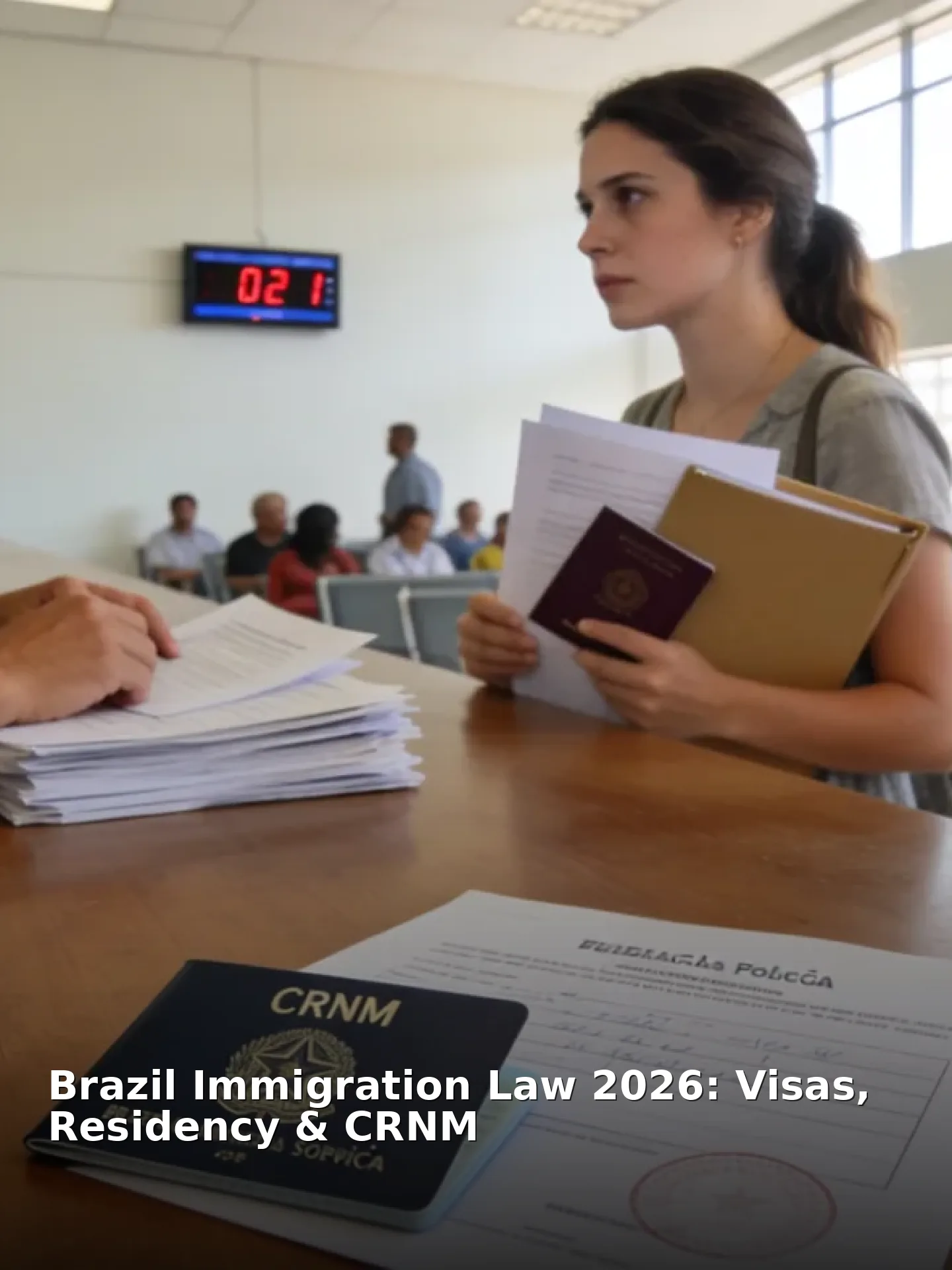\n\n](https://www.ribeirocavalcante.com.br/web-stories/brazil-immigration-law-2026/)\n\n⚡ Web Story\n[Brazil Immigration Law 2026: Visas, Residency & CRNM](https://www.ribeirocavalcante.com.br/web-stories/brazil-immigration-law-2026/)\n[Ver história visual ›](https://www.ribeirocavalcante.com.br/web-stories/brazil-immigration-law-2026/)\n\n\nWhat is worth knowing this year:\n\n- More services moved to the gov.br single sign-on platform\n- Digital appointment scheduling for biometrics is now the norm at most Federal Police units\n- Continued recognition of dual citizenship and rights-based treatment of migrants\n- Ongoing debate about faster pathways for digital nomads and remote workers\n\nCourts also continue to shape practice. The [Superior Court of Justice (STJ)](https://www.stj.jus.br) has reinforced that migrants cannot be denied basic rights over missing paperwork alone. When an office wrongly refuses you, judicial remedies exist and often work.\n\n\n## Step-by-Step: How to Regularize Your Status in Brazil\n\nTo regularize your status, you request the correct residency category, gather translated documents, pay the federal fee (GRU), book a Federal Police biometric appointment online, and collect your CRNM. The process usually takes 1 to 6 months and starts on the gov.br portal or at a Brazilian consulate.\n\n\n### Step 1: Get your CPF\n\nRequest your CPF from Receita Federal, free of charge, online or at a consulate before arrival. Everything else depends on it.\n\n\n### Step 2: Choose the right residency category\n\nIdentify whether you qualify through work, family, investment, study, or Mercosur. Picking wrong is the top cause of restarts.\n\n\n### Step 3: Prepare and translate documents\n\nYou will typically need:\n\n- Passport (and visa, if your nationality requires one)\n- Birth certificate and, if relevant, marriage certificate\n- Apostille from your home country\n- Sworn translation (tradutor juramentado) into Portuguese\n- Proof of residence in Brazil\n- Criminal background check, when required\n\n\n### Step 4: Pay the fee and submit online\n\nGenerate the GRU payment slip, pay it, and submit your application through the Federal Police system on gov.br. Save the protocol.\n\n\n*Who can legally live in brazil as a foreigner? — foto: jackmac34*\n\n\n### Step 5: Attend biometrics and collect the CRNM\n\nGo to your scheduled Federal Police appointment for fingerprints and photo. The CRNM is then issued within 90 to 180 days. Budget extra time and check your status periodically online. Refuge applicants follow a parallel track through the National Committee for Refugees (CONARE), which grants a protocol allowing legal stay while the request is analyzed.\n\n\n## Frequently Asked Questions\n\n\n### Do I need a lawyer to immigrate to Brazil?\n\nLegally, no. You can file most residency requests yourself through gov.br and the Federal Police. In practice, a lawyer registered with the OAB saves time and prevents costly rejections, especially in work, investor, and naturalization cases. Simple Mercosur or family cases are often manageable alone, while complex situations — denied applications, irregular status, or missing documents — benefit greatly from professional help. A lawyer can also pursue judicial remedies if an office wrongly denies your rights, which happens more often than it should.\n\n\n### How long does the CRNM take to be issued?\n\nThe CRNM is generally issued 90 to 180 days after your biometric appointment, according to Federal Police timelines. While you wait, your protocol (protocolo) serves as valid proof of legal status. The exact time depends on the local Federal Police unit and current backlog. Larger cities sometimes move faster because they process higher volumes, but delays are common everywhere. Keep checking your status online and never let your protocol expire — renew it if the card has not arrived by the deadline shown on the document.\n\n\n### Can a foreigner work legally in Brazil?\n\nYes. Once you hold a residency authorization and CRNM, you have the right to work formally in Brazil, including a signed work card (carteira de trabalho). The Migration Law guarantees equal labor rights to migrants. You will need a CPF and, for formal employment, the digital work card linked to your CPF. Self-employment and company ownership are also allowed. Your protocol may already let you start working in many situations, but confirm your specific category, since some temporary visas restrict the type of work permitted.\n\n\n### Can a foreigner own 100% of a Brazilian company?\n\nYes, in most sectors a foreigner can own 100% of a Brazilian company. You generally need a CPF and, for management roles, a residency authorization. A few strategic sectors — such as rural land, media, and aviation — have restrictions or require Brazilian partners. Setting up a company involves registration with the Junta Comercial (commercial board), Receita Federal, and the municipality. The process is fully legal but document-heavy, so most foreign investors use a lawyer and an accountant to register the company correctly and avoid tax surprises.\n\n\n### Does Brazil allow dual citizenship?\n\nYes. Brazil allows dual or multiple citizenship, so naturalizing as Brazilian usually does not force you to renounce your original nationality. Whether your home country accepts dual citizenship is a separate question you must check with its own rules. Brazilian naturalization typically requires four years of residency, dropping to one year if you have a Brazilian spouse or child, and over fifteen years grants access to extraordinary naturalization. Portuguese language proficiency and a clean recent criminal record are standard requirements for the ordinary route.\n\n\n### What happens if my immigration status becomes irregular?\n\nAn irregular status in Brazil is usually fixable. The Migration Law favors regularization over punishment, so you are rarely deported for overstaying alone. You may face a fine of around R$ 100 per day, capped by law, plus a regularization process. Acting quickly matters: the longer you wait, the more it costs and the harder it becomes to access services. A lawyer can request regularization, negotiate fines, and argue for protection based on family ties, work, or length of residence in the country.\n\n\n## Navigate Brazilian Immigration Law With Confidence\n\nMoving to a new country is hard enough without fighting a bureaucracy in a language you may not yet speak. The fear of doing it wrong — of being denied, fined, or stuck in limbo — is real. But Brazilian law is on your side, and almost every situation has a legal solution.\n\nOur bilingual legal team at Ribeiro Cavalcante Advocacia guides expats, investors, digital nomads, and international families through every step — from your first CPF to full citizenship. We handle the paperwork, the deadlines, and the Federal Police, so you can focus on building your life in Brazil.\n\nTalk to a specialist lawyer now\n[ Talk to a Lawyer on WhatsApp](https://www.ribeirocavalcante.com.br/ads/wpp.html)",
"content_hash": {
"algo": "sha256",
"scope": "content_markdown",
"value": "0270e80527edd1205f827e489e99ecdbef6f33dbad73090a120acd7f246a7ec7"
},
"date_published": "2026-06-16T05:58:00-03:00",
"date_modified": "2026-06-16T05:58:00-03:00",
"author": {
"name": "Lucas Ribeiro Cavalcante",
"url": "https://www.ribeirocavalcante.com.br/autor/lucas/"
},
"canonical_url": "https://www.ribeirocavalcante.com.br/brazil-immigration/",
"json_url": "https://www.ribeirocavalcante.com.br/brazil-immigration-law-2026.json",
"word_count": 2576,
"reading_time": 13,
"robots": {
"index": true,
"follow": true
},
"license": {
"name": "CC BY-NC-ND 4.0",
"url": "https://creativecommons.org/licenses/by-nc-nd/4.0/deed.pt-br",
"notice": "Conteúdo protegido. Cite a fonte com link para a URL canônica. Reprodução integral proibida."
},
"publisher": {
"name": "Ribeiro Cavalcante Advocacia",
"url": "https://www.ribeirocavalcante.com.br/"
},
"publisher_ref": "https://www.ribeirocavalcante.com.br/org.json",
"language": "pt-BR",
"site": "Ribeiro Cavalcante Advocacia",
"categories": [
{
"id": 4609,
"name": "Immigration Law",
"slug": "immigration-law",
"url": "https://www.ribeirocavalcante.com.br/english/immigration-law/"
}
],
"tags": [
{
"id": 6423,
"name": "brazil immigration law",
"slug": "brazil-immigration-law",
"url": "https://www.ribeirocavalcante.com.br/tag/brazil-immigration-law/"
},
{
"id": 6425,
"name": "brazil naturalization",
"slug": "brazil-naturalization",
"url": "https://www.ribeirocavalcante.com.br/tag/brazil-naturalization/"
},
{
"id": 6422,
"name": "brazil-immigration-law:-the-complete-guide-for-foreigners",
"slug": "brazil-immigration-law-the-complete-guide-for-foreigners",
"url": "https://www.ribeirocavalcante.com.br/tag/brazil-immigration-law-the-complete-guide-for-foreigners/"
},
{
"id": 4680,
"name": "crnm brazil",
"slug": "crnm-brazil",
"url": "https://www.ribeirocavalcante.com.br/tag/crnm-brazil/"
},
{
"id": 6424,
"name": "live in brazil as a foreigner",
"slug": "live-in-brazil-as-a-foreigner",
"url": "https://www.ribeirocavalcante.com.br/tag/live-in-brazil-as-a-foreigner/"
},
{
"id": 4647,
"name": "residency visa brazil",
"slug": "residency-visa-brazil",
"url": "https://www.ribeirocavalcante.com.br/tag/residency-visa-brazil/"
}
],
"featured_image": {
"url": "https://cdn.ribeirocavalcante.com.br/2026/06/brazil-immigration-law-the-complete-guide-for-foreigners-214451-1781600319.webp",
"width": 1400,
"height": 788,
"alt": "Imagem representando Brazil Immigration Law: The Complete Guide for Foreigners — Ribeiro Cavalcante Advocacia"
},
"faq": [
{
"question": "What is the main Brazil immigration law?",
"answer": "Brazil immigration law is governed by the Migration Law (Lei nº 13.445/2017), a rights-based framework that replaced the old foreigner statute in 2017."
},
{
"question": "How can a foreigner legally live in Brazil?",
"answer": "Foreigners can live in Brazil through work, family reunion, investment, study, retirement, refuge, or the Mercosur agreement, each granting temporary or permanent residency after Federal Police approval."
},
{
"question": "What is the CRNM and why do I need it?",
"answer": "The CRNM is your official ID as a legal resident, required to work, open a bank account, sign contracts, and access services. The 2026 fee is R$204.77 (about US$38)."
},
{
"question": "How long does Brazilian residency take to process?",
"answer": "It varies by category: a Mercosur citizen can regularize in weeks, while an investor case may take several months due to bureaucracy and document requirements."
},
{
"question": "Does Brazil immigration law allow naturalization?",
"answer": "Yes. Under Brazil immigration law, foreigners can apply for naturalization after meeting residency time, Portuguese language, and other legal requirements set by Law 13.445/2017."
}
],
"table_of_contents": [
{
"level": 2,
"text": "Brazil immigration law: Who Can Legally Live in Brazil as a Foreigner?",
"anchor": "brazil-immigration-law-who-can-legally-live-in-brazil-as-a-foreigner"
},
{
"level": 2,
"text": "Brazil immigration law: What Is the CRNM and Why Do You Need It?",
"anchor": "brazil-immigration-law-what-is-the-crnm-and-why-do-you-need-it"
},
{
"level": 2,
"text": "How Long Does It Take to Regularize Your Status?",
"anchor": "how-long-does-it-take-to-regularize-your-status"
},
{
"level": 2,
"text": "What Are the Most Common Problems Foreigners Face?",
"anchor": "what-are-the-most-common-problems-foreigners-face"
},
{
"level": 2,
"text": "How Do You Become a Permanent Resident or Citizen?",
"anchor": "how-do-you-become-a-permanent-resident-or-citizen"
},
{
"level": 2,
"text": "How Much Does the Immigration Process Cost?",
"anchor": "how-much-does-the-immigration-process-cost"
},
{
"level": 2,
"text": "What Changed for Foreigners in 2026?",
"anchor": "what-changed-for-foreigners-in-2026"
},
{
"level": 2,
"text": "Step-by-Step: How to Regularize Your Status in Brazil",
"anchor": "step-by-step-how-to-regularize-your-status-in-brazil"
},
{
"level": 3,
"text": "Step 1: Get your CPF",
"anchor": "step-1-get-your-cpf"
},
{
"level": 3,
"text": "Step 2: Choose the right residency category",
"anchor": "step-2-choose-the-right-residency-category"
},
{
"level": 3,
"text": "Step 3: Prepare and translate documents",
"anchor": "step-3-prepare-and-translate-documents"
},
{
"level": 3,
"text": "Step 4: Pay the fee and submit online",
"anchor": "step-4-pay-the-fee-and-submit-online"
},
{
"level": 3,
"text": "Step 5: Attend biometrics and collect the CRNM",
"anchor": "step-5-attend-biometrics-and-collect-the-crnm"
},
{
"level": 2,
"text": "Frequently Asked Questions",
"anchor": "frequently-asked-questions"
},
{
"level": 3,
"text": "Do I need a lawyer to immigrate to Brazil?",
"anchor": "do-i-need-a-lawyer-to-immigrate-to-brazil"
},
{
"level": 3,
"text": "How long does the CRNM take to be issued?",
"anchor": "how-long-does-the-crnm-take-to-be-issued"
},
{
"level": 3,
"text": "Can a foreigner work legally in Brazil?",
"anchor": "can-a-foreigner-work-legally-in-brazil"
},
{
"level": 3,
"text": "Can a foreigner own 100% of a Brazilian company?",
"anchor": "can-a-foreigner-own-100-of-a-brazilian-company"
},
{
"level": 3,
"text": "Does Brazil allow dual citizenship?",
"anchor": "does-brazil-allow-dual-citizenship"
},
{
"level": 3,
"text": "What happens if my immigration status becomes irregular?",
"anchor": "what-happens-if-my-immigration-status-becomes-irregular"
},
{
"level": 2,
"text": "Navigate Brazilian Immigration Law With Confidence",
"anchor": "navigate-brazilian-immigration-law-with-confidence"
}
],
"internal_links": [
{
"anchor_text": "Technical Assistance Visa Brazil 2026: New Simplified Rules",
"url": "https://www.ribeirocavalcante.com.br/technical-assistance-visa-brazil-2026/"
},
{
"anchor_text": "How to Apply for Asylum in Brazil 2026: Complete Guide",
"url": "https://www.ribeirocavalcante.com.br/how-to-apply-for-asylum-in-brazil-2026/"
},
{
"anchor_text": "complete guide to the residency visa in Brazil",
"url": "https://www.ribeirocavalcante.com.br/residency-visa-in-brazil-2026/"
},
{
"anchor_text": "CRNM registration guide for 2026",
"url": "https://www.ribeirocavalcante.com.br/crnm-registration-2026/"
},
{
"anchor_text": "permanent residency in Brazil and the 4-year rule",
"url": "https://www.ribeirocavalcante.com.br/permanent-residency-brazil-requirements-2026/"
},
{
"anchor_text": "extraordinary naturalization 15-year right",
"url": "https://www.ribeirocavalcante.com.br/extraordinary-naturalization-brazil-15-years-2026/"
},
{
"anchor_text": "2026 naturalization document checklist",
"url": "https://www.ribeirocavalcante.com.br/documents-for-brazilian-naturalization-2026/"
},
{
"anchor_text": "Brazil Immigration Law 2026: Visas, Residency & CRNM",
"url": "https://www.ribeirocavalcante.com.br/web-stories/brazil-immigration-law-2026/"
}
],
"cta": [
{
"label": "Talk to a Lawyer on WhatsApp",
"url": "https://www.ribeirocavalcante.com.br/ads/wpp.html",
"type": "whatsapp"
}
],
"legal_basis": [
{
"title": "Law 13.445/2017 on the Planalto government portal",
"url": "https://www.planalto.gov.br/ccivil_03/_ato2015-2018/2017/lei/l13445.htm"
},
{
"title": "Decree 9.199/2017 on the Planalto portal",
"url": "https://www.planalto.gov.br/ccivil_03/_ato2015-2018/2017/decreto/d9199.htm"
}
],
"institutions": [
{
"title": "Superior Court of Justice (STJ)",
"url": "https://www.stj.jus.br"
}
],
"external_references": [
{
"title": "Federal Police",
"url": "https://www.gov.br/pf/pt-br"
},
{
"title": "Receita Federal (Brazilian IRS)",
"url": "https://www.gov.br/receitafederal/pt-br"
}
],
"related_posts": [
{
"title": "Documents for Brazilian Naturalization: 2026 Checklist",
"url": "https://www.ribeirocavalcante.com.br/documents-for-brazilian-naturalization-2026/",
"json_url": "https://www.ribeirocavalcante.com.br/documents-for-brazilian-naturalization-2026.json",
"relationship": "cluster"
},
{
"title": "Extraordinary Naturalization Brazil: 15-Year Right Explained",
"url": "https://www.ribeirocavalcante.com.br/extraordinary-naturalization-brazil-15-years-2026/",
"json_url": "https://www.ribeirocavalcante.com.br/extraordinary-naturalization-brazil-15-years-2026.json",
"relationship": "cluster"
},
{
"title": "Permanent Residency Brazil: 4-Year Rule Explained",
"url": "https://www.ribeirocavalcante.com.br/permanent-residency-brazil-requirements-2026/",
"json_url": "https://www.ribeirocavalcante.com.br/permanent-residency-brazil-requirements-2026.json",
"relationship": "cluster"
},
{
"title": "Residency Visa in Brazil in 2026: Complete Updated Guide",
"url": "https://www.ribeirocavalcante.com.br/residency-visa-in-brazil-2026/",
"json_url": "https://www.ribeirocavalcante.com.br/residency-visa-in-brazil-2026.json",
"relationship": "cluster"
},
{
"title": "CRNM Registration in 2026: Complete Updated Guide",
"url": "https://www.ribeirocavalcante.com.br/crnm-registration-2026/",
"json_url": "https://www.ribeirocavalcante.com.br/crnm-registration-2026.json",
"relationship": "cluster"
}
]
}