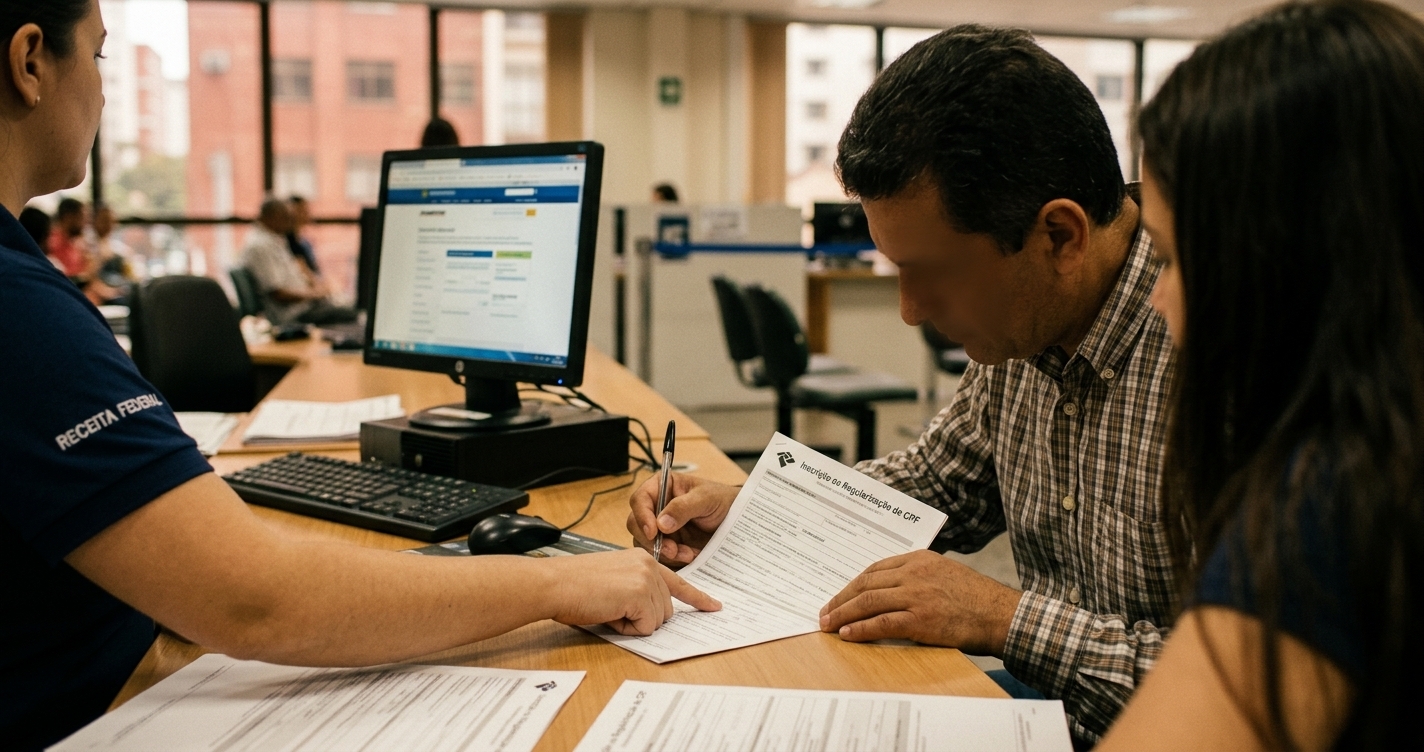
You feel like Brazil is quietly blocking you from doing anything normal. That feeling has a name, and it has a solution: the CPF. Almost every wall you have hit so far, the bank that said no, the phone store that shrugged, the landlord who stopped answering, comes back to a single missing number.
The CPF (Cadastro de Pessoas Físicas, or “Registry of Natural Persons”) is Brazil’s individual taxpayer number, issued by the Receita Federal (Brazilian Federal Revenue Service). It has 11 digits, in the format 123.456.789-09. It is issued once and stays with you for life.
Here is the rule, stated plainly: in Brazil, the CPF functions as the de facto national identification number for civil and commercial life, and any foreigner who owns, or wants to own, assets or rights subject to public registration in Brazil is required to have one. That includes property, vehicles, boats, aircraft, company shares, bank accounts and financial market investments.
The second half of this article is where it gets interesting, because there is a real counter-argument. Officials, banks and even lawyers sometimes tell foreigners that a CPF means tax residency, or that tourists cannot have one. Both claims are wrong, and knowing exactly why protects you.
On this page
What Exactly Is a CPF, and What Is It Not?
A CPF is an 11-digit taxpayer registration number issued by the Receita Federal to identify individuals in Brazil’s tax and civil systems. It is free when requested directly from the Receita Federal, and costs around R$ 7.00 (roughly US$ 1.30) when processed through Correios (the post office) or a Brazilian consulate abroad. It is permanent and never reissued.
The number self-validates. The last two digits are check digits, calculated by a modulo-11 algorithm, which is why Brazilian systems instantly reject a typo. The 9th digit encodes the fiscal region where the CPF was first issued: 8 for São Paulo, 7 for Rio de Janeiro and Espírito Santo, 6 for Minas Gerais, 0 for Rio Grande do Sul. That detail sometimes helps a lawyer trace where a client first registered years ago.
Now the part that causes the most confusion. The CPF is not:
- Not an immigration document. It grants zero right to enter, stay or work in Brazil. Your legal status comes from your visa and, if applicable, your CRNM (National Immigration Registration Card), issued by the Federal Police.
- Not proof of tax residency. Holding a CPF does not, by itself, make you a Brazilian tax resident. Residency for tax purposes depends on your visa type and physical presence, not on having a number.
- Not an ID card. Brazilians carry an RG or the new CIN. Your CPF alone is not a photo ID, though it is often requested alongside one.
- Not a bank account requirement you can skip. Banks will ask for it, but they will also ask for proof of address and immigration status separately.
- Not something that expires. It can, however, be flagged as “pending regularisation” or “suspended” if you fail to file a required tax return.
Common mistake: Applying for a second CPF because you cannot find the first one. The number is unique and definitive, with no possibility of a second registration. If you already had one issued years ago, even as a child on a family trip, that is your number forever. Retrieve it, do not re-apply.
Why Does Every Foreigner in Brazil Absolutely Need a CPF?
Because Brazilian institutions have adopted the CPF as the universal key to identity verification. Per Receita Federal rules, foreign citizens of any age who own or wish to own assets and rights subject to public registration in Brazil must register. In daily life, the practical effect is broader: without a CPF you cannot open a bank account, sign a lease, or create a gov.br login.
The legally mandatory cases are narrow and clear. If you want to buy an apartment in Rio, register a car, hold shares in a Brazilian company, open a bank account or invest through a Brazilian broker, the CPF is not optional. The cartório (notary office with legal registration powers) will not register a property deed without it. The Junta Comercial (Board of Trade) will not register a company without a CPF for every partner.
Then there is the informal, and arguably heavier, layer. Brazil runs on the CPF culturally. You will be asked for it at pharmacy counters (for loyalty discounts), at restaurants (for the fiscal receipt), when buying a bus ticket, when booking a doctor’s appointment, when signing up for a gym, when receiving a package. None of those are legal requirements. All of them are practical barriers.
In practice: A Canadian client arrived on a tourist visa planning to stay four months while deciding whether to relocate. She could not get a local SIM card with a data plan, could not use Brazilian delivery apps that required CPF-linked payment, and could not rent a furnished apartment because the landlord’s agency ran a credit check keyed to CPF. Her CPF took 20 minutes online and cost nothing. Four months of friction, solved.
There is also a protective dimension people miss. Because Brazil uses Civil Law rather than Common Law, rights over assets generally flow from formal registration, not from possession or informal agreement. A verbal deal or an unregistered contract gives you far weaker protection than it might in your home country. Your CPF is what allows your name to appear in those registries at all.
If you are mapping out the whole relocation process, our broader guide for foreigners moving to Brazil shows where the CPF fits alongside visas, apostilles and residence registration.
Who Can Apply, and What Does It Actually Cost in 2026?
Any foreign national of any age can apply, with no minimum stay, no residence permit and no requirement to be in Brazil. The Receita Federal charges nothing for an application made directly through its own channels. Applications routed through Correios or Banco do Brasil branches carry a service fee of about R$ 7.00. Consular applications abroad may carry a consular fee.
Here is what you should have ready, whichever channel you use. The exact list varies slightly by channel, but the logic is consistent: prove who you are, and give Brazil an address or contact it can accept.
- Valid passport (the biographic page), or your CRNM if you already hold Brazilian residence
- Birth certificate (often requested for minors and sometimes for adults, depending on the channel)
- Proof of address, in Brazil or abroad
- A working email address you control
- For minors under 16: documents of the parent or legal guardian making the request
- For consular applications: a signed application form plus the documents required by that specific consulate
Worth knowing: Foreign documents presented for official Brazilian purposes frequently need an apostille and a sworn translation. For the CPF itself this is often waived when a passport is the identity document, but for the transactions that follow (property, marriage, company formation) it is not. See our checklist on which documents need an apostille for Brazil before you fly.
Cost simulation, so you can budget realistically:
| Route | Who it suits | Cost | Realistic timeline |
|---|---|---|---|
| Online, Receita Federal portal | Foreigners already in Brazil with a passport and email | Free | Immediate to 5 business days |
| In person, Receita Federal office (by appointment) | Cases the online system rejects | Free | Same day, plus appointment wait of 1-3 weeks |
| Correios or Banco do Brasil branch | Documents that need human review | Around R$ 7.00 | Up to 5-10 business days |
| Brazilian consulate abroad | Investors and buyers who have never entered Brazil | Consular fee, varies by post | 2-8 weeks, varies widely by consulate |
| Power of attorney via a Brazilian lawyer | Remote investors, estate matters, complex cases | Professional fees plus notary costs | 1-3 weeks after the POA arrives |
If a service in Brazil quotes you R$ 300 to “obtain your CPF”, understand what you are buying. You are paying for someone to handle a free government process, which is legitimate if your case is complicated (rejected documents, a lost historic CPF, a minor with foreign birth records) and overpriced if it is not.
How Do You Get a CPF Step by Step in 2026?
If you are inside Brazil, start with the Receita Federal online channel: it is free and often issues the number in minutes. If the system rejects your documents, switch to an in-person channel by appointment. If you are abroad, apply through the Brazilian consulate with jurisdiction over your residence, using the Itamaraty consular network.
Route A: Online from inside Brazil
- Go to the Receita Federal CPF services page and select the option to register (inscrição).
- Enter your full name exactly as it appears in your passport, including all middle names, with no abbreviations.
- Enter your mother’s full name, also exactly as documented. This is the single most common cause of rejection.
- Provide date of birth, country of birth, nationality and email.
- Submit. If accepted, you receive the number and a receipt (comprovante) that displays it.
- Save a PDF of the comprovante and screenshot the number. You will type it dozens of times a month.
Route B: In person, when online fails
- Book an appointment through the Receita Federal’s scheduling system, or go to a Correios or Banco do Brasil unit that offers the service.
- Bring passport, proof of address and, where requested, birth certificate.
- Pay the R$ 7.00 fee if you are using Correios or a bank branch.
- Collect your protocol number and follow up online.
Route C: From abroad, before you ever land
- Identify the Brazilian consulate covering your city of residence.
- Follow that consulate’s published CPF instructions: they differ between posts, so do not rely on a friend’s experience in another country.
- Send the application with certified copies of your identity documents.
- If speed matters (a property closing, a company registration), instruct a Brazilian lawyer to act under a power of attorney instead.
Tip: Once you have the CPF, immediately create your gov.br account and try to raise it to the silver or gold verification level. The gov.br login is the gateway to immigration appointments, tax filings, vehicle records and dozens of other services, and it is keyed entirely to your CPF.
Realistic expectation setting matters here. The CPF itself is one of the fastest things in Brazilian bureaucracy. Almost everything downstream, from the CRNM to a bank account to a property registration, is slower. Our breakdown of real Brazilian bureaucracy timelines for foreigners gives honest numbers for each step.
When Does the Rule Not Apply, and What Will the Other Side Argue?
The strongest counter-argument you will hear is this: “A CPF creates a tax footprint in Brazil, so a non-resident who takes one exposes themselves to Brazilian taxation on worldwide income.” That argument is coherent, and it is why some advisors tell clients to avoid registering. It is also wrong on Brazilian law, and here is why.
Take the argument in its strongest form first. Brazil taxes residents on worldwide income. The CPF is a taxpayer registry number issued by the tax authority. It is used to link financial accounts, property records and investment income to a single person. It is genuinely visible to the Receita Federal. A cautious adviser could reasonably conclude that registering invites scrutiny you do not need.
Now the answer. Brazilian tax residency is not triggered by holding a registry number. It is triggered by defined factual situations: holding a permanent residence visa, holding a temporary visa with an employment relationship, or physical presence in Brazil for more than 183 days within a 12-month period, among other criteria set out in Brazilian tax legislation and Receita Federal normative acts. A non-resident with a CPF remains a non-resident, taxed only on Brazilian-source income, typically at source.
In other words, the CPF is the identifier, not the trigger. Refusing to register does not reduce your tax exposure. It just prevents you from lawfully owning, selling or receiving anything in Brazil, and unregistered ownership structures create far more risk than a taxpayer number ever will.
Heads up: If you are a non-resident with Brazilian assets, your CPF must be correctly flagged as non-resident in Receita Federal records, and you may need to appoint a legal representative in Brazil for tax purposes. A CPF wrongly registered as resident can generate filing obligations you never intended. This is a fix best done before it becomes a problem.
The second frequent objection comes from front-line staff: “Tourists cannot get a CPF.” They can. The number does not depend on residence status, and Receita Federal rules explicitly contemplate foreign citizens of any age who hold or wish to hold registrable assets in Brazil. Nothing in the framework requires a residence permit. If a clerk refuses, request the refusal in writing or escalate to a different unit.
The third objection concerns privacy. Brazil’s data protection framework and constitutional privacy debates, including cases such as ADI 6309 before the Supreme Federal Court, have shaped how public bodies handle personal data. But the practical reality is that your CPF is already semi-public: it appears on receipts, contracts and registry entries. Protect the number sensibly, do not treat it as a secret.
What Changed for the CPF in 2026?
The core rules did not change: the CPF is still free from the Receita Federal, still unique for life, and still available to non-residents. What changed is consolidation. Brazil has been merging identity numbers, with the CIN (National Identity Card) now using the CPF as its base number, reinforcing the CPF’s status as the single national identifier.
Three practical consequences for foreigners in 2026:
- Digital-first verification. More institutions now validate your CPF against Receita Federal records in real time. If your name spelling differs by even a middle name, a bank or broker may reject you. Fix the registry data, not the form.
- gov.br gatekeeping. An increasing number of immigration and tax procedures require a verified gov.br account, which requires a CPF. This makes the CPF the first step of the sequence, not an afterthought.
- Tighter bank onboarding. Banks and fintechs apply stronger know-your-customer checks, cross-referencing CPF, immigration status and address. A CPF alone no longer opens an account, but no account opens without it.
For company formation, note that a CNPJ (company tax number) requires each partner to hold a CPF, plus a valid registered address in Brazil. Foreign founders without physical premises often use a fiscal address in Brazil to satisfy that requirement, which is a service we provide.
Frequently Asked Questions About the CPF for Foreigners
These are the questions foreigners most often bring to us after their first weeks in Brazil, answered directly.
Can a tourist get a CPF in Brazil?
Yes. A tourist can apply for and receive a CPF, and the process is the same as for a resident. The number does not depend on permanent residence, does not grant immigration rights, and does not extend your permitted stay. Many foreigners obtain a CPF during a first exploratory trip precisely so that they can open a bank account or sign a lease on the next visit. If a clerk tells you tourists are ineligible, that is a misunderstanding of the rules, not the rules themselves. Try the online channel or a different Receita Federal unit.
Does a CPF make me a tax resident of Brazil?
No. Tax residency in Brazil depends on your immigration status and physical presence, notably permanent residence, a temporary visa combined with employment, or presence exceeding 183 days within a 12-month window. Holding a CPF is simply how the Receita Federal identifies you. A non-resident with a CPF is taxed only on Brazilian-source income. That said, your CPF record should correctly reflect your non-resident status, and in some cases you must appoint a representative in Brazil. Getting that classification right at the outset avoids unnecessary filing obligations later.
Can I get a CPF for my child born abroad?
Yes, and you often must. Children of any age can hold a CPF, and it is commonly required for school enrolment, private health insurance, bank products, dependent status on tax returns and official records. The application is made by a parent or legal guardian, who submits their own identity documents alongside the child’s passport and birth certificate. Foreign birth certificates usually need an apostille and a sworn translation, so build extra time into your planning if you are enrolling a child for a specific school term.
I had a CPF years ago but lost the number. What do I do?
Recover it, do not re-apply. The CPF is assigned once and is definitive, with no possibility of a second registration, so a duplicate application will be rejected or, worse, create a records conflict. You can retrieve the number through Receita Federal consultation services using your full name, mother’s full name and date of birth. If the data on file was entered with a spelling error decades ago, an in-person visit or a lawyer’s intervention may be needed to reconcile the records before anything else can move forward.
Can someone get a CPF for me while I stay abroad?
Yes, through a power of attorney granted to a lawyer or representative in Brazil. This is the standard route for investors buying property or forming companies remotely. The power of attorney normally needs to be signed before a notary in your country, apostilled, and then translated by a sworn translator in Brazil. Budget two to four weeks for the document chain alone. Before signing anything, confirm your representative is genuinely licensed: you can verify a Brazilian lawyer’s OAB registration online for free.
Can my CPF be suspended or cancelled?
Yes. A CPF can be marked as pending regularisation, suspended or cancelled, most often because a required annual tax return was not filed, or because registry data is inconsistent. A flagged CPF causes immediate practical problems: blocked bank transactions, refused property registration, failed credit checks. The fix is administrative, filing the missing return or correcting the data, but it can take weeks and it always surfaces at the worst possible moment, such as the week of a property closing. Check your CPF status before any major transaction.
CPF for Foreigners: Key Facts at a Glance
| Question | Short answer |
|---|---|
| What is it | 11-digit individual taxpayer number issued by the Receita Federal |
| Who can hold one | Any foreigner of any age, resident or not, inside or outside Brazil |
| Cost | Free from Receita Federal; around R$ 7.00 via Correios or bank branch |
| Timeline | Minutes to 5 business days online; 2-8 weeks via consulate |
| Validity | Permanent, one per person for life, never reissued |
| Grants immigration rights | No. Visa and CRNM are separate and governed by the Migration Law |
| Creates tax residency | No. Residency depends on visa status and 183-day presence rules |
| Legally required for | Bank accounts, property, vehicles, company shares, investments |
| Practically required for | Leases, mobile plans, gov.br login, employment, healthcare, deliveries |
| Main rejection cause | Name or mother’s name spelled differently from passport records |
Important: Getting a CPF does not regularise your immigration status. If your stay has expired or your residence application has stalled, that is a separate and more urgent matter, with its own deadlines. See our guide on deportation defence and appeal rights in Brazil if that describes your situation.
Get Your CPF and the Documents That Follow It, With a Bilingual Brazilian Lawyer
Most CPF applications are straightforward, and if yours is, you should do it yourself for free. Where foreigners genuinely need help is everything the CPF unlocks: a lease you can actually enforce, a bank that will accept you, a property deed registered in your name, a non-resident tax classification that does not create obligations you never wanted. Our team handles those, in English, from Brazil.
If you already have a CPF and your next step is signing a lease, read our notes on the rental contract clauses foreigners must check before you sign anything.
Your concrete next step: open the Receita Federal CPF page, apply with your passport name spelled exactly as printed, and save the receipt as a PDF. If the system rejects it, send us the error message and your passport details, and we will tell you which channel will work for your case.
Talk to a specialist lawyer now
Talk to a Lawyer on WhatsApp