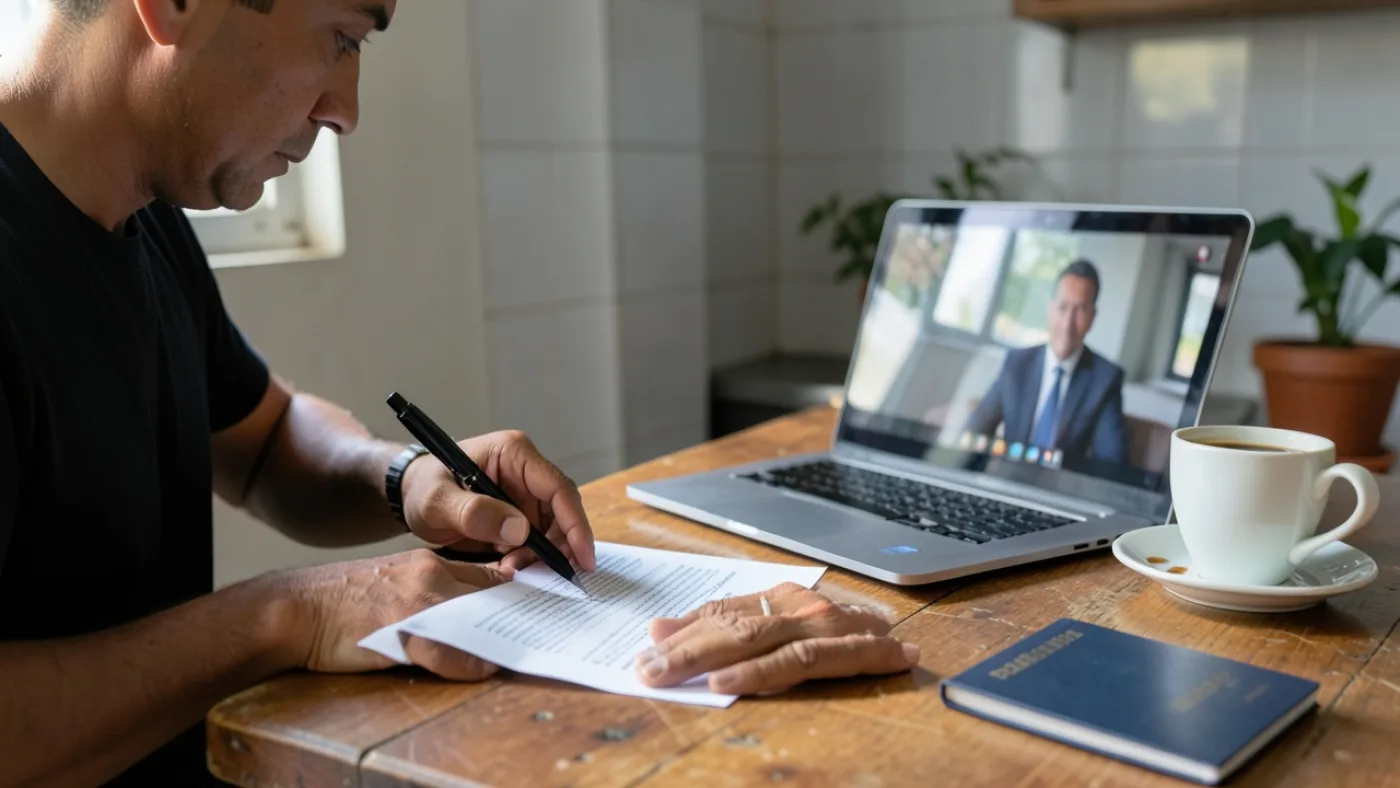
The most expensive mistake foreign plaintiffs make in Brazil is not losing the case. It is having the case thrown out before a judge ever reads the merits, because of a document problem or a missing deposit. A power of attorney signed at home without an apostille. A contract in English filed without a sworn translation. A non-resident plaintiff who ignored the caução (security bond) required by Article 83 of the Brazilian Civil Procedure Code and got the claim dismissed after eight months of waiting.
Each of those errors costs the same thing: months of delay, thousands of reais in wasted fees, and sometimes the loss of the claim entirely if a deadline expired in the meantime.
This guide walks you through how to file a lawsuit in Brazil as a foreigner, step by step, with the exact documents, real 2026 costs in reais and dollars, and the specific points where foreign claims get denied. Your right to sue in Brazil is not in doubt. The machinery around that right is what defeats people, and that is what we are going to fix.
On this page
Where Do Foreigners’ Lawsuits in Brazil Actually Get Denied?
Foreign claims in Brazil rarely fail on nationality. They fail on three procedural gates: an invalid power of attorney (no apostille or no sworn translation), documents filed in English without a certified Portuguese translation, and non-compliance with the caução under Article 83 of the Civil Procedure Code (Law 13.105/2015). All three are fixable before filing, and expensive after.
Let us start with the exception, because that is where the money is lost. If you live outside Brazil and you own no real estate in Brazil, you are not treated like an ordinary plaintiff. Under Article 83 of the Civil Procedure Code, you must post a security deposit sufficient to cover the defendant’s court costs and attorney fees if you lose. The same rule applies if you were living in Brazil when you filed and then moved abroad during the case.
The defendant’s lawyer knows this rule. In practice, one of the first things a well-prepared Brazilian defence lawyer does when the plaintiff has a foreign address is file a motion demanding the caução. If you do not deposit it within the time the judge sets, the case can be extinguished without judgment on the merits.
Watch out: The caução is not a court fee and it is not lost money. It is a deposit held by the court that comes back to you if you win. But it is real cash you must be able to wire into a Brazilian judicial account, often on 15 days’ notice, and it can be tens of thousands of reais on a large commercial claim.
There are recognised exceptions to the bond. It is not required when there is a treaty or international agreement waiving it, in enforcement proceedings based on an título executivo extrajudicial (an out-of-court enforceable instrument, such as a properly signed and witnessed contract), or in counterclaims. Your lawyer should test whether you fall into one of those before assuming you must deposit anything.
Now the rule behind the exception: your access to Brazilian courts is constitutionally protected. Article 5 of the Brazilian Constitution guarantees equality before the law and states that no law may exclude judicial review of a violation of a right. The Civil Procedure Code goes further and expressly extends free legal aid (gratuidade de justiça) to any natural or legal person, Brazilian or foreign, with insufficient resources.
Can a Foreigner File a Lawsuit in Brazil Without Living There?
Yes. You do not need Brazilian residency, a CRNM (National Immigration Registration Card), or physical presence in Brazil to be a plaintiff. Under Article 21 of the Civil Procedure Code, Brazilian courts have jurisdiction whenever the defendant is domiciled in Brazil, the obligation must be performed in Brazil, or the facts giving rise to the claim occurred in Brazil.
That covers almost every commercial dispute a foreigner has with a Brazilian counterparty: an unpaid invoice from a São Paulo distributor, a supplier who shipped defective goods, a business partner who diluted your stake, a construction company that never delivered, a landlord who kept your deposit.
Two extra jurisdiction rules matter a lot in practice:
- Foreign companies with a Brazilian arm: under the sole paragraph of Article 21, a foreign legal entity with a branch, agency or subsidiary in Brazil is deemed domiciled in Brazil. You can sue the local arm instead of chasing the parent abroad.
- Exclusive Brazilian jurisdiction: Article 23 reserves to Brazilian courts any dispute over real estate located in Brazil, estates and probate of Brazilian assets, and the division of marital property located in Brazil. A foreign judgment on these subjects will never be recognised in Brazil, so filing abroad is wasted money.
Key point: If your contract contains a clause sending disputes to a foreign court, that clause is not automatically worthless, but it is also not automatically effective. Read our detailed breakdown of the governing law clause in Brazil and when foreign law applies before you assume your London or Miami jurisdiction clause protects you.
The practical barrier is language and access. Brazilian civil litigation runs almost entirely through electronic case systems (PJe and equivalent state platforms), and only lawyers registered with the OAB (Brazilian Bar Association) can file into them. There is no self-service portal for a foreign plaintiff. That is why the answer to “do I need a Brazilian lawyer” is effectively yes for anything beyond the smallest claims.
Do You Really Need a Brazilian Lawyer, and What Does the OAB Requirement Mean?
For ordinary civil and commercial cases, yes: representation by a lawyer registered with the OAB is mandatory. The only meaningful exception is Small Claims Court (Juizado Especial Cível), where a party can act alone in claims up to 20 times the minimum wage. Above that ceiling, and on appeal, a lawyer is required.
Brazil is a Civil Law country, not Common Law. There is no discovery process as US litigators know it, no jury in commercial cases, and precedent works differently: judges apply codified statutes, with binding effect only from specific higher-court rulings. Your foreign lawyer cannot appear for you, cannot sign filings, and cannot access the electronic docket. They can, and should, coordinate with your Brazilian counsel.
Tip: Verify your lawyer’s registration yourself on the OAB national register before signing anything or transferring funds. Ask for the OAB number and the state section. Our guide on how to find an English speaking lawyer in Brazil, with OAB checks and 2026 fees, explains exactly what to look for.
The self-representation trap in Small Claims deserves a warning. Even where the law allows you to file alone, the hearing will be conducted in Portuguese, deadlines run in business days, and the judge will not translate anything for you. Article 192 of the Civil Procedure Code requires all procedural acts to be in Portuguese. Winning a claim you technically could file alone is very different from winning it in a language you do not read.
Which Documents Do You Need to File a Lawsuit in Brazil as a Foreigner?
The core package is a notarised and apostilled power of attorney (procuração), your identification documents, a Brazilian CPF (individual taxpayer number), and every piece of evidence translated into Portuguese by a tradutor público juramentado (sworn public translator). Missing the apostille is the single most common reason a foreign filing gets rejected at the outset.
If you are an individual living abroad
- Power of attorney (procuração ad judicia) naming your Brazilian lawyer, signed before a notary in your country and apostilled under the Hague Apostille Convention (or legalised at the Brazilian consulate if your country is not a member)
- Passport copy, plus your national ID
- CPF number (issued by Receita Federal, the Brazilian tax authority; obtainable from abroad through a Brazilian consulate)
- Proof of address in your home country
- Sworn Portuguese translation of the power of attorney and all foreign-language evidence
If you are a foreign company
- Certificate of incorporation and current corporate documents, apostilled and sworn-translated
- Proof of the signatory’s authority to grant the power of attorney
- CNPJ (corporate taxpayer number) if the company holds assets or investments in Brazil
- The contract at issue, plus invoices, emails, WhatsApp exchanges and delivery records
Important: Emails and WhatsApp messages are accepted evidence in Brazilian civil courts, but foreign-language messages generally need sworn translation to carry weight. Budget for this early. A 200-page contract bundle in English can cost more to translate than the court filing fee itself.
You can find the official list of countries and procedures for apostille and consular legalisation on the Itamaraty (Ministry of Foreign Affairs) portal. Sworn translators are appointed and listed by each state’s Junta Comercial (Board of Trade).
How Much Does It Cost to Sue in Brazil in 2026?
Expect court filing fees of roughly 1% to 4% of the claim value depending on the state, attorney fees typically between 10% and 20% of the claim (or hourly rates from R$ 400 to R$ 1,200), plus expert fees when technical evidence is needed. Small Claims Court charges no filing fee at first instance. There is no cost-free path in ordinary State Court.
Court fees (custas judiciais) are set by each state court, not federally, so the same claim costs different amounts in São Paulo, Rio de Janeiro and Bahia. They are calculated on the declared value of the claim (valor da causa) and paid through a guia de recolhimento (payment slip) generated on the state court website.
Example: On a R$ 500,000 commercial debt claim (about US$ 92,000), a realistic 2026 budget in São Paulo State Court looks like this: filing fees around R$ 5,000 to R$ 10,000, sworn translation of the contract bundle R$ 3,000 to R$ 8,000, apostille and notarisation abroad R$ 500 to R$ 1,500, expert accounting fees if ordered R$ 8,000 to R$ 20,000, and attorney fees of R$ 50,000 to R$ 100,000 depending on the fee structure. If you are non-resident, add a caução deposit that a judge could set in the R$ 40,000 to R$ 56,000 range on a claim of that size.
One cost most foreigners never see coming: the loser-pays rule. Under the Civil Procedure Code, the losing party pays the winner’s court costs plus court-awarded attorney fees (honorários de sucumbência), typically set between 10% and 20% of the judgment value. Lose a R$ 200,000 claim and you may owe the other side R$ 20,000 to R$ 40,000 on top of your own lawyer.
For a deeper breakdown of every line item, see our reference on legal costs in Brazil, court and lawyer fees for 2026.
Small Claims or State Court: Which Track Should You File In?
Small Claims Court (Juizado Especial Cível) handles claims up to 40 times the minimum wage, roughly R$ 56,480 in 2026 based on a minimum wage of R$ 1,412, with no filing fee at first instance and resolution in 6 to 18 months. Ordinary State Court (Vara Cível) has no value ceiling but commonly takes 2 to 5 years with appeals.
The minimum wage changes every year, so the Small Claims ceiling moves with it. Confirm the exact figure with your lawyer at the moment you file, because it decides which track is even available to you.
| Feature | Small Claims (Juizado Especial Cível) | State Court (Vara Cível) |
|---|---|---|
| Value ceiling | Up to 40 minimum wages (approx. R$ 56,480 in 2026) | No ceiling |
| Filing fee | None at first instance | Approx. 1% to 4% of claim value, varies by state |
| Lawyer required | Optional up to 20 minimum wages | Always mandatory |
| Realistic timeline | 6-18 months | 2-5 years, longer with appeals |
| Complex expert evidence | Generally not admitted | Fully available |
| Foreign non-resident plaintiff | Accepted, but practical hurdles with hearings | Accepted, caução may apply |
Small Claims looks attractive because it is cheap and faster. Be honest about its limits. It does not do complex accounting expertise, it expects the parties to attend conciliation hearings in person or by videoconference, and it caps what you can recover. Splitting a R$ 300,000 claim into pieces to fit the ceiling is not allowed.
There is a third track worth considering before you file anything: arbitration. Under the Brazilian Arbitration Act (Law 9,307/1996), parties can agree to resolve commercial disputes before an arbitral tribunal, and Brazilian courts enforce those awards. Arbitration is faster and can run in English, but it is expensive and only available if your contract contains a valid arbitration clause. If it does, filing in court may get your case dismissed for lack of jurisdiction. Compare paths in our overview of commercial litigation in Brazil in 2026.
How Do You Actually File the Lawsuit, Step by Step?
Filing is 100% electronic through PJe or the equivalent state court platform, and only an OAB-registered lawyer with a digital certificate can submit. Expect 4 to 10 weeks between hiring a lawyer and having the case formally filed, mostly consumed by apostille, translation and CPF steps rather than the filing itself.
Step 1: Get your CPF (1-3 weeks)
Apply through the Receita Federal website or a Brazilian consulate abroad. Non-residents can obtain a CPF remotely. This number identifies you in every court system.
Step 2: Sign and apostille the power of attorney (2-4 weeks)
Your Brazilian lawyer drafts the procuração in Portuguese (often bilingual). Sign it before a notary in your country, then obtain the apostille from your country’s competent authority. If your country is not a Hague Convention member, legalise it at the nearest Brazilian consulate instead.
Step 3: Commission sworn translations (1-3 weeks)
Only a tradutor público juramentado registered with a state Board of Trade produces translations courts accept. Ordinary bilingual translations are routinely rejected.
Step 4: Send a formal demand letter (optional, 10-15 days)
A registered notificação extrajudicial can trigger payment without litigation, and it puts the debtor formally in default, which strengthens your interest and penalty claim later.
Step 5: File the initial petition and pay the fees (1-5 days)
Your lawyer files the petição inicial with all evidence attached, generates the guia de recolhimento, pays the court fee, and receives a case number. If a caução is likely, the smart move is to address it proactively in the petition rather than wait for the defendant to attack.
Step 6: Service, conciliation hearing, defence
The court serves the defendant and usually schedules a mandatory conciliation hearing. You can normally attend by videoconference from abroad or authorise your lawyer to settle within limits stated in the power of attorney. Grant that settlement power expressly, or you will be flying to Brazil for a 20-minute hearing.
For realistic expectations on what happens after filing, see our analysis of how long a lawsuit in Brazil takes and the Brazilian court system, appeals and costs.
What Is the Defendant’s Strongest Argument Against You?
The strongest defence against a foreign plaintiff is not “you are a foreigner.” It is this: “The plaintiff resides abroad, owns no property in Brazil, and has provided no security under Article 83 of the Civil Procedure Code. If this claim fails, the defendant will have no realistic way to recover its costs. Order the bond, or dismiss.”
Take that argument seriously, because it is legitimate. Brazilian defendants really do face an asymmetry. If a resident plaintiff loses, the winner can attach a bank account, a car, a property. If a plaintiff in Lisbon or Chicago loses, the Brazilian winner faces a costly, uncertain foreign enforcement process to collect R$ 30,000 in fees. The bond exists to level that.
The answer is not to fight the principle. It is to remove the leverage:
- Check the exceptions first. If your claim is enforcement of an out-of-court enforceable instrument (a properly executed contract signed by two witnesses, a promissory note, a duly registered lease), the bond requirement generally does not apply.
- Check treaties. Brazil is party to international agreements with several countries that dispense with security for costs from their nationals and residents.
- Check your Brazilian assets. If you own real estate in Brazil, the Article 83 requirement does not apply to you at all. Many foreign plaintiffs who own an apartment in Brazil are wrongly asked to post a bond and simply never contest it.
- Budget it and offer it upfront. Volunteering a reasonable bond in your initial petition removes the defendant’s best procedural weapon and signals credibility to the judge.
Warning: Do not respond to a bond order by ignoring it or by arguing only about the amount. Judges set a deadline, and failure to comply can end the case without a ruling on the merits. Contest the amount if it is excessive, but deposit something within the deadline or obtain a formal extension.
What Changed for Foreign Litigants in Brazil in 2026?
The statutory framework is stable: the Civil Procedure Code of 2015, the Arbitration Act of 1996, and the contract indexation rules of Law 10,192/2001 all remain in force. What changed in practice is operational: near-universal electronic filing, routine remote hearings by videoconference, and annually revised state court fee tables and Small Claims ceilings.
Three practical shifts matter for foreigners:
- Remote hearings are now normal. Videoconference attendance at conciliation and even evidentiary hearings is standard practice in most state courts, which removes the old need to fly in.
- Digital evidence is mainstream. Courts routinely accept WhatsApp threads, emails and electronic signatures, though sworn translation of foreign-language content remains necessary.
- Fee tables reset annually. Because the minimum wage and state indexes are updated each year, never rely on a figure you read in an article from a previous year. Confirm the current table on the relevant state court’s website before you budget.
Also note that Brazil continues to enforce contracts denominated in reais, with indexation rules restricting monetary adjustment clauses to periods of at least one year. If your contract is priced in dollars or euros with a Brazilian counterparty, that clause may be attacked. Our guide to Brazilian contracts for foreigners and five costly mistakes covers this in detail. You can read the underlying legislation on the Planalto government portal.
Frequently Asked Questions About Filing a Lawsuit in Brazil as a Foreigner
Can I file the lawsuit from my home country without travelling to Brazil?
Yes. The filing is done electronically by your Brazilian lawyer using their digital certificate, so you never need to be present to start the case. What you must send from abroad is the notarised and apostilled power of attorney and your identification documents. Conciliation hearings are commonly held by videoconference, and if you grant your lawyer express settlement powers in the procuração, they can appear and negotiate for you.
Do I need a CPF to sue in Brazil?
In practice, yes. The CPF (individual taxpayer number) is how the court system identifies natural persons, and electronic filing platforms require it. Non-residents can obtain a CPF remotely through Receita Federal via a Brazilian consulate, usually within one to three weeks. A foreign company suing in Brazil may need a CNPJ (corporate taxpayer number) instead, particularly if it holds registered investments or assets in the country.
How much is the caução for a non-resident plaintiff?
There is no fixed percentage. The judge sets an amount sufficient to cover the defendant’s likely court costs plus court-awarded attorney fees, which typically run 10% to 20% of the claim value. On a R$ 200,000 claim, an order in the range of R$ 20,000 to R$ 40,000 is realistic. The deposit is returned to you if you win, so treat it as locked capital, not a lost expense.
Can I recover my legal fees if I win?
Partly. Brazil applies a loser-pays rule: the losing party reimburses court costs and pays court-awarded attorney fees (honorários de sucumbência), generally set at 10% to 20% of the judgment. Those fees belong to your lawyer by law, not to you, so they usually offset rather than fully replace your own legal bill. Contractual arrangements with your lawyer determine how much you ultimately recover.
What if my contract says disputes go to a court in my country?
Brazilian law allows international forum selection clauses in contracts, but Brazilian courts retain exclusive jurisdiction over disputes involving Brazilian real estate, estates of Brazilian assets, and marital property located in Brazil. A foreign judgment on those subjects will never be recognised. Even where a foreign clause is valid, enforcing a foreign judgment in Brazil requires homologation by the STJ (Superior Court of Justice), which adds years. Filing directly in Brazil is often faster.
Can I get court fees waived as a foreigner?
Yes, in principle. The Civil Procedure Code expressly grants free legal aid (gratuidade de justiça) to any natural or legal person, Brazilian or foreign, who lacks sufficient resources to pay court costs. You must document your financial situation, and a judge may reject the request if your claim value or assets contradict it. Note that a waiver of court fees does not automatically remove the Article 83 security bond obligation.
Quick recap: Your right to sue in Brazil is constitutional. Your case is won or lost on preparation: apostilled power of attorney, sworn translations, a CPF, the correct court track, and a plan for the Article 83 bond before the defendant raises it.
File Your Lawsuit in Brazil With a Bilingual Legal Team
Suing in a foreign legal system, in a language you do not read, against a party who knows the local rules better than you do, is genuinely difficult. It is also completely doable when the paperwork is done correctly the first time. Most of the foreign claims we see fail were lost at the document stage, not in front of a judge.
Your concrete next step: gather your contract, invoices and message history, note the date the other side breached, and send them to an OAB-registered lawyer for a jurisdiction and limitation review before any deadline runs. Message our bilingual team on WhatsApp and we will tell you which court track fits your claim, whether the Article 83 bond applies to you, and what the filing will realistically cost.
Talk to a specialist lawyer now
Talk to a Lawyer on WhatsApp