On this page
Option A: The Humanitarian Visa (Main Path in 2026)
The humanitarian visa (visto temporário para acolhida humanitária) is a temporary residence permit granted to nationals of countries facing severe institutional crisis, widespread human‑rights violations, or catastrophic events. It does not require you to prove individual persecution. Brazil recognises that your entire nationality is at risk.
How the new 2026 system works: Humanitarian visa brazil
On 1 January 2026, the Ministry of Justice and the Ministry of Foreign Affairs issued a joint ordinance that completely overhauled the humanitarian visa regime. Previous ad‑hoc resolutions for Afghans, Haitians, Syrians and others were revoked. Now there is a single legal framework. Eligibility is no longer automatic based on your passport alone. Instead, the two ministries will publish periodic joint acts listing the nationalities and specific crisis conditions that qualify. For those listed, the key requirement is a formal sponsorship letter from a Brazilian non‑governmental organisation (NGO) duly registered with the government.
The NGO acts as your local guarantor, committing to assist with your initial settlement. You must obtain this sponsorship before applying for the visa at a Brazilian consulate. Once the joint act names your country, you can start searching for an approved NGO willing to sponsor you.
Requirements and documents: Humanitarian visa brazil
- Valid passport or travel document (expired passports may be accepted in extreme cases, but this is at the consulate’s discretion)
- Sponsorship letter from an approved Brazilian NGO detailing the support it will provide (shelter, food, integration assistance)
- Completed online application form via the E‑consular platform of the Ministry of Foreign Affairs
- Two recent colour photographs, background white
- Proof of clean criminal record from your country of origin or from the country where you have resided for the last five years (if obtainable; the consulate may waive this if you explain why it is impossible)
- Flight itinerary or statement of intended travel date (not mandatory for visa issuance, but helps)
- Visa fee payment: approximately R$ 400 to R$ 600 (about €75‑115), depending on the consulate and any reciprocity agreements
Step‑by‑step: from sponsorship to residence card
- Confirm eligibility: Check the latest joint act on the Ministry of Justice website to see if your nationality and the specific crisis conditions are listed.
- Find an NGO sponsor: Reach out to organisations such as Cáritas Brasileira, Aldeias Infantis SOS, or other entities registered with the Ministry of Justice. Some NGOs specialise in specific nationalities.
- Gather documents and complete the online form: Upload everything on the E‑consular system and pay the fee.
- Consular interview: The consulate may call you for an interview. Explain your situation clearly and honestly.
- Visa issuance: If approved, you receive a temporary visa valid for up to 180 days, allowing a single entry into Brazil.
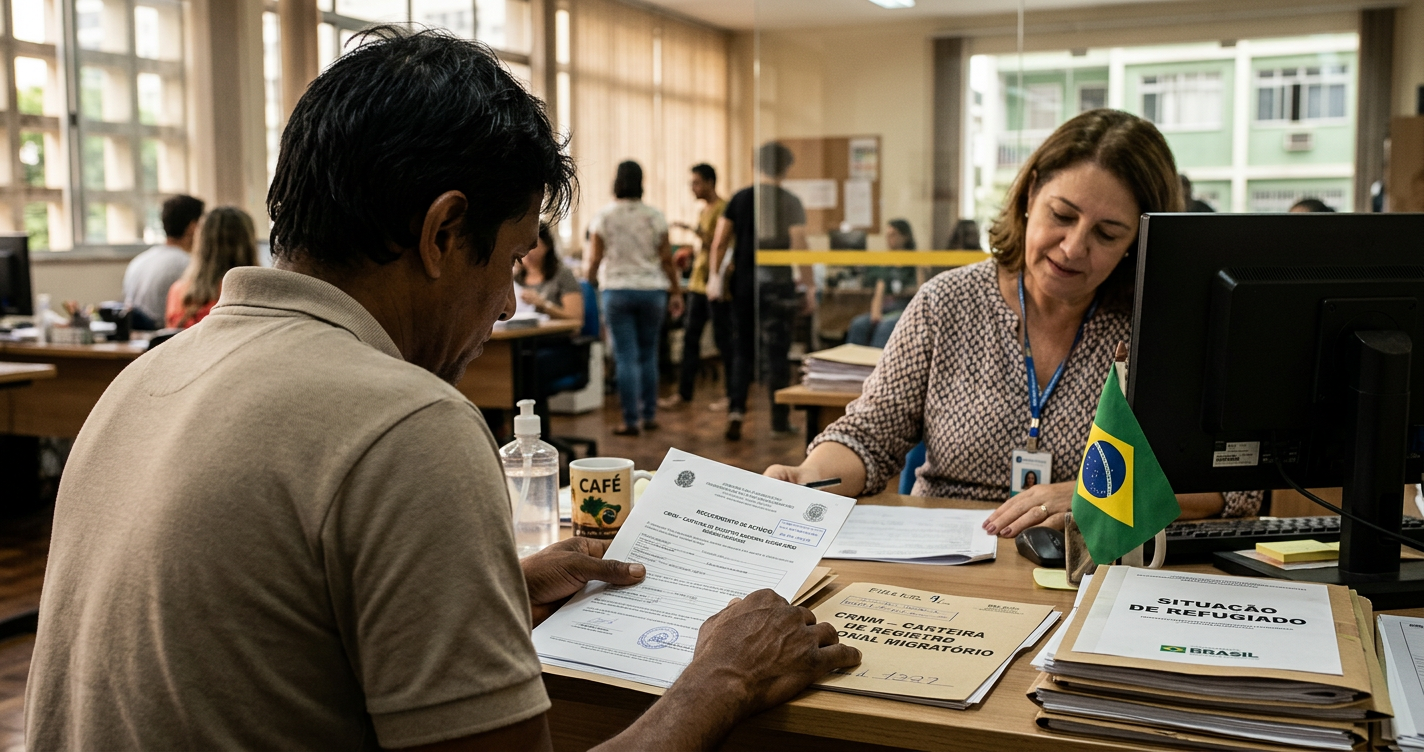
- Arrival and registration: Within 90 days of entry, you must register at the Federal Police. Schedule an appointment, submit biometrics, and pay the CRNM fee of R$ 204.77 (2026 rate). You will then receive your Carteira de Registro Nacional Migratório (National Immigration Registration Card). For a detailed walk‑through, see our CRNM First Time: Step‑by‑Step Guide.
Pros and cons
- Pro: You don’t need to prove individual persecution; the crisis in your country is enough.
- Pro: Once registered, you have full rights to work legally, access the public health system (SUS), and enrol in education. The visa can be converted into a permanent residence permit after a certain period (usually two years, but the new ordinance may establish a timeline; consult a lawyer).
- Pro: Family members can be included in the same application.
- Con: The NGO sponsorship requirement is new and may create delays if you cannot find a willing organisation quickly.
- Con: Eligibility depends on a joint act that can be updated or revoked. Your country may be removed if the situation improves.
- Con: Processing times at consulates and the Federal Police can be unpredictable, ranging from a few weeks to several months.
Option B: Refugee Status (Asylum) Through CONARE
Asylum in Brazil is a separate legal route, governed mainly by Lei 9.474/1997. You apply for refugee status if you have a well‑founded fear of persecution based on race, religion, nationality, political opinion, or membership in a particular social group. Unlike the humanitarian visa, the asylum process requires an individualised analysis of your personal risk.

Requirements and process
- You must be physically on Brazilian soil or at the border. You cannot apply from abroad.
- You submit a declaration of intention to seek refuge to any Federal Police unit or directly to CONARE (National Committee for Refugees).
- There is no fee. The process is free of charge.
- You will be interviewed by CONARE officials, who will assess your specific fear. If you arrive without documents, this is accepted; the principle of non‑refoulement prevents return to danger.
- While your case is pending, you receive a provisional document that allows you to work, study, and access healthcare. You also get a CPF and can open a bank account.
- If recognised as a refugee, you obtain permanent residence and can later apply for naturalisation under simplified conditions.
Pros and cons
- Pro: No need for a consular visa or an NGO sponsor. You can apply at the border.
- Pro: No upfront costs, and if approved you receive a permanent solution.
- Con: The process can take years. CONARE has a huge backlog, and you may wait a long time for a final decision.
- Con: You must prove individual persecution, which is not always possible if you are fleeing a generalised conflict rather than a specific threat.
- Con: During the waiting period, your status is provisional and can cause bureaucratic hurdles with employers or banks that are unfamiliar with the refugee protocol.
Option C: Other Regularisation Pathways
If you don’t qualify for a humanitarian visa or refugee status, you might consider other visas that offer legal stay in Brazil. While they don’t address humanitarian needs directly, they can buy time and allow you to rebuild your life.
- Digital Nomad Visa: If you can work remotely and have a monthly income of at least US$ 1,500, you can apply for a temporary visa that leads to residence. This requires proof of employment and health insurance.
- Investor Visa: With an investment of R$ 600,000 in a Brazilian company or R$ 1,000,000 in real estate (if your spouse is Brazilian, lower amounts may apply), you can obtain permanent residence immediately. See our Investor Visa Brazil 2026 guide.
- Mercosur Residence Agreement: Nationals of Argentina, Paraguay, Uruguay, Bolivia, Chile, Colombia, Ecuador, Peru, Guyana and Suriname can apply for a two‑year temporary residence quite easily, without an NGO sponsor.
- Family Reunion: If you have a Brazilian spouse, child or parent, you can obtain a family reunion visa.
These options are not designed for humanitarian crises, but they may work if you have the financial resources or family ties.
Comparison Table: Humanitarian Visa, Asylum, and Other Pathways
| Criterion | Humanitarian Visa (2026) | Asylum (CONARE) | Other Visas (Investor, Digital Nomad, etc.) |
|---|---|---|---|
| Who qualifies? | Nationals from countries listed in joint acts, facing severe institutional crisis or humanitarian emergency; must have NGO sponsor. | Anyone with well‑founded fear of individual persecution based on race, religion, nationality, political opinion, or social group. | Those with financial means (investment, remote income), family ties, or Mercosur nationality. |
| Where to apply? | Brazilian consulate abroad, before travel. | On Brazilian soil or at the border. | Consulate abroad (or in some cases, request residence while in Brazil). |
| Key documents | Passport, NGO sponsorship letter, criminal record, online application, photos. | Declaration of intent, identity document (even if expired), any evidence of persecution. | Proof of investment, work contract, birth/marriage certificate, etc. |
| Costs | Consular fee (R$ 400‑600), CRNM fee (R$ 204.77). No lawyer fee mandatory but highly recommended. | Free. | Varies; investor visa requires capital investment, digital nomad has fees (around R$ 200‑300), plus documents. |
| Processing time | Consular issuance: 15‑30 days; Federal Police registration: up to 3 months or more. | Provisional document within days; final decision often 2‑4 years. | Varies; investor visa approval can be relatively quick (2‑3 months), digital nomad a few weeks. |
| Rights after approval | Full work rights, public healthcare, education; can apply for permanent residence after a defined period (usually 2 years). | Immediate permanent residence, work, health, education; path to citizenship. | Depends on visa type; investor gets permanent residence, digital nomad temporary, but renewable. |
| Path to permanent residence | Yes, after meeting time and integration requirements. | Automatic upon recognition. | Yes, eventually for most categories. |
| NGO sponsorship required? | Yes, mandatory. | No. | No. |
Which Option Is Best for You?
If you are currently outside Brazil and your country is on the ministry’s joint act, the humanitarian visa is your clearest route. It gives you a legal entry and immediate rights upon registration — but you must find an approved NGO to sponsor you. Start contacting Brazilian NGOs as soon as the joint act is published. If you cannot secure sponsorship, or if your nationality is not yet included, asylum may be the fallback once you manage to reach Brazilian territory. However, asylum demands a personal fear of persecution, not just a generalised conflict. For those with financial resources or family ties, an investor visa or family reunion visa may be faster and less bureaucratic. You should also be aware that overstaying any visa can lead to fines; if you find yourself in an irregular situation, check our guide on overstaying a visa in Brazil for current fines and possible amnesties. Ultimately, the right path depends on your specific circumstances, your ability to obtain NGO sponsorship, and whether you are already in Brazil or still abroad.
Frequently Asked Questions
What exactly is the new NGO sponsorship requirement for the humanitarian visa?
Since January 2026, you must present a sponsorship letter from a Brazilian NGO registered with the Ministry of Justice. The NGO essentially vouches for you and commits to helping you settle. This is a major change; previously, citizenship alone allowed you to apply. Now you need to actively find an NGO partner before you can even submit your application at a consulate.

Can I apply for a humanitarian visa if I am already in Brazil on a tourist visa?
Usually no. The humanitarian visa must be obtained at a consulate abroad before you enter Brazil. However, in exceptional cases, you might request a change of status at the Ministry of Justice if you arrived as a tourist and then your country is added to the joint act and you can document the urgent humanitarian reason. This is legally complex and you should consult an immigration lawyer.
How long does the humanitarian visa allow me to stay, and can I later become a permanent resident?
The initial temporary residence is typically granted for two years. Before it expires, you can apply for permanent residence, provided you have maintained a clean record and demonstrate integration. The path to naturalisation opens after four years of permanent residence, or even faster under extraordinary naturalisation rules if you meet certain criteria.
Is the humanitarian visa application fee refundable if my country is removed from the joint act?
No. The consular fee is generally non‑refundable. If your application is denied because your nationality is no longer eligible, you lose the fee. That’s why it’s crucial to confirm the current joint act before paying. You can always check the latest list on the Ministry of Justice website.
What if I lose my CRNM card or it gets damaged?
You must request a duplicate card from the Federal Police. The process is similar to the first issuance, but you’ll need a police report if it was stolen. The replacement fee in 2026 is also R$ 204.77. Our article on how to replace a lost or damaged CRNM walks you through the entire procedure step by step.
Ready to Secure Your Humanitarian Visa? Let Our Bilingual Team Guide You
Brazil’s humanitarian visa remains a vital lifeline, but the 2026 overhaul made the process more demanding. The NGO sponsorship requirement, shifting joint acts, and bureaucratic hurdles can feel overwhelming — especially when you are already dealing with the stress of displacement. Our firm, Ribeiro Cavalcante Advocacia, has a dedicated immigration team that speaks your language and understands both the legal framework and the real‑world challenges you face. We can help you identify eligible NGO sponsors, prepare your application, and smoothen your registration once you arrive.
Talk to a specialist lawyer now
Talk to a Lawyer on WhatsApp