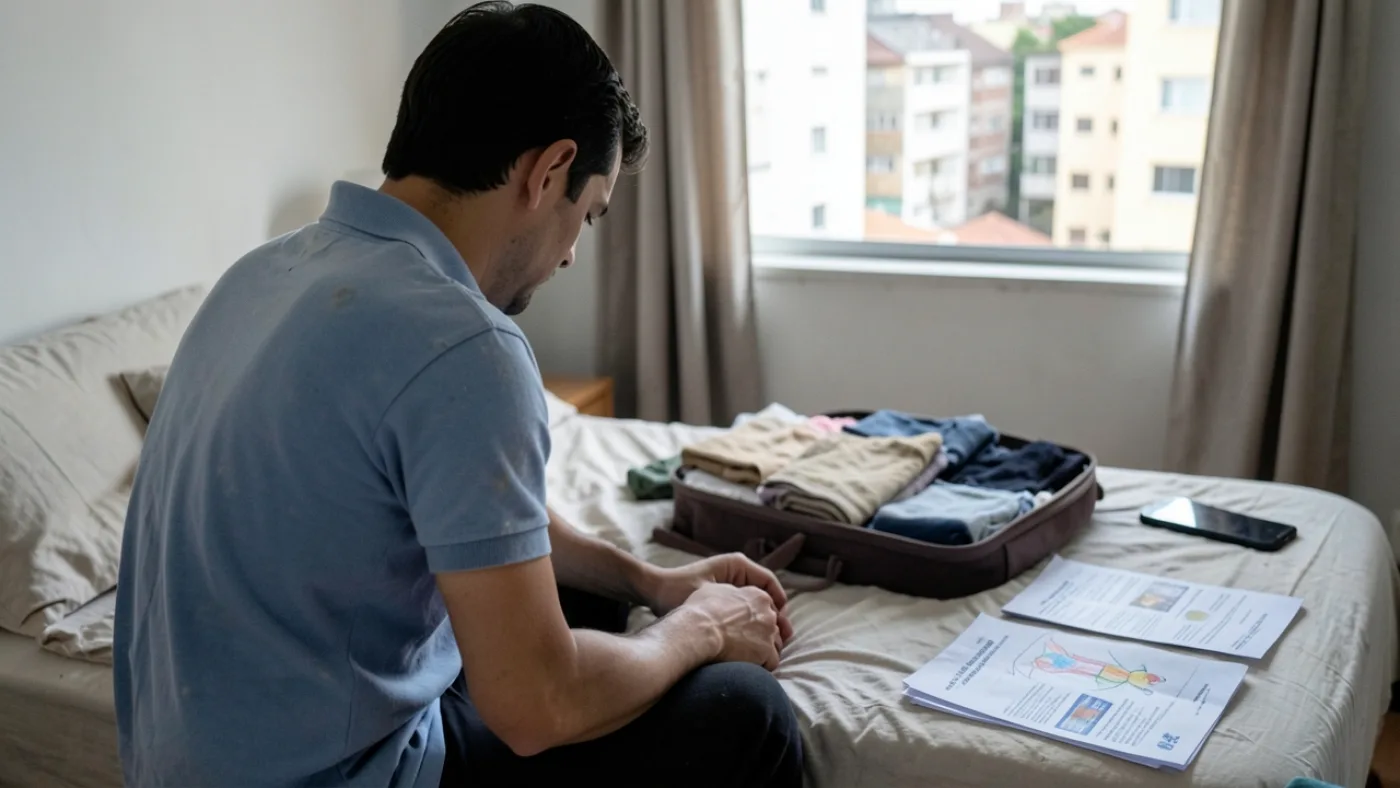

The single most expensive sentence in an international divorce is this one: “each spouse shall keep the assets registered in their own name.” Foreign spouses sign it every week, in settlement agreements drafted in Miami, Lisbon or Berlin, believing it is fair. In Brazil, that sentence can waive a right worth R$ 1,000,000.
Here is why. If you married a Brazilian without a prenuptial agreement, the default regime under Brazil’s Civil Code (Lei nº 10.406/2002) gives you half of everything acquired during the marriage, no matter whose name is on the deed, the share certificate or the bank account. A startup that went from zero to R$ 2,000,000 while you were married? Half of that growth is yours, even if you never attended a single meeting.
The problem is that nobody tells you. There is no automatic disclosure of assets in Brazil the way there is in a US or English divorce. No mandatory financial statement. If you do not ask, and ask correctly, you will never see the apartment in Balneário Camboriú, the quotas in the family company, or the R$ 600,000 that quietly moved between accounts in the year before the separation.
This guide focuses on one thing only: how property division actually works when a foreigner divorces a Brazilian in 2026, and why so many people lose this right without ever knowing it existed.
On this page
Which Assets Are Excluded From Division, Even in Brazil?
Under the partial community regime of Brazil’s Civil Code (Lei nº 10.406/2002), four categories stay with their owner: assets owned before the wedding, inheritances, gifts received by one spouse alone, and property bought with the proceeds of any of those (sub-rogação, or substitution of assets). Everything else acquired during the marriage is split 50/50.
Start with the exceptions, because that is where the fight happens. Your Brazilian spouse’s lawyer will not argue about the car bought in 2022. They will argue that the R$ 800,000 apartment was actually a gift from the mother-in-law, or that it was purchased with money inherited from a grandfather, and therefore belongs to one side only.
Substitution of assets is the most abused exception. The rule is logical: if your spouse sold a pre-marital apartment for R$ 600,000 and used exactly that amount to buy another one, the new property replaces the old and stays excluded. But if the new apartment cost R$ 1,200,000, and R$ 600,000 came from joint income during the marriage, half of that R$ 600,000 (R$ 300,000) is yours.
In practice: A Canadian husband accepted that his wife’s São Paulo apartment was “family money” and walked away. Bank records later showed R$ 450,000 of the purchase price came from the couple’s joint account during the marriage. His share was R$ 225,000, and by then the apartment had been sold and the money moved abroad.
The burden of proof matters enormously. In Brazilian practice, the spouse claiming an asset is excluded must prove it with documents: the prior deed, the inheritance formal (formal de partilha), the gift instrument, the bank transfer trail. A verbal claim that “my parents paid for it” is not enough. If they cannot document it, the presumption of joint ownership prevails.
What Is the Actual Rule? Which Marital Property Regime Governs You?
Brazil’s Civil Code sets out four regimes. Without a registered prenuptial agreement (pacto antenupcial), partial community of assets applies automatically to marriages celebrated in Brazil. That means a 50/50 split of everything acquired from the wedding date to the date of factual separation, regardless of who earned it or whose name it is in.
The four regimes, in plain English:
- Comunhão parcial de bens (partial community): the default. Assets acquired during the marriage are shared; pre-marital assets, inheritances and gifts are not.
- Comunhão universal de bens (universal community): nearly everything is shared, including what each spouse owned before the wedding and inheritances received during it. Requires a prenup.
- Separação total de bens (total separation): each spouse keeps their own assets and income. Requires a prenup, except where the law imposes it (for example, marriages of people over 70 in certain situations).
- Participação final nos aquestos (final participation in acquired assets): during the marriage each spouse manages their property independently, but on divorce the increase in wealth is calculated and shared. Rare in practice.
Key point: The regime is fixed at the moment of the wedding, not at the moment of divorce. Whatever the law said on your wedding day is what governs the split, unless you later obtained a court order changing the regime.
You can read the Civil Code provisions on marital property regimes directly on the government’s legislation portal, in the official text of Lei nº 10.406/2002. The relevant chapter is titled “Do Direito Patrimonial” and it is the single document your Brazilian lawyer will keep coming back to.
Why Do So Many Foreigners Lose Half of What They Are Owed?
Three reasons, in order of frequency: they assume their home country’s rules apply, they consent to a “divorce now, split later” arrangement that never happens, and they sign documents in Portuguese without a certified translation. Brazil is a Civil Law country, so nothing works the way a Common Law divorce works.
There is no discovery process in a Brazilian divorce. No deposition of your spouse. No automatic obligation to file a sworn statement of net worth. To find hidden assets, your lawyer must ask the judge for specific measures: a banking secrecy break (quebra de sigilo bancário e fiscal), a search of the Receita Federal database, a query to the Central Bank’s CCS system that lists every account a person holds in Brazil, and searches at the real estate registries (registros de imóveis) of the relevant municipalities.
The second trap is the “consensual divorce without partition.” Brazilian law allows you to dissolve the marriage first and divide assets later, and cartórios and courts approve it routinely. It sounds efficient. In reality, the moment the marriage ends, cooperation ends. Years later the apartment has been sold, the company has been restructured, and you are trying to prove the value of something that no longer exists.
Watch out: Brazilian courts generally treat undivided marital property as continuing co-ownership, so your claim does not simply vanish. But the other side will argue prescription and, more damagingly, will argue about valuation. Delay does not erase the right. It erases the evidence.
The third reason is language. A settlement drafted in Portuguese by your spouse’s lawyer may contain a clause stating you declare there are no assets to be divided (“declaram inexistir bens a partilhar”). Once you sign that before a cartório (notary office with legal registration powers) and it is ratified, reversing it requires proving fraud or error, which is a far harder case than simply claiming your half in the first place.
What Is the Strongest Argument Against You, and How Do You Answer It?
The strongest argument is this: “We married in New York, where the default is separate property. Under Article 7 of the LINDB, the property regime follows the law of the spouses’ domicile, which was the United States. Brazilian partial community never applied, so my client owes nothing.” That argument wins cases when it is not answered properly.
It deserves respect, because it is legally coherent. The Lei de Introdução às Normas do Direito Brasileiro (LINDB) genuinely does tie the property regime to domicile. Where the spouses had different domiciles when they married, Brazilian law looks to the law of the first marital domicile, the first country where the couple actually set up their life together.
Here is the answer, in three layers.
- Real estate in Brazil is different. Property located in Brazil is governed by Brazilian law, and the Civil Procedure Code gives Brazilian courts exclusive jurisdiction over immovable property situated in Brazil and over the partition of assets located in Brazil in divorce and civil union cases, even where the holder is a foreigner living abroad. No foreign judgment can divide a Brazilian apartment on its own.
- Where was the first marital domicile really? If you married in Lisbon but moved to Rio three months later and built your entire life there, the factual analysis often points to Brazil. Domicile is about facts (residence, tax filings, CPF, lease, children’s schools), not about the wedding venue.
- A foreign prenup must be proven and registered. A German or American prenuptial agreement can be recognised in Brazil, but it must be apostilled, sworn-translated by a tradutor público, and registered at the competent registry to be effective against third parties and, in practice, to be enforced smoothly over Brazilian assets.
If your marriage was celebrated abroad, registering it in Brazil also changes the practical landscape considerably. Our guide on how to register a foreign marriage in Brazil explains that step, which frequently determines how easily you can act against Brazilian-situs property later.
How Do the Regimes Compare in Real Numbers?
Take one couple, four scenarios. The Brazilian spouse owned an apartment worth R$ 800,000 before the wedding, inherited R$ 600,000 during the marriage, and built a company that reached a valuation of R$ 2,000,000 from zero while married. The foreign spouse’s entitlement changes dramatically depending on the regime.
| Regime | Pre-marital apartment (R$ 800,000) | Inheritance (R$ 600,000) | Company built during marriage (R$ 2,000,000) | Total to foreign spouse |
|---|---|---|---|---|
| Comunhão parcial (default) | Excluded | Excluded | Half: R$ 1,000,000 | R$ 1,000,000 |
| Comunhão universal | Half: R$ 400,000 | Half: R$ 300,000 | Half: R$ 1,000,000 | R$ 1,700,000 |
| Separação total | Excluded | Excluded | Excluded | R$ 0 |
| Participação final nos aquestos | Excluded | Excluded | Half of the accumulated increase: around R$ 1,000,000 | Around R$ 1,000,000 |
Note what the table shows about business assets. In the default regime, company quotas registered exclusively in your spouse’s name and CNPJ (company tax ID) are still marital property to the extent their value grew during the marriage. Brazilian courts do not usually hand a former spouse voting shares in a family business. Instead, they order the quotas valued by a court-appointed expert (perito) and award the other spouse the cash equivalent, often payable in instalments.
Can You Divide Assets Without Going to Court?
Yes. Since 2007, Brazil allows a fully extrajudicial divorce with property division at a cartório, provided both spouses agree on everything, there are no minor or incapable children, and each side is represented by a lawyer registered with the OAB (Brazilian Bar Association). Notary fees for the deed typically run from R$ 2,000 to R$ 5,000, plus registry fees.
How it works: the lawyers draft an escritura pública de divórcio e partilha (public deed of divorce and property division) listing every asset, its value, and who receives what. Both spouses sign at the cartório. The deed is then taken to the civil registry to update the marriage record, and to the real estate registry to transfer any property.
You do not need to fly to Brazil. You can sign a procuração pública (notarised power of attorney) at the nearest Brazilian consulate, or a local notary plus apostille and sworn translation, authorising a Brazilian lawyer to act for you. Since the expansion of the e-Notariado platform run by the notaries’ association, many deeds can also be signed by videoconference with a digital certificate.
What you will need:
- Marriage certificate (certidão de casamento), issued within the last 90 days if the marriage was registered in Brazil
- Passport or RG, and a Brazilian CPF (taxpayer number) for each spouse, including the foreign one
- Prenuptial agreement, if any, apostilled and sworn-translated
- Deeds and updated registry certificates (matrícula atualizada) for every property
- Vehicle documents, company articles of association with the CNPJ, bank and investment statements
- Power of attorney if either spouse will not attend in person
Key point: An equal division of marital property is generally not treated as a taxable transfer. But if one spouse receives clearly more than their share, Brazilian states may tax the excess as a donation under ITCMD, at rates that vary by state and commonly fall between 2% and 8%. On a R$ 500,000 imbalance in a state charging 4%, that is R$ 20,000 nobody budgeted for. Our overview of ITCMD and cross-border taxation explains how the rates work.
When Do You Need a Judge, and What Does It Cost?
You need a court when there is disagreement, when there are minor children, or when assets must be traced or frozen. A contested divorce with property division in Brazil typically takes 18 months to 4 years, and court costs alone often run 1% to 2% of the disputed asset value, with lawyer fees commonly between R$ 12,000 and R$ 50,000 depending on complexity.
The judicial route unlocks tools the cartório cannot offer:
- Asset freezing (arresto or bloqueio) to stop a spouse selling the apartment or emptying accounts while the case runs
- Banking and tax secrecy breaks through the courts, reaching Receita Federal returns and Central Bank account records
- Court-appointed valuation of businesses, real estate and, increasingly, crypto holdings
- Provisional support (alimentos provisórios) while the division is pending
Brazilian procedure also allows the divorce itself to be granted quickly, sometimes within a few months, while the property division continues as a separate phase or separate action. That can be strategically useful, but only if the asset freeze is already in place. Otherwise you are back to the “divorce now, split later” trap.
Realistically, delays are part of the system. Hearings get rescheduled, expert valuations take months, and appeals to the state Court of Appeals (Tribunal de Justiça) add a year or more. The Superior Court of Justice publishes its case law on property division openly at stj.jus.br, and its rulings on the valuation of company quotas and pension assets are frequently decisive in international cases.
What Happens to Assets Located Outside Brazil?
A Brazilian judge can take foreign assets into account when balancing the division, but cannot directly transfer title to a house in Portugal or a 401(k) in the United States. Enforcement abroad requires a separate action in that country, or recognition of the Brazilian judgment under local rules. That gap costs foreign spouses dearly.
The practical workaround Brazilian courts use is compensation. If the Brazilian spouse holds R$ 1,200,000 of Brazilian property and the foreign spouse holds an apartment in Madrid worth the equivalent of R$ 600,000, the judge can adjust the Brazilian share so that the overall result is equal, without ever issuing an order over Spanish real estate.
Watch out: This works in both directions. Foreign spouses who assume their overseas retirement accounts and property are invisible to a Brazilian court are frequently surprised. Full disclosure and a negotiated settlement usually produce a better outcome than a strategy built on concealment, which can be reopened as fraud.
If your divorce has already been finalised abroad and you now need it recognised in Brazil to deal with Brazilian assets, that is a separate procedure with its own rules, explained in our guide to STJ recognition of foreign divorces. Bear in mind that even a recognised foreign judgment will not, by itself, divide immovable property located in Brazil.
What Changed for International Property Division in 2026?
The biggest change is procedural, not substantive: more countries now issue fully electronic apostilles that Brazilian cartórios accept without physical stamps. That cuts weeks off authenticating a foreign prenuptial agreement, marriage certificate or power of attorney, and removes one of the most common causes of rejected filings.
Three other developments matter for asset division:
- Digital notarial acts are now routine. Consensual divorce deeds with property division can be signed remotely through e-Notariado with an ICP-Brasil digital certificate, which a foreign spouse can obtain through a Brazilian consulate or a certified agent.
- Crypto assets are increasingly traced. Brazilian exchanges report holdings to Receita Federal, and courts have become far more willing to order disclosure of digital asset positions in divorce proceedings.
- Consular services expanded online. Powers of attorney, document legalisation and civil registry acts can largely be started through the Itamaraty consular portal, reducing the need for in-person appointments abroad.
What has not changed is the underlying rule. The default partial community regime still governs marriages celebrated in Brazil without a prenup, and the LINDB still points to domicile for couples married abroad. No 2026 reform has softened either point.
Step by Step: How to Protect Your Share
Act in this order. Most rights are lost in the first 60 days after separation, before any lawyer is even hired, because assets are moved and documents disappear. Begin with evidence, then determine the regime, then negotiate. Never sign anything before step three.
- Step 1 (week 1): Photograph and save every financial document you can lawfully access: bank statements, tax returns (declaração de imposto de renda), property deeds, company documents, vehicle registrations, investment reports.
- Step 2 (weeks 1-2): Obtain your Brazilian CPF if you do not have one. You cannot register property or sign a division deed without it.
- Step 3 (weeks 2-4): Have a Brazilian family lawyer determine your regime in writing, based on where you married, where you first lived together, and any prenup.
- Step 4 (weeks 3-6): Order updated registry certificates (matrícula atualizada) for each property and a company registry search (certidão da Junta Comercial) for any business.
- Step 5: If there is any risk of dissipation, file for asset freezing before opening negotiations.
- Step 6: Choose the route. Consensual deed at the cartório (typically 30-60 days once documents are ready) or a court action.
- Step 7: Register the outcome. A deed or judgment that is not registered at the real estate registry does not transfer ownership.
Quick recap: Evidence first, regime second, signature last. Do that and you preserve the right. Reverse the order and you may spend years litigating what could have been settled in a single deed. For the broader procedural picture, see our complete guide to divorce in Brazil for foreigners.
What Mistakes Cost Foreign Spouses the Most?
The five costliest errors, seen repeatedly in international divorce files, all share one feature: they are irreversible once documented. A signed and ratified waiver is far harder to attack than an unresolved claim, so the cost of a bad signature usually exceeds the cost of a delayed one.
- Signing a Portuguese-language settlement without a certified translation and independent legal review
- Agreeing to divorce “without assets to divide” when assets clearly exist
- Assuming a foreign prenup automatically covers Brazilian real estate without registration in Brazil
- Leaving Brazil without a valid, apostilled power of attorney, which paralyses every subsequent filing
- Waiting years to claim the division, by which time properties are sold and company structures have changed
Watch out: If children are involved, financial support is a separate claim from property division and follows different enforcement rules across borders, as explained in our guide on enforcing international child support in Brazil. Settling the property split does not settle support.
Frequently Asked Questions
Does my Brazilian spouse get half of the house I own abroad?
Possibly, if it was acquired during the marriage and Brazilian law governs your regime. A Brazilian court cannot transfer title to foreign real estate, but it can value the asset and compensate your spouse out of Brazilian property, or order a cash payment. A property you owned before the wedding is excluded under the default partial community regime. Property inherited abroad during the marriage is also excluded in that regime, though not under universal community. Documentation of the purchase date and source of funds is what decides the outcome.
I signed a prenuptial agreement in Germany. Is it valid in Brazil?
It can be recognised, but it is not automatic. To be effective in Brazil, a foreign prenuptial agreement generally needs an apostille under the Hague Apostille Convention, a sworn translation by a Brazilian tradutor público, and registration at the competent Brazilian registry, particularly to affect real estate. It also cannot contradict Brazilian public policy. Practically, many foreign prenups are honoured over movable assets and financial accounts, while disputes concentrate on Brazilian immovable property. Have it reviewed and registered before any dispute begins, not after.
Can I get divorced in Brazil without dividing the assets?
Yes. Brazilian law allows the marriage to be dissolved first and property divided later, either at a cartório or in court. The dissolution can be quick, sometimes within a few months. The risk is practical rather than legal: once divorced, your former spouse has no incentive to cooperate, assets may be sold, and valuation becomes a battle of experts. If you must separate the two steps, secure an asset freeze or a written, notarised inventory of all marital property first.
Do I have to travel to Brazil for the property division?
Usually not. A notarised and apostilled power of attorney (procuração) allows a Brazilian lawyer to represent you in a consensual deed or a court case. You can sign it at a Brazilian consulate, which avoids apostille and translation costs, or before a local notary followed by apostille and sworn translation. Since the expansion of remote notarial acts through the e-Notariado platform, many divorce and division deeds can also be signed by videoconference using an ICP-Brasil digital certificate.
Is property division between spouses taxed in Brazil?
An equal split of marital property is generally not treated as a taxable transfer, so no ITBI or ITCMD is due on the balanced portion. However, if one spouse receives more than their legal share, states typically treat the excess as a donation subject to ITCMD, at rates that commonly range from 2% to 8% depending on the state. There may also be capital gains implications if assets are sold as part of the settlement. Confirm state rules and Receita Federal reporting obligations before signing.
What if my spouse owns everything through a Brazilian company?
Assets held through a company are not automatically out of reach. If the quotas were acquired or increased in value during the marriage, that value forms part of the marital estate in the default regime. Courts appoint an expert to value the company and award the other spouse a cash equivalent, often in instalments, rather than voting rights. Where a company was created purely to shelter marital assets, Brazilian courts can pierce the corporate veil, but this requires evidence of misuse.
Secure Your Share in an International Divorce With a Brazilian Spouse
Property division across borders is technical, and the difference between R$ 0 and R$ 1,000,000 often comes down to one clause and one deadline. Our bilingual team handles asset tracing, regime analysis, consensual deeds and contested partition for foreign clients in Brazil and abroad.
Your concrete next step: gather your marriage certificate, any prenuptial agreement, and a list of every asset acquired since the wedding, then send us a message for a regime analysis before you sign anything.
Talk to a specialist lawyer now
Talk to a Lawyer on WhatsApp