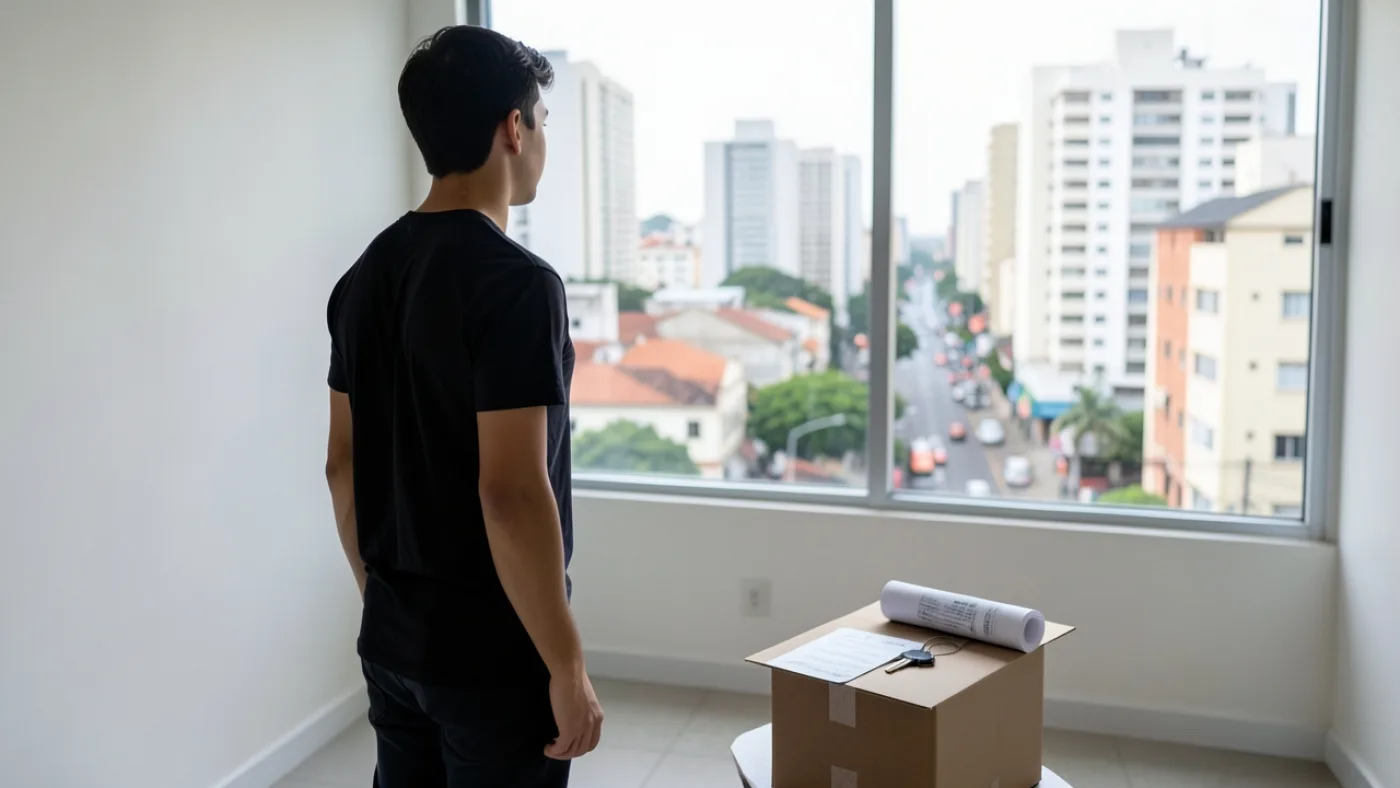

Yes, you can sign a rental contract in Brazil as a foreigner with little more than a passport and a CPF. But the signature itself is where most foreigners quietly hand over the one protection that decides whether they stay in the apartment for 30 months or get 90 days to leave.
Brazilian leases are governed by Lei nº 8.245/1991, the Lei do Inquilinato (Tenancy Act), one of the most tenant-friendly rental statutes in the Americas. The catch is that several of its strongest protections are not automatic. They exist only if specific words are written into the contract you sign, and in some cases only if that contract is registered at the property’s Real Estate Registry (Registro de Imóveis).
Foreigners lose these rights constantly. Not because landlords cheat them, but because nobody explains that a right you did not write in at signature usually cannot be recovered later. Brazil is a Civil Law country: what matters is the text of the statute and the text of your contract, not negotiations, emails or verbal promises made during the apartment viewing.
This article walks through the signing moment itself: who can legally sign, what the document must contain, which clauses silently waive your rights, what it costs, and the exact steps to sign a Brazilian lease without losing anything you are entitled to.
On this page
What Is the Costliest Thing You Lose the Moment You Sign?
The costliest loss is eviction protection when the apartment is sold. Under Article 8 of Lei nº 8.245/1991, a buyer can terminate your lease with just 90 days’ written notice, unless the contract has a fixed term, contains a “cláusula de vigência” (continuity clause) and is registered on the property’s title record at the Registro de Imóveis.
Read that again, because it is where most foreign tenants lose everything. You can sign a perfectly valid 30-month lease, pay every installment on time, invest R$ 20,000 in furniture and still be out in 90 days if the owner sells. The lease survives a sale only when two conditions are met together: the continuity clause in the text, and registration on the matrícula (title record) of the property.
The same logic applies to the second lost right: preference. Articles 27 to 33 of the Tenancy Act give the tenant the first option to buy the property if the owner decides to sell, with 30 days to accept the terms offered. If the owner sells to someone else without notifying you, Article 33 lets you claim damages, or in some cases claim the property itself by depositing the price. But that claim must be filed within six months of the sale being registered, and only if your lease was already registered on the title at least 30 days before the sale.
Warning: The six-month window in Article 33 is decadential, not a statute of limitations. It does not pause, it does not extend for negotiations, and a court cannot revive it. When it closes, the right is gone permanently.
So the honest answer to “why do so many people lose this right without knowing it?” is structural. Standard agency lease templates in Brazil rarely include the continuity clause, because it protects the tenant at the owner’s expense. Nobody is hiding it from you. It simply is not there, and nobody asks for it.
Practical example: A French consultant signs a 30-month lease in Pinheiros, São Paulo, at R$ 4,500 per month. In month 11 the owner sells the unit. Because the contract had no continuity clause and was never registered, the buyer serves a 90-day notice. The tenant leaves at month 14, pays a R$ 1,200 moving company, loses a R$ 3,000 fit-out and has no legal claim. Registering the lease would have cost a few hundred reais.
Who Can Legally Sign a Brazilian Lease as a Foreigner?
Almost anyone. Brazilian law imposes no residency or visa requirement to sign a residential lease. A tourist on a 90-day stamp can legally sign a 30-month contract. In practice, what you need is a CPF (Brazilian taxpayer number), which is free to obtain and can be requested abroad through a Brazilian consulate.
The Tenancy Act does not restrict leases by nationality. Restrictions on foreign ownership exist for rural and border-zone land, which is why our guides on buying rural land in Brazil and the 150 km border rule exist, but renting urban property is not affected.
- CPF: essentially mandatory. No agency will process a lease without it. You can apply through the Receita Federal (Brazilian IRS) portal or at a Brazilian consulate abroad.
- Identity document: passport for non-residents, or the CRNM (National Immigration Registration Card) issued by the Federal Police if you hold a residence permit.
- Address proof: often requested. A hotel booking, a previous lease or a utility bill in a relative’s name with a declaration usually works.
- Legal capacity: 18 or older, or 16 to 18 with parental assistance.
- Married tenants: no spousal consent is needed for leases under 10 years, under Article 3 of the Tenancy Act.
Signing from abroad is also possible, through a power of attorney (procuração). If the document is executed outside Brazil, it generally needs an apostille under the Hague Convention (or consular legalization for non-member countries) plus a sworn translation by a tradutor público (public sworn translator) registered with the state commercial board. Rules and consular fees are published by Itamaraty’s consular portal.
Important: Never sign a lease where the “landlord” is not the person named on the property’s matrícula, unless they present a registered power of attorney or a documented chain of title. A lease signed by someone without authority to let the property is a dispute waiting to happen.
Does the Contract Have to Be in Portuguese, Notarized or Witnessed?
No. A Brazilian residential lease is valid as a simple private document, in any language, with no notarization and no witnesses. But three optional formalities change what the contract can actually do: two witness signatures, signature authentication at a cartório (notary office), and registration at the Registro de Imóveis.
Here is what each one adds:
- Two witnesses: under the Brazilian Civil Procedure Code, a private written instrument signed by the debtor and two witnesses qualifies as an enforceable title (título executivo extrajudicial). It cuts straight to enforcement, skipping a full merits trial. This cuts both ways: it also makes it faster for the landlord to collect from you.
- Firma reconhecida (signature authentication at a cartório): removes any argument that a signature was forged. Costs a few reais per signature.
- Registration at the Registro de Imóveis: the only formality that makes the lease effective against a future buyer and preserves the Article 33 preference right.
Language is a separate issue. The contract can be bilingual, and many agencies will accept a side-by-side Portuguese/English version. If a dispute reaches a Brazilian court, however, the Portuguese text prevails and any foreign-language document must be filed with a sworn translation. A bilingual lease is for your comprehension, not for your legal protection.
Digital signatures are now standard. Platforms such as Clicksign and D4Sign, and the free gov.br digital signature, are accepted for leases under Brazil’s electronic signature legislation (Lei nº 14.063/2020). You can sign a São Paulo apartment lease from Lisbon in 20 minutes. What you cannot do remotely is the property inspection, which is the second most common source of foreigner losses.
Which Clauses Do Foreigners Sign Away Without Realizing?
The Tenancy Act voids clauses that defeat its purpose (Article 45), but it allows contractual waiver of several specific rights. The two most expensive waivers for foreigners are reimbursement for improvements (Article 35) and the exemption from the early-termination penalty for employer-transferred tenants (Article 4, sole paragraph).
Start with the transfer exemption, because it is worth thousands and almost no foreigner knows it exists. Article 4 says a tenant who breaks a fixed-term lease owes a penalty proportional to the time remaining. The sole paragraph of the same article exempts a tenant who is transferred by their employer to another municipality or state, provided they give at least 30 days’ written notice and attach proof of the transfer.
Practical example: Rent of R$ 4,500 on a 30-month lease, contractual penalty of three months’ rent (R$ 13,500). You leave at month 12, with 18 months remaining. The proportional penalty is R$ 13,500 × 18/30 = R$ 8,100. If your employer transfers you to Rio and you serve proper 30-day notice with the transfer letter, the legal penalty is R$ 0. The difference between knowing and not knowing is R$ 8,100.
Other clauses worth checking line by line before you sign:
- Rent indexed to USD or EUR. Article 17 requires rent to be fixed in Brazilian reais and prohibits indexing to foreign currency or to the minimum wage. Foreigners are frequently offered “USD leases”. That indexation clause is void. Inbound transfers to pay rent go through authorized institutions under the foreign exchange framework of Lei nº 14.286/2021, regulated by the Banco Central do Brasil.
- Two guarantees at once. Article 37 allows exactly one guarantee per contract: fiador, caução (deposit capped at three months’ rent), seguro-fiança or assignment of investment fund shares. Demanding a guarantor plus a deposit is illegal. Our guide on renting in Brazil without a fiador covers each option.
- Advance payment of several months. Article 20 prohibits demanding more than one month’s rent in advance when a guarantee exists.
- Waiver of reimbursement for necessary improvements. Legal, and almost always in the template. Assume you will not be reimbursed for anything.
- Transfer of IPTU and extraordinary condominium expenses. Article 22 puts these on the landlord by default, but the parties may agree otherwise. Know what you are accepting.
- Subletting and short-term rental bans. Article 13 requires the landlord’s prior written consent to sublet or assign. Listing the unit on Airbnb without it is grounds for eviction.
Tip: Ask for the draft contract 48 hours before signing, in editable format. Agencies routinely refuse to change clauses “on the day” purely for internal process reasons, and routinely accept the same changes when asked two days earlier. For a clause-by-clause checklist, see our breakdown of rental contract clauses foreigners must check.
Why Do Landlords Insist Foreign Tenants Are Riskier?
Because, from a purely financial standpoint, they have a serious point. A Brazilian eviction for non-payment typically takes 8-18 months in major state courts, and the landlord’s realistic recovery route is seizing the guarantor’s local assets. Against a tenant who can board a flight, that route does not exist.
Stated in its strongest form, the landlord’s argument goes like this: a Brazilian tenant leaves a trail. Credit scores at Serasa and SPC, a CPF with payment history, employment records, a family address, assets inside the jurisdiction. A foreign tenant who stops paying in month 4 can leave the country in week 2 of the dispute, and enforcing a Brazilian judgment against assets in Germany or Canada requires a recognition proceeding abroad that costs more than the debt. The landlord is not being xenophobic. They are pricing a real, uninsurable enforcement gap.
That argument is legitimate, and the correct response is not to protest it. It is to close the gap with instruments the landlord can actually enforce without you in the country:
- Seguro-fiança (rental insurance): the insurer pays the landlord and then pursues you. This neutralizes the enforcement argument entirely, which is why it unlocks apartments that a foreign guarantor never will.
- Caução in cash: up to three months’ rent, deposited in a joint savings account under Article 38. Money already inside Brazil is money the landlord can reach.
- A registered power of attorney naming a Brazilian resident to receive service of process on your behalf. Tiny cost, large psychological effect.
What does not work is offering a foreign bank statement, a letter from a non-resident employer or a guarantor who owns property in Miami. Not because landlords reject them on principle, but because none of them can be enforced in Brazil without an international proceeding.
Which Lease Type Are You Actually Signing?
Brazilian law treats lease duration as a legal category, not a commercial detail. A 30-month written residential lease ends automatically at term under Article 46, with no notice required, while a lease under 30 months keeps the tenant in place under Article 47 unless the landlord can prove one of the statutory grounds to retake the property.
This is counterintuitive for most foreigners: the shorter contract can give you more security of tenure, while the longer one expires cleanly. Here is how the main categories compare.
| Lease type | Legal basis | What signing commits you to | Key risk for foreigners |
|---|---|---|---|
| Residential, 30 months or more (written) | Art. 46 | Ends automatically at term. If you stay over 30 days with no objection, it becomes indefinite and either side may end it with 30 days’ notice | No automatic right to renew. Assuming otherwise is the classic mistake |
| Residential, under 30 months | Art. 47 | At term it continues indefinitely; landlord can only retake on listed grounds, or after 5 continuous years | Agencies rarely offer it; must be negotiated |
| Temporada (short-stay), up to 90 days | Art. 48 | Full rent may be charged in advance; no tenure protection | Used to disguise long leases and strip your protections |
| Commercial (non-residential) | Art. 51 | Renewal action (ação renovatória) available only if strict conditions are met | Filing window is between 1 year and 6 months before expiry, and it is decadential |
| Built-to-suit | Art. 54-A | Penalty regimes and waiver of the revisional action are enforceable | Multi-year exposure; never sign without legal review |
Important: If you run a business from the property, the commercial renewal deadline in Article 51 is the single hardest deadline in Brazilian tenancy law. Miss the window that opens 12 months and closes 6 months before expiry, and your right to renew disappears even with 20 years of perfect payments.
What Changed in 2026?
The core statute has not changed: Lei nº 8.245/1991, as amended by Lei nº 12.112/2009, remains the governing law in 2026. What changed is procedural. Electronic signature acceptance is now near-universal in agency leases, and most state Real Estate Registries process lease registration through online portals, cutting the typical registration time to around 5-15 business days.
Three practical developments matter for foreign tenants this year:
- Digital registration of leases. Submitting a lease for registration at the Registro de Imóveis no longer requires a physical trip in most capitals. This removes the main practical excuse for skipping the step that protects you against a sale.
- Index shift. Many 2026 contracts have moved from IGP-M to IPCA or INPC for annual adjustment, after years of IGP-M volatility. Check which index your contract uses before signing; the difference over 30 months can exceed a full month’s rent.
- Bills under discussion in Congress would adjust guarantee rules and streamline eviction procedures. None has been enacted. Treat any agency claim that “the law changed” as something to verify against the official text of Lei nº 8.245/1991.
How Do You Sign a Brazilian Lease Step by Step?
Budget 10-20 days from chosen apartment to keys in hand, assuming your CPF is already issued. The sequence below is ordered deliberately: steps 1 to 4 must happen before you sign, because none of them can be fixed afterwards.
- Get your CPF. Free, through the Receita Federal portal or a Brazilian consulate. Takes from same-day to about 10 days abroad.
- Pull the property’s matrícula (title record) from the Registro de Imóveis for the district where the property sits. Confirm the owner’s name matches the person signing, and check for mortgages, liens or pending judicial actions. Cost is usually under R$ 150.
- Request the condominium debt statement and the IPTU (municipal property tax) status. Unpaid condo fees can lead to foreclosure of the unit while you live in it.
- Negotiate the text. Insert the continuity clause (cláusula de vigência), confirm only one guarantee is required, confirm the adjustment index, and confirm the early-termination penalty formula is proportional.
- Do the vistoria (inspection report). Photograph and video every room, appliance, wall and fixture. Attach the photo set to the contract as an annex signed by both parties. This single annex decides most deposit disputes.
- Sign. Digital signature via gov.br or a certified platform, or physical with two witnesses. Keep the complete signed PDF, not just the pages you signed.
- Register the lease at the Registro de Imóveis. This is the step that preserves your protection against a sale and your preference right.
- Transfer utilities into your name (electricity, water, gas, internet) and keep every receipt. Under Article 22, you are entitled to itemized receipts for rent and charges.
Tip: Pay rent exclusively by bank transfer or boleto, never in cash. In a Brazilian court, proof of payment is on the tenant, and a Pix receipt with the landlord’s CPF is worth more than any verbal assurance.
What Documents and Costs Should You Budget For?
Expect R$ 300 to R$ 2,500 in one-off signing costs beyond rent and guarantee, depending on whether you register the lease and need translations. The CPF itself is free. Cartório and registry fees are set by state fee tables (tabelas de custas) published by each state’s judiciary, so amounts vary significantly between São Paulo, Rio de Janeiro and Bahia.
| Item | Typical cost (BRL, 2026) | Approx. USD |
|---|---|---|
| CPF application | Free (consular service fee may apply) | – |
| Matrícula / title certificate | R$ 60 – R$ 150 | $11 – $28 |
| Firma reconhecida (per signature) | R$ 10 – R$ 30 | $2 – $6 |
| Registration of the lease at Registro de Imóveis | R$ 300 – R$ 1,200 (scaled to contract value) | $55 – $220 |
| Sworn translation (per page) | R$ 80 – R$ 160 | $15 – $30 |
| Power of attorney at a cartório | R$ 100 – R$ 250 | $18 – $46 |
| Seguro-fiança (annual) | 1.2 – 2 times one month’s rent | varies |
| Caução (refundable deposit) | Up to 3 months’ rent (Art. 38) | varies |
Documents the agency will normally request from a non-resident: valid passport, CPF, proof of income or bank statements (last 3 months), and the chosen guarantee documents. If you hold residency, the CRNM replaces the passport and makes approval noticeably faster. For a broader overview of the market and neighbourhood practicalities, see our main guide on renting property in Brazil as a foreigner.
Frequently Asked Questions
Can I sign a Brazilian rental contract on a tourist visa?
Yes. Lei nº 8.245/1991 sets no immigration requirement for tenants, so a visitor can legally sign a 30-month residential lease. In practice you will need a CPF, and many agencies apply internal credit policies that favour residents. The usual solution is seguro-fiança or a cash caução of up to three months’ rent, which satisfies the landlord’s risk assessment without any residency document.
Is a lease written only in English valid in Brazil?
It is valid between the parties, but it is weak in court. Any document filed in a Brazilian court must be accompanied by a sworn translation by a public sworn translator, and in a conflict between versions the Portuguese text generally prevails. The safe approach is a bilingual contract with a clause stating which language controls, plus a lawyer reading the Portuguese column before you sign.
Can the landlord evict me if the apartment is sold?
Yes, with 90 days’ written notice, unless your lease has a fixed term, contains a cláusula de vigência and is registered on the property’s matrícula. Those three conditions together are what make the lease binding on the buyer under Article 8 of the Tenancy Act. Without them, no amount of rent paid or time lived there protects you. Registration typically costs R$ 300 to R$ 1,200.
How much do I pay if I break the lease early?
Under Article 4, the penalty must be proportional to the remaining term. If your contract sets three months’ rent as the penalty and you leave with 18 of 30 months remaining at R$ 4,500 per month, you owe R$ 13,500 × 18/30 = R$ 8,100. If your employer transfers you to another city or state, the sole paragraph of Article 4 exempts you entirely, provided you give at least 30 days’ written notice with proof of the transfer.
Can the landlord require both a guarantor and a deposit?
No. Article 37 of Lei nº 8.245/1991 permits only one guarantee per contract, and Article 43 treats demanding more than one as an offence subject to penalties. If an agency asks for a fiador plus a three-month caução, the extra guarantee is void and you can demand its removal. More detail on each permitted modality is in our guide to tenant rights under Brazilian rental law.
Do I need a lawyer just to sign a rental contract?
Not legally. But the items that cannot be fixed after signature (continuity clause, registration, single guarantee, proportional penalty, inspection annex) are exactly the ones a standard template omits. A pre-signature review by an OAB-registered lawyer usually costs far less than a single month’s rent and is the only moment when all of these rights are still available to you.
Sign Your Brazilian Rental Contract With Full Legal Protection
Signing a lease in a legal system you did not grow up in, in a language you may not read fluently, with an agency that wants the deal closed today, is a genuinely difficult position. The good news is that the window where everything can still be fixed is wide open right up until your signature lands on the page.
Send us the draft contract and the property’s matrícula before you sign. Our bilingual team reviews both, marks the clauses that must change, and tells you in plain English what you are agreeing to.
Talk to a specialist lawyer now
Talk to a Lawyer on WhatsApp