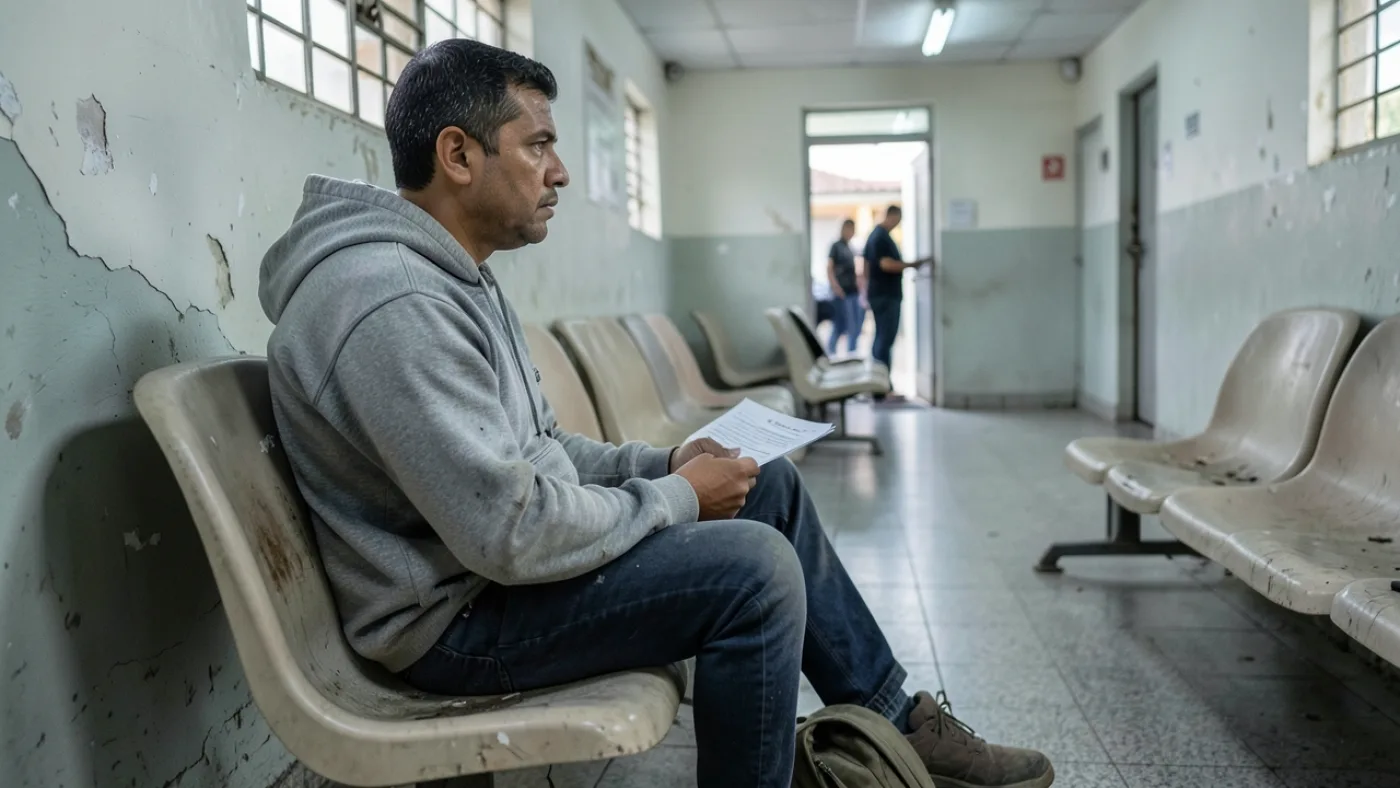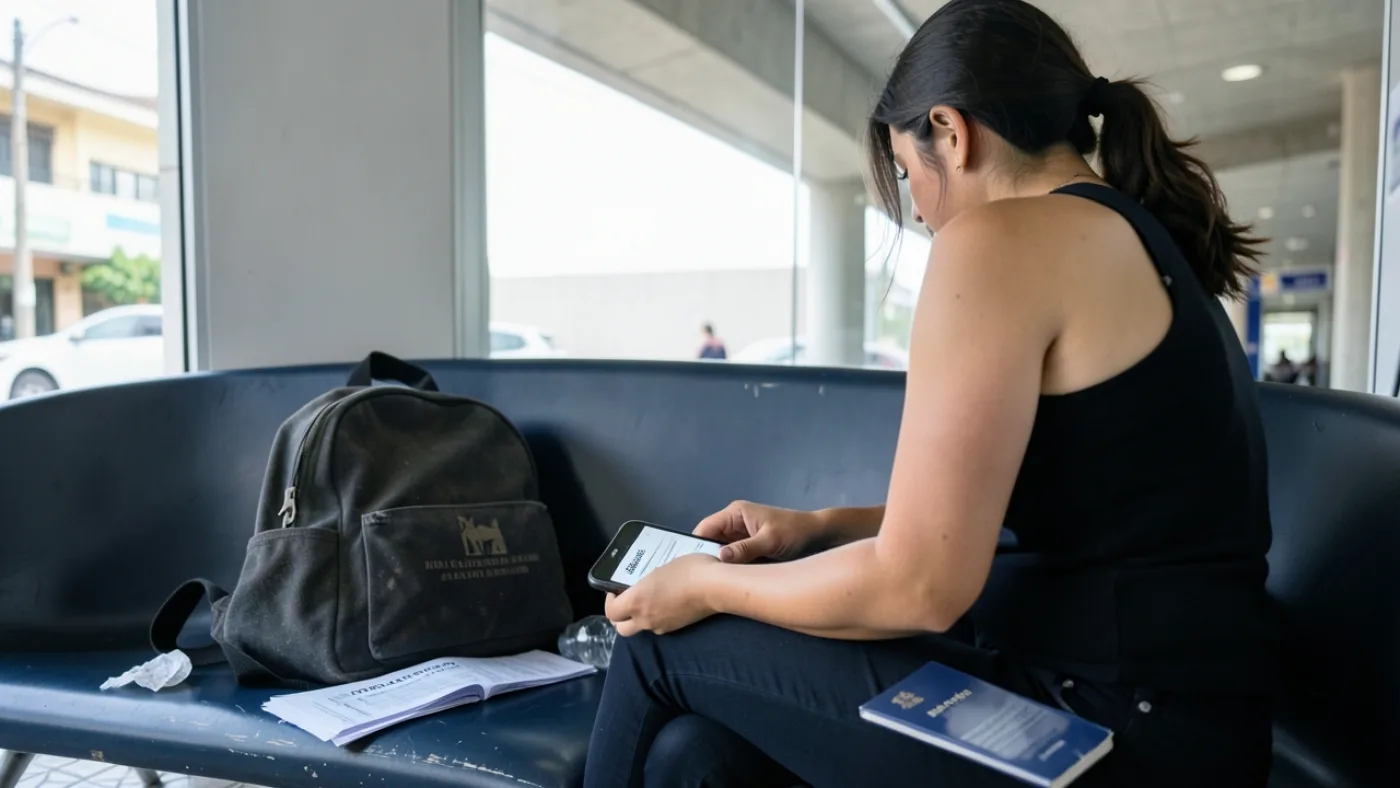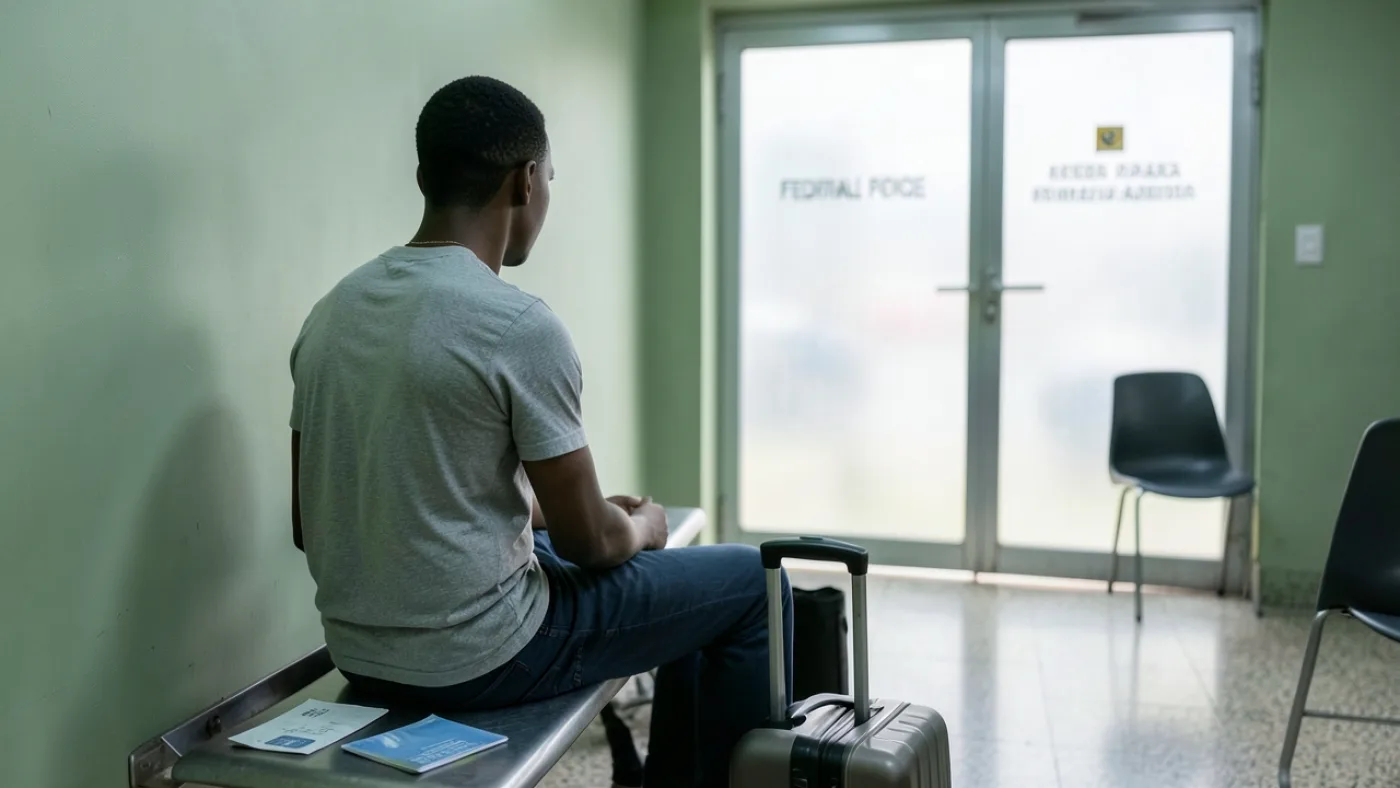
The most expensive mistake in a Brazil visa overstay case is not the overstay itself. It is walking up to the airline counter at Guarulhos with an expired visa and a one-way ticket, hoping nobody notices. The Federal Police do notice, and at that moment you lose something worth far more than the fine: the right to apply for residence from inside Brazil. That right disappears the second your boarding pass is scanned.
Here is the number that matters. Under Brazil’s Migration Law (Law 13.445/2017, article 108, V), the overstay fine is charged per day of excess stay, within a legal band of R$ 100.00 minimum to R$ 10,000.00 maximum for an individual, and it can be reduced according to your economic condition. R$ 10,000 (roughly US$ 1,850) is an absolute ceiling. It does not matter whether you are 200 days late or five years late: the bill for an individual stops there.
That single fact flips the whole calculation. Most people in irregular status panic about a bill that grows forever, and in panicking they throw away the one path that actually fixes their life in Brazil. This article explains how the fine really works in 2026, whether an amnesty is coming, and exactly how to regularize without leaving the country.
On this page
Why Does Leaving Brazil Before You Regularize Cost You So Much?
Because Brazilian law lets you file a residence authorization request while you are physically inside Brazil, and almost every other country does not. Under the Migration Law and Decree 9.199/2017, irregular migratory status does not by itself bar your request. Fly out first and you must restart from a consulate abroad, with a flagged record and an unpaid R$ 10,000-ceiling fine attached to your name.
Think of it as two separate files sitting on two different desks at the Polícia Federal (Federal Police). File one is the administrative infraction: your overstay, and the fine attached to it. File two is your residence application: marriage, child, job offer, digital nomad income, investment, family reunion. The existence of file one does not decide file two. Being fined is not being refused.
When you leave the country, file two cannot be opened anymore. You become a visa applicant abroad, subject to consular queues, document legalization from scratch, and the discretion of an officer who sees a Brazilian record showing an unresolved penalty. Article 45 of the Migration Law lists grounds for denial of entry, and an unresolved removal or penalty record is precisely what gets flagged at the border.
Watch out: Nobody at the airline check-in desk will warn you about this. Airlines check passports for destination requirements, not for your Brazilian regularization options. By the time the Federal Police officer at emigration control issues the fine notice, the decision is already made.
This is the answer to the question that runs through this entire article: why do so many people lose this right without knowing it? Because the right is silent. No letter arrives telling you that you may still apply from inside Brazil. The only loud signal is fear, and fear pushes people toward the exit.
How Much Is the Fine for Overstaying a Visa in Brazil in 2026?
Under Law 13.445/2017, article 108, V, the fine is assessed per day of excess stay, within a statutory range of R$ 100.00 to R$ 10,000.00 for an individual, and is reducible according to the migrant’s economic condition. There is no fixed national daily tariff. The practical headline: up to R$ 100 per day, capped at R$ 10,000 (about US$ 1,850 or € 1,600).
Two things in that sentence do real work. First, “range” means discretion: the Federal Police assess the amount in an administrative infraction procedure, and article 109 of the same law allows fines to be graded and reduced. Second, “capped” means the arithmetic ends. If you see figures like R$ 10,238 circulating online, they are wrong. The statutory ceiling for an individual is a round R$ 10,000. You can read the full text of the Migration Law on the Planalto government portal.
Example: A Canadian digital nomad entered on an e-Visa (US$ 80.90, up to 90 days per year under Decree 11.515/2023), then stayed 14 months. Her excess stay runs past 300 days, so the daily calculation would exceed the ceiling. Her maximum exposure as an individual is still R$ 10,000, and with proof of modest freelance income her lawyer can argue for a reduction based on economic condition.
The fine is collected through a GRU (Guia de Recolhimento da União, the Federal Collection Form), payable at Banco do Brasil or by internet banking. Paying it is an administrative act. It does not brand you, does not bar residence, and does not create a criminal record. Irregular status under the Migration Law is an administrative infraction, not a crime. Brazil abandoned the old Foreigner Statute precisely to stop treating migrants as suspects.
Key point: The real risk of a long overstay is never an unlimited bill. It is receiving a deportation notice, ignoring it, and losing the inside-Brazil route altogether.
Does an Overstay Mean Immediate Deportation?
No. Article 50 of the Migration Law requires personal written notification listing the irregularities and giving you a deadline of not less than 60 days to leave or regularize, extendable by an equal period through a reasoned decision. Deportation happens only if you neither regularize nor leave within that window. It is never automatic and never same-day.
Three removal mechanisms get confused constantly, and the confusion drives bad decisions:
- Deportation (art. 50): removal for irregular migratory status, only after the 60-day notice period. This is the only one an overstay can trigger.
- Expulsion (art. 54): removal with a re-entry ban, and it requires a final criminal conviction. An expired tourist visa never leads to expulsion. Article 55 also bars expulsion for someone with a Brazilian child in their care or a Brazilian spouse or partner resident in Brazil.
- Extradition (art. 81): handover at the request of another country. Completely unrelated to overstay.
The deportation procedure must respect contraditório e ampla defesa (adversarial process and full defence) and allows appeal. If you have no lawyer, the Defensoria Pública da União (Federal Public Defender) is notified to defend you free of charge, regardless of your nationality. If you have already received a notice, our guide on the 60-day window to fix your status walks through that specific scenario.
How it works: Filing a residence request inside the 60-day window converts the file. Instead of a removal process, the Federal Police now have a pending residence application on their hands, and the protocolo (protocol receipt) you receive documents your lawful presence while the decision is pending.
Who Can Still Regularize From Inside Brazil in 2026?
Far more people than expect to. Any residence category can be requested from within Brazil, and the typical Federal Police cost is R$ 372.90 total: R$ 168.13 for processing the residence authorization (revenue code 140066) plus R$ 204.77 for the CRNM card (code 140120), both unchanged in 2026 per Federal Police fee schedules.
The common routes out of irregular status:
- Family reunion: Brazilian spouse, stable partner (união estável), Brazilian child, or a resident foreigner family member. No income threshold in the law. This is the strongest and most common route.
- Mercosur residence: nationals of Argentina, Uruguay, Paraguay, Bolivia, Chile, Peru, Colombia, Ecuador and Guyana use a simplified agreement-based route.
- Employment: a formal job offer from a Brazilian employer supporting a work-based residence authorization.
- Digital nomad: foreign-source income of at least US$ 1,500 per month, or US$ 18,000 in bank funds (CNIg Resolution 45/2021).
- Retiree: monthly transfer of at least US$ 2,000 to Brazil (CNIg RN 40/2019).
- Investor: at least R$ 500,000 in a Brazilian company, or from R$ 150,000 for innovation and startup projects (CNIg RN 13/2017). See our breakdown of the R$ 500,000 investor residency rules.
- Real estate investor: urban property of at least R$ 1,000,000, or R$ 700,000 in the North and Northeast regions (CNIg RN 36/2018).
- Refuge: decided by CONARE (National Committee for Refugees) under Law 9.474/1997. The application is free, and while it is pending you stay lawfully and may work. Read about the CONARE process, timeline and risks before choosing this route.
Important: Regularization is not amnesty. You still owe the fine, and the overstay stays on your immigration record. What you buy with R$ 372.90 plus the fine is a CRNM (National Immigration Registration Card), a CPF-linked legal life, and eventually a path to naturalization after 4 years of residence (or 1 year with a Brazilian child or non-separated Brazilian spouse, under articles 65 and 66 of the Migration Law).
Should You Wait for a Brazilian Amnesty Program (Anistia Migratória)?
No, not as a strategy. As of November 2026 there is no general amnesty program in force. Brazil’s last broad amnesty was Law 11.961/2009, and the Migration Law itself contained a one-off transitional window that closed in 2018. Waiting costs you the 60-day deadline, and a missed deadline cannot be recovered by a program that may never arrive.
Here is the strongest version of the opposite argument, because it deserves a fair hearing. Brazil has a genuine historical pattern of regularizing irregular migrants in bulk: the 2009 amnesty, the transitional window under the Migration Law, and a steady stream of CNIg resolutions and Ministry of Justice ordinances covering specific populations (Venezuelans, Haitians, Afghans, Ukrainians). The Ministry of Justice retains discretion to create special programs. An amnesty typically waives or reduces penalties. So if you are three years into an overstay with no family tie and no US$ 1,500 of monthly income, waiting for a free pass is not irrational. It is arithmetic: R$ 0 under a future amnesty versus R$ 10,000 plus fees today.
That argument fails on one point: timing is not yours to control. Amnesty windows are announced with short application periods and specific cut-off dates for entry into Brazil. Nothing stops the Federal Police from notifying you under article 50 next month. Once that 60-day clock runs out without action, you are in a removal process, and no future amnesty retroactively undoes a deportation. Meanwhile every year in irregular status is a year that does not count toward naturalization, a year without a work card, without a bank account, without the ability to put your name on a lease.
The intelligent response is not to choose between the two. File now under the category that fits you, pay the capped fine, and if an amnesty appears later, your lawyer can seek relief from the penalty under that program. Regularized status is never a disadvantage.
Which Route Fits Your Situation? A Side-by-Side Comparison
Three realistic paths exist for an overstayer: regularize from inside Brazil, wait for an amnesty, or leave voluntarily and pay at the airport. The first costs roughly R$ 372.90 in Federal Police fees plus the fine (capped at R$ 10,000) and keeps every option open. The third is cheapest in cash and most expensive in rights.
| Factor | Regularize from inside Brazil | Wait for amnesty | Leave voluntarily and pay at airport |
|---|---|---|---|
| Fine exposure | R$ 100 to R$ 10,000, reducible | Possibly waived, possibly R$ 10,000 later | R$ 100 to R$ 10,000 at emigration control |
| Federal Police fees | R$ 168.13 + R$ 204.77 = R$ 372.90 | Deferred, unknown | None in Brazil, consular fees abroad later |
| Keeps the inside-Brazil route | Yes | Only while you are not notified | No, lost on departure |
| Deportation risk | Removed once the request is filed | Active and growing | None, but re-entry becomes discretionary |
| Counts toward naturalization | Yes, from residence grant | No | No |
| Right to work legally | Yes, with the protocolo | No | No |
| Best for | Family tie, job offer, Mercosur, income or investment route | Nobody as a plan; monitor it as a bonus | Tourist leaving anyway with no Brazilian ties |
Quick recap: Leaving voluntarily is defensible only if you have no intention of building a life in Brazil. If you have a partner, a child, a business or a job here, departure is the single most costly move available to you.
What Will the Federal Police Argue Against You, and What Answers It?
The strongest argument against you is not legal, it is evidentiary: that your claimed basis for residence appeared only after the overstay, making it look manufactured to escape a penalty. Documentation dated before the irregularity, and proof of the relationship or activity over time, is what answers it. The law never requires you to have been regular to apply.
Typical objections you should prepare for:
- “The união estável was declared last week.” Answer with joint lease agreements, shared bank statements, utility bills, photos with dates, WhatsApp history, witness declarations signed at a cartório (notary office), and the declaration itself registered before a notary rather than privately drafted.
- “Your income is not stable.” For the digital nomad route, show 6-12 months of foreign-source receipts averaging above US$ 1,500 per month, plus contracts, not a single good month.
- “You were already notified and did nothing.” Answer with the protocol number and the date of filing. This is why filing fast beats filing perfectly.
- “The file is incomplete.” Answer with a formal petition citing Law 9.784/1999, which governs federal administrative procedure, including the right to a reasoned decision and a 30-day decision deadline after the file is instructed, extendable once.
If the residence request is denied, the fight is not over. There is an administrative appeal, and after that the Federal Courts (Justiça Federal), with appeals to the TRF, then the STJ on federal law and the STF on constitutional matters. Brazil is a Civil Law country, so there is no “immigration judge” in the US sense: the first battleground is administrative. Our guide on appealing a denied residence permit covers that sequence in detail.
What Changed for Visa Overstays in 2026?
The statutory fine range did not change: R$ 100 to R$ 10,000 under article 108, V of the Migration Law. What changed is around it. Visitor visas are now mandatory for US, Canadian and Australian citizens (Decree 11.515/2023, in force since 10 April 2025), the e-Visa costs US$ 80.90, and the allowance is 90 days per year, not per entry.
That last detail generates a surprising share of new overstays. Travellers who remember visa-free entry with a 90-day stay renewable to 180 days now get a per-year allowance. Two trips of 60 days in the same calendar year put you over. You can verify current requirements on the Itamaraty consular portal.
Other 2026 developments that touch overstay cases:
- Federal Police online scheduling and migration portals continue to expand, but a biometrics appointment in person remains mandatory for the CRNM. Appointment availability, not the law, is usually the bottleneck.
- Fees held steady: R$ 168.13 and R$ 204.77, per the Federal Police service pages.
- Tax side effects matter once you regularize. Under IN SRF 208/2002, you become a Brazilian tax resident on the day you complete 184 days in Brazil within a 12-month period, and residents are taxed on worldwide income. The 2026 monthly table exempts income up to R$ 2,428.80, and Law 15.270/2025 brings tax to zero up to R$ 5,000.00 per month with a decreasing reduction up to R$ 7,350.00. An overstayer who has been in Brazil for years is almost certainly already a tax resident.
- No general amnesty was enacted in 2026.
Step by Step: How Do You Regularize an Overstay in Brazil?
Regularization runs through the Federal Police in six steps, and most files reach a protocolo within 2-6 weeks depending on appointment availability. Budget R$ 372.90 in federal fees plus the fine and document costs. The decision deadline after your file is complete is 30 days under Law 9.784/1999, extendable once by an equal period.
- Pick your legal basis first. Family reunion, Mercosur, work, digital nomad, retiree, investment or refuge. Filing under the wrong category is the most common cause of delay.
- Get a CPF (tax ID) if you do not have one. Free at Receita Federal through the online form for foreigners or at a Brazilian consulate; R$ 7.00 only at partner units such as Banco do Brasil, Caixa, Correios or civil registry offices.
- Assemble and legalize documents. Foreign documents need an apostille under the Hague Convention (in force for Brazil since 14 August 2016) plus sworn translation by a public translator registered with a Junta Comercial (Commercial Registry). Since Law 14.195/2021 that registration is valid nationwide and translations may be issued electronically.
- File the residence request online. Use the Federal Police migration system, generate and pay the GRU for R$ 168.13 (code 140066), and keep the protocol number.
- Attend the in-person appointment. Biometrics, photo, signature and original documents. Pay R$ 204.77 (code 140120) for the CRNM card. You leave with a protocolo document proving your stay is now being regularized.
- Handle the fine. The Federal Police open the infraction procedure and issue a GRU. Your lawyer can petition for reduction based on economic condition under articles 108 and 109 of the Migration Law. Pay it, keep the receipt, and never let it sit unpaid when you plan to travel.
Tip: Save every protocol number, GRU receipt and appointment confirmation as PDFs in two places. In Brazilian administrative practice the protocol number is the single most useful thing you own, and you will be asked for it by banks, employers and the Federal Police itself.
Frequently Asked Questions About Overstaying a Brazil Visa
These are the questions foreigners search most often after realizing their stay has expired, answered with the 2026 figures from the Migration Law and Federal Police fee schedules.
Can I be banned from Brazil for overstaying?
An overstay by itself does not produce a formal re-entry ban. Re-entry bans belong to expulsion (article 54 of the Migration Law), which requires a final criminal conviction. What an overstay does create is a record and, if unpaid, an open fine. Article 45 lists grounds for denial of entry, and border officers have discretion. In practice, paying the fine and closing the file is what protects future entries.
What if I simply cannot pay R$ 10,000?
The Migration Law expressly allows the fine to be reduced according to the migrant’s economic condition, and article 109 requires it to be applied through a proper administrative procedure where the amount can be graded. Submit evidence: bank statements, proof of income, dependants, medical costs. An unpaid fine also does not block your residence application, because the infraction file and the residence file are legally separate.
Is overstaying a visa a crime in Brazil?
No. Under Law 13.445/2017, irregular migratory status is an administrative infraction, not a criminal offence. That was one of the central changes when the Migration Law replaced the old Foreigner Statute. You cannot be imprisoned for an expired visa. If you are ever detained for an unrelated reason, you have the right to consular notification under article 36 of the Vienna Convention, as explained in our guide on rights after an arrest in Brazil.
Can I marry a Brazilian and have the overstay erased?
Marriage or a registered união estável gives you a very strong basis for residence through family reunion, with no income threshold. It does not erase the fine or the record. It also does not grant citizenship: naturalization still requires 1 year of residence with a non-separated Brazilian spouse or partner under article 66 of the Migration Law, plus Portuguese language ability and no criminal conviction.
How long can I stay in Brazil as a tourist in 2026?
For US, Canadian and Australian citizens, the e-Visa allows multiple entries and a stay of up to 90 days per year, at a cost of US$ 80.90, under Decree 11.515/2023 in force since 10 April 2025. Other nationalities follow their own reciprocity rules. The critical word is “year”, not “entry”. Always check the stamped authorized period on arrival, because the officer’s stamp, not your expectation, defines the deadline.
I lost my CRNM while in irregular status. Does that make things worse?
A lost card and an expired residence are different problems. Replacement of the card costs R$ 204.77 under revenue code 140120, per Federal Police fee schedules in 2026, and the procedure is straightforward. If the underlying residence has expired, the renewal must be handled at the same time. Our article on CRNM replacement covers the documents and timeline.
Regularize Your Brazil Visa Overstay With a Bilingual Immigration Lawyer
If your authorized stay has expired, the honest summary is this: the fine is capped at R$ 10,000 and can be reduced, the Federal Police fees total R$ 372.90, and the right to apply from inside Brazil survives your overstay but not your departure. Every week you wait narrows the options, and every flight out closes them.
Our bilingual team at Ribeiro Cavalcante Advocacia works these files daily: identifying the residence category that actually fits you, building the evidence the Federal Police will test, petitioning to reduce the fine, and responding inside the 60-day deadline when a notification has already arrived. Every lawyer here is registered with the OAB (Brazilian Bar Association), and you can verify any registration free on the OAB national registry.
Your next step is specific: gather your passport, your entry stamp or e-Visa, and any document proving a Brazilian tie, job offer, income or investment, and send us a message on WhatsApp for a case assessment.
Talk to a specialist lawyer now
Talk to a Lawyer on WhatsApp