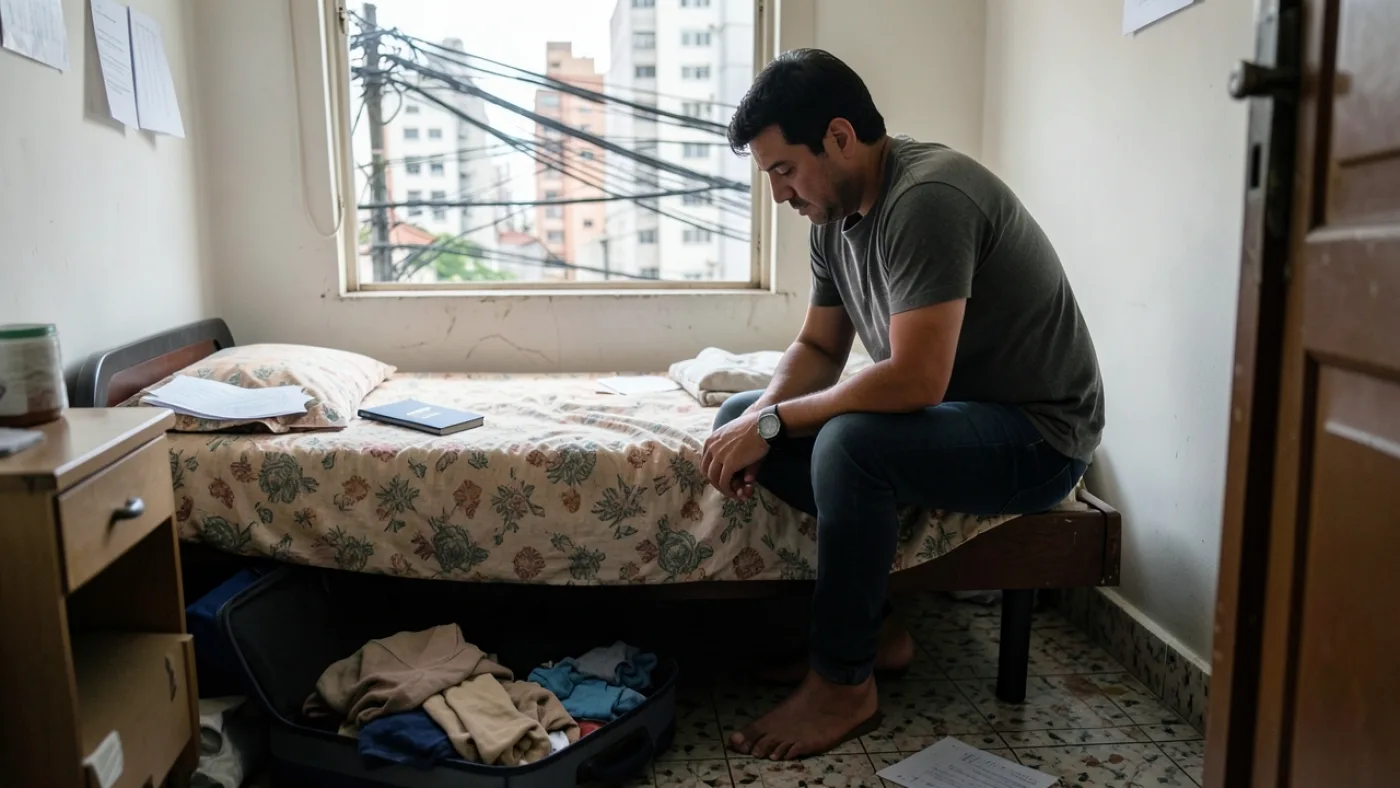
The most expensive mistake in Brazilian immigration law is not overstaying a visa. It is moving house after the Federal Police (Polícia Federal) hands you a deportation notification, and never telling them your new address. That single omission converts a case you were statutorily entitled to fix into a removal order you have to fight from outside the country, plus a re-entry ban that can follow you for years.
Here is what most foreigners in Brazil do not know: when the Federal Police formally notifies you that your migratory situation is irregular, Brazilian law does not start a countdown to your removal. It starts a countdown to your regularization. Under Article 50 of Law 13.445/2017 (the Brazilian Migration Law), you must receive personal written notice listing the irregularities and a minimum of 60 days to fix them, extendable by another 60 days. Up to 120 days, inside Brazil, without detention.
The window only works if you can be reached, if you answer, and if you file the right request with evidence. This guide shows you exactly how to use those days: what the exceptions are, who still qualifies for residence from inside the country, what the Federal Police will argue against you, and the documents, fees and portals you need in 2026.
Key point: Being in an irregular migratory situation in Brazil is an administrative infraction, not a crime. Article 123 of the Migration Law states that no one may be deprived of liberty for migratory reasons, which is why Brazil has no immigration detention system comparable to the United States.
On this page
When Does Brazil Remove a Foreigner Without Giving 60 Days?
The 60-day window is the rule, but there are exceptions where removal is fast or immediate. The main one is repatriation: a foreigner denied entry at an airport or land border can be sent back on the next available transport, without the 60-day regularization period, because the Migration Law treats border refusal separately from deportation of someone already inside the country.
Understanding the exceptions first matters, because they explain why timing decides your case. There are three situations where you do not get the comfortable 60 + 60 days:
- Repatriation at the border. You are stopped at immigration control at Guarulhos, Galeão or a land crossing and never formally admitted. The Federal Police may return you to your point of origin. The law still forbids repatriation where it would expose you to risk (the non-refoulement principle) and forbids collective removals.
- Expulsion after a criminal conviction. Expulsion is a different, heavier measure applied after a final criminal sentence for specific serious offences. It comes with a re-entry ban and follows its own procedure, not the deportation notification route.
- An expired window you never answered. If you were notified, did nothing for 60 days (or 120 with the extension) and did not keep your address updated with the Federal Police, deportation can be formalized. Your defence then shifts to appeals and, often, to court.
Watch out: Article 61 of the Migration Law prohibits collective repatriation, deportation and expulsion, and Article 62 forbids removal when there are reasonable grounds to believe your life or personal integrity would be at risk. If you fear returning to your country of origin, the correct move is usually an asylum application in Brazil, filed before, not after, a removal decision.
What Is the Rule, Then? How the 60 + 60 Day Regularization Window Works
Under Article 50, §1º of Law 13.445/2017, deportation may only proceed after you receive personal written notification specifying the irregularities and a period of at least 60 days to regularize, extendable for another 60 days by a reasoned decision, provided you keep your address updated with the Federal Police. Deportation is therefore the consequence of an unused window, not of the irregularity itself.
Read the full text of the Migration Law on the Brazilian government’s official site, Law 13.445/2017 at Planalto. Three other guarantees in the same statute change the balance of power in your favour:
- Free movement is preserved. Article 50, §2º makes clear that the deportation notification does not restrict your movement inside Brazil. You must declare your domicile and activities, not stay put or report to a facility.
- Full defence and a suspensive appeal. Article 51 guarantees adversarial process and full defence, with an appeal that has suspensive effect. In plain terms: filing the appeal freezes the removal while it is decided.
- The Federal Public Defender must be notified. Article 51, §1º requires notification of the Defensoria Pública da União (DPU, Federal Public Defender’s Office) in every administrative deportation proceeding. Failure to notify the DPU is treated as an absolute nullity, one of the most frequently successful defence arguments in these cases.
How it works: Day 1 you receive the notification with a protocol number. Days 1-15 you gather documents and identify which residence category fits you. Days 15-45 you file the residence request on the Federal Police system and pay the GRU (federal payment slip). Days 45-60 you file, if needed, a written request for the additional 60 days, attaching proof that documents are pending from abroad. That is the timeline that wins cases.
In practice: A Portuguese consultant living in São Paulo since 2022 on a series of tourist entries received a notification in March 2026. Because he had a Brazilian partner and a stable address, his lawyer filed a family reunion residence request within 22 days and attached the protocol to the administrative file. The deportation procedure was archived. Had he waited until day 70, the same evidence would have needed an appeal to be considered.
Repatriation, Deportation or Expulsion: Which One Applies to You?
Brazil has three distinct removal measures, and confusing them is a common and costly error. Repatriation applies at the border, deportation applies to irregular status inside the country (with the 60 + 60 day window under Article 50), and expulsion follows a criminal conviction and carries a re-entry ban set in the removal decision. Only expulsion is punitive.
| Measure | When it applies | Regularization window | Re-entry ban |
|---|---|---|---|
| Repatriation | Entry denied at airport or land border, before formal admission | None (return on next available transport) | No automatic ban, but entry conditions must be met on any new attempt |
| Deportation | Irregular status while already inside Brazil (overstay, visa condition breached, no registration) | Minimum 60 days, extendable to 120 days (Art. 50, §1º) | Possible barrier to re-entry until pending fines and irregularities are settled |
| Expulsion | Final criminal conviction for offences listed in the Migration Law | Not a regularization procedure; defence is judicial and administrative | Yes, with a fixed period set in the decision |
Article 55 of the Migration Law also blocks expulsion in specific family and long-residence situations, including having a Brazilian child under your guardianship or economic dependence, a spouse or partner residing in Brazil, or having arrived in Brazil as a young child and lived here since. These protections are frequently decisive and must be proven with documents, not simply stated. For a deeper look at the appeal mechanics, see our guide on deportation in Brazil and 60-day appeal rights.
Who Can Still Regularize From Inside Brazil in 2026?
More people than expect it. The Migration Law allows residence authorization to be requested from inside Brazil in several categories, and the Federal Police accepts applications from foreigners already in irregular status. Filing typically costs a fee in the range of R$ 168 to R$ 204 (roughly US$ 31-38), and the protocol itself is what suspends the deportation logic.
The most common routes for someone racing a deadline:
- Family reunion. Brazilian spouse or stable union partner (união estável registered at a cartório, the Brazilian notary office with legal registration powers), Brazilian child, Brazilian parent, or a family member who already holds residence.
- Mercosur residence. Nationals of Argentina, Uruguay, Paraguay, Bolivia, Chile, Peru, Colombia, Ecuador, Guyana and Suriname can generally apply under the Mercosur Residence Agreement with a clean criminal record and identity documents. This is often the fastest path.
- Work with a formal employment contract or a professional activity backed by a CNPJ (company tax ID) and proof of income.
- Study at a recognized Brazilian institution, with enrolment proof.
- Humanitarian reception for nationals of countries facing grave instability, armed conflict, disaster or serious human rights violations. See our breakdown of the humanitarian visa in Brazil and who qualifies.
- Asylum or refugee status, filed with CONARE through the Federal Police, which grants a provisional document while the claim is pending.
- Investment or retirement categories, where you can prove capital brought into Brazil or a stable foreign pension.
Quick recap: If any Brazilian family tie, Mercosur nationality, formal job, enrolment or protection ground exists in your file, you almost certainly have a residence route. The question is not whether you qualify, it is whether you file inside the window with proof.
What Will the Federal Police Argue Against You, and What Answers It?
The strongest argument the authority can make is this: you entered as a visitor, you knew your stay was limited to 90 days (extendable to 180 days per year at the discretion of the Federal Police), you worked or settled in breach of that purpose, you were personally notified, and you let the statutory period lapse. On that record, deportation is the lawful outcome, not a punishment.
That argument is serious and it wins cases. It is not a strawman: administrative authorities are entitled to enforce the conditions of a visitor stay, and the Migration Law itself provides fines for breach, from R$ 100 to R$ 10,000 per infraction, with overstay calculated per day of excess up to the R$ 10,000 ceiling. Our detailed breakdown of the R$ 10,238 overstay fine and how to regularize explains that arithmetic.
Here is what answers it, point by point:
- The fine is not the same as removal. Paying or committing to pay the administrative fine settles the infraction. The Migration Law does not make removal automatic once the debt is regularized and a residence request is pending.
- Notification defects are fatal to the file. Article 50, §1º requires personal written notification specifying the irregularities. A notification that is generic, delivered to a third party, or silent about the 60-day period is vulnerable.
- DPU absence is an absolute nullity. If the Federal Public Defender was never notified as Article 51, §1º demands, the proceeding can be annulled regardless of the merits. Contact details are available at the Defensoria Pública da União.
- The appeal suspends removal. Because Article 51 grants suspensive effect, a timely appeal keeps you in the country while the decision is pending.
- Established life carries weight in 2026. The Migration Law is built on principles of human rights, family reunification and non-criminalization of migration. Where a foreigner shows years of integration, Brazilian children, formal income and tax compliance, administrative and judicial decisions have increasingly leaned toward regularization instead of removal.
Pro tip: Build the “established life” file before you need it: rental contracts, utility bills, CPF (Brazilian tax number), bank statements, school enrolment for children, medical records, employment or CNPJ documents, and photographs with dates. Bare assertions lose. Documented years win.
How Do You Regularize Step by Step in 2026?
Residence requests are filed digitally through the Federal Police migration system, reached from the Polícia Federal portal on gov.br, followed by an in-person biometrics appointment. Expect roughly 30-90 days for the protocol to be analysed, and longer in São Paulo and Rio de Janeiro, where appointment queues are heaviest.
The sequence that works:
- Read the notification and diarize the deadline. Note the exact date of receipt. Day 60 and day 120 go in your calendar immediately.
- Update your address with the Federal Police, in writing. This is the condition attached to the extension in Article 50, §1º. Keep the receipt.
- Choose your residence category. Family reunion, Mercosur, work, study, humanitarian or protection. Choosing wrong wastes weeks and a fee.
- Obtain a CPF from the Receita Federal (Brazilian IRS) if you do not have one. It is free for foreigners and required for almost every following step. Check the Receita Federal portal.
- Legalize your foreign documents. Birth or marriage certificates need an apostille (if your country is a Hague Convention member) or consular legalization, plus a sworn translation (tradução juramentada) by a translator registered with a Brazilian Junta Comercial.
- File the residence request online with all attachments, and generate and pay the GRU fee. Save the PDF protocol, the payment receipt and screenshots.
- Attach the protocol to the deportation file and, where applicable, request archiving of the procedure. This is the step foreigners handling it alone almost always skip.
- Attend the biometrics appointment and collect your CRNM (Carteira de Registro Nacional Migratório, the National Immigration Registration Card).
- If the deadline approaches with documents pending, request the 60-day extension in writing, attaching evidence of what is pending abroad.
Watch out: The digital systems are glitchy. Uploads fail silently, appointment slots vanish, and protocol emails land in spam. Download and store every confirmation the same day you generate it. In an administrative dispute, a protocol number is worth more than any explanation.
Which Documents Do You Need?
Every residence request needs an identity core plus category-specific proof. The base set is a valid passport, birth certificate (apostilled and translated), proof of address in Brazil, a CPF, criminal record certificates, and the paid GRU. Missing translations are the single most common reason a protocol is returned for correction.
Base documents (everyone)
- Passport or travel document, all used pages
- Birth certificate, apostilled or consularized, with sworn translation
- Proof of residence in Brazil (utility bill, rental contract, or a declaration with a witness signature)
- CPF (Brazilian tax number)
- Criminal record certificates from Brazil and from your country of residence in the last years
- Declaration that you have no criminal convictions anywhere, signed under penalty of law
- Proof of payment of the GRU fee
Additional, by situation
- Brazilian spouse or partner: marriage certificate or união estável deed issued by a cartório, plus the Brazilian partner’s RG (identity card) and CPF
- Brazilian child: child’s birth certificate and proof of guardianship, cohabitation or economic dependence
- Work: signed employment contract or CTPS (work card) entry, or company documents with CNPJ and income proof if self-employed
- Study: enrolment certificate from the institution
- Mercosur: nationality proof and certificates from countries where you lived in the previous years
- Established life evidence: bank statements, tax returns, school records, medical records, CNH (Brazilian driving licence) if you hold one
What Does Regularization Cost in Brazil in 2026?
Government fees are modest. The CRNM issuance fee is R$ 204.77 in 2026 (about US$ 38 or €35 at roughly R$ 5.40 to the dollar), per the Federal Police fee table, and residence authorization requests generally cost around R$ 168 (about US$ 31). Always confirm the live figure on the Federal Police site before paying, since these values are periodically adjusted.
| Item | Typical 2026 cost (BRL) | Approx. USD / EUR |
|---|---|---|
| Residence authorization request (GRU) | R$ 168 | US$ 31 / €29 |
| CRNM issuance | R$ 204.77 | US$ 38 / €35 |
| Overstay fine (per day of excess) | R$ 100 per day, capped at R$ 10,000 | US$ 18.50 per day, cap US$ 1,850 |
| Sworn translation (per page) | R$ 80 – R$ 150 | US$ 15 – 28 |
| Apostille abroad or consular legalization | Varies by country | Varies |
| Cartório recognition of signature / copies | R$ 7 – R$ 60 per act | US$ 1.30 – 11 |
| CPF for foreigners | Free | Free |
In practice: A Colombian national who overstayed 100 days and files a Mercosur residence request would face roughly R$ 10,000 in fine exposure if the daily calculation ran to the ceiling in a worst-case scenario, plus about R$ 373 in GRU fees and R$ 300 in translations. The fine is the variable that grows every day you delay. The fees do not.
Fines can be challenged or reduced, and payment can often be split into instalments. Note also that the Defensoria Pública da União provides free legal assistance to migrants who cannot afford a private lawyer, and that only professionals registered with the OAB (Brazilian Bar Association) may represent you. A despachante (document agent) cannot sign a defence or an appeal.
What Changed for Immigration Regularization in 2026?
The Migration Law of 2017 remains fully in force, with no repeal of the 60 + 60 day window. What changed in 2026 is procedural: more of the process now runs through gov.br and the Federal Police digital systems, the CRNM fee sits at R$ 204.77, and enforcement attention has shifted toward long, repeated visitor stays used as de facto residence.
Three practical shifts worth planning around:
- Digitalization, with friction. Fewer counters, more uploads. Good news for people outside big cities, bad news when the system fails and you have no paper trail. Keep every digital receipt.
- Serial tourist entries under scrutiny. Living in Brazil on back-to-back visitor stamps is increasingly treated as a breach of the visa’s purpose rather than a grey area. If that describes you, proactive regularization is the cheaper choice.
- Established life gains traction. Administrative and judicial decisions continue to give weight to genuine, documented integration, in line with the Migration Law’s principles. Case law on migration rights is searchable at the Superior Tribunal de Justiça.
Remember that Brazil is a Civil Law country. Your rights come primarily from the statute’s text, not from precedent, which is exactly why quoting Article 50 and Article 51 of the Migration Law in your filings is so effective.
Frequently Asked Questions About Regularizing Immigration Status in Brazil
Can I be arrested or detained in Brazil for being undocumented?
No. Article 123 of Law 13.445/2017 expressly prohibits depriving anyone of liberty for migratory reasons. Irregular status is an administrative infraction, not a crime, and Brazil does not operate immigration detention centres. You may be fined and formally notified to regularize, and you keep the right to move freely inside the country under Article 50, §2º, provided you declare your domicile and activities to the Federal Police.
Can I apply for residence if I am already in irregular status?
Yes. The Migration Law allows residence authorization requests to be filed from inside Brazil, and being irregular does not by itself bar the application. The Federal Police may apply the overstay fine (R$ 100 per day, capped at R$ 10,000 under the Migration Law’s penalty framework) in parallel. The critical point is sequencing: file the residence request and attach the protocol to any deportation file before the 60-day period expires.
Does filing an appeal stop my deportation?
Yes, if filed on time. Article 51 of the Migration Law guarantees adversarial process, full defence and an appeal with suspensive effect, meaning removal is frozen while the appeal is pending. The same article requires notification of the Defensoria Pública da União in every administrative deportation proceeding, and courts have treated the absence of that notification as an absolute nullity, which can void the entire procedure.
How long does the CRNM take to be issued in 2026?
Plan for 60-180 days from the biometrics appointment to physical card delivery, depending on the Federal Police unit. Your protocol and the provisional document (DPRNM) prove your regular status in the meantime and allow you to work, open bank accounts and sign contracts. The CRNM fee is R$ 204.77 in 2026, roughly US$ 38, and should be confirmed on the Federal Police site before payment.
Will an overstay stop me from returning to Brazil later?
An unpaid fine or an unresolved deportation record can create problems at the border on a future entry, because the Federal Police can see pending infractions in the system. Deportation itself is not designed as a punitive ban, unlike expulsion, which carries a fixed re-entry prohibition. Settling the fine and closing the administrative file before leaving Brazil is the cleanest way to protect future travel.
Do I need a lawyer, or can a despachante handle it?
A despachante can queue and file forms, but cannot sign a defence, an appeal or a court petition. Only lawyers registered with the OAB (Brazilian Bar Association) may do that. If cost is the obstacle, the Defensoria Pública da União assists migrants free of charge. For contested deportation files, notification defects or complex family evidence, legal representation is what converts documents into a decision.
Regularize Your Immigration Status in Brazil: Take the Next Step
If you are holding a notification from the Federal Police, or you have simply lost track of how long you have been in Brazil on a visitor stamp, you are not out of options. The Migration Law was built to give you a path back to regularity, and it gives you time to use it. What it does not forgive is silence.
Your concrete next step: find the date you were notified (or the date your last legal stay ended), gather your passport, CPF and proof of address, and send us those three items with the date. Our bilingual team will tell you which residence category fits, how many days you have left, and what we can file this week.
Talk to a specialist lawyer now
Talk to a Lawyer on WhatsApp