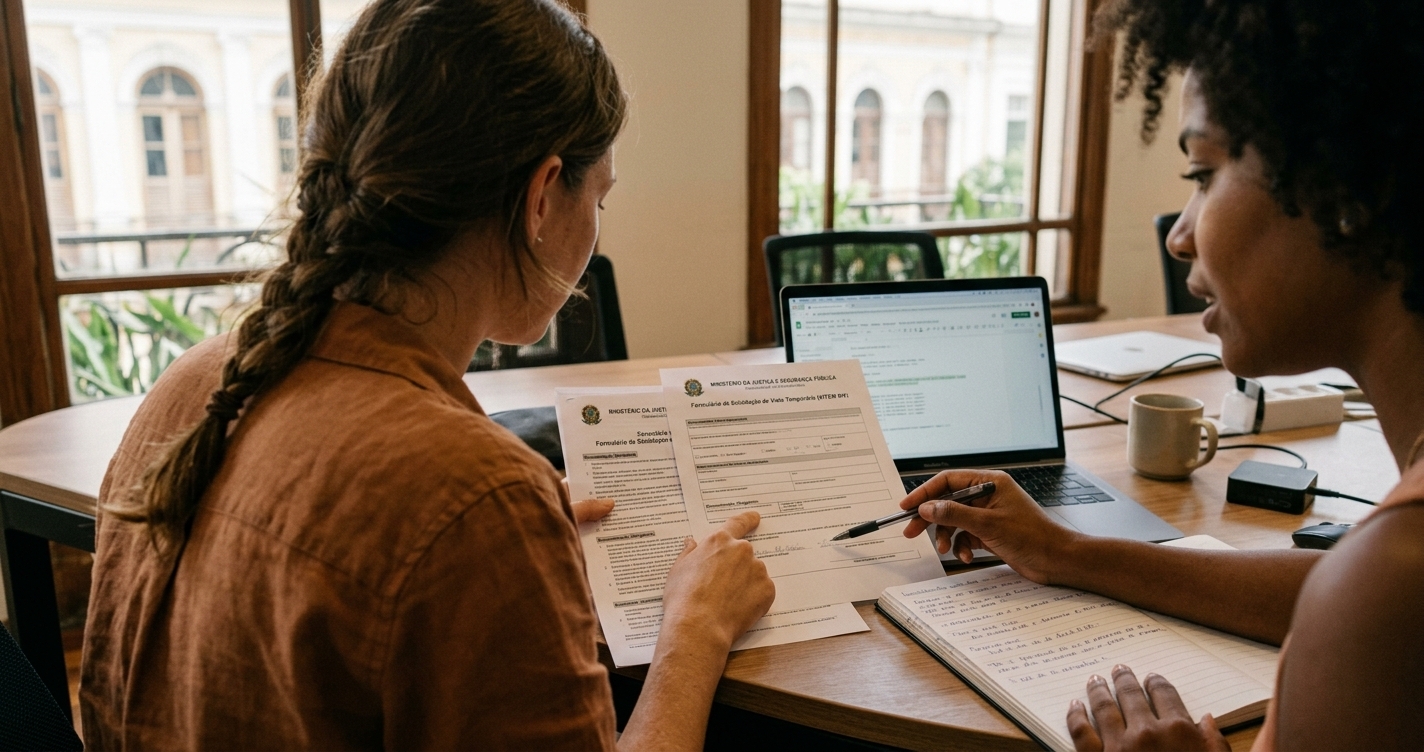
Yes, you almost certainly qualify for Brazil’s digital nomad visa: the income floor is just US$ 1,500 per month. But the income test is almost never why applications get refused.
Refusals and endless “pending” files at the Federal Police happen for a different reason: the paperwork fails to prove that your money comes from outside Brazil, or that your documents were legalised the way Brazilian law demands. A perfectly solvent freelancer earning US$ 6,000 a month can be denied, while a junior remote employee on US$ 1,600 sails through.
This guide is written backwards on purpose. Instead of starting with the rule and hoping you spot the traps, we start with the traps: the exact points where remote-worker applications collapse. Then we give you the rule, the two application routes (consulate abroad versus Federal Police inside Brazil), the real 2026 costs in reais and dollars, the document list with the legalisation requirements most blogs skip, and realistic timelines that account for Brazilian bureaucracy.
By the end you will know whether to board a plane as a tourist and apply here, or do everything from your home country before you fly.
On this page
Where Do Digital Nomad Visa Applications Actually Get Denied?
Most refusals are documentary, not financial. In practice, applications fail on four points: income that cannot be traced to a foreign payer, foreign documents without apostille or sworn translation, missing or non-compliant health insurance, and expired deadlines (the 90-day registration window set by Decreto 9.199/2017, or an overstayed tourist entry).
Let us take them one by one, because this is where your preparation time should go.
1. Income that cannot be traced to a foreign source
Resolução Normativa CNIg nº 45/2021, the rule that created the category, defines a digital nomad as an immigrant who performs professional activity remotely, using information technology, for a foreign employer or foreign clients. The income must originate abroad.
Freelancers get caught here constantly. A Wise or Payoneer statement showing deposits with no named payer proves you have money, not where it came from. If three of your five biggest clients are Brazilian companies, an analyst can reasonably conclude you are in the Brazilian labour market, which this visa does not allow.
Warning: Invoicing a Brazilian client while holding a digital nomad residence can be treated as unauthorised work. It puts both your renewal and your current status at risk, and in serious cases triggers a notification to leave the country.
2. Documents without apostille or sworn translation
Brazil is a Civil Law country, and Brazilian authorities take documentary form seriously. Foreign public documents (criminal record certificates, in many cases employment letters notarised abroad) must carry an apostille under the Hague Apostille Convention, which Brazil has applied since 2016. Then they generally need a translation by a tradutor público juramentado (sworn public translator) registered in Brazil.
A translation done by a certified translator in London or Miami is usually rejected by the Federal Police. Only translators registered with a Brazilian Junta Comercial (commercial registry) count.
3. Health insurance that does not say the right thing
RN 45/2021 requires proof of health insurance valid in Brazil for the whole period of stay. Travel policies with a 90-day cap, or policies whose certificate does not expressly name Brazil and the coverage period, are the single most common “fix this and come back” request.
4. Timing mistakes
If you obtained the visa at a consulate, you must enter Brazil within the visa’s validity and then register with the Federal Police within 90 days of arrival, under Decreto 9.199/2017. Miss it and you face a daily fine. If you are applying from inside Brazil, you should file before your tourist stay ends, not after.
Important: Overstay fines under the Migration Law regulations run from roughly R$ 100 to R$ 1,000 per day of irregular stay, capped at R$ 10,000. Paying the fine does not automatically fix your status, you still need a valid residence application.
What Is Brazil’s Digital Nomad Visa and How Does It Work?
It is a temporary residence for remote workers created by Resolução Normativa CNIg nº 45/2021, under the framework of Lei 13.445/2017 (the Brazilian Migration Law). It is granted for one year and is renewable for one more, lets you live in Brazil legally while working for foreign employers or clients, and requires either US$ 1,500 in monthly income or US$ 18,000 in available funds.
Two things make Brazil unusually attractive compared with other nomad regimes. First, the financial threshold is one of the lowest in the Americas. Second, the Migration Law allows a residence authorization to be requested from inside Brazil regardless of your current migratory status, which means you can land as a tourist and convert without flying home. You can read the full statute on the Planalto government portal (Portuguese).
What it is not: a work permit for the Brazilian market, and not a tax shelter. The visa authorises residence; it says nothing about which tax authority can tax you. We return to that below, because it surprises people more than any other point.
Once approved, you are registered in the national migration system and issued a CRNM (Carteira de Registro Nacional Migratório, the National Migration Registration Card). With the CRNM and a CPF (Brazilian taxpayer number) you can open a bank account, sign a long-term lease, get a local phone plan and enrol children in school.
According to figures reported from Brazil’s federal migration registry, more than 3,800 remote workers had been registered under the nomad framework by early 2026. That is small compared with Brazil’s total immigration numbers, which means many Federal Police units still see these cases rarely. Expect to educate the counter clerk about the category.
Who Qualifies as a Digital Nomad Under the Brazilian Rules?
You qualify if you work remotely for employers or clients based outside Brazil and meet one of two financial tests: monthly income of at least US$ 1,500, or available bank funds of at least US$ 18,000. RN 45/2021 uses “or”, not “and”. You do not need to satisfy both.
- You are a foreign national (any nationality) with a valid passport.
- Your professional activity can be performed remotely using information and communication technologies.
- Your employer or clients are located outside Brazil.
- You prove either US$ 1,500 per month in income or US$ 18,000 in available funds.
- You hold health insurance valid in Brazil for the entire stay.
- You have a clean criminal record certificate from your country of residence for the past 12 months (apostilled).
- You sign the declaration that you will not perform work for a Brazilian employer.
Practical example: Marco, an Italian UX designer employed by a Berlin agency on EUR 2,900 per month, qualifies on income. Sarah, an American writer between contracts with US$ 24,000 sitting in a Chase savings account, qualifies on funds even though her monthly income last quarter was US$ 900. Both are approvable, but Sarah’s file must show the balance is available (not locked in retirement accounts).
Dependants matter too. Spouses and minor children can be included as family reunion applicants based on your residence, with their own documents and fees. Plan for extra translations and extra CRNM fees per person.
Why Does the Federal Police Sometimes Say You Are “Working in Brazil”?
Here is the authority’s strongest argument, stated honestly: you are physically in Brazil, using Brazilian infrastructure, generating economic value every working day from Brazilian soil. Under that reading, the place where you sit, not the place where your payer is incorporated, defines where the work happens. That reading is not absurd. It is how most tax systems treat labour.
A sceptical analyst can push it further. If you have a Brazilian CPF, a Brazilian bank account receiving regular transfers, a long-term lease and a laptop in São Paulo, what distinguishes you from a resident worker who happens to be paid offshore? If the answer is only “my invoices are in dollars”, the file looks thin.
The answer is in the text of the rule itself. RN 45/2021 does not ask where the keystrokes happen. It asks who the employer or contracting party is and where the remuneration originates. The whole point of the category was to allow work performed in Brazil for foreign payers, something the old regime had no slot for. That is why the declaration you sign is specifically about not working for a Brazilian employer, and not about not working while in Brazil.
Where the authority is right, and where nomads get burned, is on tax. Immigration status and tax residency are separate questions. Under Receita Federal (Brazilian IRS) rules, a foreigner holding a temporary visa generally becomes a Brazilian tax resident after completing 184 days of presence, consecutive or not, within a 12-month period. From that point your worldwide income can be taxable in Brazil at progressive rates up to 27.5%. You can check the official guidance on the Receita Federal portal.
Important: A digital nomad visa does not make you tax-free in Brazil. If you stay beyond 183 days, get a tax opinion on your specific situation and on any double taxation treaty between Brazil and your country before your first Brazilian filing season.
Should You Apply at a Consulate Abroad or Inside Brazil?
Both routes are valid under RN 45/2021. The consulate route gives you a temporary visa stamped before you fly and a cleaner entry record; the domestic route (residence authorization filed with the Federal Police) saves you a trip home and typically costs less in consular fees. The deciding factors are usually your consulate’s backlog and whether you are already in Brazil.
| Factor | Consulate abroad (temporary visa) | Inside Brazil (residence authorization) |
|---|---|---|
| Where you file | Brazilian consulate with jurisdiction over your residence, via the e-consular system | Federal Police, through the Migrante portal on gov.br, plus an in-person appointment |
| Typical decision time | 2-8 weeks, varies heavily by post | 30-90 days for the authorization decision |
| Main fee | Consular visa fee, commonly around US$ 100 depending on nationality and reciprocity | Analysis fee of roughly R$ 168 plus CRNM issuance of R$ 204.77 |
| Document legalisation | Apostille required; consulate may accept translations done abroad | Apostille plus sworn translation by a Brazil-registered translator |
| Risk if refused | You stay abroad, re-file later | You may be left with an expiring tourist stay |
| Best for | Nomads who have not travelled yet and want certainty before flying | Nomads already in Brazil who tested the country on a tourist entry |
One nuance that catches people: if you apply at a consulate, your work is not finished when the visa is issued. You still must register with the Federal Police in Brazil within 90 days of arrival to get your CRNM. Many applicants treat the stamp as the finish line and then discover they are unregistered six months later.
Tip: Before choosing, check the appointment calendar of both your nearest consulate (through the Itamaraty consular portal) and the Federal Police unit in the Brazilian city where you plan to live. Availability, not law, is what usually decides the faster route.
How Do You Apply Step by Step in 2026?
The domestic route runs through the Federal Police’s Migrante system on gov.br and takes 30-90 days for a decision, plus 60-120 days for the physical CRNM card. Below is the sequence we use with clients, including the preparation phase that happens before you touch any portal.
- Build the income evidence first (2-4 weeks). Collect an employment contract or client contracts, an employer letter confirming remote work and salary, and 3-6 months of bank statements where the payer’s name is visible. Where the payer is a platform, add the platform’s earnings report.
- Request your criminal record certificate (1-3 weeks). From your country of nationality or residence, then have it apostilled by the competent authority there.
- Buy compliant health insurance. The certificate must state coverage in Brazil and the exact validity period.
- Order sworn translations in Brazil (3-7 days). Use a tradutor público juramentado registered with a Brazilian commercial registry.
- Get your CPF. You can request it through Receita Federal, or at a Brazilian consulate before travelling. It makes everything downstream easier.
- File the application. Consulate route: submit through the e-consular system of the Ministry of Foreign Affairs. Domestic route: create the request on the Federal Police Migrante platform, upload PDFs, generate and pay the GRU payment slips.
- Attend the biometrics appointment. In Brazil this is at a Federal Police immigration counter. Bring originals of everything you uploaded.
- Receive the protocol. The protocolo de residência is a valid interim document. It lets you stay legally, open accounts and leave and re-enter Brazil while the file is analysed.
- Collect your CRNM. You will be notified when the card is printed. The validity matches your residence period.
- Diary the renewal. File for the second year before the first expires, with fresh income and insurance proof.
Tip: Save every protocol number, GRU receipt and uploaded PDF in one folder, and keep it for at least five years. If a renewal or a later permanent residence application is questioned, the original evidence is what resolves it.
Which Documents Do You Need, and How Must They Be Prepared?
RN 45/2021 sets a short core list, but form matters more than quantity. Expect six document families: passport, criminal record (apostilled), proof of remote work for a foreign payer, proof of income or funds, health insurance valid in Brazil, and proof of address in Brazil for the domestic route.
Everyone
- Valid passport, full copy of all used pages
- Recent passport-size photo (3×4 for Brazilian standards)
- Criminal record certificate from your country of residence, apostilled and sworn-translated
- Signed declaration of absence of criminal record in other countries where you lived
- Health insurance certificate covering Brazil for the full residence period
- Declaration that you will work remotely for a foreign employer or clients
If you are an employee
- Employment contract or employer letter stating remote work, position and gross monthly pay
- Last 3-6 payslips
- Bank statements matching the payslips
If you are a freelancer or company owner
- Service contracts with foreign clients (named parties, values, duration)
- Invoices issued in the last 6 months
- Bank or payment-platform statements showing identifiable foreign payers
- If you own a foreign company: incorporation documents plus proof of distributions to you
If you are relying on savings instead of income
- Bank letter or statement showing at least US$ 18,000 available (not blocked or pledged)
- Ideally 3 months of history showing the balance is stable, not a one-day deposit
Warning: Do not submit statements with the payer’s name redacted for privacy. Redacted statements are the fastest route to an exigência (formal demand for more documents), which restarts your waiting clock.
What Does the Brazil Digital Nomad Visa Really Cost in 2026?
Budget R$ 2,000 to R$ 4,500 (roughly US$ 370 to US$ 830) for a single applicant going the domestic route without legal representation, with the CRNM card alone costing R$ 204.77 according to the Federal Police fee schedule under Decreto 9.199/2017. Translations and insurance, not government fees, are the biggest variables.
| Item | Amount in R$ | Approx. USD |
|---|---|---|
| Residence authorization analysis fee (Federal Police) | R$ 168.13 | US$ 31 |
| CRNM card issuance | R$ 204.77 | US$ 38 |
| Sworn translation (per page, market range) | R$ 80 – R$ 160 | US$ 15 – US$ 30 |
| Criminal record certificate + apostille (home country) | varies | US$ 30 – US$ 150 |
| Health insurance valid in Brazil (12 months) | R$ 1,200 – R$ 4,000 | US$ 220 – US$ 740 |
| Consular visa fee (if applying abroad) | n/a | around US$ 100, varies by nationality |
| Legal representation (optional) | market-dependent | market-dependent |
Practical example: A single Canadian developer applying in Florianópolis in 2026 paid R$ 168.13 in analysis fee, R$ 204.77 for the CRNM, R$ 480 for six translated pages, CAD 65 for her RCMP certificate and apostille, and R$ 1,850 for a 12-month international policy covering Brazil. Total government and document cost: about R$ 2,700, roughly US$ 500.
Compare that with the capital-based routes. The investor path requires R$ 500,000 in a Brazilian company (or R$ 150,000 for qualifying innovation projects) under Portaria Interministerial nº 11/2018, as we explain in our guide to the Brazil investor visa and its R$ 500,000 residency rules. The rentista (passive income) route under Portaria nº 12/2018 requires proving US$ 2,000 per month transferred into Brazil. For remote workers, the nomad route is dramatically cheaper. If you are weighing capital routes against each other, see our comparison of the investor visa versus real estate residency.
What Changed for Remote Workers Heading Into 2026?
The legal core did not change: RN 45/2021 remains the governing rule, with the US$ 1,500 monthly income or US$ 18,000 funds test intact. What changed is operational. Filing and document upload are now almost entirely digital through gov.br, and several consulates moved visa requests to the e-consular platform, which shifts the bottleneck from paperwork to appointment slots.
Three practical shifts are worth knowing.
- Stricter scrutiny of the foreign-source requirement. As volumes grew, analysts started reading contracts rather than just totting up balances. Files with Brazilian-sourced revenue now draw questions that would have passed unnoticed in 2022.
- Tax residency awareness. With Brazil tightening reporting on foreign assets and income, long-staying nomads are increasingly contacted about Brazilian tax filings after crossing 184 days.
- Renewal and conversion planning. Because the nomad residence maxes out at two years, applicants now think earlier about what comes next: family-based residence, the investor route, or residência based on other grounds. Our overview of the broader residency visa landscape in Brazil in 2026 maps the alternatives.
Important: There is no automatic conversion from digital nomad residence to permanent residence after two years. Time spent as a nomad can count toward naturalisation requirements, but you must independently qualify for a new residence ground before your second year expires.
Frequently Asked Questions About the Brazil Digital Nomad Visa
These are the questions foreigners search most often, answered directly. Each answer reflects RN 45/2021, Lei 13.445/2017 and current Federal Police practice as of 2026.
Can I apply for the digital nomad visa while already in Brazil on a tourist stamp?
Yes. The Brazilian Migration Law allows a residence authorization to be requested from inside the country regardless of your migratory status, and RN 45/2021 expressly offers the domestic route. File through the Federal Police Migrante system before your authorised tourist stay expires. Once you have the protocol number, your stay is regular while the file is analysed, even if the original tourist period ends. Applying after you have already overstayed is possible but adds fines and discretion you do not want.
How long does the CRNM card take to arrive?
Realistically 60 to 120 days after approval, though some units deliver in under 45 days and others take longer. In the meantime your protocolo plus passport is the document you use for banks, landlords and re-entry. Keep a digital copy on your phone and a printed copy in your travel documents. If the card is later lost or stolen, replacement costs the same R$ 204.77 issuance fee, as explained in our guide to replacing a lost CRNM card in Brazil.
Will I pay Brazilian tax on my foreign salary?
Possibly. Under Receita Federal rules, a temporary visa holder generally becomes a Brazilian tax resident after 184 days of presence within a 12-month period, and tax residents are taxed on worldwide income at rates up to 27.5%. Double taxation treaties and foreign tax credits can reduce or eliminate the bill depending on your country, but they do not remove the filing obligation. Get a tax opinion before your first April filing deadline, not after.
Can I bring my spouse and children?
Yes. Family members can obtain residence based on family reunion linked to your nomad residence. You will need apostilled and sworn-translated marriage and birth certificates, plus separate fees and CRNM cards for each dependant. Budget around R$ 370 in federal fees per person plus translation costs. Dependants’ residence is tied to yours, so if your residence lapses, theirs is affected too. File their applications at the same time as yours whenever possible.
What happens if my application is refused?
Most negative outcomes are not outright refusals but an exigência, a formal demand to supply or correct documents within a set deadline. Comply within the deadline and the file continues. A genuine refusal can be challenged administratively, and in some cases judicially, since administrative decisions must be reasoned under Brazilian law. If you receive a notification to leave the country, act immediately; our guide on deportation appeals and the 60-day defence window explains the deadlines.
Do I need a Brazilian lawyer to apply?
Legally, no. The application can be filed by the applicant. Practically, the value of a lawyer registered with the OAB (Brazilian Bar Association) lies in the two places files fail: structuring income evidence so the foreign source is undeniable, and handling exigências and Federal Police communications in Portuguese within deadline. If your income comes from multiple countries, platforms or your own offshore company, representation usually pays for itself in avoided delays.
Get Your Brazil Digital Nomad Visa Reviewed Before You File
Brazilian bureaucracy is slow, but it is also predictable. The applications that succeed are the ones where the income evidence names a foreign payer, the certificates carry an apostille, the translations come from a Brazil-registered sworn translator, and the file is submitted before a deadline rather than after one. Our bilingual immigration team handles these files daily for remote workers in São Paulo, Rio, Florianópolis and the Northeast.
Your concrete next step: gather your last six months of bank statements plus your work contract, and send them to us for a document review. We will tell you within a few business days whether your file passes the foreign-source test, which route (consulate or Federal Police) is faster for your city, and exactly what is missing.
Message us on WhatsApp with your nationality, current location and income source to start the review.
Talk to a specialist lawyer now
Talk to a Lawyer on WhatsApp