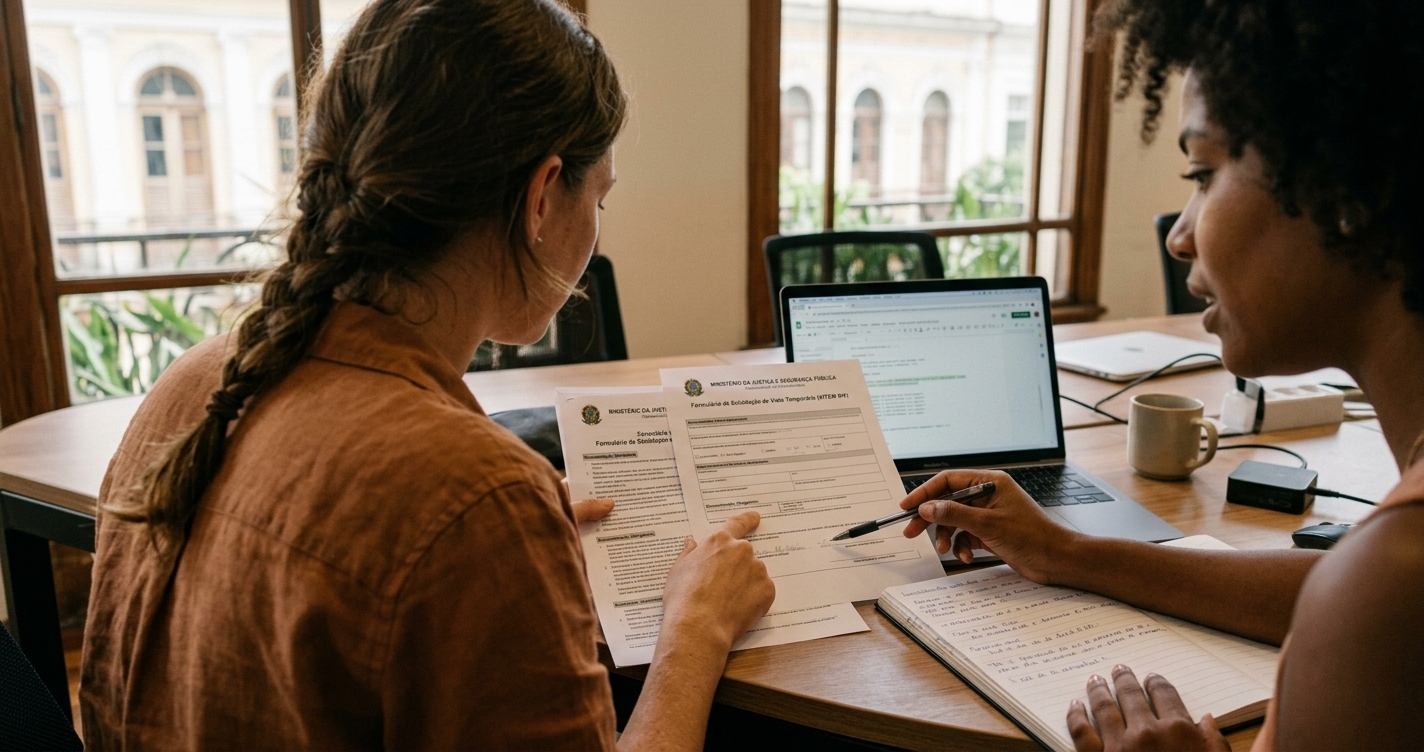
Yes, you can move to Brazil and keep your foreign job. But the visa that lets you do it comes with a catch most people miss: it will not, on its own, lead to permanent residency or citizenship, and it can quietly create a double-tax problem if you ignore your fiscal residence.
You are a remote worker. Maybe a software developer paid in dollars, a freelance designer with clients in Europe, or an employee of a company that has no idea where Brazil is on a map. You found a country with cheap rent, warm beaches, and a real digital nomad visa. Now you are staring at government pages in Portuguese wondering which form applies to you, whether your income qualifies, and what happens after the first year.
This guide answers the questions the official pages skip. We start with the exception (who gets rejected and why), then give you the rule. We cover the exact income thresholds, the two application paths, the 90-day registration trap, and the tax question that immigration lawyers rarely mention. By the end you will know whether Brazil’s Digital Nomad Visa fits your life, and exactly what to do next.
On this page
Who Gets Denied the Brazil Digital Nomad Visa (and Why)?
The most common rejection is not for lack of money. It is for having the wrong kind of income. Under Resolução Normativa CNIg nº 45/2021, the visa requires that your work serves employers or clients located outside Brazil. If your main income comes from Brazilian companies or the Brazilian market, you do not qualify, no matter how much you earn.
This is the exception that trips people up, so let’s start there. Immigration authorities scrutinize the source of your money, not just the amount. A consultant billing São Paulo clients through a foreign invoice can be denied. A YouTuber whose audience and ad revenue are foreign, on the other hand, fits perfectly.
The second frequent denial: incomplete or improperly legalized documents. Brazil is a Civil Law country where paperwork carries enormous weight. A missing apostille or a translation not done by a sworn translator (tradutor juramentado) can freeze your file for weeks.
Warning: Do not assume freelance income “counts” just because it lands in your foreign bank account. The authority looks at where your clients and employer are based. If the answer is Brazil, this is the wrong visa for you.
Now the rule. The Brazil Digital Nomad Visa is a temporary residence authorization created for foreign nationals who work remotely for companies or clients abroad. It is grounded in the Migration Law (Lei 13.445/2017), which replaced the old Foreigner Statute and treats migration as a right rather than a security threat. If your income is foreign-sourced and properly documented, approval is the norm, not the exception.
What Are the Income Requirements for the Brazil Digital Nomad Visa?
You must prove one of two things: a minimum monthly income of roughly US$ 1,500, or available bank funds of at least US$ 18,000. You do not need both. This threshold comes from Resolução Normativa CNIg nº 45/2021, the rule that created the visa category.
The choice between the two matters. If you have stable monthly income (a salary or recurring contracts), the US$ 1,500 route is simpler. If your income is lumpy (project-based freelancing, seasonal work), the US$ 18,000 balance route can be safer, because you are proving reserves rather than consistency.
Acceptable proof includes bank statements, payslips, employment contracts, service agreements, or an official letter from your employer confirming remote work and pay. The stronger and more consistent your paper trail, the faster the review.
Example: A German UX designer earns €2,100/month (about US$ 2,250) invoicing clients in Berlin and Amsterdam. She submits six months of bank statements plus two signed client contracts. She qualifies under the income route with room to spare, no need to prove the US$ 18,000 balance.
Tip: Present statements covering the last three to six months, not a single lucky month. A one-off deposit near the deadline looks like manufactured evidence and invites questions.
Currency conversions fluctuate, so build a buffer. If the US$/BRL or US$/EUR rate moves against you on the review date, being slightly above the minimum protects your application. If you are comparing this pathway with higher-investment routes, our breakdown of the Brazil investor visa vs real estate residency shows how the thresholds differ dramatically.
How Much Does the Digital Nomad Visa Cost in 2026?
Budget roughly US$ 300 to US$ 600 in official fees, plus translation and apostille costs. The consular visa (VITEM XIV) ranges from about US$ 100 to US$ 290 depending on reciprocity with your country, and the CRNM registration fee is R$ 204.77 (about US$ 40), according to Brazil’s Federal Police fee schedule.
Here is a clear breakdown of what you will actually pay.
| Item | Cost (2026) | Approx. USD/EUR |
|---|---|---|
| VITEM XIV visa (consulate abroad) | Varies by reciprocity | ~US$ 100-290 |
| CRNM first registration (Federal Police) | R$ 204.77 | ~US$ 40 / €38 |
| CRNM renewal fee | R$ 204.77 | ~US$ 40 / €38 |
| CPF application in Brazil | Free (Receita Federal) | , |
| CPF at Correios/consulate abroad | R$ 7.00 | ~US$ 1.40 |
| Sworn translation (per page) | R$ 80-150 (market rate) | ~US$ 16-30 |
| Apostille (home country) | Varies by country | , |
The hidden cost is usually translation. Each foreign document (birth certificate, criminal background check, proof of income) may need a sworn translation, and pages add up. Budget generously here rather than being surprised.
Important: The CPF (Cadastro de Pessoas Físicas, the Brazilian taxpayer ID) is free when requested inside Brazil at a Receita Federal unit. You will need it for almost everything: renting an apartment, opening a bank account, signing a phone contract.
Which Documents Do You Actually Need?
You need a valid passport, proof of foreign-sourced income or the US$ 18,000 balance, a criminal background check from your home country, proof of health insurance valid in Brazil, and a completed visa application. All foreign documents must be apostilled and translated by a sworn translator, per Decreto 9.199/2017.
The standard document checklist:
- Passport valid for at least six months, with blank pages
- Proof of remote work: employment contract, service agreements, or an employer letter stating you work remotely for a company abroad
- Proof of income (US$ 1,500/month) or bank balance (US$ 18,000)
- Criminal background certificate from your country of residence, apostilled
- Health/travel insurance valid throughout Brazil
- Recent passport-style photo
- Completed visa application form (and consular fee receipt if applying abroad)
Once you are inside Brazil, two Brazilian documents become essential: the CPF (taxpayer ID) and the CRNM (Carteira de Registro Nacional Migratório, the National Migration Registration Card). The CRNM is your Brazilian ID as a resident foreigner and is issued after you register with the Federal Police.
Tip: Order your criminal background check and apostille early. In some countries these take three to four weeks, and an expired certificate (many are valid only 90 days) means starting over. Keep both a digital and a paper copy of every document.
Brazil’s cartório (notary office) system is central here. Sworn translations and certain document certifications go through registered notaries who carry legal registration powers, not just signature witnessing. Factor that step into your timeline.
How Do You Apply: From Abroad or Inside Brazil?
There are two paths. You can apply for the VITEM XIV visa at a Brazilian consulate before traveling, or you can enter Brazil (for example as a tourist) and request the residence authorization from inside the country. Both are valid under Resolução Normativa CNIg nº 45/2021; the right choice depends on your timing and current location.
Path A: Apply from abroad (VITEM XIV)
- Gather and apostille all documents in your home country.
- Book an appointment at the nearest Brazilian consulate or embassy via the e-Consular platform.
- Submit your application, pay the consular fee, and receive the VITEM XIV visa in your passport.
- Travel to Brazil.
- Register with the Federal Police within 90 days of arrival to obtain your CRNM.
Path B: Apply inside Brazil
- Enter Brazil under a permitted status (many nationalities enter visa-free as tourists).
- Prepare your documents, including sworn translations done in Brazil.
- File the residence authorization request with the Federal Police through the Federal Police migration portal.
- Attend your in-person appointment for biometrics.
- Receive your CRNM once approved.
Path B suits people already in Brazil who fell in love with the place. Path A suits those planning ahead who want the visa stamped before they board the plane. Either way, the 90-day Federal Police registration deadline is non-negotiable. For the mechanics of that step, our guide on CRNM registration at the Federal Police walks through it screen by screen.
Important: Whichever path you choose, you must register with the Federal Police and obtain your CRNM within 90 days of your first entry. Miss this window and you risk fines and complications when you try to renew.
How Long Does the Process Take, and How Long Does the Visa Last?
The initial digital nomad residence is granted for up to one year, renewable for one additional period with the Federal Police while you remain in Brazil. Processing time for the visa itself typically runs a few weeks to a couple of months, depending on document quality and the local immigration workload.
Realistic timeline expectations, with a buffer for Brazilian bureaucracy:
- Gathering and legalizing documents abroad: 3-6 weeks
- Consular visa processing (Path A): 2-8 weeks after submission
- Federal Police registration and CRNM issuance: the physical card can take weeks to a few months to arrive after your appointment
- Renewal: file before your first-year authorization expires
The maximum standard stay under this visa is therefore about two years (one year plus one renewal). This is where the caveat from our opening returns.
Warning: Unlike some European digital nomad visas, Brazil’s does not by itself lead to permanent residency or naturalization. It is a temporary authorization tied to your status as a remote worker for foreign clients. If you want a long-term future in Brazil, you will eventually need a different pathway.
Those pathways exist and are worth mapping early. Common routes include the investor visa, family reunification, or eventual Brazilian naturalization after years of legal residence. If a business is in your plans, compare the investor residency path and its costs before your nomad visa expires.
Will Brazil Tax Your Foreign Income? The Question Nobody Answers
Here is the strongest argument against becoming a Brazilian digital nomad resident: you could end up paying tax twice on the same income. Once you become a tax resident of Brazil (which can happen after a set period of physical presence), Receita Federal may tax your worldwide income, including the foreign earnings that qualified you for the visa in the first place.
That is the counter-argument in its strongest form, and it is real. So let’s answer it honestly.
Immigration status and tax residency are two different legal questions. Holding a digital nomad visa does not automatically make you a Brazilian tax resident, but spending enough days in Brazil generally does. When both your home country and Brazil claim you as a tax resident, the same income can, in certain scenarios, be taxed in full in both places with no offset.
The answer is planning, not avoidance. Brazil has double-taxation treaties and foreign-tax-credit mechanisms with several countries. Whether you benefit depends on your nationality, your home country’s rules on losing or keeping fiscal residence, and how you structure your affairs before you move. Just as a Brazilian moving abroad must formalize a fiscal exit with Receita Federal, a foreigner becoming resident in Brazil should check how their home country treats the change.
Tip: Sort out your tax position before you cross the 183-day mark, not after. Retroactive fixes are expensive; upfront planning is cheap. Speak to a lawyer who handles both immigration and international tax so the two strategies align.
If you plan to invoice through a Brazilian entity or open a company later, note that registering a CNPJ (business tax ID) requires a valid business address; Ribeiro Cavalcante can provide a compliant fiscal address in Brazil for that purpose.
What Changed for Digital Nomads in 2026?
The core framework remains Resolução Normativa CNIg nº 45/2021, built on the Migration Law (Lei 13.445/2017). No sweeping legislative overhaul replaced it for 2026, but administrative practice has tightened around document quality and proof of foreign-source income, and consulates increasingly use the digital e-Consular platform.

The practical shifts remote workers should note in 2026:
- More digital submission through gov.br and e-Consular portals, though in-person biometrics remain mandatory for the CRNM.
- Greater scrutiny of the “foreign source” requirement, meaning applicants must document where their clients and employer are based, not just their income.
- Rising awareness among authorities of tax-residency implications, making early tax planning more important than ever.
For family-based alternatives, which follow a completely different legal logic, see our detailed comparison in Residency Visa in Brazil in 2026.
Frequently Asked Questions
Can I work for a Brazilian company on the digital nomad visa?
No. The Brazil Digital Nomad Visa, under Resolução Normativa CNIg nº 45/2021, is strictly for remote work serving employers or clients located outside Brazil. Entering the Brazilian job market or making Brazilian clients your primary income source violates the visa’s conditions and can jeopardize renewal. If your goal is to work for Brazilian employers, a different work authorization applies. Review the rules on hiring foreign workers in Brazil to understand that separate pathway.
Do I need to prove both the income and the bank balance?
No, you only need to prove one. Either a minimum monthly income of about US$ 1,500 or available bank funds of at least US$ 18,000. Choose whichever you can document most convincingly. If your monthly earnings are stable, the income route is simplest; if your income fluctuates but you hold savings, the balance route is safer. Present three to six months of consistent statements rather than a single deposit, which authorities may view as manufactured evidence.
How long does the CRNM card take to arrive?
After your Federal Police appointment and biometrics, the physical CRNM (National Migration Registration Card) can take from a few weeks to a few months to be issued, depending on the local unit’s workload. In the meantime, you generally receive a protocol document proving your registration is in progress. You must complete this registration within 90 days of your first entry into Brazil to stay compliant, so book your appointment as soon as you arrive.
Can I bring my spouse and children?
Yes. Dependents can generally accompany the main visa holder, applying for residence based on the family link. You will need to prove the relationship with apostilled and sworn-translated marriage or birth certificates, and demonstrate that your income or funds can support the family. Each dependent registers separately with the Federal Police and receives their own CRNM. The family reunification framework has its own requirements, which differ from the nomad visa’s income logic.
Does the digital nomad visa lead to permanent residency?
Not by itself. The digital nomad visa is a temporary residence authorization of up to one year, renewable once, tied to your remote-work status. It does not automatically convert into permanent residency or citizenship. If you want a long-term future in Brazil, plan to transition to another pathway, such as an investor visa, family-based residency, or eventual naturalization after the required years of legal residence, before your nomad authorization expires.
Move to Brazil as a Remote Worker With Confidence: Get Expert Help
The Brazil Digital Nomad Visa is one of the most accessible remote-work residencies in the world, but the details decide everything: the foreign-source requirement, the 90-day registration deadline, and the tax question that can quietly cost you thousands if handled late. Getting these right the first time saves you money and stress.
Our bilingual legal team at Ribeiro Cavalcante Advocacia handles the entire journey, from choosing between applying abroad or inside Brazil, to CRNM registration, to aligning your immigration and tax strategy so your foreign income stays protected. Send us your situation and we will tell you exactly which documents you need and which path fits your timeline.
Your concrete next step: message us with your nationality, your income source, and your target move date. We will map your application from there.
Talk to a specialist lawyer now
Talk to a Lawyer on WhatsApp