
Every year, foreign professionals lose their Brazilian work visa before they even set foot in the country. The reason is almost always the same: they book a flight, sign an employment offer, and fly to Brazil on a tourist stamp expecting to “sort out the paperwork later.” That mistake can cost them thousands in relocation expenses, a canceled job offer, and a re-entry ban. Here is what most people miss: a VITEM V work visa is not something you apply for after arriving. The work authorization must be approved inside Brazil, by your employer, before the consulate abroad will even stamp your passport.
This article explains how to avoid that costly error and every other trap in the VITEM V process. The VITEM V (Visto Temporário V, or Temporary Visa V) is Brazil’s main work visa, governed by the Migration Law (Lei nº 13.445/2017). It lets a foreigner work legally for a Brazilian employer for up to two years, renewable, and convertible into permanent residency later. Below you will find the exact requirements, documents, real costs in reais, timelines, and the exceptions that trip people up. We start with the exception, because that is where most rights are quietly lost.
On this page
Why Do So Many People Lose the VITEM V Before Arriving?
Most people lose the VITEM V because they invert the order of the process. The work authorization must be requested inside Brazil by the employer through the Ministry of Labor’s Migrante portal, and approved, before the consulate abroad can issue the visa. Under Decreto nº 9.199/2017, the consulate legally cannot stamp your passport without that prior authorization number.
Start with the exception that surprises everyone. There is one narrow situation where a foreigner can begin working in Brazil quickly: the 90-day technical assistance visa (based on CNIg resolutions, often called the “RN 100” route). It is meant for short technical support tied to a Brazilian company under a service contract, not for a normal employment relationship. It is fast, but it is not a general work visa, and it cannot be stretched into long-term employment.
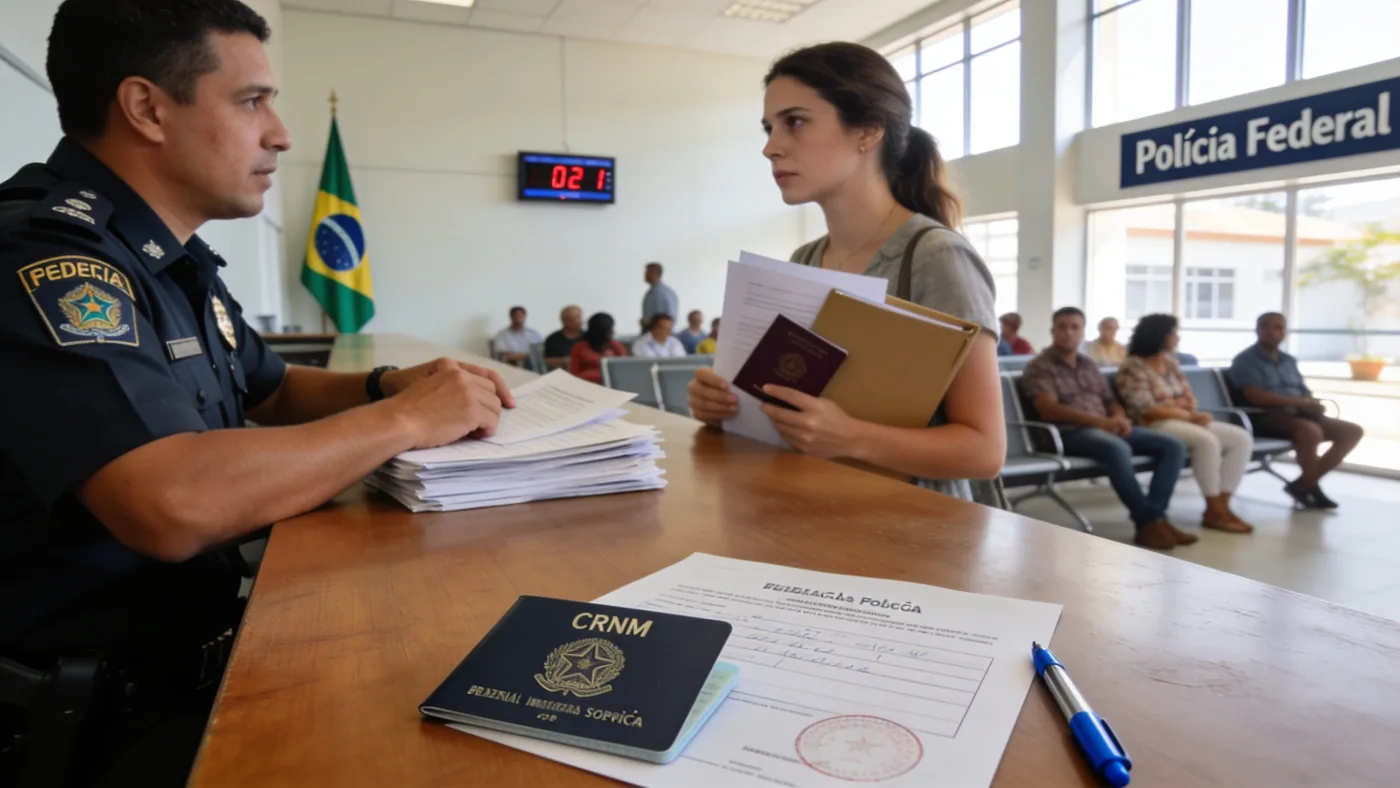
Now the rule. For actual employment, the VITEM V follows a strict two-stage sequence. First, your Brazilian employer files for the residence authorization for work purposes (autorização de residência para fins de trabalho). Only after the Ministry of Labor approves it does the consulate in your home country issue the visa. Then you fly to Brazil and register with the Federal Police (Polícia Federal).
Watch out: Entering Brazil on a tourist stamp with the intention of “converting” it into a work visa almost never works for standard employment. The authorization must exist first, and immigration officers can and do deny entry to travelers whose real purpose is work.
Who Qualifies for a VITEM V Work Visa in Brazil?
Any foreigner with a confirmed job offer or professional engagement from a Brazilian entity can qualify for a VITEM V, under Lei nº 13.445/2017. The visa covers salaried employees, technicians, executives transferred within a company, researchers, artists, and professionals under service contracts. The common requirement is a Brazilian sponsor willing to file the authorization.
The VITEM V is not a single visa but an umbrella covering several distinct categories of work-based migration, each governed by its own Normative Resolution from the CNIg (Conselho Nacional de Imigração, the National Immigration Council). The category matters because the documents, minimum salary references, and proof requirements differ.
- Employment contract: a foreigner hired under a formal Brazilian labor contract (CLT).
- Intra-company transfer: an executive or specialist moved from a foreign branch to a Brazilian branch of the same group.
- Technical assistance / service contract: a professional providing specialized technical services tied to a Brazilian company.
- Researchers, professors, and highly qualified professionals: often with lighter requirements to attract talent.
- Artists and athletes: under specific short-term or seasonal rules.
The counter-argument you will hear from Brazilian companies is real: many employers say “the foreigner already lives here, let us just hire directly and fix immigration afterward.” Their strongest point is that hiring is a labor matter and the immigration paperwork feels secondary. The answer is that Brazilian law treats work authorization as a precondition, not an afterthought. Employing a foreigner without a valid work authorization exposes the company to fines and the worker to removal. If your employer needs guidance, our overview of hiring foreign workers in Brazil explains the employer-side obligations in detail.
What Documents Do You Need for a VITEM V?
You need a valid passport, the employment or service contract, your professional and academic certificates, and civil documents such as birth or marriage certificates. Documents issued abroad must be apostilled (or legalized) and translated by a sworn translator (tradutor juramentado) in Brazil. Inside Brazil you will also need a CPF and, after registration, an RG-style identity through the CRNM.
The document list splits into two groups: what your employer files in Brazil for the authorization, and what you present at the consulate and later to the Federal Police.
Documents the employer files (authorization stage)
- The company’s corporate registration (CNPJ and social contract).
- The employment contract or service agreement specifying role, salary, and duration.
- Proof of the foreigner’s qualifications (diplomas, professional certificates, experience letters).
- Justification for hiring a foreigner, when required by the relevant resolution.
Documents you present (consulate and Federal Police)
- Passport valid for the intended stay.
- The approved authorization number and publication in the official gazette.
- Birth certificate and, if applicable, marriage certificate, apostilled and sworn-translated.
- Police clearance certificate from your home country, apostilled.
- Passport photos and the completed visa application form.
- Proof of the CPF (Cadastro de Pessoas Físicas, the taxpayer number) and, after arrival, your CRNM registration.
Tip: Get every foreign document apostilled in your home country before you leave. Apostilling remotely later is slow and expensive, and the Federal Police will reject documents that are not properly legalized and translated by a sworn translator registered in Brazil.
The RG (Registro Geral, the Brazilian ID) for foreigners is effectively replaced by the CRNM (Carteira de Registro Nacional Migratório, the National Migration Registration Card). It is your official proof of legal residence in Brazil. You can see exactly how the card is issued in our guide on how to register your CRNM at the Federal Police.
How Much Does the VITEM V Cost in 2026?
The core government fee is the CRNM first registration, which costs R$ 204.77 in 2026, roughly US$ 40. The consular visa fee varies by nationality due to reciprocity, commonly between US$ 100 and US$ 290. Add sworn translations at around R$ 60-120 per page and apostille costs in your home country.

Here is a realistic breakdown of what a VITEM V actually costs from start to finish.
| Item | Cost in 2026 | Approximate equivalent |
|---|---|---|
| CRNM first registration | R$ 204.77 | ~US$ 40 |
| CRNM renewal | R$ 204.77 | ~US$ 40 |
| CPF at Receita Federal (in Brazil) | Free | , |
| CPF at Correios or consulate abroad | R$ 7.00 | ~US$ 1.40 |
| Consular VITEM V fee | Varies by nationality | ~US$ 100-290 |
| Sworn translation | R$ 60-120 per page | varies by volume |
| Apostille (home country) | Varies by country | varies |
The CRNM fee figures come from the Federal Police fee schedule for 2026. The CPF is free when requested directly at the Receita Federal (Brazilian IRS), and carries a small R$ 7.00 charge when done through Correios or a consulate abroad.
Example: A U.S. engineer with a two-year contract might spend around US$ 290 on the consular visa, R$ 204.77 on the CRNM, and roughly R$ 500-800 on sworn translations of a diploma, birth certificate, and police certificate, plus apostille fees paid in the United States. The government portion is small; translations and legalization are where costs quietly add up.
Important: Consular fees are set by reciprocity, meaning Brazil charges citizens of a country what that country charges Brazilians. This is why U.S. applicants often pay more than European ones. Always confirm the exact fee with the specific Brazilian consulate handling your application.
How Long Does the VITEM V Process Take?
Expect three to five months from start to finish in most cases. The work authorization through the Ministry of Labor typically takes 30 to 90 days, the consular visa another 10 to 30 days depending on the post, and Federal Police registration must happen within 90 days of arrival. Complex categories can take longer.
The timeline is sequential, not parallel, which is why rushing rarely works. Each stage depends on the previous one being finished and documented.
- Stage 1, authorization (30-90 days): the employer files through the Migrante portal and waits for Ministry of Labor approval and publication.
- Stage 2, consular visa (10-30 days): you apply at the Brazilian consulate in your home country using the authorization number.
- Stage 3, entry and registration (within 90 days): you enter Brazil and register with the Federal Police to obtain your CRNM.
Remember: The 90-day registration deadline after arrival is not flexible. Miss it and you can face fines and complications renewing your status. Set a calendar reminder the day you land, and book your Federal Police appointment early, because slots in big cities fill up fast.
The visa’s initial validity is generally up to two years, tied to your contract, and it is renewable. Toward the end, you can renew or, if you meet the requirements, convert to permanent residency. Our detailed walkthrough of the CRNM renewal process online covers the deadlines you must not miss.
What Changed for the VITEM V in 2026?
In 2026 the framework remains the Migration Law (Lei nº 13.445/2017) and Decreto nº 9.199/2017, with the main practical changes being continued digitalization of the Migrante portal and updated CNIg resolutions favoring highly qualified professionals. The CRNM fee stands at R$ 204.77 per the current Federal Police schedule.
The broader trend since the Migration Law replaced the old Foreigner Statute (Estatuto do Estrangeiro) is a shift from a security-focused approach to a rights-based one. Migrants now enjoy stronger equal-treatment guarantees, which in practice makes the system more predictable, even if the bureaucracy remains heavy. You can read the full text of the law on the official planalto.gov.br portal.
Authorities have also expanded online filing through the Ministry of Labor’s digital systems, reducing some in-person steps at the authorization stage. However, Federal Police registration still requires an in-person biometric appointment. Scheduling is handled through the Polícia Federal portal.
For 2026, categories aimed at attracting talent, such as researchers, startup professionals, and highly qualified specialists, continue to receive lighter documentation and faster handling under updated CNIg resolutions. If your profile fits one of these, the process can be noticeably smoother than a standard employment hire.
Step-by-Step Practical Guide to Getting Your VITEM V
The VITEM V is obtained in a fixed sequence: employer authorization first, consular visa second, Federal Police registration third. Skipping or reordering steps is the single most common reason applications fail. Follow this order exactly and keep every protocol number.
- Secure the job offer. Sign an employment contract or service agreement with a Brazilian company that agrees to sponsor you.
- Gather and legalize documents. Apostille your diploma, birth certificate, and police clearance in your home country before doing anything else.
- Employer files the authorization. Your sponsor submits the residence authorization for work purposes through the Ministry of Labor’s Migrante portal.
- Wait for approval and publication. Once approved, the authorization is published in the official gazette. Keep the reference number.
- Apply at the consulate. Take the authorization number, passport, photos, and legalized documents to the Brazilian consulate in your country of residence.
- Receive the VITEM V and enter Brazil. The visa is stamped in your passport; you then travel to Brazil.
- Register with the Federal Police. Within 90 days of arrival, book a biometric appointment, register, and receive your CRNM.
- Get your CPF. If you did not obtain it abroad, apply free at Receita Federal to open a bank account, sign a lease, and receive salary.
Tip: Have translations done only by a sworn translator (tradutor juramentado) registered in Brazil. Translations made abroad or by unofficial translators are routinely rejected at the Federal Police, forcing you to redo them and risk your 90-day deadline.
Because the VITEM V ties you to one employer, it is worth comparing it with other residency routes if your plans might change. Our comparison of the investor visa versus real estate residency is useful for professionals who may want to start a business or invest rather than remain employed.
Special Situations and Common Exceptions
Certain situations change the VITEM V rules: family members can accompany the worker, some short technical services use a faster 90-day route, and the visa can be converted to permanent residency after meeting continuous-residence requirements. Each exception has its own documentation under separate CNIg resolutions.
Can my family come with me?
Yes. Your spouse and children can apply for residency based on family reunification, linked to your VITEM V. They receive their own CRNM and, in many cases, the right to work or study. The documentation mirrors the family reunion process detailed in our guide to the residency visa in Brazil for families.
What if I only need to work in Brazil for a few weeks?
Short technical assistance under a service contract can use the accelerated 90-day route tied to a Brazilian company, based on CNIg rules. Note that some consulates do not issue this directly and require you to follow specific procedures. It is not a substitute for a full employment visa and cannot be renewed indefinitely.
Can the VITEM V become permanent residency?
Yes. After holding the temporary work visa and meeting continuous-residence requirements under the Migration Law, you can apply to convert to permanent residency, and later pursue naturalization. Time spent legally in Brazil on a VITEM V counts toward these requirements, which is why keeping your CRNM valid and your registrations current is so important.

Does the employer need a fiscal address to sponsor me?
The sponsoring company must be properly registered with a CNPJ (corporate taxpayer number), which requires a valid registered address. If you are a foreign entrepreneur planning to open a Brazilian company to hire yourself or others, a compliant fiscal address in Brazil is a prerequisite for the CNPJ that any work sponsorship depends on.
VITEM V at a Glance: Summary Table
| Feature | Detail (2026) |
|---|---|
| Legal basis | Lei nº 13.445/2017 and Decreto nº 9.199/2017 |
| Purpose | Paid work for a Brazilian employer or service contractor |
| Initial validity | Up to 2 years, renewable |
| First step | Employer files work authorization (Ministry of Labor) |
| Second step | Consular visa in home country |
| Third step | Federal Police registration within 90 days |
| CRNM fee | R$ 204.77 |
| Consular fee | ~US$ 100-290 (by reciprocity) |
| Typical total time | 3-5 months |
| Family included? | Yes, via family reunification |
| Path to permanent residency? | Yes, after continuous residence |
Frequently Asked Questions About the VITEM V
Can I apply for a VITEM V without a job offer?
No. The VITEM V is employer-sponsored by design. A Brazilian company or entity must file the work authorization before you can apply at the consulate. Without a confirmed job offer or service contract, there is no basis for the authorization. If you want to live in Brazil without an employer, other routes exist, such as investor residency or family-based visas, but the VITEM V specifically requires a sponsor inside Brazil who takes responsibility for the filing.
Can I switch employers on a VITEM V?
Changing employers is possible but not automatic. Because the visa is tied to the specific authorization filed by your original sponsor, a new employer generally must file a new authorization request, and you must update your status with the Federal Police. Do not simply start a new job informally; working outside the terms of your authorization can jeopardize your residence. Consult a lawyer before switching, especially if your CRNM renewal is approaching, to avoid gaps in legal status.
Do I need a CPF before or after arriving?
You can get a CPF (taxpayer number) either abroad or in Brazil. Applying at a Brazilian consulate or through Correios costs about R$ 7.00, while applying directly at Receita Federal in Brazil is free. Getting it early is smart, because you need the CPF to open a bank account, sign a rental contract, and receive your salary. Many foreigners obtain it before arrival to speed up settling in once they land.
What happens if I overstay or miss the 90-day registration?
Missing the 90-day Federal Police registration deadline can trigger daily fines and complicate your legal status. Under the Migration Law, penalties exist for irregular stays, though the current framework is less punitive than the old system. The bigger risk is practical: an unregistered status can block your CRNM issuance, delay your salary, and create problems when you renew or convert your visa. If you have already missed the deadline, seek legal help immediately to regularize before it worsens.
Is Brazil a Common Law or Civil Law country, and why does it matter for my visa?
Brazil is a Civil Law country, meaning immigration rights come from written statutes and regulations rather than judicial precedent. For your VITEM V, this means the rules are codified in the Migration Law, the regulating decree, and CNIg resolutions. Officials apply these texts literally, so meeting the exact documentary requirements matters more than arguing your case. This is also why sworn translations, apostilles, and precise filing order are decisive: the system rewards formal compliance over informal reasoning.
Get Your VITEM V Right the First Time with a Bilingual Brazilian Lawyer
The VITEM V is one of the most valuable doors into Brazil, but it is also one of the easiest to close by accident: wrong order, expired apostilles, a missed 90-day deadline, or an employer who files incorrectly. You do not have to navigate the Migrante portal, consular reciprocity fees, and Federal Police appointments alone. Our bilingual team handles the process end to end, coordinating with your employer and keeping every deadline on track.
The concrete next step is simple: before you sign anything or book a flight, confirm that your employer files the work authorization first. Send us your job offer and passport details, and we will map your exact timeline and document list for 2026.
Quick recap: Authorization in Brazil first, consular visa second, Federal Police registration within 90 days third. Apostille and sworn-translate everything, budget R$ 204.77 for the CRNM plus consular fees, and never work on a tourist stamp.
Talk to a specialist lawyer now
Talk to a Lawyer on WhatsApp