Brazil’s investor residency program is not a citizenship-by-investment scheme. It is a formal residence permit — authorized under Lei 13.445/2017 (the Brazilian Migration Law) — that allows foreign nationals who meet minimum investment thresholds to live legally in Brazil. The process is bureaucratic, the timelines are real, and the risks for Iraqi applicants are specific. This article covers all of it.
Whether you plan to buy property in São Paulo, start a company in the Northeast, or simply want a second residency in a stable democratic country, understanding the rules before you wire money is critical. Let’s break it down.
On this page
What Is the Brazil Investor Visa and How Does It Work for Iraqi Citizens?
The Brazil Investor Visa — formally called the Autorização de Residência por Investimento (Residence Authorization for Investment) — allows foreign nationals to obtain legal residency by investing a minimum amount in Brazil, either through a registered company or through the purchase of real estate. Under Lei 13.445/2017 and its implementing Decree 9.199/2017, two main pathways exist: a business investment route requiring a minimum of R$ 500,000, and a real estate route requiring a minimum of R$ 1,000,000 in urban areas.
For Iraqi citizens, this is not a tourist visa or a temporary work permit. It is a full residence permit that can lead to permanent residency and, eventually, Brazilian citizenship. Brazil operates under a Civil Law system — meaning the rules are codified in statutes, not built on court precedents as in Common Law countries. Every requirement is written into law, and compliance must be documented precisely.
There is no bilateral visa exemption agreement between Brazil and Iraq for long-stay purposes. Iraqi passport holders must apply through the Brazilian consulate in their country of residence and meet all standard immigration requirements on top of the investment thresholds. This makes legal preparation especially important.
Ponto-chave: The investor residency permit is not automatically granted upon investment. The Brazilian Ministry of Labor and Employment (Ministério do Trabalho e Emprego) must formally authorize your residence. The investment alone does not guarantee approval.
What Are the Minimum Investment Requirements in 2026?
In 2026, the two main investment thresholds remain as established by Normative Resolution No. 13/2017 and Normative Resolution No. 36/2018 of the National Immigration Council (CNIG/MTE): R$ 500,000 for business investment and R$ 1,000,000 for urban real estate. Regional exceptions apply and can significantly reduce the required amount.
Business Investment Route: Investor visa Brazil
You must invest a minimum of R$ 500,000 (approximately USD 90,000–100,000 at current exchange rates) into a new or existing Brazilian company. The company must be registered with a valid CNPJ (Cadastro Nacional da Pessoa Jurídica — Brazil’s company tax ID) and you must submit a detailed Plano de Negócios (Business Plan) demonstrating job creation or economic impact.
There is a reduced threshold of R$ 150,000 if the investment targets technology, scientific research, or an approved innovative startup — but this requires specific approval of an investment plan by the Ministry of Labor. This route is harder to qualify for and involves more scrutiny.
Real Estate Investment Route: Investor visa Brazil
You must purchase urban real estate worth at least R$ 1,000,000 (approximately USD 180,000–200,000). If the property is located in the North or Northeast regions of Brazil — states like Pará, Amazonas, Ceará, or Bahia — the minimum drops to R$ 700,000.
Rural land purchases are subject to additional restrictions under Law 5.709/1971 (the Foreign Rural Property Law), which limits how much land foreign individuals or foreign-controlled companies can acquire. If you are considering agricultural land, this requires separate legal analysis.
Fique atento: The investment amount must be proven through official bank transfer documentation showing funds entering Brazil through the Brazilian banking system. Cash transactions or informal transfers are not accepted and can result in automatic rejection of your application.
Comparison: Business Investment vs. Real Estate Investment Route
Choosing the right route depends on your goals, capital, and tolerance for ongoing obligations. Here is a side-by-side comparison of the two main pathways available to Iraqi investors in 2026, based on current regulatory frameworks.
| Factor | Business Investment | Real Estate Investment |
|---|---|---|
| Minimum Investment | R$ 500,000 (~USD 95,000) | R$ 1,000,000 (~USD 190,000) |
| Reduced Threshold | R$ 150,000 (tech/innovation) | R$ 700,000 (North/Northeast) |
| Ongoing Obligations | Business Plan + job creation | Property ownership maintenance |
| Processing Authority | Ministry of Labor (MTE) | Ministry of Labor (MTE) |
| Initial Permit Duration | 2 years (renewable) | 2 years (renewable) |
| Path to Permanence | Yes, after 4 years | Yes, after 4 years |
| Key Risk | Business failure, plan rejection | Property valuation disputes, ITBI costs |
| Additional Taxes | Company registration fees | ITBI (2–3%) + Land Registry (~1–1.5%) |
For Iraqi investors who prefer a passive investment without managing a business, the real estate route is often simpler — despite the higher minimum. For those with entrepreneurial plans, the business route offers more flexibility. You can read a broader comparison of investor pathways in our guide to Brazil Residency Visa: Investor Path & Costs 2026.
What Documents Does an Iraqi Citizen Need to Apply?
Iraqi applicants must prepare documents in two categories: personal identification documents and investment-proof documents. All foreign documents must be apostilled or legalized at the Brazilian consulate and translated into Portuguese by a sworn translator (tradutor juramentado). Missing even one document can delay your application by months.
Personal Documents
- Valid Iraqi passport (minimum 6 months validity beyond intended stay)
- Birth certificate (certidão de nascimento) — apostilled and sworn-translated
- Marriage certificate if applicable — apostilled and sworn-translated
- Criminal background check from Iraq AND from any country where you have lived for 5+ years in the last 10 years
- Proof of current address (comprovante de residência) in your country of residence
- Two recent passport-sized photos
- CPF (Cadastro de Pessoa Física — Brazilian taxpayer ID number), which you can apply for at a Brazilian consulate abroad or online via the Receita Federal (Brazilian IRS) portal
Investment Documents — Business Route
- Registered company contract (contrato social) or articles of incorporation showing your equity stake
- CNPJ certificate of the Brazilian company
- Detailed Business Plan (Plano de Negócios/Investimento) in Portuguese
- Bank transfer receipts showing funds remitted to Brazil through official channels
- Proof of capital deposit in the company’s bank account
- Declaration of investment signed before a Brazilian notary (cartório)
Investment Documents — Real Estate Route
- Deed of purchase (escritura pública de compra e venda) registered at the Land Registry (Cartório de Registro de Imóveis)
- Updated property registration certificate (certidão de matrícula atualizada)
- ITBI (Imposto de Transmissão de Bens Imóveis — Property Transfer Tax) payment receipt
- Bank transfer documentation proving funds originated abroad
- Property appraisal report if requested by the Ministry
Como funciona: The CPF is the single most important document to obtain first. Without a CPF, you cannot open a Brazilian bank account, sign a property deed, or register a company. Apply for it at the Brazilian consulate in Baghdad or Amman before you travel to Brazil. It is free of charge when obtained at a consulate.

Step-by-Step Process: How to Apply for the Brazil Investor Visa as an Iraqi Citizen
The full process from initial planning to receiving your CRNM (Carteira de Registro Nacional Migratório — National Migration Registry Card) typically takes between 6 and 12 months, according to processing timelines published by the Polícia Federal (Federal Police). Plan for delays — Brazilian bureaucracy is real, and document authentication alone can take 30 to 60 days.
Step 1 — Obtain your CPF. Contact the nearest Brazilian consulate (Baghdad, Amman, or Cairo) or apply online via the Receita Federal portal. This is your entry point into the entire Brazilian legal system. Timeline: 1–4 weeks.
Step 2 — Choose your investment route and conduct due diligence. If buying property, hire a Brazilian real estate lawyer to verify the property’s legal status, debt history, and zoning compliance. If starting a company, define the corporate structure and prepare the Business Plan. Timeline: 2–8 weeks.
Step 3 — Transfer funds through official banking channels. Open a non-resident bank account in Brazil (possible with your CPF before you have residency) and transfer the investment amount from Iraq or your current country of residence. The transfer must be declared to the Banco Central do Brasil. Timeline: 2–4 weeks.
Step 4 — Execute the investment. Sign the property deed at a cartório (notary office with legal registration powers) or register the company at the Junta Comercial (State Commercial Registry). Deposit capital into the company account or pay for the property. Timeline: 1–3 weeks.
Step 5 — Compile the full document package. Gather all personal and investment documents, have foreign documents apostilled, and hire a sworn translator for Portuguese versions. Timeline: 4–8 weeks.
Step 6 — Apply at the Brazilian consulate or online via the Ministry of Labor. Submit your residence authorization request through the SISAC system (Ministry of Labor online portal) or through the Brazilian consulate in your country of residence. Pay the applicable government fees. Timeline: 60–90 days for processing.
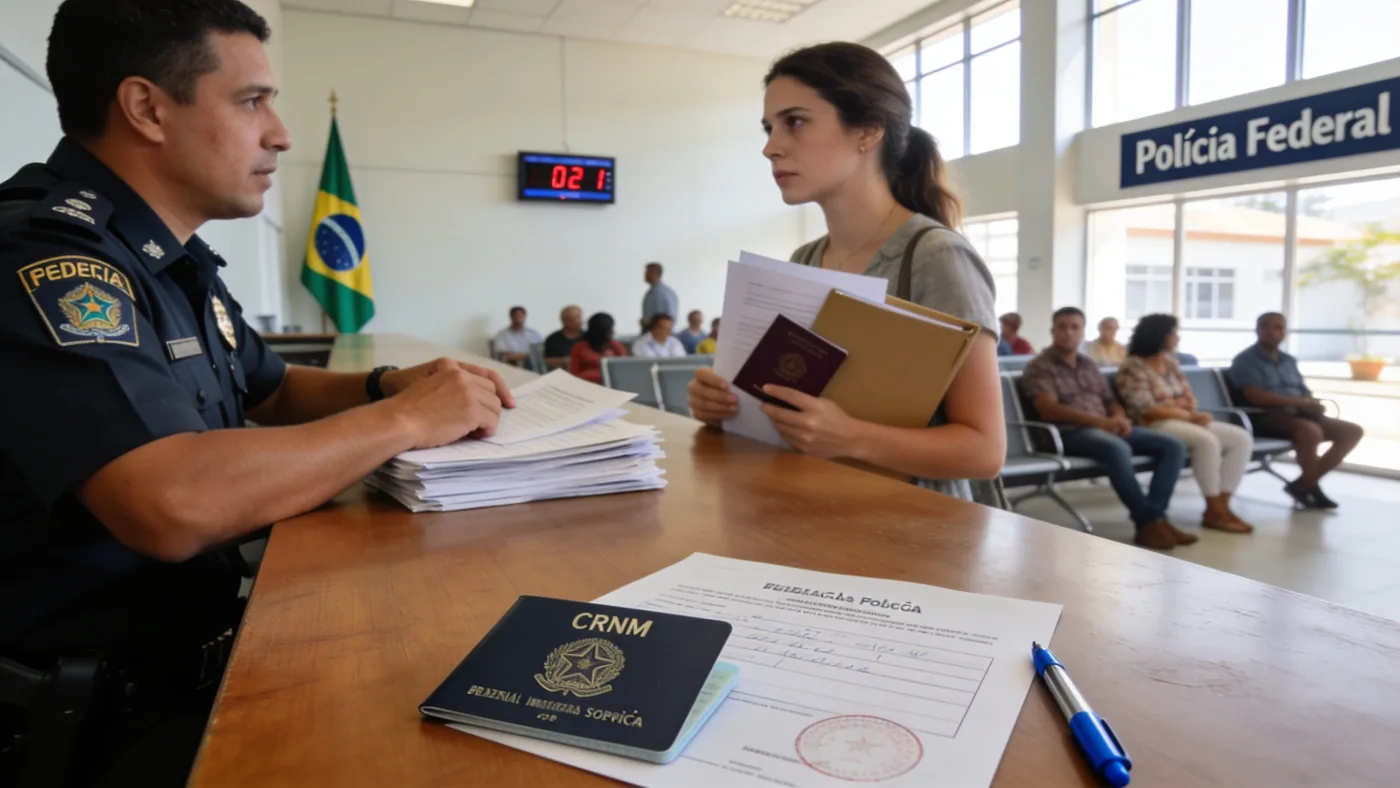
Step 7 — Enter Brazil and register with the Federal Police. Once your residence authorization is approved, you have 90 days from entry to register at a Federal Police station and receive your CRNM. The first CRNM registration fee is R$ 204.77, according to the Federal Police fee schedule. Timeline: 30 days recommended.
Resumo rápido: CPF first → due diligence → fund transfer → execute investment → gather documents → apply for authorization → enter Brazil → register with Federal Police → receive CRNM. Do not skip or reverse these steps.
What Are the Specific Risks for Iraqi Citizens Applying for This Visa?
Iraqi applicants face specific compliance challenges that citizens of other nationalities may not encounter at the same level. Understanding these risks upfront — rather than discovering them mid-process — can save significant time and money.
Banking and AML Compliance
Brazil’s banking system applies strict Anti-Money Laundering (AML) and Know-Your-Customer (KYC) procedures to all international transfers, particularly from high-risk jurisdictions. Iraq is classified in a heightened due diligence category by many Brazilian banks. You should expect your bank transfer to be subjected to additional documentation requests, including proof of the lawful origin of funds (salary history, tax returns, sale of assets, etc.).
Warning: If your bank transfer is flagged by the Banco Central do Brasil or the receiving Brazilian bank and you cannot provide satisfactory documentation of fund origins, the transfer may be frozen or returned. This can collapse your entire application timeline. Prepare your fund-origin documentation before initiating any transfer.
Criminal Background Check Complexity
Brazil requires a criminal background check from every country where you have resided for 5 or more years in the last decade. For Iraqi citizens, obtaining an official, apostilled criminal clearance certificate can be complex given Iraq’s current administrative infrastructure. Start this process at least 3 months before you plan to submit your application.
Consular Access
Brazil maintains a consulate in Baghdad, but appointment availability can be limited. Many Iraqi applicants choose to apply through Brazilian consulates in Amman (Jordan) or Dubai (UAE) if they have legal status in those countries. Confirm which consulate has jurisdiction over your case before making travel arrangements.
For context on how similar Middle Eastern applicants navigate this process, our guide on Brazil Residence Permit for Lebanese citizens covers comparable documentation and consular challenges.
What Changed in 2026 for the Brazil Investor Visa?
The core investment thresholds established by Normative Resolutions No. 13/2017 and No. 36/2018 have not been revised for 2026. The R$ 500,000 business investment minimum and R$ 1,000,000 real estate minimum remain in force. However, several procedural and compliance updates are relevant for new applicants this year.
The Brazilian government has expanded digital processing through the SISAC system, allowing more steps to be completed online rather than in person at a consulate. This reduces travel requirements for initial application stages, though the Federal Police registration in Brazil still requires a physical presence.
Brazil’s Receita Federal has also tightened its monitoring of international capital flows in 2025–2026, meaning fund-origin documentation requirements are more strictly enforced. The Banco Central do Brasil now requires a more detailed declaration for transfers above R$ 30,000 entering as investment capital.
The initial residence permit is issued for 2 years and is renewable. After 4 years of continuous residence, you can apply for permanent residency. After 4 years of permanent residency (total of approximately 4 years under the Migration Law’s naturalization provisions), you may be eligible to apply for Brazilian citizenship — though naturalization requirements include language proficiency and other conditions.
Fique atento: Brazil does not have a formal “Golden Visa” program in the European sense. There is no fast-track citizenship pathway tied to investment. The investor residency permit follows the same naturalization timeline as other residency categories. Do not be misled by agents who promise accelerated citizenship through investment.
Costs and Fees: What Will You Actually Pay?
Beyond the minimum investment amount, Iraqi investors must budget for a range of administrative fees and taxes. According to current government fee schedules and tax regulations, the total ancillary costs for the real estate route typically add 4–6% on top of the property purchase price.
Government and Administrative Fees
- CPF registration: Free at consulate or online; R$ 7.00 via Correios (Post Office)
- CRNM first registration: R$ 204.77, per the Federal Police fee schedule
- CRNM renewal: R$ 204.77
- Company registration at Junta Comercial: R$ 300 to R$ 800 depending on state (the CNPJ itself is free via government portals)
Real Estate Transaction Costs
- ITBI (Imposto de Transmissão de Bens Imóveis — Property Transfer Tax): 2% to 3% of property value, set by each municipality
- Land Registry fee (Registro de Imóveis): approximately 1% to 1.5% of property value
- Notary fees (cartório): approximately 0.5% to 1% of property value
Exemplo: If you buy a R$ 1,000,000 property in São Paulo, budget approximately R$ 30,000 for ITBI (3%), R$ 15,000 for land registry, and R$ 8,000 for notary fees — totaling roughly R$ 53,000 in transaction costs on top of the purchase price. That is approximately USD 10,000 in additional fees at current exchange rates.
Legal fees for a bilingual immigration and real estate lawyer are a separate cost but are strongly recommended for Iraqi applicants given the AML compliance complexity. Attempting to navigate the document authentication, banking compliance, and Ministry application without legal support significantly increases the risk of rejection or costly delays.
Frequently Asked Questions About the Brazil Investor Visa for Iraqi Citizens
Can I use more than one property to reach the R$ 1,000,000 minimum?
Yes, under the rules governing the real estate investment route, you can combine multiple urban properties to reach the minimum threshold, provided all properties are purchased in your name and the total registered value meets the R$ 1,000,000 (or R$ 700,000 for North/Northeast) requirement. Each property must have a separate registered deed, and all transfers must be documented through official banking channels. Discuss this strategy with your lawyer before purchasing, as the Ministry of Labor reviews all properties collectively.
How long does the entire process take from start to CRNM?
Realistically, plan for 8 to 14 months from the moment you start gathering documents to the day you receive your CRNM. The Ministry of Labor processing alone takes 60 to 90 days after a complete application is submitted. Document authentication, fund transfers, and property registration each add time. Iraqi applicants should add extra buffer for criminal background check procurement and banking compliance reviews. Do not book one-way flights until your residence authorization has been formally approved.
Do I need to be in Brazil to apply?
For the initial application, no. You can submit the residence authorization request through a Brazilian consulate abroad or via the SISAC online system. However, once the authorization is granted, you must enter Brazil and register with the Federal Police within 90 days to receive your CRNM. The investment itself — such as signing a property deed or registering a company — requires either your physical presence in Brazil or a duly appointed legal representative (procurador) holding a notarized power of attorney (procuração).
Can my family members get residency through my investor visa?
Yes. Under Lei 13.445/2017, your spouse or partner and dependent children can apply for a family reunification residence permit linked to your investor residency. Each family member must submit their own set of personal documents, including apostilled birth and marriage certificates and criminal background checks. They do not need to make a separate investment. The family reunification permit follows the same initial 2-year duration as your investor permit and can be renewed alongside yours.
Will I need to pay taxes in Brazil on my foreign income?
Once you become a Brazilian tax resident — which generally occurs when you obtain a permanent residence permit or spend more than 183 days in Brazil in a 12-month period — you become subject to Brazilian income tax on worldwide income, according to the Receita Federal’s rules. Brazil has limited tax treaties with Middle Eastern countries, and Iraq is not among those with a double taxation agreement with Brazil. This means you could face taxation in both countries on the same income. Tax planning before establishing residency is essential — consult both a Brazilian and an Iraqi tax advisor.
What happens if my investment fails or I sell the property after getting residency?
Your residence permit is conditional on maintaining the investment during the permit period. If you sell the property or close the company before obtaining permanent residency, the Ministry of Labor can revoke your residence authorization. After 4 years of continuous residence and once permanent residency is granted, this condition is typically no longer applicable. This is one of the most important risks to understand before choosing the investor route — it is not a one-time transaction but an ongoing commitment for the duration of your provisional permit.
For a broader view of how investors from similar backgrounds have approached this process, see our articles on Brazil Investor Visa requirements and process and Turkish citizen Brazil residency via the investor pathway.
Ready to Apply for Your Brazil Investor Visa? Work With a Bilingual Legal Team
The Brazil investor visa process for Iraqi citizens is achievable — but it requires precise document preparation, strict banking compliance, and a thorough understanding of Brazilian immigration law. One missing apostille, one improperly documented bank transfer, or one incorrect Business Plan can delay your application by months or result in outright rejection. Working with a qualified Brazilian immigration lawyer who understands the specific challenges Iraqi nationals face is not optional — it is the most efficient investment you can make in this process.
Ribeiro Cavalcante Advocacia is a Brazilian law firm that serves international clients navigating immigration, investment, and business law in Brazil. Our bilingual team has experience with investor residency applications, real estate transactions for foreign nationals, and AML-compliant fund transfer documentation. Contact us directly to discuss your specific situation and get a clear roadmap for your application.
Talk to a specialist lawyer now
Talk to a Lawyer on WhatsApp