The short answer: yes, Brazil has a dedicated residency pathway for retirees and people living on passive income. It is commonly called the retirement visa (visto para aposentado) or, more accurately under current law, residency based on retirement or passive income (residência por aposentadoria ou renda passiva).
The core requirement is a verifiable retirement income of roughly US$ 2,000 per month (around R$ 11,000 at 2026 exchange rates) that you can transfer into Brazil. But — and this is where most websites get it wrong — the source of that money matters as much as the amount.
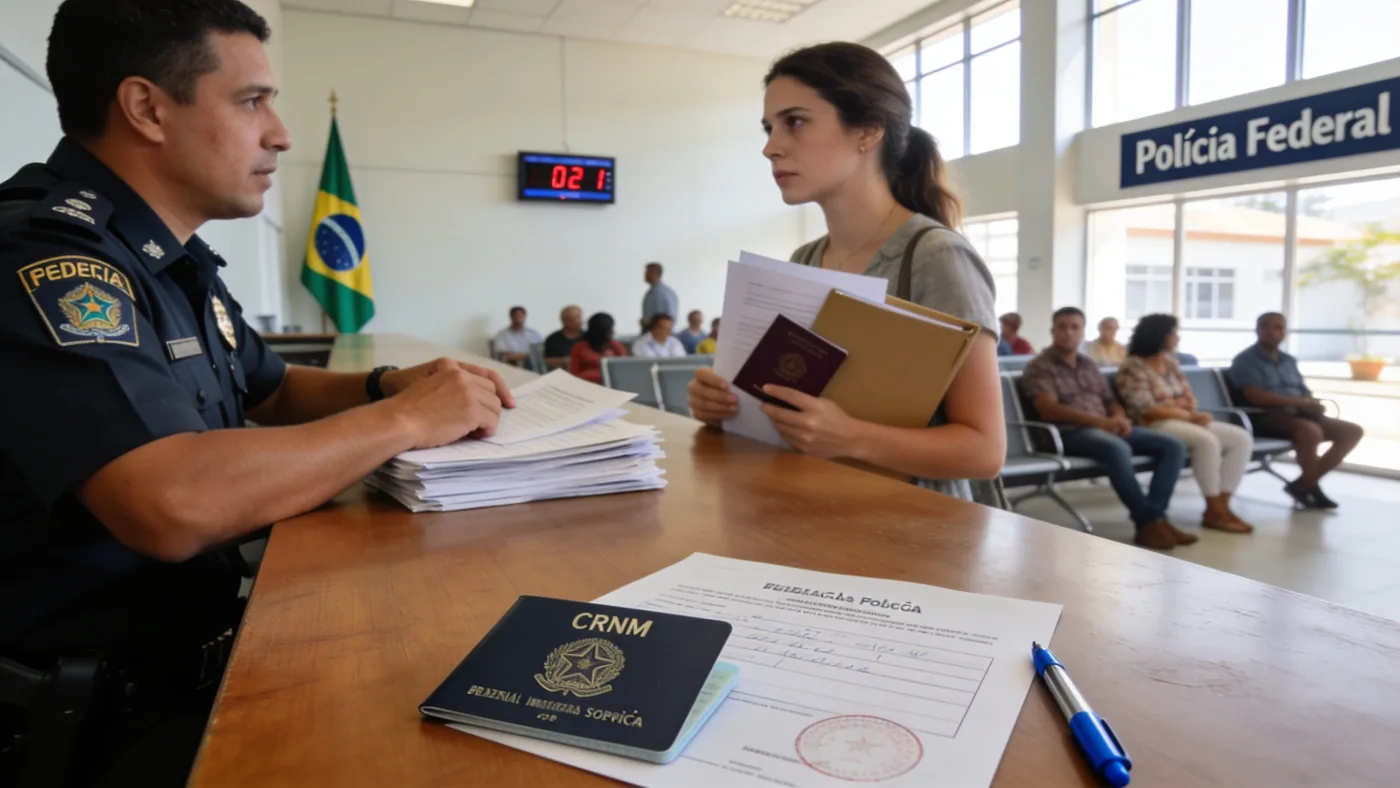
This route is governed by the Brazilian Migration Law (Lei 13.445/2017), not the old Estatuto do Estrangeiro. It leads to a CRNM (Carteira de Registro Nacional Migratório — National Migration Registry Card), your official Brazilian ID as a resident foreigner.
Below, we break down the income rule, which income counts, the documents the Federal Police actually accept, the real costs in 2026, and the step-by-step process — written for real people, not lawyers.
On this page
Who Qualifies for Brazil’s Retirement / Passive Income Visa?
To qualify for Brazil’s retirement visa, you must receive a traditional type of retirement income — such as social security, a pension, disability, or a survivor’s pension — of at least US$ 2,000 per month, and be able to transfer that money into Brazil. This is granted under the Migration Law (Lei 13.445/2017) as a residency authorization.
Unlike a work visa, this pathway does not require you to have a job offer, open a company, or make a large investment. You simply need to prove that you can support yourself in Brazil without competing in the local labor market.
There is no strict minimum age written into the law. In practice, however, this route is designed for people who are already retired or drawing a pension. If you are younger and living on investments alone, you may fit better under a passive-income or investor category — see our guide to the Brazil investor visa.
Who typically applies:
- Retirees drawing Social Security (US, UK, Canada, Australia) or a government/private pension
- People receiving disability or survivor’s pension payments
- Retirees taking regular distributions from 401(k), IRA, or Roth IRA accounts
- Foreign nationals with stable, recurring passive income who want to base themselves in Brazil
Important: The current framework replaced the old “visto permanente para aposentado.” Since 2017, the correct term is a residency authorization based on retirement or passive income — and it results in a CRNM, not a stamp-in-passport “permanent visa.”
For the full landscape of options, see our pillar guide to Brazil immigration law, visas, residency and the CRNM.
How Much Money Do You Need? The US$ 2,000 Rule Explained
Brazil’s retirement route runs on the “US$ 2,000 rule”: roughly US$ 2,000 per month (about R$ 11,000 at 2026 rates) in verifiable retirement income that is transferable to Brazil. For each dependent — spouse, minor child, or dependent parent — you traditionally must show an additional US$ 1,000 per month.
The single most misunderstood point is this: it is not enough to have money in a bank account. You must prove a recurring monthly transfer of retirement income into Brazil. A one-time lump sum or a fat savings balance does not satisfy the rule.
Example: A retired couple — one main applicant plus a spouse as a dependent — would typically need to prove around US$ 3,000 per month (US$ 2,000 + US$ 1,000) in transferable retirement or pension income. Add a dependent parent and you are looking at roughly US$ 4,000 per month.
The Federal Police and the immigration coordination body verify the money can flow into Brazil. This usually means transfers routed through the banking system and, where applicable, registered with the Central Bank of Brazil (Banco Central) for foreign-currency inflows.
Warning: A bank statement showing a R$ 6,000 deposit is not enough on its own. The Polícia Federal and CGIG (the immigration coordination body) do not accept vague documentation — you need the source document (SSA benefit letter, pension statement, 1099-R) proving the income is passive and recurring.
Retirement visa brazil: What Income Counts Toward the Requirement?
You must receive a “traditional” type of retirement income as the primary basis — social security, pension, disability, or survivor’s pension. Distributions from retirement accounts like 401(k)s and Roth IRAs count on this traditional side too. Other passive income can complement your pension to reach the US$ 2,000 threshold, but it generally cannot be the sole basis.
Social Security Benefits (US, UK, Canada, Australia)
Government social security payments are the gold standard for this visa. US Social Security, the UK State Pension, the Canada Pension Plan, and Australian government pensions all qualify. You prove them with an official benefit-award or entitlement letter from the paying agency.
Pension and Annuity Payments: Retirement visa brazil
Private and public employer pensions, as well as lifetime annuities, count as traditional retirement income. You will need a statement from the pension fund or insurer showing the monthly amount and its recurring nature.
Retirement Account Distributions
Regular distributions from 401(k), traditional IRA, and Roth IRA accounts count on the traditional retirement side. The key is that the distributions are recurring and documented — a 1099-R and a schedule of periodic withdrawals help establish this.
Dividends, Investment and Rental Income
Dividends, investment income, and rental income can complement your pension to reach the threshold. However, they usually cannot be the entire basis for a retirement-category application. If your income is purely from investments and property, a passive-income or investor route may be more appropriate.
Tip: If your pension alone is close to but below US$ 2,000, structure your file so the pension is the anchor and rental or dividend income tops it up. Present clean source documents for each stream — mixing sources is fine as long as each one is provable.
How Does the US–Brazil Totalization Agreement Affect Social Security?
The US–Brazil Social Security Totalization Agreement, in force since October 2018, lets workers combine credits earned in both countries to qualify for benefits and avoid double social-security taxation. For immigration purposes, though, what matters is that your US Social Security benefit is officially awarded and payable — the agreement helps you qualify for that benefit in the first place.
Two practical implications for retirees moving to Brazil:
- You can generally keep receiving US Social Security while living in Brazil. The US Social Security Administration pays benefits to eligible beneficiaries residing in Brazil.
- The agreement can help you meet the credit requirements to draw a benefit if you split your career between the two countries — which then becomes your qualifying retirement income for the visa.
For confirmation of how payments abroad work, the US Social Security Administration’s international operations pages are the authoritative source. On the Brazilian side, retirement and pension income is subject to Brazilian tax rules once you become a tax resident — governed by the Income Tax Regulation (Decreto 9.580/2018).
Note: Becoming a Brazilian resident can trigger Brazilian income tax on your worldwide income, including foreign pensions. Brazil and the US do not have a full double-taxation treaty, so plan your tax position with a Brazilian accountant before you move.
What Documents Do You Need for the Retirement Visa Application?
The core documents are your passport, a criminal background check, proof of recurring retirement income (the source document), and proof that the money is transferable to Brazil. Foreign documents must be apostilled and translated by a sworn translator (tradutor juramentado) — a bank statement alone will not be accepted.
Typical document checklist:
- Valid passport (and copies of all pages)
- Recent passport-style photo
- Birth certificate and, if applicable, marriage certificate (for dependents)
- Proof of retirement income at the source — SSA benefit letter, pension fund statement, 1099-R, or official annuity statement
- Proof that income is transferable to Brazil (bank documentation, transfer records)
- Criminal background check from your country of residence (and, in some cases, others where you lived)
- Proof of Brazilian address (utility bill, lease, or declaration)
- CPF (Brazilian taxpayer number)
- Completed application form and paid guia de recolhimento (payment slip)
Every foreign document generally needs an apostille (under the Hague Apostille Convention) in your home country, followed by a sworn translation into Portuguese in Brazil. This two-step legalization is where most applicants lose time, so start early.
Remember: The income document must show that the money is passive and recurring. An award letter stating a fixed monthly benefit is far stronger than a printout of a single deposit. Present the source, not just the destination.
What Does It Cost and How Long Does It Take in 2026?
Government fees are modest: the CRNM registration fee is R$ 204.77 (about US$ 40) in 2026, and the CPF is free in Brazil. The bigger costs are apostilles, sworn translations (roughly R$ 60–120 per page), and professional legal fees, which typically range from R$ 5,000 to R$ 15,000 depending on complexity.
Here is a realistic cost breakdown for planning purposes:
| Item | Cost (2026) |
|---|---|
| CRNM first registration fee | R$ 204.77 (~US$ 40) |
| CRNM renewal fee | R$ 204.77 |
| CPF (in Brazil, at Receita Federal) | Free |
| CPF (abroad, via consulate/Correios) | ~R$ 7.00 |
| Sworn translation | ~R$ 60–120 per page |
| Apostille (home country) | Varies by country |
| Immigration lawyer fees | R$ 5,000–15,000 |
The fees above are official government amounts; source: the Federal Police fee schedule (guia de recolhimento) and Receita Federal for the CPF. Legal fees are market estimates and vary by firm and case complexity.
In practice: A single retiree who prepares documents efficiently might spend R$ 8,000–12,000 all-in (translations, apostilles, and legal support included), plus the small government fees. A couple with a dependent will spend more on translations and background checks.
On timing, expect the process to span several months. Gathering and legalizing documents abroad can take 4–8 weeks. Once in Brazil, the Federal Police appointment and CRNM issuance can add several weeks to a few months. Brazilian bureaucracy is slow but predictable — build in a buffer.
Retirement Visa vs. Other Brazilian Residency Routes
The retirement route is the cheapest and simplest for people with recurring pension income, while the investor route suits those with capital and the work visa suits those with a job offer. The retirement visa needs about US$ 2,000/month; the investor route needs a qualifying capital investment. All three lead to a CRNM under the Migration Law.
| Feature | Retirement / Passive Income | Investor Visa | Work Visa (VITEM V) |
|---|---|---|---|
| Main requirement | ~US$ 2,000/month recurring income | Qualifying capital investment | Job offer / employment |
| Age focus | Retirees / pensioners | Any adult with capital | Working-age professionals |
| Can you work? | Not the basis; supplemental only | Runs the business | Yes — that is the purpose |
| Dependents | Yes (+~US$ 1,000/month each) | Yes | Yes |
| Result | CRNM | CRNM | CRNM |
If you plan to earn actively in Brazil, review our guide to the Brazil work visa (VITEM V) requirements and cost. If you have capital to deploy, the investor route may open a business path instead.
What Changed in 2026?
As of 2026, the legal framework remains the Migration Law (Lei 13.445/2017) and its regulation (Decreto 9.199/2017), with no overhaul of the retirement route. The main practical shifts are administrative: more digital processing through the gov.br platform and continued reliance on the US$ 2,000/month benchmark, which fluctuates in reais with the exchange rate.
Key points to keep in mind for 2026:
- Because the threshold is anchored in US dollars, the reais equivalent moves with the exchange rate — at 2026 rates, US$ 2,000 is roughly R$ 11,000.
- Digital submission and scheduling with the Federal Police continue to expand, reducing (but not eliminating) in-person steps.
- Health insurance is increasingly expected in practice; while the Constitution guarantees health as a right (Art. 196), private coverage under the Health Plans Law (Lei 9.656/1998) is advisable for expats.
You can read the Migration Law itself on the official Planalto legislation portal (in Portuguese). For procedural updates, the Federal Police (Polícia Federal) portal is the authoritative source.
Step-by-Step: How to Apply for the Retirement Visa
The process has two main phases: preparing and legalizing your documents abroad, then registering in Brazil to obtain your CRNM. You can start the residency authorization from your home country through a Brazilian consulate, or in some cases apply for residency after entering Brazil, depending on your route.
Phase 1 — Prepare your documents (home country)
- Gather your income source documents (SSA letter, pension statement, 1099-R).
- Obtain your criminal background check.
- Apostille all documents that will be used in Brazil.
- Apply for a CPF (you can do this abroad via a Brazilian consulate or the Receita Federal online service).
Phase 2 — Submit the application
- File the residency-authorization request with the appropriate authority (consulate abroad or the immigration body in Brazil).
- Have all foreign documents translated by a sworn translator in Brazil.
- Pay the guia de recolhimento for the applicable fees.
Phase 3 — Register with the Federal Police and get your CRNM
- Schedule your Federal Police appointment online through the gov.br portal.
- Attend in person for biometrics and document verification.
- Pay the R$ 204.77 CRNM registration fee.
- Receive your CRNM — your official Brazilian resident ID card.
Tip: Keep every protocol number, receipt, and payment slip. Brazilian processes are tracked by protocol, and you will need these numbers to follow up or resolve delays. Store both paper and digital copies for at least five years.
Frequently Asked Questions
Is there a minimum age to apply for the Brazilian retirement visa?
There is no fixed minimum age written into the Migration Law for this route. What matters is that you receive a traditional, recurring retirement income — such as a pension, Social Security, disability, or survivor’s benefit — of at least US$ 2,000 per month that you can transfer to Brazil. In practice, applicants are usually retirees or pensioners. Younger people living purely on investments often fit better under a passive-income or investor category instead.
Can I include my spouse and children on my retirement visa?
Yes. You can include dependents such as a spouse, minor children, and dependent parents. Traditionally you must show an additional US$ 1,000 per month of transferable income for each dependent, on top of the US$ 2,000 for the main applicant. So a couple typically needs to prove around US$ 3,000 per month. You will need to provide marriage and birth certificates — apostilled and translated — to prove the family relationship.
Will I pay tax in Brazil on my foreign pension?
Possibly. Once you become a Brazilian tax resident, you are generally taxed on your worldwide income, including foreign pensions, under the Income Tax Regulation (Decreto 9.580/2018). Brazil and the US do not have a comprehensive double-taxation treaty, though foreign tax credits may reduce double taxation. This is a genuinely complex area — speak with a Brazilian accountant before you move so you understand your position and can plan the timing of your relocation.
Does a bank statement showing R$ 6,000 deposited count as proof?
No — not on its own. The Federal Police and immigration authorities want the source document proving the income is passive and recurring: an SSA benefit letter, a pension fund statement, or a 1099-R. A bank statement showing a deposit only shows money arrived, not that it is a stable retirement income. You should present the source document plus evidence that the money is transferable into Brazil.
Can I use rental or investment income instead of a pension?
Rental, dividend, and investment income can complement your pension to reach the US$ 2,000 threshold, but they generally cannot be the sole basis for a retirement-category application. The authorities expect a traditional retirement income as the anchor. If your income is purely passive investment income with no pension, an investor or dedicated passive-income route is usually the better fit — a lawyer can confirm which category matches your facts.
How long does the CRNM take to be issued?
After your Federal Police appointment, the physical CRNM card typically takes several weeks to a few months to be issued, depending on the local office’s backlog. You usually receive a protocol document that proves your legal status while you wait for the card. Keep that protocol safe — it functions as temporary proof of your residency and is often required to open bank accounts or sign contracts.
Ready to Retire in Brazil? Get Expert Help With Your Passive Income Visa
Moving to Brazil to retire should feel exciting, not overwhelming. The rules around the retirement and passive income visa are manageable — but the fine print of your income documents, apostilles, translations, and tax exposure is exactly where applications get stuck. You do not have to navigate Brazilian bureaucracy alone or in a language you do not speak.
Our bilingual legal team reviews your specific income sources, tells you honestly whether your file meets the US$ 2,000 rule, and handles the process end to end — from CPF and document legalization to your Federal Police appointment and CRNM. Reach out today and let’s build your path to living in Brazil.
Talk to a specialist lawyer now
Talk to a Lawyer on WhatsApp