

How to Buy Property in Brazil as a Foreigner: Steps

Imagem representando How to Buy Property in Brazil as a Foreigner: Step-by-Step — Ribeiro Cavalcante Advocacia
Quick Summary

The absolutely first and non-negotiable step to buy property in Brazil as a foreigner is obtaining your CPF (Cadastro de Pessoas Físicas), Brazil's individual taxpayer registry number, which is required for virtually all financial transactions, including property purchases, as mandated by the Receita Federal.

Direct vs. Indirect Ownership

Foreigners can choose to buy property either directly in their personal name (using their CPF) or indirectly through a Brazilian legal entity (using a CNPJ). Each approach has different implications for taxation, legal liability, and estate planning.

Your two main paths to ownership: Individual (CPF) vs. Company (CNPJ)?

Foreigners buying property in Brazil have two main paths: purchasing as an individual using a CPF, which is simpler and quicker, or via a Brazilian holding company using a CNPJ, which offers potential tax benefits, asset protection, and greater flexibility for larger investments or multiple properties.

The decision between buying property as an individual or through a Brazilian company is crucial and depends on your investment goals, tax residency, and long-term plans. Both have distinct advantages and disadvantages.

Option A: Purchasing as a Foreign Individual (The CPF Route)

This is the most direct and common method for many foreigners, particularly those buying a single property for personal use or a relatively modest investment.

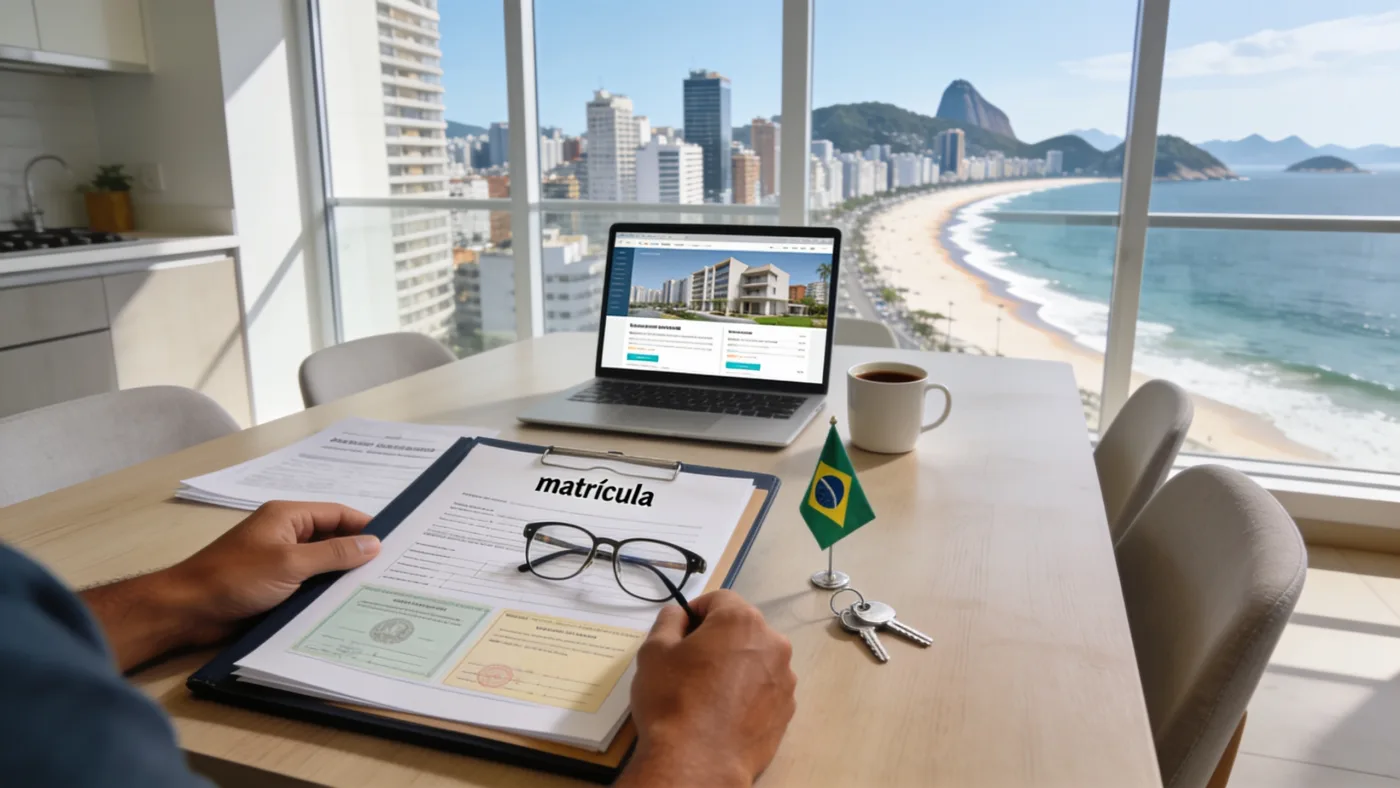
Pessoa escrevendo em um documento em uma mesa. — foto: maximilianovich
What is the absolute first step to buy property in Brazil as a foreigner? — Foto: Maximilianovich
  • Simplicity: The process is generally quicker and involves less initial bureaucracy compared to setting up a company. You only need your CPF and a valid passport.
  • Direct Ownership: You hold the title directly in your name, offering clear personal control.
  • Taxation:
  • ITBI (Imposto sobre a Transmissão de Bens Imóveis): This is a municipal transfer tax, typically between 2-4% of the property’s market value (or sale price, whichever is higher), paid at the time of purchase. For a R$ 800,000 apartment, this could be R$ 24,000 (3%).
  • Capital Gains Tax: If you sell the property in the future, capital gains (profit) are generally taxed at a progressive rate, starting at 15% for gains up to R$ 5 million. This is calculated on the difference between the sale price and the purchase price, adjusted for certain costs.
  • Inheritance Tax (ITCMD): Brazilian inheritance tax (ITCMD – Imposto sobre a Transmissão Causa Mortis e Doação) is a state-level tax, generally ranging from 2% to 8% of the property’s value, paid by the heirs.
  • Drawbacks: Less flexibility for tax planning, potential for higher capital gains tax on resale, and the property becomes part of your personal estate, subject to Brazilian succession laws.

Option B: Purchasing via a Brazilian Holding Company (The LTDA Route)

This option involves establishing a Brazilian legal entity, typically an LTDA (Limitada), which is similar to a Limited Liability Company. It’s often preferred by investors planning multiple properties, larger acquisitions, or those seeking tax efficiency and asset protection.

  • Complexity: Setting up an LTDA requires more upfront legal and accounting work, including drafting a social contract, registering with the Junta Comercial (Commercial Registry), obtaining a CNPJ, and opening a corporate bank account.
  • Asset Protection: The property is owned by the company, separating it from your personal assets, which can offer liability protection.
  • Taxation:
  • Reduced Capital Gains Tax: Profits from property sales by a company can often be taxed at lower corporate rates, especially if the company’s primary activity is real estate and managed under favorable tax regimes (e.g., Lucro Presumido). This can be a significant advantage compared to individual capital gains tax.
  • Succession Planning: Transferring company shares (which hold the property) can be simpler and potentially more tax-efficient than transferring individual property titles, avoiding or minimizing inheritance tax.
  • Foreign Direct Investment (FDI): When funds are brought into Brazil for a company purchase, they are registered with the Central Bank (Banco Central do Brasil) via the RDE-IED system. This registration is crucial for ensuring that future profits or the proceeds from a sale can be repatriated out of Brazil without issues.
  • Drawbacks: Higher initial setup and ongoing maintenance costs (accounting fees, legal compliance), more bureaucracy, and you will need a Brazilian director or administrator for the company.

Example: An investor buying a R$ 1,200,000 apartment might choose the LTDA route if they plan to eventually sell or rent out multiple properties, as the long-term tax savings on capital gains and potential inheritance tax benefits can outweigh the initial setup costs of around R$ 8,000 to R$ 15,000 for company formation.

What are the key steps in the property purchase process in Brazil?

The key steps in the Brazilian property purchase process involve signing a binding purchase agreement, obtaining a public deed (escritura pública) from a Tabelionato de Notas (Notary Public Office), paying the ITBI transfer tax, and finally registering the deed at the Cartório de Registro de Imóveis to formally transfer ownership.

Once due diligence is complete and you’ve decided on your ownership path, the transaction itself follows a specific sequence. This is where the “ritual” aspect of Brazilian real estate truly comes into play.

  • 1. Preliminary Purchase Agreement (Contrato de Compra e Venda or Promessa de Compra e Venda):
  • This contract, drafted by your lawyer, formalizes the terms of the sale, including price, payment schedule, responsibilities, and conditions precedent (e.g., clear title). It is a legally binding document but does not transfer ownership. It usually involves a down payment (sinal), typically 10-20% of the purchase price.
  • 2. Finalizing Payment Structure and Foreign Exchange:
  • Ensure your funds are properly transferred to Brazil. For significant amounts, especially if you plan to repatriate funds later, it is vital to ensure your bank registers this as “Foreign Direct Investment” (IED) in the Central Bank’s RDE-IED system. This process is complex and often requires assistance from a specialized exchange broker or bank and your lawyer.
  • 3. Public Deed (Escritura Pública de Compra e Venda):
  • The public deed is the most critical document for transferring property ownership in Brazil. It must be prepared and signed at a Tabelionato de Notas (Notary Public Office). This is where the seller formally declares the transfer of ownership to you, and you declare acceptance. All parties (or their legal representatives with valid procurações) must be present. Your lawyer will review the draft deed meticulously to ensure all terms are correct and consistent with the preliminary agreement and due diligence findings.
  • 4. Payment of ITBI (Imposto sobre a Transmissão de Bens Imóveis):
  • Before the public deed can be registered, the municipal property transfer tax (ITBI) must be paid. This is typically calculated on the greater of the sale price or the municipal valuation (valor venal) of the property. The rate varies by municipality, generally between 2% and 4%. For example, in Rio de Janeiro, the ITBI is 3%.
  • 5. Registration of the Deed (Registro da Escritura):
  • After the public deed is signed and the ITBI is paid, your lawyer will take the deed to the competent Cartório de Registro de Imóveis (Property Registry Office) where the property is located. Registration is the final and crucial step that legally transfers ownership from the seller to you and makes it public. Without registration, even with a signed public deed, you are not the legal owner in the eyes of the law. The cartório will issue a new matrícula (property registration certificate) in your name.

Warning: The Brazilian legal system operates on a “first to register” principle. If your deed is not registered, and the seller fraudulently sells the property to someone else who registers their deed first, that person will legally own the property. Always ensure immediate registration after signing the public deed and paying ITBI.

What changed in 2026 for foreign property buyers in Brazil?

In 2026, the primary changes for foreign property buyers in Brazil include enhanced digitalization of processes at the Central Bank’s RDE-IED system and various cartórios, facilitating online document submission and tracking, though in-person steps for signing public deeds remain essential for legal validity.

The Brazilian real estate landscape, while fundamentally stable regarding foreign ownership, continually sees minor adjustments, particularly in bureaucratic processes and digital integration. For 2026, the key points of attention are:

  • Enhanced Digitalization: Processes at the Central Bank’s RDE-IED system (for registering foreign investment) and many cartórios are becoming more integrated digitally. While certain in-person steps, like the signing of the public deed, remain mandatory, document submission and tracking are increasingly handled online via the gov.br portal and specific cartório platforms. This aims to streamline initial submissions and reduce physical trips for some formalities, according to official statements from the Ministry of Economy.
  • Focus on RDE-IED Compliance: With increased digitalization, the Central Bank (BACEN) has been reinforcing the importance of proper registration of foreign capital inflows for real estate investment (RDE-IED). This ensures that investors have a clear record for future capital repatriation (e.g., selling the property and taking the money out of Brazil) and for maintaining accurate financial records for tax purposes. Failure to correctly register can lead to significant hurdles later.
  • Stability in Urban Property Laws: There have been no significant legislative changes in 2026 regarding foreign ownership of urban properties. Foreign individuals and companies continue to enjoy full “fee simple” title, meaning complete ownership rights, as long as they comply with the standard legal and tax requirements. The Brazilian Migration Law (Law 13.445/2017) remains the cornerstone for general foreign presence in the country.
  • Continued Discussion on Rural Property: While urban property laws are stable, discussions about potential changes or clarifications regarding foreign ownership of rural land continue. These legislative debates are ongoing but have not resulted in new laws as of early 2026. For now, existing restrictions on rural land purchases by foreigners remain in effect.

These changes reflect Brazil’s ongoing efforts to modernize its bureaucracy and attract foreign investment while maintaining regulatory oversight. The emphasis remains on transparency and adherence to established procedures.

What are the realistic costs of buying property in Brazil?

The realistic costs of buying property in Brazil go beyond the sticker price, including municipal transfer tax (ITBI, 2-4%), public deed fees (0.3-0.5% of value), property registration fees (0.5-0.8%), and lawyer’s fees (1-3% of property value), totaling approximately 5% to 9% on top of the purchase price, according to market estimates for 2026.

Understanding the total financial outlay is crucial. Beyond the property’s purchase price, you must budget for a range of taxes, fees, and professional services. These additional costs typically add 5% to 9% to the total investment, though this can vary by state and municipality.

Practical Examples: Real Costs of Buying a R$ 800,000 Apartment

Let’s simulate the costs for purchasing an apartment valued at R$ 800,000 in a major Brazilian city, assuming an ITBI rate of 3%.

Cost Item Calculation (based on R$ 800,000) Estimated Cost (R$) Notes
ITBI (Transfer Tax) 3% of R$ 800,000 R$ 24,000 Municipal tax, usually 2-4%. Paid by buyer.
Public Deed Fees (Tabelionato de Notas) ~0.3% – 0.5% of value R$ 2,400 – R$ 4,000 Varies by state and property value, capped at certain amounts.
Property Registration Fees (Cartório de Registro de Imóveis) ~0.5% – 0.8% of value R$ 4,000 – R$ 6,400 Varies by state and property value, capped. Mandatory for ownership transfer.
Lawyer’s Fees 1% – 3% of property value R$ 8,000 – R$ 24,000 Highly recommended; varies by complexity and lawyer.
Property Certification Fees (Certidões) Fixed fees per document R$ 500 – R$ 1,200 Obtained during due diligence by your lawyer.
Real Estate Agent Commission Typically 5-6% (paid by seller) R$ 0 (usually) In Brazil, the seller usually pays the commission, but this can be negotiated.
Total Additional Costs R$ 38,900 – R$ 59,600 Excluding the purchase price. Roughly 4.8% to 7.4% of purchase price.

As seen in the table, for an R$ 800,000 apartment, you should budget an additional R$ 38,900 to R$ 59,600 (or about €7,200 to €11,000 or US$7,800 to US$12,000, depending on exchange rates in 2026) for transaction costs. This doesn’t include potential renovation costs or furnishing.

Ongoing Costs After Purchase

  • IPTU (Imposto sobre a Propriedade Predial e Territorial Urbana): Annual municipal property tax, varying widely by municipality and property value. For an R$ 800,000 apartment, this could be anywhere from R$ 1,000 to R$ 4,000 annually.
  • Condominium Fees (Taxa Condominial): For apartments, these monthly fees cover building maintenance, security, and common area utilities. They can range from R$ 300 to over R$ 1,500 depending on the building’s amenities and services.
  • Utilities: Electricity, water, gas, internet – similar to costs in other countries.

Step-by-step practical guide to closing the deal

Closing a property deal in Brazil requires a systematic approach starting with CPF acquisition, robust legal due diligence, drafting and signing a preliminary contract, transferring funds correctly, executing the public deed at a cartório, paying ITBI, and finally registering the deed at the Property Registry Office.

The entire process, from initial search to final registration, is a sequence of interdependent steps. Missing one can cause significant delays or even legal issues. Here is the safest workflow for 2026:

  • Step 1: Obtain your CPF. (1-5 days)
    • As detailed above, this is your entry ticket to any financial transaction in Brazil.
  • Step 2: Engage a Qualified Brazilian Real Estate Lawyer. (Ongoing)
    • Crucial for guidance, due diligence, and contract drafting from the very beginning.
  • Step 3: Property Search and Initial Agreement. (Weeks to months)
    • Identify suitable properties. Once you find one, your lawyer will help negotiate terms and prepare a preliminary offer.
  • Step 4: Conduct Comprehensive Due Diligence. (2-4 weeks)
    • Your lawyer gathers all necessary certidões (property, seller, tax, municipal) to ensure a clean title and free from encumbrances.
  • Step 5: Sign the Preliminary Purchase Agreement (Contrato de Compra e Venda). (1-3 days)
    • This legally binding document outlines all terms, including payment schedule and conditions. A deposit (sinal) is usually paid at this stage (e.g., 10-20% of the property value).
  • Step 6: Plan Foreign Exchange and Fund Transfer. (1-2 weeks for transfer)
    • Work with your lawyer and a specialized exchange broker/bank to transfer funds to Brazil. Ensure proper registration of Foreign Direct Investment (IED) with the Central Bank (RDE-IED system) if applicable for future repatriation.
  • Step 7: Draft and Review the Public Deed (Escritura Pública). (1 week)
    • Your lawyer will prepare the draft of the final public deed, ensuring it accurately reflects the terms and legal checks.
  • Step 8: Pay the ITBI (Property Transfer Tax). (1-3 days after deed draft is ready)
    • The municipal tax must be paid before the public deed can be registered.
  • Step 9: Sign the Public Deed at a Tabelionato de Notas. (1 day)
    • All parties (or their proxies) sign the deed. This must be done in person. The Notary Public (Tabelião) authenticates the signatures and issues the official deed.
  • Step 10: Register the Public Deed at the Cartório de Registro de Imóveis. (1-4 weeks)
    • This is the final and most crucial step for legal ownership transfer. Your lawyer will submit the signed deed and proof of ITBI payment to the competent Property Registry Office. They will issue a new property registration certificate (matrícula) in your name. This process might be partly digital via gov.br portals for submission, but usually requires physical submission of original documents.

Required Documents Checklist: How to buy property in Brazil (for foreigners)

To ensure a smooth process, have these documents ready:

  • Your CPF number (and physical card/proof, if applicable).
  • Valid passport (original and copies).
  • Proof of marital status (e.g., birth certificate, marriage certificate, divorce decree), translated by a sworn translator (tradutor juramentado) and apostilled, if applicable.
  • Proof of address in Brazil (e.g., recent utility bill).
  • Proof of funds/bank statements (may be required for due diligence or for Central Bank registration).
  • Any power of attorney (procuração) if you are being represented by a lawyer or other proxy.
  • For purchases via a company: CNPJ, corporate documents, and identification of company partners.

Comparison Table: Individual vs. Company Purchase

Here’s a simplified comparison of buying property as an individual versus through a Brazilian holding company:

Feature Purchasing as an Individual (CPF) Purchasing via a Brazilian Holding Company (LTDA/CNPJ)
Initial Setup Complexity Low (CPF only) High (company formation, CNPJ, social contract, Brazilian administrator)
Initial Setup Cost (approx.) R$ 8.00 (CPF fee) R$ 8,000 – R$ 15,000 (legal/accounting for company setup)
Ongoing Maintenance Costs Low (IPTU, condo fees) Higher (IPTU, condo fees, monthly accounting fees, annual corporate filings, admin)
Capital Gains Tax (on resale) Progressive (15% to 22.5% for individuals) Potentially lower corporate rates (e.g., 6.7% to 15% depending on tax regime and activity)
Inheritance/Succession Subject to Brazilian ITCMD (2-8%) and probate law Simpler transfer of company shares, potential ITCMD savings
Asset Protection Limited (personal liability) High (assets held by company, limited shareholder liability)
Repatriation of Funds Straightforward for declared capital gains Requires careful RDE-IED registration for foreign investment; easier for documented profits/capital return
Best For Single property, personal use, simpler transactions Multiple properties, high-value investments, long-term rental income, tax optimization, succession planning

Frequently Asked Questions (FAQ)

1. Can I get a residency visa by buying property in Brazil?

Yes, through the VICARE (Visa for Investment in Real Estate) program. As of 2026, it typically requires a minimum investment of R$ 1,000,000 in urban real estate. This investment grants you a temporary residency visa, which can lead to permanent residency after a certain period, usually four years, provided the investment is maintained. This program aims to attract high-net-worth individuals and stimulate the Brazilian real estate market, as stipulated by resolutions from the Brazilian Ministry of Foreign Affairs (Itamaraty).

2. Do I need a lawyer to buy property in Brazil?

While not legally mandatory to sign the public deed, hiring a specialized real estate lawyer is absolutely essential for foreigners. Brazil’s Civil Law system, combined with its unique bureaucracy, means that an experienced lawyer will protect your interests through comprehensive due diligence, contract drafting, and navigating the registration process. Skipping legal counsel can expose you to significant financial and legal risks, including buying a property with undisclosed debts or encumbrances, which your lawyer helps uncover through various certidões.

3. Can a foreigner own 100% of a Brazilian company that owns property?

Yes, a foreigner can own 100% of a Brazilian company, such as an LTDA (Limitada), which then owns property. This is a common and fully legal strategy, especially for foreign investors seeking asset protection, tax efficiency, and flexibility in managing multiple properties. While you can be the sole owner, the company will still need a resident Brazilian administrator to manage its day-to-day operations and represent it officially, particularly with tax authorities and banks, as per Brazilian corporate law.

4. How long does the entire property purchase process typically take?

From finding a property to final registration, the process can realistically take anywhere from 2 to 4 months. The longest part is often the due diligence (2-4 weeks) and the final registration of the deed at the Cartório de Registro de Imóveis (1-4 weeks), which can experience delays due to bureaucratic procedures. Expedited processes are rare, so setting realistic expectations and having patience is key when navigating the Brazilian system. Proper planning with your lawyer can help streamline these timelines.

5. What are the ongoing taxes after purchasing property in Brazil?

After buying property in Brazil, you’ll be responsible for a few ongoing taxes and fees. The main one is IPTU (Imposto sobre a Propriedade Predial e Territorial Urbana), an annual municipal property tax, which varies significantly by city and property value. Additionally, if you own an apartment or a house within a condominium, you will pay monthly taxa condominial (condominium fees) for building maintenance and services. These are distinct from taxes and essential for the upkeep of shared facilities and security.

Buy Property in Brazil with Confidence: Get Expert Legal Help Now

Navigating the intricacies of Brazilian property law as a foreigner can be daunting, but it doesn’t have to be. With the right legal support, your dream of owning property in this vibrant country can become a secure and rewarding reality. Our bilingual legal team at Ribeiro Cavalcante Advocacia is here to guide you through every step, ensuring compliance, protecting your investment, and making the process as smooth as possible.

Talk to a specialist lawyer now

Talk to a Lawyer on WhatsApp

Site Visit and Structural Inspection

Beyond legal checks, it’s essential to visit the property in person. For older or significantly valued properties, consider hiring a professional engineer or architect for a structural inspection (vistoria). This can uncover hidden issues that might not be apparent during a casual viewing.

Tip: Always include a clause in your preliminary purchase agreement allowing you to withdraw without penalty if the legal due diligence uncovers significant issues with the property or the seller. Your lawyer will draft this.

Who can legally buy property in Brazil as a foreigner in 2026?

As of 2026, foreigners can legally buy urban property in Brazil with full ownership rights, provided they have a valid CPF and adhere to specific legal requirements, under the general provisions of the Brazilian Migration Law (Law 13.445/2017), which fosters a welcoming environment for foreign investment.

Brazil generally welcomes foreign investment in real estate, offering significant opportunities for individuals and companies alike. The core principle is that foreigners can own property in Brazil, but certain distinctions apply, primarily between urban and rural properties, and the method of purchase.

Urban vs. Rural Property Ownership

  • Urban Properties: Foreign individuals and companies can fully own urban properties (e.g., apartments, houses, commercial buildings, lots within city limits) without significant restrictions. The process is straightforward, requiring primarily a CPF for individuals or a CNPJ (Cadastro Nacional da Pessoa Jurídica – Brazil’s company tax ID) for legal entities. This is the most common and least complicated path for foreign buyers.
  • Rural Properties: While possible, purchasing rural land by foreigners comes with specific restrictions and additional scrutiny, especially for large areas or properties near national borders. These restrictions are in place to protect national sovereignty and food security. Approval from INCRA (National Institute for Colonization and Agrarian Reform) is often required, and there are limits on the size of land that can be acquired, usually tied to “fiscal modules” (módulos fiscais), which vary by municipality. For most foreign buyers, focusing on urban real estate is significantly simpler.

Direct vs. Indirect Ownership

Foreigners can choose to buy property either directly in their personal name (using their CPF) or indirectly through a Brazilian legal entity (using a CNPJ). Each approach has different implications for taxation, legal liability, and estate planning.

Your two main paths to ownership: Individual (CPF) vs. Company (CNPJ)?

Foreigners buying property in Brazil have two main paths: purchasing as an individual using a CPF, which is simpler and quicker, or via a Brazilian holding company using a CNPJ, which offers potential tax benefits, asset protection, and greater flexibility for larger investments or multiple properties.

The decision between buying property as an individual or through a Brazilian company is crucial and depends on your investment goals, tax residency, and long-term plans. Both have distinct advantages and disadvantages.

Option A: Purchasing as a Foreign Individual (The CPF Route)

This is the most direct and common method for many foreigners, particularly those buying a single property for personal use or a relatively modest investment.

Pessoa escrevendo em um documento em uma mesa. — foto: maximilianovich
What is the absolute first step to buy property in brazil as a foreigner? — foto: maximilianovich
  • Simplicity: The process is generally quicker and involves less initial bureaucracy compared to setting up a company. You only need your CPF and a valid passport.
  • Direct Ownership: You hold the title directly in your name, offering clear personal control.
  • Taxation:
  • ITBI (Imposto sobre a Transmissão de Bens Imóveis): This is a municipal transfer tax, typically between 2-4% of the property’s market value (or sale price, whichever is higher), paid at the time of purchase. For a R$ 800,000 apartment, this could be R$ 24,000 (3%).
  • Capital Gains Tax: If you sell the property in the future, capital gains (profit) are generally taxed at a progressive rate, starting at 15% for gains up to R$ 5 million. This is calculated on the difference between the sale price and the purchase price, adjusted for certain costs.
  • Inheritance Tax (ITCMD): Brazilian inheritance tax (ITCMD – Imposto sobre a Transmissão Causa Mortis e Doação) is a state-level tax, generally ranging from 2% to 8% of the property’s value, paid by the heirs.
  • Drawbacks: Less flexibility for tax planning, potential for higher capital gains tax on resale, and the property becomes part of your personal estate, subject to Brazilian succession laws.

Option B: Purchasing via a Brazilian Holding Company (The LTDA Route)

This option involves establishing a Brazilian legal entity, typically an LTDA (Limitada), which is similar to a Limited Liability Company. It’s often preferred by investors planning multiple properties, larger acquisitions, or those seeking tax efficiency and asset protection.

  • Complexity: Setting up an LTDA requires more upfront legal and accounting work, including drafting a social contract, registering with the Junta Comercial (Commercial Registry), obtaining a CNPJ, and opening a corporate bank account.
  • Asset Protection: The property is owned by the company, separating it from your personal assets, which can offer liability protection.
  • Taxation:
  • Reduced Capital Gains Tax: Profits from property sales by a company can often be taxed at lower corporate rates, especially if the company’s primary activity is real estate and managed under favorable tax regimes (e.g., Lucro Presumido). This can be a significant advantage compared to individual capital gains tax.
  • Succession Planning: Transferring company shares (which hold the property) can be simpler and potentially more tax-efficient than transferring individual property titles, avoiding or minimizing inheritance tax.
  • Foreign Direct Investment (FDI): When funds are brought into Brazil for a company purchase, they are registered with the Central Bank (Banco Central do Brasil) via the RDE-IED system. This registration is crucial for ensuring that future profits or the proceeds from a sale can be repatriated out of Brazil without issues.
  • Drawbacks: Higher initial setup and ongoing maintenance costs (accounting fees, legal compliance), more bureaucracy, and you will need a Brazilian director or administrator for the company.

Example: An investor buying a R$ 1,200,000 apartment might choose the LTDA route if they plan to eventually sell or rent out multiple properties, as the long-term tax savings on capital gains and potential inheritance tax benefits can outweigh the initial setup costs of around R$ 8,000 to R$ 15,000 for company formation.

What are the key steps in the property purchase process in Brazil?

The key steps in the Brazilian property purchase process involve signing a binding purchase agreement, obtaining a public deed (escritura pública) from a Tabelionato de Notas (Notary Public Office), paying the ITBI transfer tax, and finally registering the deed at the Cartório de Registro de Imóveis to formally transfer ownership.

Once due diligence is complete and you’ve decided on your ownership path, the transaction itself follows a specific sequence. This is where the “ritual” aspect of Brazilian real estate truly comes into play.

  • 1. Preliminary Purchase Agreement (Contrato de Compra e Venda or Promessa de Compra e Venda):
  • This contract, drafted by your lawyer, formalizes the terms of the sale, including price, payment schedule, responsibilities, and conditions precedent (e.g., clear title). It is a legally binding document but does not transfer ownership. It usually involves a down payment (sinal), typically 10-20% of the purchase price.
  • 2. Finalizing Payment Structure and Foreign Exchange:
  • Ensure your funds are properly transferred to Brazil. For significant amounts, especially if you plan to repatriate funds later, it is vital to ensure your bank registers this as “Foreign Direct Investment” (IED) in the Central Bank’s RDE-IED system. This process is complex and often requires assistance from a specialized exchange broker or bank and your lawyer.
  • 3. Public Deed (Escritura Pública de Compra e Venda):
  • The public deed is the most critical document for transferring property ownership in Brazil. It must be prepared and signed at a Tabelionato de Notas (Notary Public Office). This is where the seller formally declares the transfer of ownership to you, and you declare acceptance. All parties (or their legal representatives with valid procurações) must be present. Your lawyer will review the draft deed meticulously to ensure all terms are correct and consistent with the preliminary agreement and due diligence findings.
  • 4. Payment of ITBI (Imposto sobre a Transmissão de Bens Imóveis):
  • Before the public deed can be registered, the municipal property transfer tax (ITBI) must be paid. This is typically calculated on the greater of the sale price or the municipal valuation (valor venal) of the property. The rate varies by municipality, generally between 2% and 4%. For example, in Rio de Janeiro, the ITBI is 3%.
  • 5. Registration of the Deed (Registro da Escritura):
  • After the public deed is signed and the ITBI is paid, your lawyer will take the deed to the competent Cartório de Registro de Imóveis (Property Registry Office) where the property is located. Registration is the final and crucial step that legally transfers ownership from the seller to you and makes it public. Without registration, even with a signed public deed, you are not the legal owner in the eyes of the law. The cartório will issue a new matrícula (property registration certificate) in your name.

Warning: The Brazilian legal system operates on a “first to register” principle. If your deed is not registered, and the seller fraudulently sells the property to someone else who registers their deed first, that person will legally own the property. Always ensure immediate registration after signing the public deed and paying ITBI.

What changed in 2026 for foreign property buyers in Brazil?

In 2026, the primary changes for foreign property buyers in Brazil include enhanced digitalization of processes at the Central Bank’s RDE-IED system and various cartórios, facilitating online document submission and tracking, though in-person steps for signing public deeds remain essential for legal validity.

The Brazilian real estate landscape, while fundamentally stable regarding foreign ownership, continually sees minor adjustments, particularly in bureaucratic processes and digital integration. For 2026, the key points of attention are:

  • Enhanced Digitalization: Processes at the Central Bank’s RDE-IED system (for registering foreign investment) and many cartórios are becoming more integrated digitally. While certain in-person steps, like the signing of the public deed, remain mandatory, document submission and tracking are increasingly handled online via the gov.br portal and specific cartório platforms. This aims to streamline initial submissions and reduce physical trips for some formalities, according to official statements from the Ministry of Economy.
  • Focus on RDE-IED Compliance: With increased digitalization, the Central Bank (BACEN) has been reinforcing the importance of proper registration of foreign capital inflows for real estate investment (RDE-IED). This ensures that investors have a clear record for future capital repatriation (e.g., selling the property and taking the money out of Brazil) and for maintaining accurate financial records for tax purposes. Failure to correctly register can lead to significant hurdles later.
  • Stability in Urban Property Laws: There have been no significant legislative changes in 2026 regarding foreign ownership of urban properties. Foreign individuals and companies continue to enjoy full “fee simple” title, meaning complete ownership rights, as long as they comply with the standard legal and tax requirements. The Brazilian Migration Law (Law 13.445/2017) remains the cornerstone for general foreign presence in the country.
  • Continued Discussion on Rural Property: While urban property laws are stable, discussions about potential changes or clarifications regarding foreign ownership of rural land continue. These legislative debates are ongoing but have not resulted in new laws as of early 2026. For now, existing restrictions on rural land purchases by foreigners remain in effect.

These changes reflect Brazil’s ongoing efforts to modernize its bureaucracy and attract foreign investment while maintaining regulatory oversight. The emphasis remains on transparency and adherence to established procedures.

What are the realistic costs of buying property in Brazil?

The realistic costs of buying property in Brazil go beyond the sticker price, including municipal transfer tax (ITBI, 2-4%), public deed fees (0.3-0.5% of value), property registration fees (0.5-0.8%), and lawyer’s fees (1-3% of property value), totaling approximately 5% to 9% on top of the purchase price, according to market estimates for 2026.

Understanding the total financial outlay is crucial. Beyond the property’s purchase price, you must budget for a range of taxes, fees, and professional services. These additional costs typically add 5% to 9% to the total investment, though this can vary by state and municipality.

Practical Examples: Real Costs of Buying a R$ 800,000 Apartment

Let’s simulate the costs for purchasing an apartment valued at R$ 800,000 in a major Brazilian city, assuming an ITBI rate of 3%.

Cost Item Calculation (based on R$ 800,000) Estimated Cost (R$) Notes
ITBI (Transfer Tax) 3% of R$ 800,000 R$ 24,000 Municipal tax, usually 2-4%. Paid by buyer.
Public Deed Fees (Tabelionato de Notas) ~0.3% – 0.5% of value R$ 2,400 – R$ 4,000 Varies by state and property value, capped at certain amounts.
Property Registration Fees (Cartório de Registro de Imóveis) ~0.5% – 0.8% of value R$ 4,000 – R$ 6,400 Varies by state and property value, capped. Mandatory for ownership transfer.
Lawyer’s Fees 1% – 3% of property value R$ 8,000 – R$ 24,000 Highly recommended; varies by complexity and lawyer.
Property Certification Fees (Certidões) Fixed fees per document R$ 500 – R$ 1,200 Obtained during due diligence by your lawyer.
Real Estate Agent Commission Typically 5-6% (paid by seller) R$ 0 (usually) In Brazil, the seller usually pays the commission, but this can be negotiated.
Total Additional Costs R$ 38,900 – R$ 59,600 Excluding the purchase price. Roughly 4.8% to 7.4% of purchase price.

As seen in the table, for an R$ 800,000 apartment, you should budget an additional R$ 38,900 to R$ 59,600 (or about €7,200 to €11,000 or US$7,800 to US$12,000, depending on exchange rates in 2026) for transaction costs. This doesn’t include potential renovation costs or furnishing.

Ongoing Costs After Purchase

  • IPTU (Imposto sobre a Propriedade Predial e Territorial Urbana): Annual municipal property tax, varying widely by municipality and property value. For an R$ 800,000 apartment, this could be anywhere from R$ 1,000 to R$ 4,000 annually.
  • Condominium Fees (Taxa Condominial): For apartments, these monthly fees cover building maintenance, security, and common area utilities. They can range from R$ 300 to over R$ 1,500 depending on the building’s amenities and services.
  • Utilities: Electricity, water, gas, internet – similar to costs in other countries.

Step-by-step practical guide to closing the deal

Closing a property deal in Brazil requires a systematic approach starting with CPF acquisition, robust legal due diligence, drafting and signing a preliminary contract, transferring funds correctly, executing the public deed at a cartório, paying ITBI, and finally registering the deed at the Property Registry Office.

The entire process, from initial search to final registration, is a sequence of interdependent steps. Missing one can cause significant delays or even legal issues. Here is the safest workflow for 2026:

  • Step 1: Obtain your CPF. (1-5 days)
    • As detailed above, this is your entry ticket to any financial transaction in Brazil.
  • Step 2: Engage a Qualified Brazilian Real Estate Lawyer. (Ongoing)
    • Crucial for guidance, due diligence, and contract drafting from the very beginning.
  • Step 3: Property Search and Initial Agreement. (Weeks to months)
    • Identify suitable properties. Once you find one, your lawyer will help negotiate terms and prepare a preliminary offer.
  • Step 4: Conduct Comprehensive Due Diligence. (2-4 weeks)
    • Your lawyer gathers all necessary certidões (property, seller, tax, municipal) to ensure a clean title and free from encumbrances.
  • Step 5: Sign the Preliminary Purchase Agreement (Contrato de Compra e Venda). (1-3 days)
    • This legally binding document outlines all terms, including payment schedule and conditions. A deposit (sinal) is usually paid at this stage (e.g., 10-20% of the property value).
  • Step 6: Plan Foreign Exchange and Fund Transfer. (1-2 weeks for transfer)
    • Work with your lawyer and a specialized exchange broker/bank to transfer funds to Brazil. Ensure proper registration of Foreign Direct Investment (IED) with the Central Bank (RDE-IED system) if applicable for future repatriation.
  • Step 7: Draft and Review the Public Deed (Escritura Pública). (1 week)
    • Your lawyer will prepare the draft of the final public deed, ensuring it accurately reflects the terms and legal checks.
  • Step 8: Pay the ITBI (Property Transfer Tax). (1-3 days after deed draft is ready)
    • The municipal tax must be paid before the public deed can be registered.
  • Step 9: Sign the Public Deed at a Tabelionato de Notas. (1 day)
    • All parties (or their proxies) sign the deed. This must be done in person. The Notary Public (Tabelião) authenticates the signatures and issues the official deed.
  • Step 10: Register the Public Deed at the Cartório de Registro de Imóveis. (1-4 weeks)
    • This is the final and most crucial step for legal ownership transfer. Your lawyer will submit the signed deed and proof of ITBI payment to the competent Property Registry Office. They will issue a new property registration certificate (matrícula) in your name. This process might be partly digital via gov.br portals for submission, but usually requires physical submission of original documents.

Required Documents Checklist: How to buy property in Brazil (for foreigners)

To ensure a smooth process, have these documents ready:

  • Your CPF number (and physical card/proof, if applicable).
  • Valid passport (original and copies).
  • Proof of marital status (e.g., birth certificate, marriage certificate, divorce decree), translated by a sworn translator (tradutor juramentado) and apostilled, if applicable.
  • Proof of address in Brazil (e.g., recent utility bill).
  • Proof of funds/bank statements (may be required for due diligence or for Central Bank registration).
  • Any power of attorney (procuração) if you are being represented by a lawyer or other proxy.
  • For purchases via a company: CNPJ, corporate documents, and identification of company partners.

Comparison Table: Individual vs. Company Purchase

Here’s a simplified comparison of buying property as an individual versus through a Brazilian holding company:

Feature Purchasing as an Individual (CPF) Purchasing via a Brazilian Holding Company (LTDA/CNPJ)
Initial Setup Complexity Low (CPF only) High (company formation, CNPJ, social contract, Brazilian administrator)
Initial Setup Cost (approx.) R$ 8.00 (CPF fee) R$ 8,000 – R$ 15,000 (legal/accounting for company setup)
Ongoing Maintenance Costs Low (IPTU, condo fees) Higher (IPTU, condo fees, monthly accounting fees, annual corporate filings, admin)
Capital Gains Tax (on resale) Progressive (15% to 22.5% for individuals) Potentially lower corporate rates (e.g., 6.7% to 15% depending on tax regime and activity)
Inheritance/Succession Subject to Brazilian ITCMD (2-8%) and probate law Simpler transfer of company shares, potential ITCMD savings
Asset Protection Limited (personal liability) High (assets held by company, limited shareholder liability)
Repatriation of Funds Straightforward for declared capital gains Requires careful RDE-IED registration for foreign investment; easier for documented profits/capital return
Best For Single property, personal use, simpler transactions Multiple properties, high-value investments, long-term rental income, tax optimization, succession planning

Frequently Asked Questions (FAQ)

1. Can I get a residency visa by buying property in Brazil?

Yes, through the VICARE (Visa for Investment in Real Estate) program. As of 2026, it typically requires a minimum investment of R$ 1,000,000 in urban real estate. This investment grants you a temporary residency visa, which can lead to permanent residency after a certain period, usually four years, provided the investment is maintained. This program aims to attract high-net-worth individuals and stimulate the Brazilian real estate market, as stipulated by resolutions from the Brazilian Ministry of Foreign Affairs (Itamaraty).

2. Do I need a lawyer to buy property in Brazil?

While not legally mandatory to sign the public deed, hiring a specialized real estate lawyer is absolutely essential for foreigners. Brazil’s Civil Law system, combined with its unique bureaucracy, means that an experienced lawyer will protect your interests through comprehensive due diligence, contract drafting, and navigating the registration process. Skipping legal counsel can expose you to significant financial and legal risks, including buying a property with undisclosed debts or encumbrances, which your lawyer helps uncover through various certidões.

3. Can a foreigner own 100% of a Brazilian company that owns property?

Yes, a foreigner can own 100% of a Brazilian company, such as an LTDA (Limitada), which then owns property. This is a common and fully legal strategy, especially for foreign investors seeking asset protection, tax efficiency, and flexibility in managing multiple properties. While you can be the sole owner, the company will still need a resident Brazilian administrator to manage its day-to-day operations and represent it officially, particularly with tax authorities and banks, as per Brazilian corporate law.

4. How long does the entire property purchase process typically take?

From finding a property to final registration, the process can realistically take anywhere from 2 to 4 months. The longest part is often the due diligence (2-4 weeks) and the final registration of the deed at the Cartório de Registro de Imóveis (1-4 weeks), which can experience delays due to bureaucratic procedures. Expedited processes are rare, so setting realistic expectations and having patience is key when navigating the Brazilian system. Proper planning with your lawyer can help streamline these timelines.

5. What are the ongoing taxes after purchasing property in Brazil?

After buying property in Brazil, you’ll be responsible for a few ongoing taxes and fees. The main one is IPTU (Imposto sobre a Propriedade Predial e Territorial Urbana), an annual municipal property tax, which varies significantly by city and property value. Additionally, if you own an apartment or a house within a condominium, you will pay monthly taxa condominial (condominium fees) for building maintenance and services. These are distinct from taxes and essential for the upkeep of shared facilities and security.

Buy Property in Brazil with Confidence: Get Expert Legal Help Now

Navigating the intricacies of Brazilian property law as a foreigner can be daunting, but it doesn’t have to be. With the right legal support, your dream of owning property in this vibrant country can become a secure and rewarding reality. Our bilingual legal team at Ribeiro Cavalcante Advocacia is here to guide you through every step, ensuring compliance, protecting your investment, and making the process as smooth as possible.

Talk to a specialist lawyer now

Talk to a Lawyer on WhatsApp

Site Visit and Structural Inspection

Beyond legal checks, it’s essential to visit the property in person. For older or significantly valued properties, consider hiring a professional engineer or architect for a structural inspection (vistoria). This can uncover hidden issues that might not be apparent during a casual viewing.

Tip: Always include a clause in your preliminary purchase agreement allowing you to withdraw without penalty if the legal due diligence uncovers significant issues with the property or the seller. Your lawyer will draft this.

Who can legally buy property in Brazil as a foreigner in 2026?

As of 2026, foreigners can legally buy urban property in Brazil with full ownership rights, provided they have a valid CPF and adhere to specific legal requirements, under the general provisions of the Brazilian Migration Law (Law 13.445/2017), which fosters a welcoming environment for foreign investment.

Brazil generally welcomes foreign investment in real estate, offering significant opportunities for individuals and companies alike. The core principle is that foreigners can own property in Brazil, but certain distinctions apply, primarily between urban and rural properties, and the method of purchase.

Urban vs. Rural Property Ownership

  • Urban Properties: Foreign individuals and companies can fully own urban properties (e.g., apartments, houses, commercial buildings, lots within city limits) without significant restrictions. The process is straightforward, requiring primarily a CPF for individuals or a CNPJ (Cadastro Nacional da Pessoa Jurídica – Brazil’s company tax ID) for legal entities. This is the most common and least complicated path for foreign buyers.
  • Rural Properties: While possible, purchasing rural land by foreigners comes with specific restrictions and additional scrutiny, especially for large areas or properties near national borders. These restrictions are in place to protect national sovereignty and food security. Approval from INCRA (National Institute for Colonization and Agrarian Reform) is often required, and there are limits on the size of land that can be acquired, usually tied to “fiscal modules” (módulos fiscais), which vary by municipality. For most foreign buyers, focusing on urban real estate is significantly simpler.

Direct vs. Indirect Ownership

Foreigners can choose to buy property either directly in their personal name (using their CPF) or indirectly through a Brazilian legal entity (using a CNPJ). Each approach has different implications for taxation, legal liability, and estate planning.

Your two main paths to ownership: Individual (CPF) vs. Company (CNPJ)?

Foreigners buying property in Brazil have two main paths: purchasing as an individual using a CPF, which is simpler and quicker, or via a Brazilian holding company using a CNPJ, which offers potential tax benefits, asset protection, and greater flexibility for larger investments or multiple properties.

The decision between buying property as an individual or through a Brazilian company is crucial and depends on your investment goals, tax residency, and long-term plans. Both have distinct advantages and disadvantages.

Option A: Purchasing as a Foreign Individual (The CPF Route)

This is the most direct and common method for many foreigners, particularly those buying a single property for personal use or a relatively modest investment.

Pessoa escrevendo em um documento em uma mesa. — foto: maximilianovich
What is the absolute first step to buy property in brazil as a foreigner? — foto: maximilianovich
  • Simplicity: The process is generally quicker and involves less initial bureaucracy compared to setting up a company. You only need your CPF and a valid passport.
  • Direct Ownership: You hold the title directly in your name, offering clear personal control.
  • Taxation:
  • ITBI (Imposto sobre a Transmissão de Bens Imóveis): This is a municipal transfer tax, typically between 2-4% of the property’s market value (or sale price, whichever is higher), paid at the time of purchase. For a R$ 800,000 apartment, this could be R$ 24,000 (3%).
  • Capital Gains Tax: If you sell the property in the future, capital gains (profit) are generally taxed at a progressive rate, starting at 15% for gains up to R$ 5 million. This is calculated on the difference between the sale price and the purchase price, adjusted for certain costs.
  • Inheritance Tax (ITCMD): Brazilian inheritance tax (ITCMD – Imposto sobre a Transmissão Causa Mortis e Doação) is a state-level tax, generally ranging from 2% to 8% of the property’s value, paid by the heirs.
  • Drawbacks: Less flexibility for tax planning, potential for higher capital gains tax on resale, and the property becomes part of your personal estate, subject to Brazilian succession laws.

Option B: Purchasing via a Brazilian Holding Company (The LTDA Route)

This option involves establishing a Brazilian legal entity, typically an LTDA (Limitada), which is similar to a Limited Liability Company. It’s often preferred by investors planning multiple properties, larger acquisitions, or those seeking tax efficiency and asset protection.

  • Complexity: Setting up an LTDA requires more upfront legal and accounting work, including drafting a social contract, registering with the Junta Comercial (Commercial Registry), obtaining a CNPJ, and opening a corporate bank account.
  • Asset Protection: The property is owned by the company, separating it from your personal assets, which can offer liability protection.
  • Taxation:
  • Reduced Capital Gains Tax: Profits from property sales by a company can often be taxed at lower corporate rates, especially if the company’s primary activity is real estate and managed under favorable tax regimes (e.g., Lucro Presumido). This can be a significant advantage compared to individual capital gains tax.
  • Succession Planning: Transferring company shares (which hold the property) can be simpler and potentially more tax-efficient than transferring individual property titles, avoiding or minimizing inheritance tax.
  • Foreign Direct Investment (FDI): When funds are brought into Brazil for a company purchase, they are registered with the Central Bank (Banco Central do Brasil) via the RDE-IED system. This registration is crucial for ensuring that future profits or the proceeds from a sale can be repatriated out of Brazil without issues.
  • Drawbacks: Higher initial setup and ongoing maintenance costs (accounting fees, legal compliance), more bureaucracy, and you will need a Brazilian director or administrator for the company.

Example: An investor buying a R$ 1,200,000 apartment might choose the LTDA route if they plan to eventually sell or rent out multiple properties, as the long-term tax savings on capital gains and potential inheritance tax benefits can outweigh the initial setup costs of around R$ 8,000 to R$ 15,000 for company formation.

What are the key steps in the property purchase process in Brazil?

The key steps in the Brazilian property purchase process involve signing a binding purchase agreement, obtaining a public deed (escritura pública) from a Tabelionato de Notas (Notary Public Office), paying the ITBI transfer tax, and finally registering the deed at the Cartório de Registro de Imóveis to formally transfer ownership.

Once due diligence is complete and you’ve decided on your ownership path, the transaction itself follows a specific sequence. This is where the “ritual” aspect of Brazilian real estate truly comes into play.

  • 1. Preliminary Purchase Agreement (Contrato de Compra e Venda or Promessa de Compra e Venda):
  • This contract, drafted by your lawyer, formalizes the terms of the sale, including price, payment schedule, responsibilities, and conditions precedent (e.g., clear title). It is a legally binding document but does not transfer ownership. It usually involves a down payment (sinal), typically 10-20% of the purchase price.
  • 2. Finalizing Payment Structure and Foreign Exchange:
  • Ensure your funds are properly transferred to Brazil. For significant amounts, especially if you plan to repatriate funds later, it is vital to ensure your bank registers this as “Foreign Direct Investment” (IED) in the Central Bank’s RDE-IED system. This process is complex and often requires assistance from a specialized exchange broker or bank and your lawyer.
  • 3. Public Deed (Escritura Pública de Compra e Venda):
  • The public deed is the most critical document for transferring property ownership in Brazil. It must be prepared and signed at a Tabelionato de Notas (Notary Public Office). This is where the seller formally declares the transfer of ownership to you, and you declare acceptance. All parties (or their legal representatives with valid procurações) must be present. Your lawyer will review the draft deed meticulously to ensure all terms are correct and consistent with the preliminary agreement and due diligence findings.
  • 4. Payment of ITBI (Imposto sobre a Transmissão de Bens Imóveis):
  • Before the public deed can be registered, the municipal property transfer tax (ITBI) must be paid. This is typically calculated on the greater of the sale price or the municipal valuation (valor venal) of the property. The rate varies by municipality, generally between 2% and 4%. For example, in Rio de Janeiro, the ITBI is 3%.
  • 5. Registration of the Deed (Registro da Escritura):
  • After the public deed is signed and the ITBI is paid, your lawyer will take the deed to the competent Cartório de Registro de Imóveis (Property Registry Office) where the property is located. Registration is the final and crucial step that legally transfers ownership from the seller to you and makes it public. Without registration, even with a signed public deed, you are not the legal owner in the eyes of the law. The cartório will issue a new matrícula (property registration certificate) in your name.

Warning: The Brazilian legal system operates on a “first to register” principle. If your deed is not registered, and the seller fraudulently sells the property to someone else who registers their deed first, that person will legally own the property. Always ensure immediate registration after signing the public deed and paying ITBI.

What changed in 2026 for foreign property buyers in Brazil?

In 2026, the primary changes for foreign property buyers in Brazil include enhanced digitalization of processes at the Central Bank’s RDE-IED system and various cartórios, facilitating online document submission and tracking, though in-person steps for signing public deeds remain essential for legal validity.

The Brazilian real estate landscape, while fundamentally stable regarding foreign ownership, continually sees minor adjustments, particularly in bureaucratic processes and digital integration. For 2026, the key points of attention are:

  • Enhanced Digitalization: Processes at the Central Bank’s RDE-IED system (for registering foreign investment) and many cartórios are becoming more integrated digitally. While certain in-person steps, like the signing of the public deed, remain mandatory, document submission and tracking are increasingly handled online via the gov.br portal and specific cartório platforms. This aims to streamline initial submissions and reduce physical trips for some formalities, according to official statements from the Ministry of Economy.
  • Focus on RDE-IED Compliance: With increased digitalization, the Central Bank (BACEN) has been reinforcing the importance of proper registration of foreign capital inflows for real estate investment (RDE-IED). This ensures that investors have a clear record for future capital repatriation (e.g., selling the property and taking the money out of Brazil) and for maintaining accurate financial records for tax purposes. Failure to correctly register can lead to significant hurdles later.
  • Stability in Urban Property Laws: There have been no significant legislative changes in 2026 regarding foreign ownership of urban properties. Foreign individuals and companies continue to enjoy full “fee simple” title, meaning complete ownership rights, as long as they comply with the standard legal and tax requirements. The Brazilian Migration Law (Law 13.445/2017) remains the cornerstone for general foreign presence in the country.
  • Continued Discussion on Rural Property: While urban property laws are stable, discussions about potential changes or clarifications regarding foreign ownership of rural land continue. These legislative debates are ongoing but have not resulted in new laws as of early 2026. For now, existing restrictions on rural land purchases by foreigners remain in effect.

These changes reflect Brazil’s ongoing efforts to modernize its bureaucracy and attract foreign investment while maintaining regulatory oversight. The emphasis remains on transparency and adherence to established procedures.

What are the realistic costs of buying property in Brazil?

The realistic costs of buying property in Brazil go beyond the sticker price, including municipal transfer tax (ITBI, 2-4%), public deed fees (0.3-0.5% of value), property registration fees (0.5-0.8%), and lawyer’s fees (1-3% of property value), totaling approximately 5% to 9% on top of the purchase price, according to market estimates for 2026.

Understanding the total financial outlay is crucial. Beyond the property’s purchase price, you must budget for a range of taxes, fees, and professional services. These additional costs typically add 5% to 9% to the total investment, though this can vary by state and municipality.

Practical Examples: Real Costs of Buying a R$ 800,000 Apartment

Let’s simulate the costs for purchasing an apartment valued at R$ 800,000 in a major Brazilian city, assuming an ITBI rate of 3%.

Cost Item Calculation (based on R$ 800,000) Estimated Cost (R$) Notes
ITBI (Transfer Tax) 3% of R$ 800,000 R$ 24,000 Municipal tax, usually 2-4%. Paid by buyer.
Public Deed Fees (Tabelionato de Notas) ~0.3% – 0.5% of value R$ 2,400 – R$ 4,000 Varies by state and property value, capped at certain amounts.
Property Registration Fees (Cartório de Registro de Imóveis) ~0.5% – 0.8% of value R$ 4,000 – R$ 6,400 Varies by state and property value, capped. Mandatory for ownership transfer.
Lawyer’s Fees 1% – 3% of property value R$ 8,000 – R$ 24,000 Highly recommended; varies by complexity and lawyer.
Property Certification Fees (Certidões) Fixed fees per document R$ 500 – R$ 1,200 Obtained during due diligence by your lawyer.
Real Estate Agent Commission Typically 5-6% (paid by seller) R$ 0 (usually) In Brazil, the seller usually pays the commission, but this can be negotiated.
Total Additional Costs R$ 38,900 – R$ 59,600 Excluding the purchase price. Roughly 4.8% to 7.4% of purchase price.

As seen in the table, for an R$ 800,000 apartment, you should budget an additional R$ 38,900 to R$ 59,600 (or about €7,200 to €11,000 or US$7,800 to US$12,000, depending on exchange rates in 2026) for transaction costs. This doesn’t include potential renovation costs or furnishing.

Ongoing Costs After Purchase

  • IPTU (Imposto sobre a Propriedade Predial e Territorial Urbana): Annual municipal property tax, varying widely by municipality and property value. For an R$ 800,000 apartment, this could be anywhere from R$ 1,000 to R$ 4,000 annually.
  • Condominium Fees (Taxa Condominial): For apartments, these monthly fees cover building maintenance, security, and common area utilities. They can range from R$ 300 to over R$ 1,500 depending on the building’s amenities and services.
  • Utilities: Electricity, water, gas, internet – similar to costs in other countries.

Step-by-step practical guide to closing the deal

Closing a property deal in Brazil requires a systematic approach starting with CPF acquisition, robust legal due diligence, drafting and signing a preliminary contract, transferring funds correctly, executing the public deed at a cartório, paying ITBI, and finally registering the deed at the Property Registry Office.

The entire process, from initial search to final registration, is a sequence of interdependent steps. Missing one can cause significant delays or even legal issues. Here is the safest workflow for 2026:

  • Step 1: Obtain your CPF. (1-5 days)
    • As detailed above, this is your entry ticket to any financial transaction in Brazil.
  • Step 2: Engage a Qualified Brazilian Real Estate Lawyer. (Ongoing)
    • Crucial for guidance, due diligence, and contract drafting from the very beginning.
  • Step 3: Property Search and Initial Agreement. (Weeks to months)
    • Identify suitable properties. Once you find one, your lawyer will help negotiate terms and prepare a preliminary offer.
  • Step 4: Conduct Comprehensive Due Diligence. (2-4 weeks)
    • Your lawyer gathers all necessary certidões (property, seller, tax, municipal) to ensure a clean title and free from encumbrances.
  • Step 5: Sign the Preliminary Purchase Agreement (Contrato de Compra e Venda). (1-3 days)
    • This legally binding document outlines all terms, including payment schedule and conditions. A deposit (sinal) is usually paid at this stage (e.g., 10-20% of the property value).
  • Step 6: Plan Foreign Exchange and Fund Transfer. (1-2 weeks for transfer)
    • Work with your lawyer and a specialized exchange broker/bank to transfer funds to Brazil. Ensure proper registration of Foreign Direct Investment (IED) with the Central Bank (RDE-IED system) if applicable for future repatriation.
  • Step 7: Draft and Review the Public Deed (Escritura Pública). (1 week)
    • Your lawyer will prepare the draft of the final public deed, ensuring it accurately reflects the terms and legal checks.
  • Step 8: Pay the ITBI (Property Transfer Tax). (1-3 days after deed draft is ready)
    • The municipal tax must be paid before the public deed can be registered.
  • Step 9: Sign the Public Deed at a Tabelionato de Notas. (1 day)
    • All parties (or their proxies) sign the deed. This must be done in person. The Notary Public (Tabelião) authenticates the signatures and issues the official deed.
  • Step 10: Register the Public Deed at the Cartório de Registro de Imóveis. (1-4 weeks)
    • This is the final and most crucial step for legal ownership transfer. Your lawyer will submit the signed deed and proof of ITBI payment to the competent Property Registry Office. They will issue a new property registration certificate (matrícula) in your name. This process might be partly digital via gov.br portals for submission, but usually requires physical submission of original documents.

Required Documents Checklist: How to buy property in Brazil (for foreigners)

To ensure a smooth process, have these documents ready:

  • Your CPF number (and physical card/proof, if applicable).
  • Valid passport (original and copies).
  • Proof of marital status (e.g., birth certificate, marriage certificate, divorce decree), translated by a sworn translator (tradutor juramentado) and apostilled, if applicable.
  • Proof of address in Brazil (e.g., recent utility bill).
  • Proof of funds/bank statements (may be required for due diligence or for Central Bank registration).
  • Any power of attorney (procuração) if you are being represented by a lawyer or other proxy.
  • For purchases via a company: CNPJ, corporate documents, and identification of company partners.

Comparison Table: Individual vs. Company Purchase

Here’s a simplified comparison of buying property as an individual versus through a Brazilian holding company:

Feature Purchasing as an Individual (CPF) Purchasing via a Brazilian Holding Company (LTDA/CNPJ)
Initial Setup Complexity Low (CPF only) High (company formation, CNPJ, social contract, Brazilian administrator)
Initial Setup Cost (approx.) R$ 8.00 (CPF fee) R$ 8,000 – R$ 15,000 (legal/accounting for company setup)
Ongoing Maintenance Costs Low (IPTU, condo fees) Higher (IPTU, condo fees, monthly accounting fees, annual corporate filings, admin)
Capital Gains Tax (on resale) Progressive (15% to 22.5% for individuals) Potentially lower corporate rates (e.g., 6.7% to 15% depending on tax regime and activity)
Inheritance/Succession Subject to Brazilian ITCMD (2-8%) and probate law Simpler transfer of company shares, potential ITCMD savings
Asset Protection Limited (personal liability) High (assets held by company, limited shareholder liability)
Repatriation of Funds Straightforward for declared capital gains Requires careful RDE-IED registration for foreign investment; easier for documented profits/capital return
Best For Single property, personal use, simpler transactions Multiple properties, high-value investments, long-term rental income, tax optimization, succession planning

Frequently Asked Questions (FAQ)

1. Can I get a residency visa by buying property in Brazil?

Yes, through the VICARE (Visa for Investment in Real Estate) program. As of 2026, it typically requires a minimum investment of R$ 1,000,000 in urban real estate. This investment grants you a temporary residency visa, which can lead to permanent residency after a certain period, usually four years, provided the investment is maintained. This program aims to attract high-net-worth individuals and stimulate the Brazilian real estate market, as stipulated by resolutions from the Brazilian Ministry of Foreign Affairs (Itamaraty).

2. Do I need a lawyer to buy property in Brazil?

While not legally mandatory to sign the public deed, hiring a specialized real estate lawyer is absolutely essential for foreigners. Brazil’s Civil Law system, combined with its unique bureaucracy, means that an experienced lawyer will protect your interests through comprehensive due diligence, contract drafting, and navigating the registration process. Skipping legal counsel can expose you to significant financial and legal risks, including buying a property with undisclosed debts or encumbrances, which your lawyer helps uncover through various certidões.

3. Can a foreigner own 100% of a Brazilian company that owns property?

Yes, a foreigner can own 100% of a Brazilian company, such as an LTDA (Limitada), which then owns property. This is a common and fully legal strategy, especially for foreign investors seeking asset protection, tax efficiency, and flexibility in managing multiple properties. While you can be the sole owner, the company will still need a resident Brazilian administrator to manage its day-to-day operations and represent it officially, particularly with tax authorities and banks, as per Brazilian corporate law.

4. How long does the entire property purchase process typically take?

From finding a property to final registration, the process can realistically take anywhere from 2 to 4 months. The longest part is often the due diligence (2-4 weeks) and the final registration of the deed at the Cartório de Registro de Imóveis (1-4 weeks), which can experience delays due to bureaucratic procedures. Expedited processes are rare, so setting realistic expectations and having patience is key when navigating the Brazilian system. Proper planning with your lawyer can help streamline these timelines.

5. What are the ongoing taxes after purchasing property in Brazil?

After buying property in Brazil, you’ll be responsible for a few ongoing taxes and fees. The main one is IPTU (Imposto sobre a Propriedade Predial e Territorial Urbana), an annual municipal property tax, which varies significantly by city and property value. Additionally, if you own an apartment or a house within a condominium, you will pay monthly taxa condominial (condominium fees) for building maintenance and services. These are distinct from taxes and essential for the upkeep of shared facilities and security.

Buy Property in Brazil with Confidence: Get Expert Legal Help Now

Navigating the intricacies of Brazilian property law as a foreigner can be daunting, but it doesn’t have to be. With the right legal support, your dream of owning property in this vibrant country can become a secure and rewarding reality. Our bilingual legal team at Ribeiro Cavalcante Advocacia is here to guide you through every step, ensuring compliance, protecting your investment, and making the process as smooth as possible.

Talk to a specialist lawyer now

Talk to a Lawyer on WhatsApp
Direct vs. Indirect Ownership

Foreigners can choose to buy property either directly in their personal name (using their CPF) or indirectly through a Brazilian legal entity (using a CNPJ). Each approach has different implications for taxation, legal liability, and estate planning.

Your two main paths to ownership: Individual (CPF) vs. Company (CNPJ)?

Foreigners buying property in Brazil have two main paths: purchasing as an individual using a CPF, which is simpler and quicker, or via a Brazilian holding company using a CNPJ, which offers potential tax benefits, asset protection, and greater flexibility for larger investments or multiple properties.

The decision between buying property as an individual or through a Brazilian company is crucial and depends on your investment goals, tax residency, and long-term plans. Both have distinct advantages and disadvantages.

Option A: Purchasing as a Foreign Individual (The CPF Route)

This is the most direct and common method for many foreigners, particularly those buying a single property for personal use or a relatively modest investment.

Pessoa escrevendo em um documento em uma mesa. — foto: maximilianovich
What is the absolute first step to buy property in brazil as a foreigner? — foto: maximilianovich
  • Simplicity: The process is generally quicker and involves less initial bureaucracy compared to setting up a company. You only need your CPF and a valid passport.
  • Direct Ownership: You hold the title directly in your name, offering clear personal control.
  • Taxation:
  • ITBI (Imposto sobre a Transmissão de Bens Imóveis): This is a municipal transfer tax, typically between 2-4% of the property’s market value (or sale price, whichever is higher), paid at the time of purchase. For a R$ 800,000 apartment, this could be R$ 24,000 (3%).
  • Capital Gains Tax: If you sell the property in the future, capital gains (profit) are generally taxed at a progressive rate, starting at 15% for gains up to R$ 5 million. This is calculated on the difference between the sale price and the purchase price, adjusted for certain costs.
  • Inheritance Tax (ITCMD): Brazilian inheritance tax (ITCMD – Imposto sobre a Transmissão Causa Mortis e Doação) is a state-level tax, generally ranging from 2% to 8% of the property’s value, paid by the heirs.
  • Drawbacks: Less flexibility for tax planning, potential for higher capital gains tax on resale, and the property becomes part of your personal estate, subject to Brazilian succession laws.

Option B: Purchasing via a Brazilian Holding Company (The LTDA Route)

This option involves establishing a Brazilian legal entity, typically an LTDA (Limitada), which is similar to a Limited Liability Company. It’s often preferred by investors planning multiple properties, larger acquisitions, or those seeking tax efficiency and asset protection.

  • Complexity: Setting up an LTDA requires more upfront legal and accounting work, including drafting a social contract, registering with the Junta Comercial (Commercial Registry), obtaining a CNPJ, and opening a corporate bank account.
  • Asset Protection: The property is owned by the company, separating it from your personal assets, which can offer liability protection.
  • Taxation:
  • Reduced Capital Gains Tax: Profits from property sales by a company can often be taxed at lower corporate rates, especially if the company’s primary activity is real estate and managed under favorable tax regimes (e.g., Lucro Presumido). This can be a significant advantage compared to individual capital gains tax.
  • Succession Planning: Transferring company shares (which hold the property) can be simpler and potentially more tax-efficient than transferring individual property titles, avoiding or minimizing inheritance tax.
  • Foreign Direct Investment (FDI): When funds are brought into Brazil for a company purchase, they are registered with the Central Bank (Banco Central do Brasil) via the RDE-IED system. This registration is crucial for ensuring that future profits or the proceeds from a sale can be repatriated out of Brazil without issues.
  • Drawbacks: Higher initial setup and ongoing maintenance costs (accounting fees, legal compliance), more bureaucracy, and you will need a Brazilian director or administrator for the company.

Example: An investor buying a R$ 1,200,000 apartment might choose the LTDA route if they plan to eventually sell or rent out multiple properties, as the long-term tax savings on capital gains and potential inheritance tax benefits can outweigh the initial setup costs of around R$ 8,000 to R$ 15,000 for company formation.

What are the key steps in the property purchase process in Brazil?

The key steps in the Brazilian property purchase process involve signing a binding purchase agreement, obtaining a public deed (escritura pública) from a Tabelionato de Notas (Notary Public Office), paying the ITBI transfer tax, and finally registering the deed at the Cartório de Registro de Imóveis to formally transfer ownership.

Once due diligence is complete and you’ve decided on your ownership path, the transaction itself follows a specific sequence. This is where the “ritual” aspect of Brazilian real estate truly comes into play.

  • 1. Preliminary Purchase Agreement (Contrato de Compra e Venda or Promessa de Compra e Venda):
  • This contract, drafted by your lawyer, formalizes the terms of the sale, including price, payment schedule, responsibilities, and conditions precedent (e.g., clear title). It is a legally binding document but does not transfer ownership. It usually involves a down payment (sinal), typically 10-20% of the purchase price.
  • 2. Finalizing Payment Structure and Foreign Exchange:
  • Ensure your funds are properly transferred to Brazil. For significant amounts, especially if you plan to repatriate funds later, it is vital to ensure your bank registers this as “Foreign Direct Investment” (IED) in the Central Bank’s RDE-IED system. This process is complex and often requires assistance from a specialized exchange broker or bank and your lawyer.
  • 3. Public Deed (Escritura Pública de Compra e Venda):
  • The public deed is the most critical document for transferring property ownership in Brazil. It must be prepared and signed at a Tabelionato de Notas (Notary Public Office). This is where the seller formally declares the transfer of ownership to you, and you declare acceptance. All parties (or their legal representatives with valid procurações) must be present. Your lawyer will review the draft deed meticulously to ensure all terms are correct and consistent with the preliminary agreement and due diligence findings.
  • 4. Payment of ITBI (Imposto sobre a Transmissão de Bens Imóveis):
  • Before the public deed can be registered, the municipal property transfer tax (ITBI) must be paid. This is typically calculated on the greater of the sale price or the municipal valuation (valor venal) of the property. The rate varies by municipality, generally between 2% and 4%. For example, in Rio de Janeiro, the ITBI is 3%.
  • 5. Registration of the Deed (Registro da Escritura):
  • After the public deed is signed and the ITBI is paid, your lawyer will take the deed to the competent Cartório de Registro de Imóveis (Property Registry Office) where the property is located. Registration is the final and crucial step that legally transfers ownership from the seller to you and makes it public. Without registration, even with a signed public deed, you are not the legal owner in the eyes of the law. The cartório will issue a new matrícula (property registration certificate) in your name.

Warning: The Brazilian legal system operates on a “first to register” principle. If your deed is not registered, and the seller fraudulently sells the property to someone else who registers their deed first, that person will legally own the property. Always ensure immediate registration after signing the public deed and paying ITBI.

What changed in 2026 for foreign property buyers in Brazil?

In 2026, the primary changes for foreign property buyers in Brazil include enhanced digitalization of processes at the Central Bank’s RDE-IED system and various cartórios, facilitating online document submission and tracking, though in-person steps for signing public deeds remain essential for legal validity.

The Brazilian real estate landscape, while fundamentally stable regarding foreign ownership, continually sees minor adjustments, particularly in bureaucratic processes and digital integration. For 2026, the key points of attention are:

  • Enhanced Digitalization: Processes at the Central Bank’s RDE-IED system (for registering foreign investment) and many cartórios are becoming more integrated digitally. While certain in-person steps, like the signing of the public deed, remain mandatory, document submission and tracking are increasingly handled online via the gov.br portal and specific cartório platforms. This aims to streamline initial submissions and reduce physical trips for some formalities, according to official statements from the Ministry of Economy.
  • Focus on RDE-IED Compliance: With increased digitalization, the Central Bank (BACEN) has been reinforcing the importance of proper registration of foreign capital inflows for real estate investment (RDE-IED). This ensures that investors have a clear record for future capital repatriation (e.g., selling the property and taking the money out of Brazil) and for maintaining accurate financial records for tax purposes. Failure to correctly register can lead to significant hurdles later.
  • Stability in Urban Property Laws: There have been no significant legislative changes in 2026 regarding foreign ownership of urban properties. Foreign individuals and companies continue to enjoy full “fee simple” title, meaning complete ownership rights, as long as they comply with the standard legal and tax requirements. The Brazilian Migration Law (Law 13.445/2017) remains the cornerstone for general foreign presence in the country.
  • Continued Discussion on Rural Property: While urban property laws are stable, discussions about potential changes or clarifications regarding foreign ownership of rural land continue. These legislative debates are ongoing but have not resulted in new laws as of early 2026. For now, existing restrictions on rural land purchases by foreigners remain in effect.

These changes reflect Brazil’s ongoing efforts to modernize its bureaucracy and attract foreign investment while maintaining regulatory oversight. The emphasis remains on transparency and adherence to established procedures.

What are the realistic costs of buying property in Brazil?

The realistic costs of buying property in Brazil go beyond the sticker price, including municipal transfer tax (ITBI, 2-4%), public deed fees (0.3-0.5% of value), property registration fees (0.5-0.8%), and lawyer’s fees (1-3% of property value), totaling approximately 5% to 9% on top of the purchase price, according to market estimates for 2026.

Understanding the total financial outlay is crucial. Beyond the property’s purchase price, you must budget for a range of taxes, fees, and professional services. These additional costs typically add 5% to 9% to the total investment, though this can vary by state and municipality.

Practical Examples: Real Costs of Buying a R$ 800,000 Apartment

Let’s simulate the costs for purchasing an apartment valued at R$ 800,000 in a major Brazilian city, assuming an ITBI rate of 3%.

Cost Item Calculation (based on R$ 800,000) Estimated Cost (R$) Notes
ITBI (Transfer Tax) 3% of R$ 800,000 R$ 24,000 Municipal tax, usually 2-4%. Paid by buyer.
Public Deed Fees (Tabelionato de Notas) ~0.3% – 0.5% of value R$ 2,400 – R$ 4,000 Varies by state and property value, capped at certain amounts.
Property Registration Fees (Cartório de Registro de Imóveis) ~0.5% – 0.8% of value R$ 4,000 – R$ 6,400 Varies by state and property value, capped. Mandatory for ownership transfer.
Lawyer’s Fees 1% – 3% of property value R$ 8,000 – R$ 24,000 Highly recommended; varies by complexity and lawyer.
Property Certification Fees (Certidões) Fixed fees per document R$ 500 – R$ 1,200 Obtained during due diligence by your lawyer.
Real Estate Agent Commission Typically 5-6% (paid by seller) R$ 0 (usually) In Brazil, the seller usually pays the commission, but this can be negotiated.
Total Additional Costs R$ 38,900 – R$ 59,600 Excluding the purchase price. Roughly 4.8% to 7.4% of purchase price.

As seen in the table, for an R$ 800,000 apartment, you should budget an additional R$ 38,900 to R$ 59,600 (or about €7,200 to €11,000 or US$7,800 to US$12,000, depending on exchange rates in 2026) for transaction costs. This doesn’t include potential renovation costs or furnishing.

Ongoing Costs After Purchase

  • IPTU (Imposto sobre a Propriedade Predial e Territorial Urbana): Annual municipal property tax, varying widely by municipality and property value. For an R$ 800,000 apartment, this could be anywhere from R$ 1,000 to R$ 4,000 annually.
  • Condominium Fees (Taxa Condominial): For apartments, these monthly fees cover building maintenance, security, and common area utilities. They can range from R$ 300 to over R$ 1,500 depending on the building’s amenities and services.
  • Utilities: Electricity, water, gas, internet – similar to costs in other countries.

Step-by-step practical guide to closing the deal

Closing a property deal in Brazil requires a systematic approach starting with CPF acquisition, robust legal due diligence, drafting and signing a preliminary contract, transferring funds correctly, executing the public deed at a cartório, paying ITBI, and finally registering the deed at the Property Registry Office.

The entire process, from initial search to final registration, is a sequence of interdependent steps. Missing one can cause significant delays or even legal issues. Here is the safest workflow for 2026:

  • Step 1: Obtain your CPF. (1-5 days)
    • As detailed above, this is your entry ticket to any financial transaction in Brazil.
  • Step 2: Engage a Qualified Brazilian Real Estate Lawyer. (Ongoing)
    • Crucial for guidance, due diligence, and contract drafting from the very beginning.
  • Step 3: Property Search and Initial Agreement. (Weeks to months)
    • Identify suitable properties. Once you find one, your lawyer will help negotiate terms and prepare a preliminary offer.
  • Step 4: Conduct Comprehensive Due Diligence. (2-4 weeks)
    • Your lawyer gathers all necessary certidões (property, seller, tax, municipal) to ensure a clean title and free from encumbrances.
  • Step 5: Sign the Preliminary Purchase Agreement (Contrato de Compra e Venda). (1-3 days)
    • This legally binding document outlines all terms, including payment schedule and conditions. A deposit (sinal) is usually paid at this stage (e.g., 10-20% of the property value).
  • Step 6: Plan Foreign Exchange and Fund Transfer. (1-2 weeks for transfer)
    • Work with your lawyer and a specialized exchange broker/bank to transfer funds to Brazil. Ensure proper registration of Foreign Direct Investment (IED) with the Central Bank (RDE-IED system) if applicable for future repatriation.
  • Step 7: Draft and Review the Public Deed (Escritura Pública). (1 week)
    • Your lawyer will prepare the draft of the final public deed, ensuring it accurately reflects the terms and legal checks.
  • Step 8: Pay the ITBI (Property Transfer Tax). (1-3 days after deed draft is ready)
    • The municipal tax must be paid before the public deed can be registered.
  • Step 9: Sign the Public Deed at a Tabelionato de Notas. (1 day)
    • All parties (or their proxies) sign the deed. This must be done in person. The Notary Public (Tabelião) authenticates the signatures and issues the official deed.
  • Step 10: Register the Public Deed at the Cartório de Registro de Imóveis. (1-4 weeks)
    • This is the final and most crucial step for legal ownership transfer. Your lawyer will submit the signed deed and proof of ITBI payment to the competent Property Registry Office. They will issue a new property registration certificate (matrícula) in your name. This process might be partly digital via gov.br portals for submission, but usually requires physical submission of original documents.

Required Documents Checklist: How to buy property in Brazil (for foreigners)

To ensure a smooth process, have these documents ready:

  • Your CPF number (and physical card/proof, if applicable).
  • Valid passport (original and copies).
  • Proof of marital status (e.g., birth certificate, marriage certificate, divorce decree), translated by a sworn translator (tradutor juramentado) and apostilled, if applicable.
  • Proof of address in Brazil (e.g., recent utility bill).
  • Proof of funds/bank statements (may be required for due diligence or for Central Bank registration).
  • Any power of attorney (procuração) if you are being represented by a lawyer or other proxy.
  • For purchases via a company: CNPJ, corporate documents, and identification of company partners.

Comparison Table: Individual vs. Company Purchase

Here’s a simplified comparison of buying property as an individual versus through a Brazilian holding company:

Feature Purchasing as an Individual (CPF) Purchasing via a Brazilian Holding Company (LTDA/CNPJ)
Initial Setup Complexity Low (CPF only) High (company formation, CNPJ, social contract, Brazilian administrator)
Initial Setup Cost (approx.) R$ 8.00 (CPF fee) R$ 8,000 – R$ 15,000 (legal/accounting for company setup)
Ongoing Maintenance Costs Low (IPTU, condo fees) Higher (IPTU, condo fees, monthly accounting fees, annual corporate filings, admin)
Capital Gains Tax (on resale) Progressive (15% to 22.5% for individuals) Potentially lower corporate rates (e.g., 6.7% to 15% depending on tax regime and activity)
Inheritance/Succession Subject to Brazilian ITCMD (2-8%) and probate law Simpler transfer of company shares, potential ITCMD savings
Asset Protection Limited (personal liability) High (assets held by company, limited shareholder liability)
Repatriation of Funds Straightforward for declared capital gains Requires careful RDE-IED registration for foreign investment; easier for documented profits/capital return
Best For Single property, personal use, simpler transactions Multiple properties, high-value investments, long-term rental income, tax optimization, succession planning

Frequently Asked Questions (FAQ)

1. Can I get a residency visa by buying property in Brazil?

Yes, through the VICARE (Visa for Investment in Real Estate) program. As of 2026, it typically requires a minimum investment of R$ 1,000,000 in urban real estate. This investment grants you a temporary residency visa, which can lead to permanent residency after a certain period, usually four years, provided the investment is maintained. This program aims to attract high-net-worth individuals and stimulate the Brazilian real estate market, as stipulated by resolutions from the Brazilian Ministry of Foreign Affairs (Itamaraty).

2. Do I need a lawyer to buy property in Brazil?

While not legally mandatory to sign the public deed, hiring a specialized real estate lawyer is absolutely essential for foreigners. Brazil’s Civil Law system, combined with its unique bureaucracy, means that an experienced lawyer will protect your interests through comprehensive due diligence, contract drafting, and navigating the registration process. Skipping legal counsel can expose you to significant financial and legal risks, including buying a property with undisclosed debts or encumbrances, which your lawyer helps uncover through various certidões.

3. Can a foreigner own 100% of a Brazilian company that owns property?

Yes, a foreigner can own 100% of a Brazilian company, such as an LTDA (Limitada), which then owns property. This is a common and fully legal strategy, especially for foreign investors seeking asset protection, tax efficiency, and flexibility in managing multiple properties. While you can be the sole owner, the company will still need a resident Brazilian administrator to manage its day-to-day operations and represent it officially, particularly with tax authorities and banks, as per Brazilian corporate law.

4. How long does the entire property purchase process typically take?

From finding a property to final registration, the process can realistically take anywhere from 2 to 4 months. The longest part is often the due diligence (2-4 weeks) and the final registration of the deed at the Cartório de Registro de Imóveis (1-4 weeks), which can experience delays due to bureaucratic procedures. Expedited processes are rare, so setting realistic expectations and having patience is key when navigating the Brazilian system. Proper planning with your lawyer can help streamline these timelines.

5. What are the ongoing taxes after purchasing property in Brazil?

After buying property in Brazil, you’ll be responsible for a few ongoing taxes and fees. The main one is IPTU (Imposto sobre a Propriedade Predial e Territorial Urbana), an annual municipal property tax, which varies significantly by city and property value. Additionally, if you own an apartment or a house within a condominium, you will pay monthly taxa condominial (condominium fees) for building maintenance and services. These are distinct from taxes and essential for the upkeep of shared facilities and security.

Buy Property in Brazil with Confidence: Get Expert Legal Help Now

Navigating the intricacies of Brazilian property law as a foreigner can be daunting, but it doesn’t have to be. With the right legal support, your dream of owning property in this vibrant country can become a secure and rewarding reality. Our bilingual legal team at Ribeiro Cavalcante Advocacia is here to guide you through every step, ensuring compliance, protecting your investment, and making the process as smooth as possible.

Talk to a specialist lawyer now

Talk to a Lawyer on WhatsApp

Site Visit and Structural Inspection

Beyond legal checks, it’s essential to visit the property in person. For older or significantly valued properties, consider hiring a professional engineer or architect for a structural inspection (vistoria). This can uncover hidden issues that might not be apparent during a casual viewing.

Tip: Always include a clause in your preliminary purchase agreement allowing you to withdraw without penalty if the legal due diligence uncovers significant issues with the property or the seller. Your lawyer will draft this.

Who can legally buy property in Brazil as a foreigner in 2026?

As of 2026, foreigners can legally buy urban property in Brazil with full ownership rights, provided they have a valid CPF and adhere to specific legal requirements, under the general provisions of the Brazilian Migration Law (Law 13.445/2017), which fosters a welcoming environment for foreign investment.

Brazil generally welcomes foreign investment in real estate, offering significant opportunities for individuals and companies alike. The core principle is that foreigners can own property in Brazil, but certain distinctions apply, primarily between urban and rural properties, and the method of purchase.

Urban vs. Rural Property Ownership

  • Urban Properties: Foreign individuals and companies can fully own urban properties (e.g., apartments, houses, commercial buildings, lots within city limits) without significant restrictions. The process is straightforward, requiring primarily a CPF for individuals or a CNPJ (Cadastro Nacional da Pessoa Jurídica – Brazil’s company tax ID) for legal entities. This is the most common and least complicated path for foreign buyers.
  • Rural Properties: While possible, purchasing rural land by foreigners comes with specific restrictions and additional scrutiny, especially for large areas or properties near national borders. These restrictions are in place to protect national sovereignty and food security. Approval from INCRA (National Institute for Colonization and Agrarian Reform) is often required, and there are limits on the size of land that can be acquired, usually tied to “fiscal modules” (módulos fiscais), which vary by municipality. For most foreign buyers, focusing on urban real estate is significantly simpler.

Direct vs. Indirect Ownership

Foreigners can choose to buy property either directly in their personal name (using their CPF) or indirectly through a Brazilian legal entity (using a CNPJ). Each approach has different implications for taxation, legal liability, and estate planning.

Your two main paths to ownership: Individual (CPF) vs. Company (CNPJ)?

Foreigners buying property in Brazil have two main paths: purchasing as an individual using a CPF, which is simpler and quicker, or via a Brazilian holding company using a CNPJ, which offers potential tax benefits, asset protection, and greater flexibility for larger investments or multiple properties.

The decision between buying property as an individual or through a Brazilian company is crucial and depends on your investment goals, tax residency, and long-term plans. Both have distinct advantages and disadvantages.

Option A: Purchasing as a Foreign Individual (The CPF Route)

This is the most direct and common method for many foreigners, particularly those buying a single property for personal use or a relatively modest investment.

Pessoa escrevendo em um documento em uma mesa. — foto: maximilianovich
What is the absolute first step to buy property in brazil as a foreigner? — foto: maximilianovich
  • Simplicity: The process is generally quicker and involves less initial bureaucracy compared to setting up a company. You only need your CPF and a valid passport.
  • Direct Ownership: You hold the title directly in your name, offering clear personal control.
  • Taxation:
  • ITBI (Imposto sobre a Transmissão de Bens Imóveis): This is a municipal transfer tax, typically between 2-4% of the property’s market value (or sale price, whichever is higher), paid at the time of purchase. For a R$ 800,000 apartment, this could be R$ 24,000 (3%).
  • Capital Gains Tax: If you sell the property in the future, capital gains (profit) are generally taxed at a progressive rate, starting at 15% for gains up to R$ 5 million. This is calculated on the difference between the sale price and the purchase price, adjusted for certain costs.
  • Inheritance Tax (ITCMD): Brazilian inheritance tax (ITCMD – Imposto sobre a Transmissão Causa Mortis e Doação) is a state-level tax, generally ranging from 2% to 8% of the property’s value, paid by the heirs.
  • Drawbacks: Less flexibility for tax planning, potential for higher capital gains tax on resale, and the property becomes part of your personal estate, subject to Brazilian succession laws.

Option B: Purchasing via a Brazilian Holding Company (The LTDA Route)

This option involves establishing a Brazilian legal entity, typically an LTDA (Limitada), which is similar to a Limited Liability Company. It’s often preferred by investors planning multiple properties, larger acquisitions, or those seeking tax efficiency and asset protection.

  • Complexity: Setting up an LTDA requires more upfront legal and accounting work, including drafting a social contract, registering with the Junta Comercial (Commercial Registry), obtaining a CNPJ, and opening a corporate bank account.
  • Asset Protection: The property is owned by the company, separating it from your personal assets, which can offer liability protection.
  • Taxation:
  • Reduced Capital Gains Tax: Profits from property sales by a company can often be taxed at lower corporate rates, especially if the company’s primary activity is real estate and managed under favorable tax regimes (e.g., Lucro Presumido). This can be a significant advantage compared to individual capital gains tax.
  • Succession Planning: Transferring company shares (which hold the property) can be simpler and potentially more tax-efficient than transferring individual property titles, avoiding or minimizing inheritance tax.
  • Foreign Direct Investment (FDI): When funds are brought into Brazil for a company purchase, they are registered with the Central Bank (Banco Central do Brasil) via the RDE-IED system. This registration is crucial for ensuring that future profits or the proceeds from a sale can be repatriated out of Brazil without issues.
  • Drawbacks: Higher initial setup and ongoing maintenance costs (accounting fees, legal compliance), more bureaucracy, and you will need a Brazilian director or administrator for the company.

Example: An investor buying a R$ 1,200,000 apartment might choose the LTDA route if they plan to eventually sell or rent out multiple properties, as the long-term tax savings on capital gains and potential inheritance tax benefits can outweigh the initial setup costs of around R$ 8,000 to R$ 15,000 for company formation.

What are the key steps in the property purchase process in Brazil?

The key steps in the Brazilian property purchase process involve signing a binding purchase agreement, obtaining a public deed (escritura pública) from a Tabelionato de Notas (Notary Public Office), paying the ITBI transfer tax, and finally registering the deed at the Cartório de Registro de Imóveis to formally transfer ownership.

Once due diligence is complete and you’ve decided on your ownership path, the transaction itself follows a specific sequence. This is where the “ritual” aspect of Brazilian real estate truly comes into play.

  • 1. Preliminary Purchase Agreement (Contrato de Compra e Venda or Promessa de Compra e Venda):
  • This contract, drafted by your lawyer, formalizes the terms of the sale, including price, payment schedule, responsibilities, and conditions precedent (e.g., clear title). It is a legally binding document but does not transfer ownership. It usually involves a down payment (sinal), typically 10-20% of the purchase price.
  • 2. Finalizing Payment Structure and Foreign Exchange:
  • Ensure your funds are properly transferred to Brazil. For significant amounts, especially if you plan to repatriate funds later, it is vital to ensure your bank registers this as “Foreign Direct Investment” (IED) in the Central Bank’s RDE-IED system. This process is complex and often requires assistance from a specialized exchange broker or bank and your lawyer.
  • 3. Public Deed (Escritura Pública de Compra e Venda):
  • The public deed is the most critical document for transferring property ownership in Brazil. It must be prepared and signed at a Tabelionato de Notas (Notary Public Office). This is where the seller formally declares the transfer of ownership to you, and you declare acceptance. All parties (or their legal representatives with valid procurações) must be present. Your lawyer will review the draft deed meticulously to ensure all terms are correct and consistent with the preliminary agreement and due diligence findings.
  • 4. Payment of ITBI (Imposto sobre a Transmissão de Bens Imóveis):
  • Before the public deed can be registered, the municipal property transfer tax (ITBI) must be paid. This is typically calculated on the greater of the sale price or the municipal valuation (valor venal) of the property. The rate varies by municipality, generally between 2% and 4%. For example, in Rio de Janeiro, the ITBI is 3%.
  • 5. Registration of the Deed (Registro da Escritura):
  • After the public deed is signed and the ITBI is paid, your lawyer will take the deed to the competent Cartório de Registro de Imóveis (Property Registry Office) where the property is located. Registration is the final and crucial step that legally transfers ownership from the seller to you and makes it public. Without registration, even with a signed public deed, you are not the legal owner in the eyes of the law. The cartório will issue a new matrícula (property registration certificate) in your name.

Warning: The Brazilian legal system operates on a “first to register” principle. If your deed is not registered, and the seller fraudulently sells the property to someone else who registers their deed first, that person will legally own the property. Always ensure immediate registration after signing the public deed and paying ITBI.

What changed in 2026 for foreign property buyers in Brazil?

In 2026, the primary changes for foreign property buyers in Brazil include enhanced digitalization of processes at the Central Bank’s RDE-IED system and various cartórios, facilitating online document submission and tracking, though in-person steps for signing public deeds remain essential for legal validity.

The Brazilian real estate landscape, while fundamentally stable regarding foreign ownership, continually sees minor adjustments, particularly in bureaucratic processes and digital integration. For 2026, the key points of attention are:

  • Enhanced Digitalization: Processes at the Central Bank’s RDE-IED system (for registering foreign investment) and many cartórios are becoming more integrated digitally. While certain in-person steps, like the signing of the public deed, remain mandatory, document submission and tracking are increasingly handled online via the gov.br portal and specific cartório platforms. This aims to streamline initial submissions and reduce physical trips for some formalities, according to official statements from the Ministry of Economy.
  • Focus on RDE-IED Compliance: With increased digitalization, the Central Bank (BACEN) has been reinforcing the importance of proper registration of foreign capital inflows for real estate investment (RDE-IED). This ensures that investors have a clear record for future capital repatriation (e.g., selling the property and taking the money out of Brazil) and for maintaining accurate financial records for tax purposes. Failure to correctly register can lead to significant hurdles later.
  • Stability in Urban Property Laws: There have been no significant legislative changes in 2026 regarding foreign ownership of urban properties. Foreign individuals and companies continue to enjoy full “fee simple” title, meaning complete ownership rights, as long as they comply with the standard legal and tax requirements. The Brazilian Migration Law (Law 13.445/2017) remains the cornerstone for general foreign presence in the country.
  • Continued Discussion on Rural Property: While urban property laws are stable, discussions about potential changes or clarifications regarding foreign ownership of rural land continue. These legislative debates are ongoing but have not resulted in new laws as of early 2026. For now, existing restrictions on rural land purchases by foreigners remain in effect.

These changes reflect Brazil’s ongoing efforts to modernize its bureaucracy and attract foreign investment while maintaining regulatory oversight. The emphasis remains on transparency and adherence to established procedures.

What are the realistic costs of buying property in Brazil?

The realistic costs of buying property in Brazil go beyond the sticker price, including municipal transfer tax (ITBI, 2-4%), public deed fees (0.3-0.5% of value), property registration fees (0.5-0.8%), and lawyer’s fees (1-3% of property value), totaling approximately 5% to 9% on top of the purchase price, according to market estimates for 2026.

Understanding the total financial outlay is crucial. Beyond the property’s purchase price, you must budget for a range of taxes, fees, and professional services. These additional costs typically add 5% to 9% to the total investment, though this can vary by state and municipality.

Practical Examples: Real Costs of Buying a R$ 800,000 Apartment

Let’s simulate the costs for purchasing an apartment valued at R$ 800,000 in a major Brazilian city, assuming an ITBI rate of 3%.

Cost Item Calculation (based on R$ 800,000) Estimated Cost (R$) Notes
ITBI (Transfer Tax) 3% of R$ 800,000 R$ 24,000 Municipal tax, usually 2-4%. Paid by buyer.
Public Deed Fees (Tabelionato de Notas) ~0.3% – 0.5% of value R$ 2,400 – R$ 4,000 Varies by state and property value, capped at certain amounts.
Property Registration Fees (Cartório de Registro de Imóveis) ~0.5% – 0.8% of value R$ 4,000 – R$ 6,400 Varies by state and property value, capped. Mandatory for ownership transfer.
Lawyer’s Fees 1% – 3% of property value R$ 8,000 – R$ 24,000 Highly recommended; varies by complexity and lawyer.
Property Certification Fees (Certidões) Fixed fees per document R$ 500 – R$ 1,200 Obtained during due diligence by your lawyer.
Real Estate Agent Commission Typically 5-6% (paid by seller) R$ 0 (usually) In Brazil, the seller usually pays the commission, but this can be negotiated.
Total Additional Costs R$ 38,900 – R$ 59,600 Excluding the purchase price. Roughly 4.8% to 7.4% of purchase price.

As seen in the table, for an R$ 800,000 apartment, you should budget an additional R$ 38,900 to R$ 59,600 (or about €7,200 to €11,000 or US$7,800 to US$12,000, depending on exchange rates in 2026) for transaction costs. This doesn’t include potential renovation costs or furnishing.

Ongoing Costs After Purchase

  • IPTU (Imposto sobre a Propriedade Predial e Territorial Urbana): Annual municipal property tax, varying widely by municipality and property value. For an R$ 800,000 apartment, this could be anywhere from R$ 1,000 to R$ 4,000 annually.
  • Condominium Fees (Taxa Condominial): For apartments, these monthly fees cover building maintenance, security, and common area utilities. They can range from R$ 300 to over R$ 1,500 depending on the building’s amenities and services.
  • Utilities: Electricity, water, gas, internet – similar to costs in other countries.

Step-by-step practical guide to closing the deal

Closing a property deal in Brazil requires a systematic approach starting with CPF acquisition, robust legal due diligence, drafting and signing a preliminary contract, transferring funds correctly, executing the public deed at a cartório, paying ITBI, and finally registering the deed at the Property Registry Office.

The entire process, from initial search to final registration, is a sequence of interdependent steps. Missing one can cause significant delays or even legal issues. Here is the safest workflow for 2026:

  • Step 1: Obtain your CPF. (1-5 days)
    • As detailed above, this is your entry ticket to any financial transaction in Brazil.
  • Step 2: Engage a Qualified Brazilian Real Estate Lawyer. (Ongoing)
    • Crucial for guidance, due diligence, and contract drafting from the very beginning.
  • Step 3: Property Search and Initial Agreement. (Weeks to months)
    • Identify suitable properties. Once you find one, your lawyer will help negotiate terms and prepare a preliminary offer.
  • Step 4: Conduct Comprehensive Due Diligence. (2-4 weeks)
    • Your lawyer gathers all necessary certidões (property, seller, tax, municipal) to ensure a clean title and free from encumbrances.
  • Step 5: Sign the Preliminary Purchase Agreement (Contrato de Compra e Venda). (1-3 days)
    • This legally binding document outlines all terms, including payment schedule and conditions. A deposit (sinal) is usually paid at this stage (e.g., 10-20% of the property value).
  • Step 6: Plan Foreign Exchange and Fund Transfer. (1-2 weeks for transfer)
    • Work with your lawyer and a specialized exchange broker/bank to transfer funds to Brazil. Ensure proper registration of Foreign Direct Investment (IED) with the Central Bank (RDE-IED system) if applicable for future repatriation.
  • Step 7: Draft and Review the Public Deed (Escritura Pública). (1 week)
    • Your lawyer will prepare the draft of the final public deed, ensuring it accurately reflects the terms and legal checks.
  • Step 8: Pay the ITBI (Property Transfer Tax). (1-3 days after deed draft is ready)
    • The municipal tax must be paid before the public deed can be registered.
  • Step 9: Sign the Public Deed at a Tabelionato de Notas. (1 day)
    • All parties (or their proxies) sign the deed. This must be done in person. The Notary Public (Tabelião) authenticates the signatures and issues the official deed.
  • Step 10: Register the Public Deed at the Cartório de Registro de Imóveis. (1-4 weeks)
    • This is the final and most crucial step for legal ownership transfer. Your lawyer will submit the signed deed and proof of ITBI payment to the competent Property Registry Office. They will issue a new property registration certificate (matrícula) in your name. This process might be partly digital via gov.br portals for submission, but usually requires physical submission of original documents.

Required Documents Checklist: How to buy property in Brazil (for foreigners)

To ensure a smooth process, have these documents ready:

  • Your CPF number (and physical card/proof, if applicable).
  • Valid passport (original and copies).
  • Proof of marital status (e.g., birth certificate, marriage certificate, divorce decree), translated by a sworn translator (tradutor juramentado) and apostilled, if applicable.
  • Proof of address in Brazil (e.g., recent utility bill).
  • Proof of funds/bank statements (may be required for due diligence or for Central Bank registration).
  • Any power of attorney (procuração) if you are being represented by a lawyer or other proxy.
  • For purchases via a company: CNPJ, corporate documents, and identification of company partners.

Comparison Table: Individual vs. Company Purchase

Here’s a simplified comparison of buying property as an individual versus through a Brazilian holding company:

Feature Purchasing as an Individual (CPF) Purchasing via a Brazilian Holding Company (LTDA/CNPJ)
Initial Setup Complexity Low (CPF only) High (company formation, CNPJ, social contract, Brazilian administrator)
Initial Setup Cost (approx.) R$ 8.00 (CPF fee) R$ 8,000 – R$ 15,000 (legal/accounting for company setup)
Ongoing Maintenance Costs Low (IPTU, condo fees) Higher (IPTU, condo fees, monthly accounting fees, annual corporate filings, admin)
Capital Gains Tax (on resale) Progressive (15% to 22.5% for individuals) Potentially lower corporate rates (e.g., 6.7% to 15% depending on tax regime and activity)
Inheritance/Succession Subject to Brazilian ITCMD (2-8%) and probate law Simpler transfer of company shares, potential ITCMD savings
Asset Protection Limited (personal liability) High (assets held by company, limited shareholder liability)
Repatriation of Funds Straightforward for declared capital gains Requires careful RDE-IED registration for foreign investment; easier for documented profits/capital return
Best For Single property, personal use, simpler transactions Multiple properties, high-value investments, long-term rental income, tax optimization, succession planning

Frequently Asked Questions (FAQ)

1. Can I get a residency visa by buying property in Brazil?

Yes, through the VICARE (Visa for Investment in Real Estate) program. As of 2026, it typically requires a minimum investment of R$ 1,000,000 in urban real estate. This investment grants you a temporary residency visa, which can lead to permanent residency after a certain period, usually four years, provided the investment is maintained. This program aims to attract high-net-worth individuals and stimulate the Brazilian real estate market, as stipulated by resolutions from the Brazilian Ministry of Foreign Affairs (Itamaraty).

2. Do I need a lawyer to buy property in Brazil?

While not legally mandatory to sign the public deed, hiring a specialized real estate lawyer is absolutely essential for foreigners. Brazil’s Civil Law system, combined with its unique bureaucracy, means that an experienced lawyer will protect your interests through comprehensive due diligence, contract drafting, and navigating the registration process. Skipping legal counsel can expose you to significant financial and legal risks, including buying a property with undisclosed debts or encumbrances, which your lawyer helps uncover through various certidões.

3. Can a foreigner own 100% of a Brazilian company that owns property?

Yes, a foreigner can own 100% of a Brazilian company, such as an LTDA (Limitada), which then owns property. This is a common and fully legal strategy, especially for foreign investors seeking asset protection, tax efficiency, and flexibility in managing multiple properties. While you can be the sole owner, the company will still need a resident Brazilian administrator to manage its day-to-day operations and represent it officially, particularly with tax authorities and banks, as per Brazilian corporate law.

4. How long does the entire property purchase process typically take?

From finding a property to final registration, the process can realistically take anywhere from 2 to 4 months. The longest part is often the due diligence (2-4 weeks) and the final registration of the deed at the Cartório de Registro de Imóveis (1-4 weeks), which can experience delays due to bureaucratic procedures. Expedited processes are rare, so setting realistic expectations and having patience is key when navigating the Brazilian system. Proper planning with your lawyer can help streamline these timelines.

5. What are the ongoing taxes after purchasing property in Brazil?

After buying property in Brazil, you’ll be responsible for a few ongoing taxes and fees. The main one is IPTU (Imposto sobre a Propriedade Predial e Territorial Urbana), an annual municipal property tax, which varies significantly by city and property value. Additionally, if you own an apartment or a house within a condominium, you will pay monthly taxa condominial (condominium fees) for building maintenance and services. These are distinct from taxes and essential for the upkeep of shared facilities and security.

Buy Property in Brazil with Confidence: Get Expert Legal Help Now

Navigating the intricacies of Brazilian property law as a foreigner can be daunting, but it doesn’t have to be. With the right legal support, your dream of owning property in this vibrant country can become a secure and rewarding reality. Our bilingual legal team at Ribeiro Cavalcante Advocacia is here to guide you through every step, ensuring compliance, protecting your investment, and making the process as smooth as possible.

Talk to a specialist lawyer now

Talk to a Lawyer on WhatsApp
This article provides your complete, step-by-step roadmap to buy property in Brazil as a foreigner—safely, legally, and with full confidence. We cut through the confusion, explaining everything from obtaining your essential CPF to navigating the final registration at the cartório (notary office). Whether you’re an expat, digital nomad, or investor, understanding these steps is crucial for a smooth and secure property acquisition.

What is the absolute first step to buy property in Brazil as a foreigner?

The absolutely first and non-negotiable step to buy property in Brazil as a foreigner is obtaining your CPF (Cadastro de Pessoas Físicas), Brazil’s individual taxpayer registry number, which is required for virtually all financial transactions, including property purchases, as mandated by the Receita Federal.

Before you can even begin the property search or sign any preliminary agreements, a CPF (Cadastro de Pessoas Físicas), which is the Brazilian individual taxpayer registry number, is absolutely mandatory. It’s akin to a Social Security Number or tax ID in other countries and is required for virtually all financial transactions in Brazil, including opening a bank account, signing contracts, and, crucially, buying property. Without a CPF, you simply cannot proceed with any legal property transaction in Brazil.

How to Get Your CPF

There are several convenient ways for foreigners to obtain a CPF, depending on whether you are in Brazil or abroad:

  • Online via Receita Federal Portal: Foreigners can initiate the CPF application process online through the Receita Federal (Brazilian IRS) website. You’ll fill out a form, print the protocol, and then follow instructions to send required documents electronically (often via email to a specific Receita Federal unit) or, in some cases, present them in person.
  • Correios (Post Office): If you are already in Brazil, this is a common and relatively convenient option. Visit a Correios branch, fill out a simple form, and pay a small service fee. They will process your application, and you’ll typically receive your CPF number immediately.
  • Brazilian Consulates Abroad: If you are outside Brazil, you can apply for a CPF at the nearest Brazilian consulate in your country of residence. This is often the best option if you need your CPF before traveling to Brazil.
  • Through a Legal Representative: You can also grant a Brazilian lawyer or authorized representative a power of attorney (procuração) to apply for a CPF on your behalf, which is particularly useful if you cannot be present in Brazil.

Required Documents for CPF

The documents needed are straightforward:

  • For Foreigners: A valid passport or another national identity document. If you are already a resident in Brazil, your CRNM (Carteira de Registro Nacional Migratório) can be used.
  • Proof of Address: A recent utility bill (water, electricity, phone) or a declaration of residence, even if it’s a temporary address in Brazil.
  • For Minors: A birth certificate and a valid ID of the parent or legal guardian are required.

Costs & Timelines for CPF

  • Receita Federal Directly (online/in-person): Free of charge if processed directly with the Receita Federal.
  • Correios or Brazilian Consulate: As of 2026, there is a service fee of approximately R$ 8.00 (roughly €1.50 or US$1.60) when applying through these channels.
  • Timeline: Often immediate when applying directly at a Receita Federal unit or via specific online channels that offer real-time processing. At Correios or consulates, it might take a few business days for the number to be fully activated in the system, though you usually receive the number on the spot.

Important: Keep your CPF number and the physical card (if issued) or printed proof in a safe place. You will need it for every stage of your property purchase and for almost every bureaucratic interaction in Brazil.

How do I find and verify a property in Brazil?

Finding and verifying a property in Brazil involves engaging a qualified real estate lawyer for thorough due diligence on both the property and the seller to prevent future legal issues, especially since the Brazilian legal system is based on Civil Law rather than Common Law.

Once you have your CPF, the property search can begin in earnest. However, before committing to any purchase, thorough due diligence is paramount. This phase is critical to avoid future legal complications and ensure a sound, secure investment. The Brazilian legal system operates under Civil Law, a system that fundamentally differs from Common Law jurisdictions, making local legal expertise indispensable.

Engage a Brazilian Real Estate Lawyer (Advogado)

This step is non-negotiable for foreigners. A lawyer specializing in real estate will conduct comprehensive checks on the property and the seller. They will ensure that the property has a clear title, is free of debts (such as outstanding property taxes or condominium fees), and that the seller has the legal capacity to sell and is not involved in any litigation that could affect the sale. Ribeiro Cavalcante Advocacia, for instance, has a team of bilingual lawyers registered with the OAB (Brazilian Bar Association) who specialize in foreign property acquisitions.

Property Title Verification (Certidões)

Your lawyer will obtain several critical documents, known as certidões (certificates), from the relevant Cartório de Registro de Imóveis (Property Registry Office) and other public bodies. These include:

  • Matrícula Atualizada do Imóvel (Updated Property Registration Certificate): This is the most crucial document. It details the property’s complete legal history, ownership chain, exact dimensions, and any existing encumbrances like mortgages, liens, or easements. It must be updated (issued within the last 30 days) to reflect the current legal status.
  • Certidão de Ônus Reais (Certificate of Real Estate Encumbrances): Confirms there are no burdens or claims on the property.
  • Certidão Negativa de Débitos de IPTU (Negative Certificate of Property Tax Debts): Proves that all municipal property taxes (IPTU) are paid up.
  • Declaração de Quitação Condominial (Condominium Clearance Declaration): For apartments or properties within condominiums, this confirms all condominium fees are paid.
  • Certidões Negativas do Vendedor (Negative Certificates of the Seller): These are critical. They check if the seller (individual or company) has outstanding debts, lawsuits, or tax issues that could potentially invalidate the sale or lead to future legal complications. This includes certificates from federal, state, and municipal tax authorities, labor courts, and civil courts.

Option B: Purchasing via a Brazilian Holding Company (The LTDA Route)

This option involves establishing a Brazilian legal entity, typically an LTDA (Limitada), which is similar to a Limited Liability Company. It’s often preferred by investors planning multiple properties, larger acquisitions, or those seeking tax efficiency and asset protection.

  • Complexity: Setting up an LTDA requires more upfront legal and accounting work, including drafting a social contract, registering with the Junta Comercial (Commercial Registry), obtaining a CNPJ, and opening a corporate bank account.
  • Asset Protection: The property is owned by the company, separating it from your personal assets, which can offer liability protection.
  • Taxation:
  • Reduced Capital Gains Tax: Profits from property sales by a company can often be taxed at lower corporate rates, especially if the company’s primary activity is real estate and managed under favorable tax regimes (e.g., Lucro Presumido). This can be a significant advantage compared to individual capital gains tax.
  • Succession Planning: Transferring company shares (which hold the property) can be simpler and potentially more tax-efficient than transferring individual property titles, avoiding or minimizing inheritance tax.
  • Foreign Direct Investment (FDI): When funds are brought into Brazil for a company purchase, they are registered with the Central Bank (Banco Central do Brasil) via the RDE-IED system. This registration is crucial for ensuring that future profits or the proceeds from a sale can be repatriated out of Brazil without issues.
  • Drawbacks: Higher initial setup and ongoing maintenance costs (accounting fees, legal compliance), more bureaucracy, and you will need a Brazilian director or administrator for the company.

Example: An investor buying a R$ 1,200,000 apartment might choose the LTDA route if they plan to eventually sell or rent out multiple properties, as the long-term tax savings on capital gains and potential inheritance tax benefits can outweigh the initial setup costs of around R$ 8,000 to R$ 15,000 for company formation.

What are the key steps in the property purchase process in Brazil?

The key steps in the Brazilian property purchase process involve signing a binding purchase agreement, obtaining a public deed (escritura pública) from a Tabelionato de Notas (Notary Public Office), paying the ITBI transfer tax, and finally registering the deed at the Cartório de Registro de Imóveis to formally transfer ownership.

Once due diligence is complete and you’ve decided on your ownership path, the transaction itself follows a specific sequence. This is where the “ritual” aspect of Brazilian real estate truly comes into play.

  • 1. Preliminary Purchase Agreement (Contrato de Compra e Venda or Promessa de Compra e Venda):
  • This contract, drafted by your lawyer, formalizes the terms of the sale, including price, payment schedule, responsibilities, and conditions precedent (e.g., clear title). It is a legally binding document but does not transfer ownership. It usually involves a down payment (sinal), typically 10-20% of the purchase price.
  • 2. Finalizing Payment Structure and Foreign Exchange:
  • Ensure your funds are properly transferred to Brazil. For significant amounts, especially if you plan to repatriate funds later, it is vital to ensure your bank registers this as “Foreign Direct Investment” (IED) in the Central Bank’s RDE-IED system. This process is complex and often requires assistance from a specialized exchange broker or bank and your lawyer.
  • 3. Public Deed (Escritura Pública de Compra e Venda):
  • The public deed is the most critical document for transferring property ownership in Brazil. It must be prepared and signed at a Tabelionato de Notas (Notary Public Office). This is where the seller formally declares the transfer of ownership to you, and you declare acceptance. All parties (or their legal representatives with valid procurações) must be present. Your lawyer will review the draft deed meticulously to ensure all terms are correct and consistent with the preliminary agreement and due diligence findings.
  • 4. Payment of ITBI (Imposto sobre a Transmissão de Bens Imóveis):
  • Before the public deed can be registered, the municipal property transfer tax (ITBI) must be paid. This is typically calculated on the greater of the sale price or the municipal valuation (valor venal) of the property. The rate varies by municipality, generally between 2% and 4%. For example, in Rio de Janeiro, the ITBI is 3%.
  • 5. Registration of the Deed (Registro da Escritura):
  • After the public deed is signed and the ITBI is paid, your lawyer will take the deed to the competent Cartório de Registro de Imóveis (Property Registry Office) where the property is located. Registration is the final and crucial step that legally transfers ownership from the seller to you and makes it public. Without registration, even with a signed public deed, you are not the legal owner in the eyes of the law. The cartório will issue a new matrícula (property registration certificate) in your name.

Warning: The Brazilian legal system operates on a “first to register” principle. If your deed is not registered, and the seller fraudulently sells the property to someone else who registers their deed first, that person will legally own the property. Always ensure immediate registration after signing the public deed and paying ITBI.

What changed in 2026 for foreign property buyers in Brazil?

In 2026, the primary changes for foreign property buyers in Brazil include enhanced digitalization of processes at the Central Bank’s RDE-IED system and various cartórios, facilitating online document submission and tracking, though in-person steps for signing public deeds remain essential for legal validity.

The Brazilian real estate landscape, while fundamentally stable regarding foreign ownership, continually sees minor adjustments, particularly in bureaucratic processes and digital integration. For 2026, the key points of attention are:

  • Enhanced Digitalization: Processes at the Central Bank’s RDE-IED system (for registering foreign investment) and many cartórios are becoming more integrated digitally. While certain in-person steps, like the signing of the public deed, remain mandatory, document submission and tracking are increasingly handled online via the gov.br portal and specific cartório platforms. This aims to streamline initial submissions and reduce physical trips for some formalities, according to official statements from the Ministry of Economy.
  • Focus on RDE-IED Compliance: With increased digitalization, the Central Bank (BACEN) has been reinforcing the importance of proper registration of foreign capital inflows for real estate investment (RDE-IED). This ensures that investors have a clear record for future capital repatriation (e.g., selling the property and taking the money out of Brazil) and for maintaining accurate financial records for tax purposes. Failure to correctly register can lead to significant hurdles later.
  • Stability in Urban Property Laws: There have been no significant legislative changes in 2026 regarding foreign ownership of urban properties. Foreign individuals and companies continue to enjoy full “fee simple” title, meaning complete ownership rights, as long as they comply with the standard legal and tax requirements. The Brazilian Migration Law (Law 13.445/2017) remains the cornerstone for general foreign presence in the country.
  • Continued Discussion on Rural Property: While urban property laws are stable, discussions about potential changes or clarifications regarding foreign ownership of rural land continue. These legislative debates are ongoing but have not resulted in new laws as of early 2026. For now, existing restrictions on rural land purchases by foreigners remain in effect.

These changes reflect Brazil’s ongoing efforts to modernize its bureaucracy and attract foreign investment while maintaining regulatory oversight. The emphasis remains on transparency and adherence to established procedures.

What are the realistic costs of buying property in Brazil?

The realistic costs of buying property in Brazil go beyond the sticker price, including municipal transfer tax (ITBI, 2-4%), public deed fees (0.3-0.5% of value), property registration fees (0.5-0.8%), and lawyer’s fees (1-3% of property value), totaling approximately 5% to 9% on top of the purchase price, according to market estimates for 2026.

Understanding the total financial outlay is crucial. Beyond the property’s purchase price, you must budget for a range of taxes, fees, and professional services. These additional costs typically add 5% to 9% to the total investment, though this can vary by state and municipality.

Practical Examples: Real Costs of Buying a R$ 800,000 Apartment

Let’s simulate the costs for purchasing an apartment valued at R$ 800,000 in a major Brazilian city, assuming an ITBI rate of 3%.

Cost Item Calculation (based on R$ 800,000) Estimated Cost (R$) Notes
ITBI (Transfer Tax) 3% of R$ 800,000 R$ 24,000 Municipal tax, usually 2-4%. Paid by buyer.
Public Deed Fees (Tabelionato de Notas) ~0.3% – 0.5% of value R$ 2,400 – R$ 4,000 Varies by state and property value, capped at certain amounts.
Property Registration Fees (Cartório de Registro de Imóveis) ~0.5% – 0.8% of value R$ 4,000 – R$ 6,400 Varies by state and property value, capped. Mandatory for ownership transfer.
Lawyer’s Fees 1% – 3% of property value R$ 8,000 – R$ 24,000 Highly recommended; varies by complexity and lawyer.
Property Certification Fees (Certidões) Fixed fees per document R$ 500 – R$ 1,200 Obtained during due diligence by your lawyer.
Real Estate Agent Commission Typically 5-6% (paid by seller) R$ 0 (usually) In Brazil, the seller usually pays the commission, but this can be negotiated.
Total Additional Costs R$ 38,900 – R$ 59,600 Excluding the purchase price. Roughly 4.8% to 7.4% of purchase price.

As seen in the table, for an R$ 800,000 apartment, you should budget an additional R$ 38,900 to R$ 59,600 (or about €7,200 to €11,000 or US$7,800 to US$12,000, depending on exchange rates in 2026) for transaction costs. This doesn’t include potential renovation costs or furnishing.

Ongoing Costs After Purchase

  • IPTU (Imposto sobre a Propriedade Predial e Territorial Urbana): Annual municipal property tax, varying widely by municipality and property value. For an R$ 800,000 apartment, this could be anywhere from R$ 1,000 to R$ 4,000 annually.
  • Condominium Fees (Taxa Condominial): For apartments, these monthly fees cover building maintenance, security, and common area utilities. They can range from R$ 300 to over R$ 1,500 depending on the building’s amenities and services.
  • Utilities: Electricity, water, gas, internet – similar to costs in other countries.

Step-by-step practical guide to closing the deal

Closing a property deal in Brazil requires a systematic approach starting with CPF acquisition, robust legal due diligence, drafting and signing a preliminary contract, transferring funds correctly, executing the public deed at a cartório, paying ITBI, and finally registering the deed at the Property Registry Office.

The entire process, from initial search to final registration, is a sequence of interdependent steps. Missing one can cause significant delays or even legal issues. Here is the safest workflow for 2026:

  • Step 1: Obtain your CPF. (1-5 days)
    • As detailed above, this is your entry ticket to any financial transaction in Brazil.
  • Step 2: Engage a Qualified Brazilian Real Estate Lawyer. (Ongoing)
    • Crucial for guidance, due diligence, and contract drafting from the very beginning.
  • Step 3: Property Search and Initial Agreement. (Weeks to months)
    • Identify suitable properties. Once you find one, your lawyer will help negotiate terms and prepare a preliminary offer.
  • Step 4: Conduct Comprehensive Due Diligence. (2-4 weeks)
    • Your lawyer gathers all necessary certidões (property, seller, tax, municipal) to ensure a clean title and free from encumbrances.
  • Step 5: Sign the Preliminary Purchase Agreement (Contrato de Compra e Venda). (1-3 days)
    • This legally binding document outlines all terms, including payment schedule and conditions. A deposit (sinal) is usually paid at this stage (e.g., 10-20% of the property value).
  • Step 6: Plan Foreign Exchange and Fund Transfer. (1-2 weeks for transfer)
    • Work with your lawyer and a specialized exchange broker/bank to transfer funds to Brazil. Ensure proper registration of Foreign Direct Investment (IED) with the Central Bank (RDE-IED system) if applicable for future repatriation.
  • Step 7: Draft and Review the Public Deed (Escritura Pública). (1 week)
    • Your lawyer will prepare the draft of the final public deed, ensuring it accurately reflects the terms and legal checks.
  • Step 8: Pay the ITBI (Property Transfer Tax). (1-3 days after deed draft is ready)
    • The municipal tax must be paid before the public deed can be registered.
  • Step 9: Sign the Public Deed at a Tabelionato de Notas. (1 day)
    • All parties (or their proxies) sign the deed. This must be done in person. The Notary Public (Tabelião) authenticates the signatures and issues the official deed.
  • Step 10: Register the Public Deed at the Cartório de Registro de Imóveis. (1-4 weeks)
    • This is the final and most crucial step for legal ownership transfer. Your lawyer will submit the signed deed and proof of ITBI payment to the competent Property Registry Office. They will issue a new property registration certificate (matrícula) in your name. This process might be partly digital via gov.br portals for submission, but usually requires physical submission of original documents.

Required Documents Checklist: How to buy property in Brazil (for foreigners)

To ensure a smooth process, have these documents ready:

  • Your CPF number (and physical card/proof, if applicable).
  • Valid passport (original and copies).
  • Proof of marital status (e.g., birth certificate, marriage certificate, divorce decree), translated by a sworn translator (tradutor juramentado) and apostilled, if applicable.
  • Proof of address in Brazil (e.g., recent utility bill).
  • Proof of funds/bank statements (may be required for due diligence or for Central Bank registration).
  • Any power of attorney (procuração) if you are being represented by a lawyer or other proxy.
  • For purchases via a company: CNPJ, corporate documents, and identification of company partners.

Comparison Table: Individual vs. Company Purchase

Here’s a simplified comparison of buying property as an individual versus through a Brazilian holding company:

Feature Purchasing as an Individual (CPF) Purchasing via a Brazilian Holding Company (LTDA/CNPJ)
Initial Setup Complexity Low (CPF only) High (company formation, CNPJ, social contract, Brazilian administrator)
Initial Setup Cost (approx.) R$ 8.00 (CPF fee) R$ 8,000 – R$ 15,000 (legal/accounting for company setup)
Ongoing Maintenance Costs Low (IPTU, condo fees) Higher (IPTU, condo fees, monthly accounting fees, annual corporate filings, admin)
Capital Gains Tax (on resale) Progressive (15% to 22.5% for individuals) Potentially lower corporate rates (e.g., 6.7% to 15% depending on tax regime and activity)
Inheritance/Succession Subject to Brazilian ITCMD (2-8%) and probate law Simpler transfer of company shares, potential ITCMD savings
Asset Protection Limited (personal liability) High (assets held by company, limited shareholder liability)
Repatriation of Funds Straightforward for declared capital gains Requires careful RDE-IED registration for foreign investment; easier for documented profits/capital return
Best For Single property, personal use, simpler transactions Multiple properties, high-value investments, long-term rental income, tax optimization, succession planning

Frequently Asked Questions (FAQ)

1. Can I get a residency visa by buying property in Brazil?

Yes, through the VICARE (Visa for Investment in Real Estate) program. As of 2026, it typically requires a minimum investment of R$ 1,000,000 in urban real estate. This investment grants you a temporary residency visa, which can lead to permanent residency after a certain period, usually four years, provided the investment is maintained. This program aims to attract high-net-worth individuals and stimulate the Brazilian real estate market, as stipulated by resolutions from the Brazilian Ministry of Foreign Affairs (Itamaraty).

2. Do I need a lawyer to buy property in Brazil?

While not legally mandatory to sign the public deed, hiring a specialized real estate lawyer is absolutely essential for foreigners. Brazil’s Civil Law system, combined with its unique bureaucracy, means that an experienced lawyer will protect your interests through comprehensive due diligence, contract drafting, and navigating the registration process. Skipping legal counsel can expose you to significant financial and legal risks, including buying a property with undisclosed debts or encumbrances, which your lawyer helps uncover through various certidões.

3. Can a foreigner own 100% of a Brazilian company that owns property?

Yes, a foreigner can own 100% of a Brazilian company, such as an LTDA (Limitada), which then owns property. This is a common and fully legal strategy, especially for foreign investors seeking asset protection, tax efficiency, and flexibility in managing multiple properties. While you can be the sole owner, the company will still need a resident Brazilian administrator to manage its day-to-day operations and represent it officially, particularly with tax authorities and banks, as per Brazilian corporate law.

4. How long does the entire property purchase process typically take?

From finding a property to final registration, the process can realistically take anywhere from 2 to 4 months. The longest part is often the due diligence (2-4 weeks) and the final registration of the deed at the Cartório de Registro de Imóveis (1-4 weeks), which can experience delays due to bureaucratic procedures. Expedited processes are rare, so setting realistic expectations and having patience is key when navigating the Brazilian system. Proper planning with your lawyer can help streamline these timelines.

5. What are the ongoing taxes after purchasing property in Brazil?

After buying property in Brazil, you’ll be responsible for a few ongoing taxes and fees. The main one is IPTU (Imposto sobre a Propriedade Predial e Territorial Urbana), an annual municipal property tax, which varies significantly by city and property value. Additionally, if you own an apartment or a house within a condominium, you will pay monthly taxa condominial (condominium fees) for building maintenance and services. These are distinct from taxes and essential for the upkeep of shared facilities and security.

Buy Property in Brazil with Confidence: Get Expert Legal Help Now

Navigating the intricacies of Brazilian property law as a foreigner can be daunting, but it doesn’t have to be. With the right legal support, your dream of owning property in this vibrant country can become a secure and rewarding reality. Our bilingual legal team at Ribeiro Cavalcante Advocacia is here to guide you through every step, ensuring compliance, protecting your investment, and making the process as smooth as possible.

Talk to a specialist lawyer now

Talk to a Lawyer on WhatsApp

Direct vs. Indirect Ownership

Foreigners can choose to buy property either directly in their personal name (using their CPF) or indirectly through a Brazilian legal entity (using a CNPJ). Each approach has different implications for taxation, legal liability, and estate planning.

Your two main paths to ownership: Individual (CPF) vs. Company (CNPJ)?

Foreigners buying property in Brazil have two main paths: purchasing as an individual using a CPF, which is simpler and quicker, or via a Brazilian holding company using a CNPJ, which offers potential tax benefits, asset protection, and greater flexibility for larger investments or multiple properties.

The decision between buying property as an individual or through a Brazilian company is crucial and depends on your investment goals, tax residency, and long-term plans. Both have distinct advantages and disadvantages.

Option A: Purchasing as a Foreign Individual (The CPF Route)

This is the most direct and common method for many foreigners, particularly those buying a single property for personal use or a relatively modest investment.

Pessoa escrevendo em um documento em uma mesa. — foto: maximilianovich
What is the absolute first step to buy property in brazil as a foreigner? — foto: maximilianovich
  • Simplicity: The process is generally quicker and involves less initial bureaucracy compared to setting up a company. You only need your CPF and a valid passport.
  • Direct Ownership: You hold the title directly in your name, offering clear personal control.
  • Taxation:
  • ITBI (Imposto sobre a Transmissão de Bens Imóveis): This is a municipal transfer tax, typically between 2-4% of the property’s market value (or sale price, whichever is higher), paid at the time of purchase. For a R$ 800,000 apartment, this could be R$ 24,000 (3%).
  • Capital Gains Tax: If you sell the property in the future, capital gains (profit) are generally taxed at a progressive rate, starting at 15% for gains up to R$ 5 million. This is calculated on the difference between the sale price and the purchase price, adjusted for certain costs.
  • Inheritance Tax (ITCMD): Brazilian inheritance tax (ITCMD – Imposto sobre a Transmissão Causa Mortis e Doação) is a state-level tax, generally ranging from 2% to 8% of the property’s value, paid by the heirs.
  • Drawbacks: Less flexibility for tax planning, potential for higher capital gains tax on resale, and the property becomes part of your personal estate, subject to Brazilian succession laws.

Option B: Purchasing via a Brazilian Holding Company (The LTDA Route)

This option involves establishing a Brazilian legal entity, typically an LTDA (Limitada), which is similar to a Limited Liability Company. It’s often preferred by investors planning multiple properties, larger acquisitions, or those seeking tax efficiency and asset protection.

  • Complexity: Setting up an LTDA requires more upfront legal and accounting work, including drafting a social contract, registering with the Junta Comercial (Commercial Registry), obtaining a CNPJ, and opening a corporate bank account.
  • Asset Protection: The property is owned by the company, separating it from your personal assets, which can offer liability protection.
  • Taxation:
  • Reduced Capital Gains Tax: Profits from property sales by a company can often be taxed at lower corporate rates, especially if the company’s primary activity is real estate and managed under favorable tax regimes (e.g., Lucro Presumido). This can be a significant advantage compared to individual capital gains tax.
  • Succession Planning: Transferring company shares (which hold the property) can be simpler and potentially more tax-efficient than transferring individual property titles, avoiding or minimizing inheritance tax.
  • Foreign Direct Investment (FDI): When funds are brought into Brazil for a company purchase, they are registered with the Central Bank (Banco Central do Brasil) via the RDE-IED system. This registration is crucial for ensuring that future profits or the proceeds from a sale can be repatriated out of Brazil without issues.
  • Drawbacks: Higher initial setup and ongoing maintenance costs (accounting fees, legal compliance), more bureaucracy, and you will need a Brazilian director or administrator for the company.

Example: An investor buying a R$ 1,200,000 apartment might choose the LTDA route if they plan to eventually sell or rent out multiple properties, as the long-term tax savings on capital gains and potential inheritance tax benefits can outweigh the initial setup costs of around R$ 8,000 to R$ 15,000 for company formation.

What are the key steps in the property purchase process in Brazil?

The key steps in the Brazilian property purchase process involve signing a binding purchase agreement, obtaining a public deed (escritura pública) from a Tabelionato de Notas (Notary Public Office), paying the ITBI transfer tax, and finally registering the deed at the Cartório de Registro de Imóveis to formally transfer ownership.

Once due diligence is complete and you’ve decided on your ownership path, the transaction itself follows a specific sequence. This is where the “ritual” aspect of Brazilian real estate truly comes into play.

  • 1. Preliminary Purchase Agreement (Contrato de Compra e Venda or Promessa de Compra e Venda):
  • This contract, drafted by your lawyer, formalizes the terms of the sale, including price, payment schedule, responsibilities, and conditions precedent (e.g., clear title). It is a legally binding document but does not transfer ownership. It usually involves a down payment (sinal), typically 10-20% of the purchase price.
  • 2. Finalizing Payment Structure and Foreign Exchange:
  • Ensure your funds are properly transferred to Brazil. For significant amounts, especially if you plan to repatriate funds later, it is vital to ensure your bank registers this as “Foreign Direct Investment” (IED) in the Central Bank’s RDE-IED system. This process is complex and often requires assistance from a specialized exchange broker or bank and your lawyer.
  • 3. Public Deed (Escritura Pública de Compra e Venda):
  • The public deed is the most critical document for transferring property ownership in Brazil. It must be prepared and signed at a Tabelionato de Notas (Notary Public Office). This is where the seller formally declares the transfer of ownership to you, and you declare acceptance. All parties (or their legal representatives with valid procurações) must be present. Your lawyer will review the draft deed meticulously to ensure all terms are correct and consistent with the preliminary agreement and due diligence findings.
  • 4. Payment of ITBI (Imposto sobre a Transmissão de Bens Imóveis):
  • Before the public deed can be registered, the municipal property transfer tax (ITBI) must be paid. This is typically calculated on the greater of the sale price or the municipal valuation (valor venal) of the property. The rate varies by municipality, generally between 2% and 4%. For example, in Rio de Janeiro, the ITBI is 3%.
  • 5. Registration of the Deed (Registro da Escritura):
  • After the public deed is signed and the ITBI is paid, your lawyer will take the deed to the competent Cartório de Registro de Imóveis (Property Registry Office) where the property is located. Registration is the final and crucial step that legally transfers ownership from the seller to you and makes it public. Without registration, even with a signed public deed, you are not the legal owner in the eyes of the law. The cartório will issue a new matrícula (property registration certificate) in your name.

Warning: The Brazilian legal system operates on a “first to register” principle. If your deed is not registered, and the seller fraudulently sells the property to someone else who registers their deed first, that person will legally own the property. Always ensure immediate registration after signing the public deed and paying ITBI.

What changed in 2026 for foreign property buyers in Brazil?

In 2026, the primary changes for foreign property buyers in Brazil include enhanced digitalization of processes at the Central Bank’s RDE-IED system and various cartórios, facilitating online document submission and tracking, though in-person steps for signing public deeds remain essential for legal validity.

The Brazilian real estate landscape, while fundamentally stable regarding foreign ownership, continually sees minor adjustments, particularly in bureaucratic processes and digital integration. For 2026, the key points of attention are:

  • Enhanced Digitalization: Processes at the Central Bank’s RDE-IED system (for registering foreign investment) and many cartórios are becoming more integrated digitally. While certain in-person steps, like the signing of the public deed, remain mandatory, document submission and tracking are increasingly handled online via the gov.br portal and specific cartório platforms. This aims to streamline initial submissions and reduce physical trips for some formalities, according to official statements from the Ministry of Economy.
  • Focus on RDE-IED Compliance: With increased digitalization, the Central Bank (BACEN) has been reinforcing the importance of proper registration of foreign capital inflows for real estate investment (RDE-IED). This ensures that investors have a clear record for future capital repatriation (e.g., selling the property and taking the money out of Brazil) and for maintaining accurate financial records for tax purposes. Failure to correctly register can lead to significant hurdles later.
  • Stability in Urban Property Laws: There have been no significant legislative changes in 2026 regarding foreign ownership of urban properties. Foreign individuals and companies continue to enjoy full “fee simple” title, meaning complete ownership rights, as long as they comply with the standard legal and tax requirements. The Brazilian Migration Law (Law 13.445/2017) remains the cornerstone for general foreign presence in the country.
  • Continued Discussion on Rural Property: While urban property laws are stable, discussions about potential changes or clarifications regarding foreign ownership of rural land continue. These legislative debates are ongoing but have not resulted in new laws as of early 2026. For now, existing restrictions on rural land purchases by foreigners remain in effect.

These changes reflect Brazil’s ongoing efforts to modernize its bureaucracy and attract foreign investment while maintaining regulatory oversight. The emphasis remains on transparency and adherence to established procedures.

What are the realistic costs of buying property in Brazil?

The realistic costs of buying property in Brazil go beyond the sticker price, including municipal transfer tax (ITBI, 2-4%), public deed fees (0.3-0.5% of value), property registration fees (0.5-0.8%), and lawyer’s fees (1-3% of property value), totaling approximately 5% to 9% on top of the purchase price, according to market estimates for 2026.

Understanding the total financial outlay is crucial. Beyond the property’s purchase price, you must budget for a range of taxes, fees, and professional services. These additional costs typically add 5% to 9% to the total investment, though this can vary by state and municipality.

Practical Examples: Real Costs of Buying a R$ 800,000 Apartment

Let’s simulate the costs for purchasing an apartment valued at R$ 800,000 in a major Brazilian city, assuming an ITBI rate of 3%.

Cost Item Calculation (based on R$ 800,000) Estimated Cost (R$) Notes
ITBI (Transfer Tax) 3% of R$ 800,000 R$ 24,000 Municipal tax, usually 2-4%. Paid by buyer.
Public Deed Fees (Tabelionato de Notas) ~0.3% – 0.5% of value R$ 2,400 – R$ 4,000 Varies by state and property value, capped at certain amounts.
Property Registration Fees (Cartório de Registro de Imóveis) ~0.5% – 0.8% of value R$ 4,000 – R$ 6,400 Varies by state and property value, capped. Mandatory for ownership transfer.
Lawyer’s Fees 1% – 3% of property value R$ 8,000 – R$ 24,000 Highly recommended; varies by complexity and lawyer.
Property Certification Fees (Certidões) Fixed fees per document R$ 500 – R$ 1,200 Obtained during due diligence by your lawyer.
Real Estate Agent Commission Typically 5-6% (paid by seller) R$ 0 (usually) In Brazil, the seller usually pays the commission, but this can be negotiated.
Total Additional Costs R$ 38,900 – R$ 59,600 Excluding the purchase price. Roughly 4.8% to 7.4% of purchase price.

As seen in the table, for an R$ 800,000 apartment, you should budget an additional R$ 38,900 to R$ 59,600 (or about €7,200 to €11,000 or US$7,800 to US$12,000, depending on exchange rates in 2026) for transaction costs. This doesn’t include potential renovation costs or furnishing.

Ongoing Costs After Purchase

  • IPTU (Imposto sobre a Propriedade Predial e Territorial Urbana): Annual municipal property tax, varying widely by municipality and property value. For an R$ 800,000 apartment, this could be anywhere from R$ 1,000 to R$ 4,000 annually.
  • Condominium Fees (Taxa Condominial): For apartments, these monthly fees cover building maintenance, security, and common area utilities. They can range from R$ 300 to over R$ 1,500 depending on the building’s amenities and services.
  • Utilities: Electricity, water, gas, internet – similar to costs in other countries.

Step-by-step practical guide to closing the deal

Closing a property deal in Brazil requires a systematic approach starting with CPF acquisition, robust legal due diligence, drafting and signing a preliminary contract, transferring funds correctly, executing the public deed at a cartório, paying ITBI, and finally registering the deed at the Property Registry Office.

The entire process, from initial search to final registration, is a sequence of interdependent steps. Missing one can cause significant delays or even legal issues. Here is the safest workflow for 2026:

  • Step 1: Obtain your CPF. (1-5 days)
    • As detailed above, this is your entry ticket to any financial transaction in Brazil.
  • Step 2: Engage a Qualified Brazilian Real Estate Lawyer. (Ongoing)
    • Crucial for guidance, due diligence, and contract drafting from the very beginning.
  • Step 3: Property Search and Initial Agreement. (Weeks to months)
    • Identify suitable properties. Once you find one, your lawyer will help negotiate terms and prepare a preliminary offer.
  • Step 4: Conduct Comprehensive Due Diligence. (2-4 weeks)
    • Your lawyer gathers all necessary certidões (property, seller, tax, municipal) to ensure a clean title and free from encumbrances.
  • Step 5: Sign the Preliminary Purchase Agreement (Contrato de Compra e Venda). (1-3 days)
    • This legally binding document outlines all terms, including payment schedule and conditions. A deposit (sinal) is usually paid at this stage (e.g., 10-20% of the property value).
  • Step 6: Plan Foreign Exchange and Fund Transfer. (1-2 weeks for transfer)
    • Work with your lawyer and a specialized exchange broker/bank to transfer funds to Brazil. Ensure proper registration of Foreign Direct Investment (IED) with the Central Bank (RDE-IED system) if applicable for future repatriation.
  • Step 7: Draft and Review the Public Deed (Escritura Pública). (1 week)
    • Your lawyer will prepare the draft of the final public deed, ensuring it accurately reflects the terms and legal checks.
  • Step 8: Pay the ITBI (Property Transfer Tax). (1-3 days after deed draft is ready)
    • The municipal tax must be paid before the public deed can be registered.
  • Step 9: Sign the Public Deed at a Tabelionato de Notas. (1 day)
    • All parties (or their proxies) sign the deed. This must be done in person. The Notary Public (Tabelião) authenticates the signatures and issues the official deed.
  • Step 10: Register the Public Deed at the Cartório de Registro de Imóveis. (1-4 weeks)
    • This is the final and most crucial step for legal ownership transfer. Your lawyer will submit the signed deed and proof of ITBI payment to the competent Property Registry Office. They will issue a new property registration certificate (matrícula) in your name. This process might be partly digital via gov.br portals for submission, but usually requires physical submission of original documents.

Required Documents Checklist: How to buy property in Brazil (for foreigners)

To ensure a smooth process, have these documents ready:

  • Your CPF number (and physical card/proof, if applicable).
  • Valid passport (original and copies).
  • Proof of marital status (e.g., birth certificate, marriage certificate, divorce decree), translated by a sworn translator (tradutor juramentado) and apostilled, if applicable.
  • Proof of address in Brazil (e.g., recent utility bill).
  • Proof of funds/bank statements (may be required for due diligence or for Central Bank registration).
  • Any power of attorney (procuração) if you are being represented by a lawyer or other proxy.
  • For purchases via a company: CNPJ, corporate documents, and identification of company partners.

Comparison Table: Individual vs. Company Purchase

Here’s a simplified comparison of buying property as an individual versus through a Brazilian holding company:

Feature Purchasing as an Individual (CPF) Purchasing via a Brazilian Holding Company (LTDA/CNPJ)
Initial Setup Complexity Low (CPF only) High (company formation, CNPJ, social contract, Brazilian administrator)
Initial Setup Cost (approx.) R$ 8.00 (CPF fee) R$ 8,000 – R$ 15,000 (legal/accounting for company setup)
Ongoing Maintenance Costs Low (IPTU, condo fees) Higher (IPTU, condo fees, monthly accounting fees, annual corporate filings, admin)
Capital Gains Tax (on resale) Progressive (15% to 22.5% for individuals) Potentially lower corporate rates (e.g., 6.7% to 15% depending on tax regime and activity)
Inheritance/Succession Subject to Brazilian ITCMD (2-8%) and probate law Simpler transfer of company shares, potential ITCMD savings
Asset Protection Limited (personal liability) High (assets held by company, limited shareholder liability)
Repatriation of Funds Straightforward for declared capital gains Requires careful RDE-IED registration for foreign investment; easier for documented profits/capital return
Best For Single property, personal use, simpler transactions Multiple properties, high-value investments, long-term rental income, tax optimization, succession planning

Frequently Asked Questions (FAQ)

1. Can I get a residency visa by buying property in Brazil?

Yes, through the VICARE (Visa for Investment in Real Estate) program. As of 2026, it typically requires a minimum investment of R$ 1,000,000 in urban real estate. This investment grants you a temporary residency visa, which can lead to permanent residency after a certain period, usually four years, provided the investment is maintained. This program aims to attract high-net-worth individuals and stimulate the Brazilian real estate market, as stipulated by resolutions from the Brazilian Ministry of Foreign Affairs (Itamaraty).

2. Do I need a lawyer to buy property in Brazil?

While not legally mandatory to sign the public deed, hiring a specialized real estate lawyer is absolutely essential for foreigners. Brazil’s Civil Law system, combined with its unique bureaucracy, means that an experienced lawyer will protect your interests through comprehensive due diligence, contract drafting, and navigating the registration process. Skipping legal counsel can expose you to significant financial and legal risks, including buying a property with undisclosed debts or encumbrances, which your lawyer helps uncover through various certidões.

3. Can a foreigner own 100% of a Brazilian company that owns property?

Yes, a foreigner can own 100% of a Brazilian company, such as an LTDA (Limitada), which then owns property. This is a common and fully legal strategy, especially for foreign investors seeking asset protection, tax efficiency, and flexibility in managing multiple properties. While you can be the sole owner, the company will still need a resident Brazilian administrator to manage its day-to-day operations and represent it officially, particularly with tax authorities and banks, as per Brazilian corporate law.

4. How long does the entire property purchase process typically take?

From finding a property to final registration, the process can realistically take anywhere from 2 to 4 months. The longest part is often the due diligence (2-4 weeks) and the final registration of the deed at the Cartório de Registro de Imóveis (1-4 weeks), which can experience delays due to bureaucratic procedures. Expedited processes are rare, so setting realistic expectations and having patience is key when navigating the Brazilian system. Proper planning with your lawyer can help streamline these timelines.

5. What are the ongoing taxes after purchasing property in Brazil?

After buying property in Brazil, you’ll be responsible for a few ongoing taxes and fees. The main one is IPTU (Imposto sobre a Propriedade Predial e Territorial Urbana), an annual municipal property tax, which varies significantly by city and property value. Additionally, if you own an apartment or a house within a condominium, you will pay monthly taxa condominial (condominium fees) for building maintenance and services. These are distinct from taxes and essential for the upkeep of shared facilities and security.

Buy Property in Brazil with Confidence: Get Expert Legal Help Now

Navigating the intricacies of Brazilian property law as a foreigner can be daunting, but it doesn’t have to be. With the right legal support, your dream of owning property in this vibrant country can become a secure and rewarding reality. Our bilingual legal team at Ribeiro Cavalcante Advocacia is here to guide you through every step, ensuring compliance, protecting your investment, and making the process as smooth as possible.

Talk to a specialist lawyer now

Talk to a Lawyer on WhatsApp
Site Visit and Structural Inspection

Beyond legal checks, it’s essential to visit the property in person. For older or significantly valued properties, consider hiring a professional engineer or architect for a structural inspection (vistoria). This can uncover hidden issues that might not be apparent during a casual viewing.

Tip: Always include a clause in your preliminary purchase agreement allowing you to withdraw without penalty if the legal due diligence uncovers significant issues with the property or the seller. Your lawyer will draft this.

Who can legally buy property in Brazil as a foreigner in 2026?

As of 2026, foreigners can legally buy urban property in Brazil with full ownership rights, provided they have a valid CPF and adhere to specific legal requirements, under the general provisions of the Brazilian Migration Law (Law 13.445/2017), which fosters a welcoming environment for foreign investment.

Brazil generally welcomes foreign investment in real estate, offering significant opportunities for individuals and companies alike. The core principle is that foreigners can own property in Brazil, but certain distinctions apply, primarily between urban and rural properties, and the method of purchase.

Urban vs. Rural Property Ownership

  • Urban Properties: Foreign individuals and companies can fully own urban properties (e.g., apartments, houses, commercial buildings, lots within city limits) without significant restrictions. The process is straightforward, requiring primarily a CPF for individuals or a CNPJ (Cadastro Nacional da Pessoa Jurídica – Brazil’s company tax ID) for legal entities. This is the most common and least complicated path for foreign buyers.
  • Rural Properties: While possible, purchasing rural land by foreigners comes with specific restrictions and additional scrutiny, especially for large areas or properties near national borders. These restrictions are in place to protect national sovereignty and food security. Approval from INCRA (National Institute for Colonization and Agrarian Reform) is often required, and there are limits on the size of land that can be acquired, usually tied to “fiscal modules” (módulos fiscais), which vary by municipality. For most foreign buyers, focusing on urban real estate is significantly simpler.

Direct vs. Indirect Ownership

Foreigners can choose to buy property either directly in their personal name (using their CPF) or indirectly through a Brazilian legal entity (using a CNPJ). Each approach has different implications for taxation, legal liability, and estate planning.

Your two main paths to ownership: Individual (CPF) vs. Company (CNPJ)?

Foreigners buying property in Brazil have two main paths: purchasing as an individual using a CPF, which is simpler and quicker, or via a Brazilian holding company using a CNPJ, which offers potential tax benefits, asset protection, and greater flexibility for larger investments or multiple properties.

The decision between buying property as an individual or through a Brazilian company is crucial and depends on your investment goals, tax residency, and long-term plans. Both have distinct advantages and disadvantages.

Option A: Purchasing as a Foreign Individual (The CPF Route)

This is the most direct and common method for many foreigners, particularly those buying a single property for personal use or a relatively modest investment.

Pessoa escrevendo em um documento em uma mesa. — foto: maximilianovich
What is the absolute first step to buy property in brazil as a foreigner? — foto: maximilianovich
  • Simplicity: The process is generally quicker and involves less initial bureaucracy compared to setting up a company. You only need your CPF and a valid passport.
  • Direct Ownership: You hold the title directly in your name, offering clear personal control.
  • Taxation:
  • ITBI (Imposto sobre a Transmissão de Bens Imóveis): This is a municipal transfer tax, typically between 2-4% of the property’s market value (or sale price, whichever is higher), paid at the time of purchase. For a R$ 800,000 apartment, this could be R$ 24,000 (3%).
  • Capital Gains Tax: If you sell the property in the future, capital gains (profit) are generally taxed at a progressive rate, starting at 15% for gains up to R$ 5 million. This is calculated on the difference between the sale price and the purchase price, adjusted for certain costs.
  • Inheritance Tax (ITCMD): Brazilian inheritance tax (ITCMD – Imposto sobre a Transmissão Causa Mortis e Doação) is a state-level tax, generally ranging from 2% to 8% of the property’s value, paid by the heirs.
  • Drawbacks: Less flexibility for tax planning, potential for higher capital gains tax on resale, and the property becomes part of your personal estate, subject to Brazilian succession laws.

Option B: Purchasing via a Brazilian Holding Company (The LTDA Route)

This option involves establishing a Brazilian legal entity, typically an LTDA (Limitada), which is similar to a Limited Liability Company. It’s often preferred by investors planning multiple properties, larger acquisitions, or those seeking tax efficiency and asset protection.

  • Complexity: Setting up an LTDA requires more upfront legal and accounting work, including drafting a social contract, registering with the Junta Comercial (Commercial Registry), obtaining a CNPJ, and opening a corporate bank account.
  • Asset Protection: The property is owned by the company, separating it from your personal assets, which can offer liability protection.
  • Taxation:
  • Reduced Capital Gains Tax: Profits from property sales by a company can often be taxed at lower corporate rates, especially if the company’s primary activity is real estate and managed under favorable tax regimes (e.g., Lucro Presumido). This can be a significant advantage compared to individual capital gains tax.
  • Succession Planning: Transferring company shares (which hold the property) can be simpler and potentially more tax-efficient than transferring individual property titles, avoiding or minimizing inheritance tax.
  • Foreign Direct Investment (FDI): When funds are brought into Brazil for a company purchase, they are registered with the Central Bank (Banco Central do Brasil) via the RDE-IED system. This registration is crucial for ensuring that future profits or the proceeds from a sale can be repatriated out of Brazil without issues.
  • Drawbacks: Higher initial setup and ongoing maintenance costs (accounting fees, legal compliance), more bureaucracy, and you will need a Brazilian director or administrator for the company.

Example: An investor buying a R$ 1,200,000 apartment might choose the LTDA route if they plan to eventually sell or rent out multiple properties, as the long-term tax savings on capital gains and potential inheritance tax benefits can outweigh the initial setup costs of around R$ 8,000 to R$ 15,000 for company formation.

What are the key steps in the property purchase process in Brazil?

The key steps in the Brazilian property purchase process involve signing a binding purchase agreement, obtaining a public deed (escritura pública) from a Tabelionato de Notas (Notary Public Office), paying the ITBI transfer tax, and finally registering the deed at the Cartório de Registro de Imóveis to formally transfer ownership.

Once due diligence is complete and you’ve decided on your ownership path, the transaction itself follows a specific sequence. This is where the “ritual” aspect of Brazilian real estate truly comes into play.

  • 1. Preliminary Purchase Agreement (Contrato de Compra e Venda or Promessa de Compra e Venda):
  • This contract, drafted by your lawyer, formalizes the terms of the sale, including price, payment schedule, responsibilities, and conditions precedent (e.g., clear title). It is a legally binding document but does not transfer ownership. It usually involves a down payment (sinal), typically 10-20% of the purchase price.
  • 2. Finalizing Payment Structure and Foreign Exchange:
  • Ensure your funds are properly transferred to Brazil. For significant amounts, especially if you plan to repatriate funds later, it is vital to ensure your bank registers this as “Foreign Direct Investment” (IED) in the Central Bank’s RDE-IED system. This process is complex and often requires assistance from a specialized exchange broker or bank and your lawyer.
  • 3. Public Deed (Escritura Pública de Compra e Venda):
  • The public deed is the most critical document for transferring property ownership in Brazil. It must be prepared and signed at a Tabelionato de Notas (Notary Public Office). This is where the seller formally declares the transfer of ownership to you, and you declare acceptance. All parties (or their legal representatives with valid procurações) must be present. Your lawyer will review the draft deed meticulously to ensure all terms are correct and consistent with the preliminary agreement and due diligence findings.
  • 4. Payment of ITBI (Imposto sobre a Transmissão de Bens Imóveis):
  • Before the public deed can be registered, the municipal property transfer tax (ITBI) must be paid. This is typically calculated on the greater of the sale price or the municipal valuation (valor venal) of the property. The rate varies by municipality, generally between 2% and 4%. For example, in Rio de Janeiro, the ITBI is 3%.
  • 5. Registration of the Deed (Registro da Escritura):
  • After the public deed is signed and the ITBI is paid, your lawyer will take the deed to the competent Cartório de Registro de Imóveis (Property Registry Office) where the property is located. Registration is the final and crucial step that legally transfers ownership from the seller to you and makes it public. Without registration, even with a signed public deed, you are not the legal owner in the eyes of the law. The cartório will issue a new matrícula (property registration certificate) in your name.

Warning: The Brazilian legal system operates on a “first to register” principle. If your deed is not registered, and the seller fraudulently sells the property to someone else who registers their deed first, that person will legally own the property. Always ensure immediate registration after signing the public deed and paying ITBI.

What changed in 2026 for foreign property buyers in Brazil?

In 2026, the primary changes for foreign property buyers in Brazil include enhanced digitalization of processes at the Central Bank’s RDE-IED system and various cartórios, facilitating online document submission and tracking, though in-person steps for signing public deeds remain essential for legal validity.

The Brazilian real estate landscape, while fundamentally stable regarding foreign ownership, continually sees minor adjustments, particularly in bureaucratic processes and digital integration. For 2026, the key points of attention are:

  • Enhanced Digitalization: Processes at the Central Bank’s RDE-IED system (for registering foreign investment) and many cartórios are becoming more integrated digitally. While certain in-person steps, like the signing of the public deed, remain mandatory, document submission and tracking are increasingly handled online via the gov.br portal and specific cartório platforms. This aims to streamline initial submissions and reduce physical trips for some formalities, according to official statements from the Ministry of Economy.
  • Focus on RDE-IED Compliance: With increased digitalization, the Central Bank (BACEN) has been reinforcing the importance of proper registration of foreign capital inflows for real estate investment (RDE-IED). This ensures that investors have a clear record for future capital repatriation (e.g., selling the property and taking the money out of Brazil) and for maintaining accurate financial records for tax purposes. Failure to correctly register can lead to significant hurdles later.
  • Stability in Urban Property Laws: There have been no significant legislative changes in 2026 regarding foreign ownership of urban properties. Foreign individuals and companies continue to enjoy full “fee simple” title, meaning complete ownership rights, as long as they comply with the standard legal and tax requirements. The Brazilian Migration Law (Law 13.445/2017) remains the cornerstone for general foreign presence in the country.
  • Continued Discussion on Rural Property: While urban property laws are stable, discussions about potential changes or clarifications regarding foreign ownership of rural land continue. These legislative debates are ongoing but have not resulted in new laws as of early 2026. For now, existing restrictions on rural land purchases by foreigners remain in effect.

These changes reflect Brazil’s ongoing efforts to modernize its bureaucracy and attract foreign investment while maintaining regulatory oversight. The emphasis remains on transparency and adherence to established procedures.

What are the realistic costs of buying property in Brazil?

The realistic costs of buying property in Brazil go beyond the sticker price, including municipal transfer tax (ITBI, 2-4%), public deed fees (0.3-0.5% of value), property registration fees (0.5-0.8%), and lawyer’s fees (1-3% of property value), totaling approximately 5% to 9% on top of the purchase price, according to market estimates for 2026.

Understanding the total financial outlay is crucial. Beyond the property’s purchase price, you must budget for a range of taxes, fees, and professional services. These additional costs typically add 5% to 9% to the total investment, though this can vary by state and municipality.

Practical Examples: Real Costs of Buying a R$ 800,000 Apartment

Let’s simulate the costs for purchasing an apartment valued at R$ 800,000 in a major Brazilian city, assuming an ITBI rate of 3%.

Cost Item Calculation (based on R$ 800,000) Estimated Cost (R$) Notes
ITBI (Transfer Tax) 3% of R$ 800,000 R$ 24,000 Municipal tax, usually 2-4%. Paid by buyer.
Public Deed Fees (Tabelionato de Notas) ~0.3% – 0.5% of value R$ 2,400 – R$ 4,000 Varies by state and property value, capped at certain amounts.
Property Registration Fees (Cartório de Registro de Imóveis) ~0.5% – 0.8% of value R$ 4,000 – R$ 6,400 Varies by state and property value, capped. Mandatory for ownership transfer.
Lawyer’s Fees 1% – 3% of property value R$ 8,000 – R$ 24,000 Highly recommended; varies by complexity and lawyer.
Property Certification Fees (Certidões) Fixed fees per document R$ 500 – R$ 1,200 Obtained during due diligence by your lawyer.
Real Estate Agent Commission Typically 5-6% (paid by seller) R$ 0 (usually) In Brazil, the seller usually pays the commission, but this can be negotiated.
Total Additional Costs R$ 38,900 – R$ 59,600 Excluding the purchase price. Roughly 4.8% to 7.4% of purchase price.

As seen in the table, for an R$ 800,000 apartment, you should budget an additional R$ 38,900 to R$ 59,600 (or about €7,200 to €11,000 or US$7,800 to US$12,000, depending on exchange rates in 2026) for transaction costs. This doesn’t include potential renovation costs or furnishing.

Ongoing Costs After Purchase

  • IPTU (Imposto sobre a Propriedade Predial e Territorial Urbana): Annual municipal property tax, varying widely by municipality and property value. For an R$ 800,000 apartment, this could be anywhere from R$ 1,000 to R$ 4,000 annually.
  • Condominium Fees (Taxa Condominial): For apartments, these monthly fees cover building maintenance, security, and common area utilities. They can range from R$ 300 to over R$ 1,500 depending on the building’s amenities and services.
  • Utilities: Electricity, water, gas, internet – similar to costs in other countries.

Step-by-step practical guide to closing the deal

Closing a property deal in Brazil requires a systematic approach starting with CPF acquisition, robust legal due diligence, drafting and signing a preliminary contract, transferring funds correctly, executing the public deed at a cartório, paying ITBI, and finally registering the deed at the Property Registry Office.

The entire process, from initial search to final registration, is a sequence of interdependent steps. Missing one can cause significant delays or even legal issues. Here is the safest workflow for 2026:

  • Step 1: Obtain your CPF. (1-5 days)
    • As detailed above, this is your entry ticket to any financial transaction in Brazil.
  • Step 2: Engage a Qualified Brazilian Real Estate Lawyer. (Ongoing)
    • Crucial for guidance, due diligence, and contract drafting from the very beginning.
  • Step 3: Property Search and Initial Agreement. (Weeks to months)
    • Identify suitable properties. Once you find one, your lawyer will help negotiate terms and prepare a preliminary offer.
  • Step 4: Conduct Comprehensive Due Diligence. (2-4 weeks)
    • Your lawyer gathers all necessary certidões (property, seller, tax, municipal) to ensure a clean title and free from encumbrances.
  • Step 5: Sign the Preliminary Purchase Agreement (Contrato de Compra e Venda). (1-3 days)
    • This legally binding document outlines all terms, including payment schedule and conditions. A deposit (sinal) is usually paid at this stage (e.g., 10-20% of the property value).
  • Step 6: Plan Foreign Exchange and Fund Transfer. (1-2 weeks for transfer)
    • Work with your lawyer and a specialized exchange broker/bank to transfer funds to Brazil. Ensure proper registration of Foreign Direct Investment (IED) with the Central Bank (RDE-IED system) if applicable for future repatriation.
  • Step 7: Draft and Review the Public Deed (Escritura Pública). (1 week)
    • Your lawyer will prepare the draft of the final public deed, ensuring it accurately reflects the terms and legal checks.
  • Step 8: Pay the ITBI (Property Transfer Tax). (1-3 days after deed draft is ready)
    • The municipal tax must be paid before the public deed can be registered.
  • Step 9: Sign the Public Deed at a Tabelionato de Notas. (1 day)
    • All parties (or their proxies) sign the deed. This must be done in person. The Notary Public (Tabelião) authenticates the signatures and issues the official deed.
  • Step 10: Register the Public Deed at the Cartório de Registro de Imóveis. (1-4 weeks)
    • This is the final and most crucial step for legal ownership transfer. Your lawyer will submit the signed deed and proof of ITBI payment to the competent Property Registry Office. They will issue a new property registration certificate (matrícula) in your name. This process might be partly digital via gov.br portals for submission, but usually requires physical submission of original documents.

Required Documents Checklist: How to buy property in Brazil (for foreigners)

To ensure a smooth process, have these documents ready:

  • Your CPF number (and physical card/proof, if applicable).
  • Valid passport (original and copies).
  • Proof of marital status (e.g., birth certificate, marriage certificate, divorce decree), translated by a sworn translator (tradutor juramentado) and apostilled, if applicable.
  • Proof of address in Brazil (e.g., recent utility bill).
  • Proof of funds/bank statements (may be required for due diligence or for Central Bank registration).
  • Any power of attorney (procuração) if you are being represented by a lawyer or other proxy.
  • For purchases via a company: CNPJ, corporate documents, and identification of company partners.

Comparison Table: Individual vs. Company Purchase

Here’s a simplified comparison of buying property as an individual versus through a Brazilian holding company:

Feature Purchasing as an Individual (CPF) Purchasing via a Brazilian Holding Company (LTDA/CNPJ)
Initial Setup Complexity Low (CPF only) High (company formation, CNPJ, social contract, Brazilian administrator)
Initial Setup Cost (approx.) R$ 8.00 (CPF fee) R$ 8,000 – R$ 15,000 (legal/accounting for company setup)
Ongoing Maintenance Costs Low (IPTU, condo fees) Higher (IPTU, condo fees, monthly accounting fees, annual corporate filings, admin)
Capital Gains Tax (on resale) Progressive (15% to 22.5% for individuals) Potentially lower corporate rates (e.g., 6.7% to 15% depending on tax regime and activity)
Inheritance/Succession Subject to Brazilian ITCMD (2-8%) and probate law Simpler transfer of company shares, potential ITCMD savings
Asset Protection Limited (personal liability) High (assets held by company, limited shareholder liability)
Repatriation of Funds Straightforward for declared capital gains Requires careful RDE-IED registration for foreign investment; easier for documented profits/capital return
Best For Single property, personal use, simpler transactions Multiple properties, high-value investments, long-term rental income, tax optimization, succession planning

Frequently Asked Questions (FAQ)

1. Can I get a residency visa by buying property in Brazil?

Yes, through the VICARE (Visa for Investment in Real Estate) program. As of 2026, it typically requires a minimum investment of R$ 1,000,000 in urban real estate. This investment grants you a temporary residency visa, which can lead to permanent residency after a certain period, usually four years, provided the investment is maintained. This program aims to attract high-net-worth individuals and stimulate the Brazilian real estate market, as stipulated by resolutions from the Brazilian Ministry of Foreign Affairs (Itamaraty).

2. Do I need a lawyer to buy property in Brazil?

While not legally mandatory to sign the public deed, hiring a specialized real estate lawyer is absolutely essential for foreigners. Brazil’s Civil Law system, combined with its unique bureaucracy, means that an experienced lawyer will protect your interests through comprehensive due diligence, contract drafting, and navigating the registration process. Skipping legal counsel can expose you to significant financial and legal risks, including buying a property with undisclosed debts or encumbrances, which your lawyer helps uncover through various certidões.

3. Can a foreigner own 100% of a Brazilian company that owns property?

Yes, a foreigner can own 100% of a Brazilian company, such as an LTDA (Limitada), which then owns property. This is a common and fully legal strategy, especially for foreign investors seeking asset protection, tax efficiency, and flexibility in managing multiple properties. While you can be the sole owner, the company will still need a resident Brazilian administrator to manage its day-to-day operations and represent it officially, particularly with tax authorities and banks, as per Brazilian corporate law.

4. How long does the entire property purchase process typically take?

From finding a property to final registration, the process can realistically take anywhere from 2 to 4 months. The longest part is often the due diligence (2-4 weeks) and the final registration of the deed at the Cartório de Registro de Imóveis (1-4 weeks), which can experience delays due to bureaucratic procedures. Expedited processes are rare, so setting realistic expectations and having patience is key when navigating the Brazilian system. Proper planning with your lawyer can help streamline these timelines.

5. What are the ongoing taxes after purchasing property in Brazil?

After buying property in Brazil, you’ll be responsible for a few ongoing taxes and fees. The main one is IPTU (Imposto sobre a Propriedade Predial e Territorial Urbana), an annual municipal property tax, which varies significantly by city and property value. Additionally, if you own an apartment or a house within a condominium, you will pay monthly taxa condominial (condominium fees) for building maintenance and services. These are distinct from taxes and essential for the upkeep of shared facilities and security.

Buy Property in Brazil with Confidence: Get Expert Legal Help Now

Navigating the intricacies of Brazilian property law as a foreigner can be daunting, but it doesn’t have to be. With the right legal support, your dream of owning property in this vibrant country can become a secure and rewarding reality. Our bilingual legal team at Ribeiro Cavalcante Advocacia is here to guide you through every step, ensuring compliance, protecting your investment, and making the process as smooth as possible.

Talk to a specialist lawyer now

Talk to a Lawyer on WhatsApp

Direct vs. Indirect Ownership

Foreigners can choose to buy property either directly in their personal name (using their CPF) or indirectly through a Brazilian legal entity (using a CNPJ). Each approach has different implications for taxation, legal liability, and estate planning.

Your two main paths to ownership: Individual (CPF) vs. Company (CNPJ)?

Foreigners buying property in Brazil have two main paths: purchasing as an individual using a CPF, which is simpler and quicker, or via a Brazilian holding company using a CNPJ, which offers potential tax benefits, asset protection, and greater flexibility for larger investments or multiple properties.

The decision between buying property as an individual or through a Brazilian company is crucial and depends on your investment goals, tax residency, and long-term plans. Both have distinct advantages and disadvantages.

Option A: Purchasing as a Foreign Individual (The CPF Route)

This is the most direct and common method for many foreigners, particularly those buying a single property for personal use or a relatively modest investment.

Pessoa escrevendo em um documento em uma mesa. — foto: maximilianovich
What is the absolute first step to buy property in brazil as a foreigner? — foto: maximilianovich
  • Simplicity: The process is generally quicker and involves less initial bureaucracy compared to setting up a company. You only need your CPF and a valid passport.
  • Direct Ownership: You hold the title directly in your name, offering clear personal control.
  • Taxation:
  • ITBI (Imposto sobre a Transmissão de Bens Imóveis): This is a municipal transfer tax, typically between 2-4% of the property’s market value (or sale price, whichever is higher), paid at the time of purchase. For a R$ 800,000 apartment, this could be R$ 24,000 (3%).
  • Capital Gains Tax: If you sell the property in the future, capital gains (profit) are generally taxed at a progressive rate, starting at 15% for gains up to R$ 5 million. This is calculated on the difference between the sale price and the purchase price, adjusted for certain costs.
  • Inheritance Tax (ITCMD): Brazilian inheritance tax (ITCMD – Imposto sobre a Transmissão Causa Mortis e Doação) is a state-level tax, generally ranging from 2% to 8% of the property’s value, paid by the heirs.
  • Drawbacks: Less flexibility for tax planning, potential for higher capital gains tax on resale, and the property becomes part of your personal estate, subject to Brazilian succession laws.

Option B: Purchasing via a Brazilian Holding Company (The LTDA Route)

This option involves establishing a Brazilian legal entity, typically an LTDA (Limitada), which is similar to a Limited Liability Company. It’s often preferred by investors planning multiple properties, larger acquisitions, or those seeking tax efficiency and asset protection.

  • Complexity: Setting up an LTDA requires more upfront legal and accounting work, including drafting a social contract, registering with the Junta Comercial (Commercial Registry), obtaining a CNPJ, and opening a corporate bank account.
  • Asset Protection: The property is owned by the company, separating it from your personal assets, which can offer liability protection.
  • Taxation:
  • Reduced Capital Gains Tax: Profits from property sales by a company can often be taxed at lower corporate rates, especially if the company’s primary activity is real estate and managed under favorable tax regimes (e.g., Lucro Presumido). This can be a significant advantage compared to individual capital gains tax.
  • Succession Planning: Transferring company shares (which hold the property) can be simpler and potentially more tax-efficient than transferring individual property titles, avoiding or minimizing inheritance tax.
  • Foreign Direct Investment (FDI): When funds are brought into Brazil for a company purchase, they are registered with the Central Bank (Banco Central do Brasil) via the RDE-IED system. This registration is crucial for ensuring that future profits or the proceeds from a sale can be repatriated out of Brazil without issues.
  • Drawbacks: Higher initial setup and ongoing maintenance costs (accounting fees, legal compliance), more bureaucracy, and you will need a Brazilian director or administrator for the company.

Example: An investor buying a R$ 1,200,000 apartment might choose the LTDA route if they plan to eventually sell or rent out multiple properties, as the long-term tax savings on capital gains and potential inheritance tax benefits can outweigh the initial setup costs of around R$ 8,000 to R$ 15,000 for company formation.

What are the key steps in the property purchase process in Brazil?

The key steps in the Brazilian property purchase process involve signing a binding purchase agreement, obtaining a public deed (escritura pública) from a Tabelionato de Notas (Notary Public Office), paying the ITBI transfer tax, and finally registering the deed at the Cartório de Registro de Imóveis to formally transfer ownership.

Once due diligence is complete and you’ve decided on your ownership path, the transaction itself follows a specific sequence. This is where the “ritual” aspect of Brazilian real estate truly comes into play.

  • 1. Preliminary Purchase Agreement (Contrato de Compra e Venda or Promessa de Compra e Venda):
  • This contract, drafted by your lawyer, formalizes the terms of the sale, including price, payment schedule, responsibilities, and conditions precedent (e.g., clear title). It is a legally binding document but does not transfer ownership. It usually involves a down payment (sinal), typically 10-20% of the purchase price.
  • 2. Finalizing Payment Structure and Foreign Exchange:
  • Ensure your funds are properly transferred to Brazil. For significant amounts, especially if you plan to repatriate funds later, it is vital to ensure your bank registers this as “Foreign Direct Investment” (IED) in the Central Bank’s RDE-IED system. This process is complex and often requires assistance from a specialized exchange broker or bank and your lawyer.
  • 3. Public Deed (Escritura Pública de Compra e Venda):
  • The public deed is the most critical document for transferring property ownership in Brazil. It must be prepared and signed at a Tabelionato de Notas (Notary Public Office). This is where the seller formally declares the transfer of ownership to you, and you declare acceptance. All parties (or their legal representatives with valid procurações) must be present. Your lawyer will review the draft deed meticulously to ensure all terms are correct and consistent with the preliminary agreement and due diligence findings.
  • 4. Payment of ITBI (Imposto sobre a Transmissão de Bens Imóveis):
  • Before the public deed can be registered, the municipal property transfer tax (ITBI) must be paid. This is typically calculated on the greater of the sale price or the municipal valuation (valor venal) of the property. The rate varies by municipality, generally between 2% and 4%. For example, in Rio de Janeiro, the ITBI is 3%.
  • 5. Registration of the Deed (Registro da Escritura):
  • After the public deed is signed and the ITBI is paid, your lawyer will take the deed to the competent Cartório de Registro de Imóveis (Property Registry Office) where the property is located. Registration is the final and crucial step that legally transfers ownership from the seller to you and makes it public. Without registration, even with a signed public deed, you are not the legal owner in the eyes of the law. The cartório will issue a new matrícula (property registration certificate) in your name.

Warning: The Brazilian legal system operates on a “first to register” principle. If your deed is not registered, and the seller fraudulently sells the property to someone else who registers their deed first, that person will legally own the property. Always ensure immediate registration after signing the public deed and paying ITBI.

What changed in 2026 for foreign property buyers in Brazil?

In 2026, the primary changes for foreign property buyers in Brazil include enhanced digitalization of processes at the Central Bank’s RDE-IED system and various cartórios, facilitating online document submission and tracking, though in-person steps for signing public deeds remain essential for legal validity.

The Brazilian real estate landscape, while fundamentally stable regarding foreign ownership, continually sees minor adjustments, particularly in bureaucratic processes and digital integration. For 2026, the key points of attention are:

  • Enhanced Digitalization: Processes at the Central Bank’s RDE-IED system (for registering foreign investment) and many cartórios are becoming more integrated digitally. While certain in-person steps, like the signing of the public deed, remain mandatory, document submission and tracking are increasingly handled online via the gov.br portal and specific cartório platforms. This aims to streamline initial submissions and reduce physical trips for some formalities, according to official statements from the Ministry of Economy.
  • Focus on RDE-IED Compliance: With increased digitalization, the Central Bank (BACEN) has been reinforcing the importance of proper registration of foreign capital inflows for real estate investment (RDE-IED). This ensures that investors have a clear record for future capital repatriation (e.g., selling the property and taking the money out of Brazil) and for maintaining accurate financial records for tax purposes. Failure to correctly register can lead to significant hurdles later.
  • Stability in Urban Property Laws: There have been no significant legislative changes in 2026 regarding foreign ownership of urban properties. Foreign individuals and companies continue to enjoy full “fee simple” title, meaning complete ownership rights, as long as they comply with the standard legal and tax requirements. The Brazilian Migration Law (Law 13.445/2017) remains the cornerstone for general foreign presence in the country.
  • Continued Discussion on Rural Property: While urban property laws are stable, discussions about potential changes or clarifications regarding foreign ownership of rural land continue. These legislative debates are ongoing but have not resulted in new laws as of early 2026. For now, existing restrictions on rural land purchases by foreigners remain in effect.

These changes reflect Brazil’s ongoing efforts to modernize its bureaucracy and attract foreign investment while maintaining regulatory oversight. The emphasis remains on transparency and adherence to established procedures.

What are the realistic costs of buying property in Brazil?

The realistic costs of buying property in Brazil go beyond the sticker price, including municipal transfer tax (ITBI, 2-4%), public deed fees (0.3-0.5% of value), property registration fees (0.5-0.8%), and lawyer’s fees (1-3% of property value), totaling approximately 5% to 9% on top of the purchase price, according to market estimates for 2026.

Understanding the total financial outlay is crucial. Beyond the property’s purchase price, you must budget for a range of taxes, fees, and professional services. These additional costs typically add 5% to 9% to the total investment, though this can vary by state and municipality.

Practical Examples: Real Costs of Buying a R$ 800,000 Apartment

Let’s simulate the costs for purchasing an apartment valued at R$ 800,000 in a major Brazilian city, assuming an ITBI rate of 3%.

Cost Item Calculation (based on R$ 800,000) Estimated Cost (R$) Notes
ITBI (Transfer Tax) 3% of R$ 800,000 R$ 24,000 Municipal tax, usually 2-4%. Paid by buyer.
Public Deed Fees (Tabelionato de Notas) ~0.3% – 0.5% of value R$ 2,400 – R$ 4,000 Varies by state and property value, capped at certain amounts.
Property Registration Fees (Cartório de Registro de Imóveis) ~0.5% – 0.8% of value R$ 4,000 – R$ 6,400 Varies by state and property value, capped. Mandatory for ownership transfer.
Lawyer’s Fees 1% – 3% of property value R$ 8,000 – R$ 24,000 Highly recommended; varies by complexity and lawyer.
Property Certification Fees (Certidões) Fixed fees per document R$ 500 – R$ 1,200 Obtained during due diligence by your lawyer.
Real Estate Agent Commission Typically 5-6% (paid by seller) R$ 0 (usually) In Brazil, the seller usually pays the commission, but this can be negotiated.
Total Additional Costs R$ 38,900 – R$ 59,600 Excluding the purchase price. Roughly 4.8% to 7.4% of purchase price.

As seen in the table, for an R$ 800,000 apartment, you should budget an additional R$ 38,900 to R$ 59,600 (or about €7,200 to €11,000 or US$7,800 to US$12,000, depending on exchange rates in 2026) for transaction costs. This doesn’t include potential renovation costs or furnishing.

Ongoing Costs After Purchase

  • IPTU (Imposto sobre a Propriedade Predial e Territorial Urbana): Annual municipal property tax, varying widely by municipality and property value. For an R$ 800,000 apartment, this could be anywhere from R$ 1,000 to R$ 4,000 annually.
  • Condominium Fees (Taxa Condominial): For apartments, these monthly fees cover building maintenance, security, and common area utilities. They can range from R$ 300 to over R$ 1,500 depending on the building’s amenities and services.
  • Utilities: Electricity, water, gas, internet – similar to costs in other countries.

Step-by-step practical guide to closing the deal

Closing a property deal in Brazil requires a systematic approach starting with CPF acquisition, robust legal due diligence, drafting and signing a preliminary contract, transferring funds correctly, executing the public deed at a cartório, paying ITBI, and finally registering the deed at the Property Registry Office.

The entire process, from initial search to final registration, is a sequence of interdependent steps. Missing one can cause significant delays or even legal issues. Here is the safest workflow for 2026:

  • Step 1: Obtain your CPF. (1-5 days)
    • As detailed above, this is your entry ticket to any financial transaction in Brazil.
  • Step 2: Engage a Qualified Brazilian Real Estate Lawyer. (Ongoing)
    • Crucial for guidance, due diligence, and contract drafting from the very beginning.
  • Step 3: Property Search and Initial Agreement. (Weeks to months)
    • Identify suitable properties. Once you find one, your lawyer will help negotiate terms and prepare a preliminary offer.
  • Step 4: Conduct Comprehensive Due Diligence. (2-4 weeks)
    • Your lawyer gathers all necessary certidões (property, seller, tax, municipal) to ensure a clean title and free from encumbrances.
  • Step 5: Sign the Preliminary Purchase Agreement (Contrato de Compra e Venda). (1-3 days)
    • This legally binding document outlines all terms, including payment schedule and conditions. A deposit (sinal) is usually paid at this stage (e.g., 10-20% of the property value).
  • Step 6: Plan Foreign Exchange and Fund Transfer. (1-2 weeks for transfer)
    • Work with your lawyer and a specialized exchange broker/bank to transfer funds to Brazil. Ensure proper registration of Foreign Direct Investment (IED) with the Central Bank (RDE-IED system) if applicable for future repatriation.
  • Step 7: Draft and Review the Public Deed (Escritura Pública). (1 week)
    • Your lawyer will prepare the draft of the final public deed, ensuring it accurately reflects the terms and legal checks.
  • Step 8: Pay the ITBI (Property Transfer Tax). (1-3 days after deed draft is ready)
    • The municipal tax must be paid before the public deed can be registered.
  • Step 9: Sign the Public Deed at a Tabelionato de Notas. (1 day)
    • All parties (or their proxies) sign the deed. This must be done in person. The Notary Public (Tabelião) authenticates the signatures and issues the official deed.
  • Step 10: Register the Public Deed at the Cartório de Registro de Imóveis. (1-4 weeks)
    • This is the final and most crucial step for legal ownership transfer. Your lawyer will submit the signed deed and proof of ITBI payment to the competent Property Registry Office. They will issue a new property registration certificate (matrícula) in your name. This process might be partly digital via gov.br portals for submission, but usually requires physical submission of original documents.

Required Documents Checklist: How to buy property in Brazil (for foreigners)

To ensure a smooth process, have these documents ready:

  • Your CPF number (and physical card/proof, if applicable).
  • Valid passport (original and copies).
  • Proof of marital status (e.g., birth certificate, marriage certificate, divorce decree), translated by a sworn translator (tradutor juramentado) and apostilled, if applicable.
  • Proof of address in Brazil (e.g., recent utility bill).
  • Proof of funds/bank statements (may be required for due diligence or for Central Bank registration).
  • Any power of attorney (procuração) if you are being represented by a lawyer or other proxy.
  • For purchases via a company: CNPJ, corporate documents, and identification of company partners.

Comparison Table: Individual vs. Company Purchase

Here’s a simplified comparison of buying property as an individual versus through a Brazilian holding company:

Feature Purchasing as an Individual (CPF) Purchasing via a Brazilian Holding Company (LTDA/CNPJ)
Initial Setup Complexity Low (CPF only) High (company formation, CNPJ, social contract, Brazilian administrator)
Initial Setup Cost (approx.) R$ 8.00 (CPF fee) R$ 8,000 – R$ 15,000 (legal/accounting for company setup)
Ongoing Maintenance Costs Low (IPTU, condo fees) Higher (IPTU, condo fees, monthly accounting fees, annual corporate filings, admin)
Capital Gains Tax (on resale) Progressive (15% to 22.5% for individuals) Potentially lower corporate rates (e.g., 6.7% to 15% depending on tax regime and activity)
Inheritance/Succession Subject to Brazilian ITCMD (2-8%) and probate law Simpler transfer of company shares, potential ITCMD savings
Asset Protection Limited (personal liability) High (assets held by company, limited shareholder liability)
Repatriation of Funds Straightforward for declared capital gains Requires careful RDE-IED registration for foreign investment; easier for documented profits/capital return
Best For Single property, personal use, simpler transactions Multiple properties, high-value investments, long-term rental income, tax optimization, succession planning

Frequently Asked Questions (FAQ)

1. Can I get a residency visa by buying property in Brazil?

Yes, through the VICARE (Visa for Investment in Real Estate) program. As of 2026, it typically requires a minimum investment of R$ 1,000,000 in urban real estate. This investment grants you a temporary residency visa, which can lead to permanent residency after a certain period, usually four years, provided the investment is maintained. This program aims to attract high-net-worth individuals and stimulate the Brazilian real estate market, as stipulated by resolutions from the Brazilian Ministry of Foreign Affairs (Itamaraty).

2. Do I need a lawyer to buy property in Brazil?

While not legally mandatory to sign the public deed, hiring a specialized real estate lawyer is absolutely essential for foreigners. Brazil’s Civil Law system, combined with its unique bureaucracy, means that an experienced lawyer will protect your interests through comprehensive due diligence, contract drafting, and navigating the registration process. Skipping legal counsel can expose you to significant financial and legal risks, including buying a property with undisclosed debts or encumbrances, which your lawyer helps uncover through various certidões.

3. Can a foreigner own 100% of a Brazilian company that owns property?

Yes, a foreigner can own 100% of a Brazilian company, such as an LTDA (Limitada), which then owns property. This is a common and fully legal strategy, especially for foreign investors seeking asset protection, tax efficiency, and flexibility in managing multiple properties. While you can be the sole owner, the company will still need a resident Brazilian administrator to manage its day-to-day operations and represent it officially, particularly with tax authorities and banks, as per Brazilian corporate law.

4. How long does the entire property purchase process typically take?

From finding a property to final registration, the process can realistically take anywhere from 2 to 4 months. The longest part is often the due diligence (2-4 weeks) and the final registration of the deed at the Cartório de Registro de Imóveis (1-4 weeks), which can experience delays due to bureaucratic procedures. Expedited processes are rare, so setting realistic expectations and having patience is key when navigating the Brazilian system. Proper planning with your lawyer can help streamline these timelines.

5. What are the ongoing taxes after purchasing property in Brazil?

After buying property in Brazil, you’ll be responsible for a few ongoing taxes and fees. The main one is IPTU (Imposto sobre a Propriedade Predial e Territorial Urbana), an annual municipal property tax, which varies significantly by city and property value. Additionally, if you own an apartment or a house within a condominium, you will pay monthly taxa condominial (condominium fees) for building maintenance and services. These are distinct from taxes and essential for the upkeep of shared facilities and security.

Buy Property in Brazil with Confidence: Get Expert Legal Help Now

Navigating the intricacies of Brazilian property law as a foreigner can be daunting, but it doesn’t have to be. With the right legal support, your dream of owning property in this vibrant country can become a secure and rewarding reality. Our bilingual legal team at Ribeiro Cavalcante Advocacia is here to guide you through every step, ensuring compliance, protecting your investment, and making the process as smooth as possible.

Talk to a specialist lawyer now

Talk to a Lawyer on WhatsApp

Site Visit and Structural Inspection

Beyond legal checks, it’s essential to visit the property in person. For older or significantly valued properties, consider hiring a professional engineer or architect for a structural inspection (vistoria). This can uncover hidden issues that might not be apparent during a casual viewing.

Tip: Always include a clause in your preliminary purchase agreement allowing you to withdraw without penalty if the legal due diligence uncovers significant issues with the property or the seller. Your lawyer will draft this.

Who can legally buy property in Brazil as a foreigner in 2026?

As of 2026, foreigners can legally buy urban property in Brazil with full ownership rights, provided they have a valid CPF and adhere to specific legal requirements, under the general provisions of the Brazilian Migration Law (Law 13.445/2017), which fosters a welcoming environment for foreign investment.

Brazil generally welcomes foreign investment in real estate, offering significant opportunities for individuals and companies alike. The core principle is that foreigners can own property in Brazil, but certain distinctions apply, primarily between urban and rural properties, and the method of purchase.

Urban vs. Rural Property Ownership

  • Urban Properties: Foreign individuals and companies can fully own urban properties (e.g., apartments, houses, commercial buildings, lots within city limits) without significant restrictions. The process is straightforward, requiring primarily a CPF for individuals or a CNPJ (Cadastro Nacional da Pessoa Jurídica – Brazil’s company tax ID) for legal entities. This is the most common and least complicated path for foreign buyers.
  • Rural Properties: While possible, purchasing rural land by foreigners comes with specific restrictions and additional scrutiny, especially for large areas or properties near national borders. These restrictions are in place to protect national sovereignty and food security. Approval from INCRA (National Institute for Colonization and Agrarian Reform) is often required, and there are limits on the size of land that can be acquired, usually tied to “fiscal modules” (módulos fiscais), which vary by municipality. For most foreign buyers, focusing on urban real estate is significantly simpler.

Direct vs. Indirect Ownership

Foreigners can choose to buy property either directly in their personal name (using their CPF) or indirectly through a Brazilian legal entity (using a CNPJ). Each approach has different implications for taxation, legal liability, and estate planning.

Your two main paths to ownership: Individual (CPF) vs. Company (CNPJ)?

Foreigners buying property in Brazil have two main paths: purchasing as an individual using a CPF, which is simpler and quicker, or via a Brazilian holding company using a CNPJ, which offers potential tax benefits, asset protection, and greater flexibility for larger investments or multiple properties.

The decision between buying property as an individual or through a Brazilian company is crucial and depends on your investment goals, tax residency, and long-term plans. Both have distinct advantages and disadvantages.

Option A: Purchasing as a Foreign Individual (The CPF Route)

This is the most direct and common method for many foreigners, particularly those buying a single property for personal use or a relatively modest investment.

Pessoa escrevendo em um documento em uma mesa. — foto: maximilianovich
What is the absolute first step to buy property in brazil as a foreigner? — foto: maximilianovich
  • Simplicity: The process is generally quicker and involves less initial bureaucracy compared to setting up a company. You only need your CPF and a valid passport.
  • Direct Ownership: You hold the title directly in your name, offering clear personal control.
  • Taxation:
  • ITBI (Imposto sobre a Transmissão de Bens Imóveis): This is a municipal transfer tax, typically between 2-4% of the property’s market value (or sale price, whichever is higher), paid at the time of purchase. For a R$ 800,000 apartment, this could be R$ 24,000 (3%).
  • Capital Gains Tax: If you sell the property in the future, capital gains (profit) are generally taxed at a progressive rate, starting at 15% for gains up to R$ 5 million. This is calculated on the difference between the sale price and the purchase price, adjusted for certain costs.
  • Inheritance Tax (ITCMD): Brazilian inheritance tax (ITCMD – Imposto sobre a Transmissão Causa Mortis e Doação) is a state-level tax, generally ranging from 2% to 8% of the property’s value, paid by the heirs.
  • Drawbacks: Less flexibility for tax planning, potential for higher capital gains tax on resale, and the property becomes part of your personal estate, subject to Brazilian succession laws.

Option B: Purchasing via a Brazilian Holding Company (The LTDA Route)

This option involves establishing a Brazilian legal entity, typically an LTDA (Limitada), which is similar to a Limited Liability Company. It’s often preferred by investors planning multiple properties, larger acquisitions, or those seeking tax efficiency and asset protection.

  • Complexity: Setting up an LTDA requires more upfront legal and accounting work, including drafting a social contract, registering with the Junta Comercial (Commercial Registry), obtaining a CNPJ, and opening a corporate bank account.
  • Asset Protection: The property is owned by the company, separating it from your personal assets, which can offer liability protection.
  • Taxation:
  • Reduced Capital Gains Tax: Profits from property sales by a company can often be taxed at lower corporate rates, especially if the company’s primary activity is real estate and managed under favorable tax regimes (e.g., Lucro Presumido). This can be a significant advantage compared to individual capital gains tax.
  • Succession Planning: Transferring company shares (which hold the property) can be simpler and potentially more tax-efficient than transferring individual property titles, avoiding or minimizing inheritance tax.
  • Foreign Direct Investment (FDI): When funds are brought into Brazil for a company purchase, they are registered with the Central Bank (Banco Central do Brasil) via the RDE-IED system. This registration is crucial for ensuring that future profits or the proceeds from a sale can be repatriated out of Brazil without issues.
  • Drawbacks: Higher initial setup and ongoing maintenance costs (accounting fees, legal compliance), more bureaucracy, and you will need a Brazilian director or administrator for the company.

Example: An investor buying a R$ 1,200,000 apartment might choose the LTDA route if they plan to eventually sell or rent out multiple properties, as the long-term tax savings on capital gains and potential inheritance tax benefits can outweigh the initial setup costs of around R$ 8,000 to R$ 15,000 for company formation.

What are the key steps in the property purchase process in Brazil?

The key steps in the Brazilian property purchase process involve signing a binding purchase agreement, obtaining a public deed (escritura pública) from a Tabelionato de Notas (Notary Public Office), paying the ITBI transfer tax, and finally registering the deed at the Cartório de Registro de Imóveis to formally transfer ownership.

Once due diligence is complete and you’ve decided on your ownership path, the transaction itself follows a specific sequence. This is where the “ritual” aspect of Brazilian real estate truly comes into play.

  • 1. Preliminary Purchase Agreement (Contrato de Compra e Venda or Promessa de Compra e Venda):
  • This contract, drafted by your lawyer, formalizes the terms of the sale, including price, payment schedule, responsibilities, and conditions precedent (e.g., clear title). It is a legally binding document but does not transfer ownership. It usually involves a down payment (sinal), typically 10-20% of the purchase price.
  • 2. Finalizing Payment Structure and Foreign Exchange:
  • Ensure your funds are properly transferred to Brazil. For significant amounts, especially if you plan to repatriate funds later, it is vital to ensure your bank registers this as “Foreign Direct Investment” (IED) in the Central Bank’s RDE-IED system. This process is complex and often requires assistance from a specialized exchange broker or bank and your lawyer.
  • 3. Public Deed (Escritura Pública de Compra e Venda):
  • The public deed is the most critical document for transferring property ownership in Brazil. It must be prepared and signed at a Tabelionato de Notas (Notary Public Office). This is where the seller formally declares the transfer of ownership to you, and you declare acceptance. All parties (or their legal representatives with valid procurações) must be present. Your lawyer will review the draft deed meticulously to ensure all terms are correct and consistent with the preliminary agreement and due diligence findings.
  • 4. Payment of ITBI (Imposto sobre a Transmissão de Bens Imóveis):
  • Before the public deed can be registered, the municipal property transfer tax (ITBI) must be paid. This is typically calculated on the greater of the sale price or the municipal valuation (valor venal) of the property. The rate varies by municipality, generally between 2% and 4%. For example, in Rio de Janeiro, the ITBI is 3%.
  • 5. Registration of the Deed (Registro da Escritura):
  • After the public deed is signed and the ITBI is paid, your lawyer will take the deed to the competent Cartório de Registro de Imóveis (Property Registry Office) where the property is located. Registration is the final and crucial step that legally transfers ownership from the seller to you and makes it public. Without registration, even with a signed public deed, you are not the legal owner in the eyes of the law. The cartório will issue a new matrícula (property registration certificate) in your name.

Warning: The Brazilian legal system operates on a “first to register” principle. If your deed is not registered, and the seller fraudulently sells the property to someone else who registers their deed first, that person will legally own the property. Always ensure immediate registration after signing the public deed and paying ITBI.

What changed in 2026 for foreign property buyers in Brazil?

In 2026, the primary changes for foreign property buyers in Brazil include enhanced digitalization of processes at the Central Bank’s RDE-IED system and various cartórios, facilitating online document submission and tracking, though in-person steps for signing public deeds remain essential for legal validity.

The Brazilian real estate landscape, while fundamentally stable regarding foreign ownership, continually sees minor adjustments, particularly in bureaucratic processes and digital integration. For 2026, the key points of attention are:

  • Enhanced Digitalization: Processes at the Central Bank’s RDE-IED system (for registering foreign investment) and many cartórios are becoming more integrated digitally. While certain in-person steps, like the signing of the public deed, remain mandatory, document submission and tracking are increasingly handled online via the gov.br portal and specific cartório platforms. This aims to streamline initial submissions and reduce physical trips for some formalities, according to official statements from the Ministry of Economy.
  • Focus on RDE-IED Compliance: With increased digitalization, the Central Bank (BACEN) has been reinforcing the importance of proper registration of foreign capital inflows for real estate investment (RDE-IED). This ensures that investors have a clear record for future capital repatriation (e.g., selling the property and taking the money out of Brazil) and for maintaining accurate financial records for tax purposes. Failure to correctly register can lead to significant hurdles later.
  • Stability in Urban Property Laws: There have been no significant legislative changes in 2026 regarding foreign ownership of urban properties. Foreign individuals and companies continue to enjoy full “fee simple” title, meaning complete ownership rights, as long as they comply with the standard legal and tax requirements. The Brazilian Migration Law (Law 13.445/2017) remains the cornerstone for general foreign presence in the country.
  • Continued Discussion on Rural Property: While urban property laws are stable, discussions about potential changes or clarifications regarding foreign ownership of rural land continue. These legislative debates are ongoing but have not resulted in new laws as of early 2026. For now, existing restrictions on rural land purchases by foreigners remain in effect.

These changes reflect Brazil’s ongoing efforts to modernize its bureaucracy and attract foreign investment while maintaining regulatory oversight. The emphasis remains on transparency and adherence to established procedures.

What are the realistic costs of buying property in Brazil?

The realistic costs of buying property in Brazil go beyond the sticker price, including municipal transfer tax (ITBI, 2-4%), public deed fees (0.3-0.5% of value), property registration fees (0.5-0.8%), and lawyer’s fees (1-3% of property value), totaling approximately 5% to 9% on top of the purchase price, according to market estimates for 2026.

Understanding the total financial outlay is crucial. Beyond the property’s purchase price, you must budget for a range of taxes, fees, and professional services. These additional costs typically add 5% to 9% to the total investment, though this can vary by state and municipality.

Practical Examples: Real Costs of Buying a R$ 800,000 Apartment

Let’s simulate the costs for purchasing an apartment valued at R$ 800,000 in a major Brazilian city, assuming an ITBI rate of 3%.

Cost Item Calculation (based on R$ 800,000) Estimated Cost (R$) Notes
ITBI (Transfer Tax) 3% of R$ 800,000 R$ 24,000 Municipal tax, usually 2-4%. Paid by buyer.
Public Deed Fees (Tabelionato de Notas) ~0.3% – 0.5% of value R$ 2,400 – R$ 4,000 Varies by state and property value, capped at certain amounts.
Property Registration Fees (Cartório de Registro de Imóveis) ~0.5% – 0.8% of value R$ 4,000 – R$ 6,400 Varies by state and property value, capped. Mandatory for ownership transfer.
Lawyer’s Fees 1% – 3% of property value R$ 8,000 – R$ 24,000 Highly recommended; varies by complexity and lawyer.
Property Certification Fees (Certidões) Fixed fees per document R$ 500 – R$ 1,200 Obtained during due diligence by your lawyer.
Real Estate Agent Commission Typically 5-6% (paid by seller) R$ 0 (usually) In Brazil, the seller usually pays the commission, but this can be negotiated.
Total Additional Costs R$ 38,900 – R$ 59,600 Excluding the purchase price. Roughly 4.8% to 7.4% of purchase price.

As seen in the table, for an R$ 800,000 apartment, you should budget an additional R$ 38,900 to R$ 59,600 (or about €7,200 to €11,000 or US$7,800 to US$12,000, depending on exchange rates in 2026) for transaction costs. This doesn’t include potential renovation costs or furnishing.

Ongoing Costs After Purchase

  • IPTU (Imposto sobre a Propriedade Predial e Territorial Urbana): Annual municipal property tax, varying widely by municipality and property value. For an R$ 800,000 apartment, this could be anywhere from R$ 1,000 to R$ 4,000 annually.
  • Condominium Fees (Taxa Condominial): For apartments, these monthly fees cover building maintenance, security, and common area utilities. They can range from R$ 300 to over R$ 1,500 depending on the building’s amenities and services.
  • Utilities: Electricity, water, gas, internet – similar to costs in other countries.

Step-by-step practical guide to closing the deal

Closing a property deal in Brazil requires a systematic approach starting with CPF acquisition, robust legal due diligence, drafting and signing a preliminary contract, transferring funds correctly, executing the public deed at a cartório, paying ITBI, and finally registering the deed at the Property Registry Office.

The entire process, from initial search to final registration, is a sequence of interdependent steps. Missing one can cause significant delays or even legal issues. Here is the safest workflow for 2026:

  • Step 1: Obtain your CPF. (1-5 days)
    • As detailed above, this is your entry ticket to any financial transaction in Brazil.
  • Step 2: Engage a Qualified Brazilian Real Estate Lawyer. (Ongoing)
    • Crucial for guidance, due diligence, and contract drafting from the very beginning.
  • Step 3: Property Search and Initial Agreement. (Weeks to months)
    • Identify suitable properties. Once you find one, your lawyer will help negotiate terms and prepare a preliminary offer.
  • Step 4: Conduct Comprehensive Due Diligence. (2-4 weeks)
    • Your lawyer gathers all necessary certidões (property, seller, tax, municipal) to ensure a clean title and free from encumbrances.
  • Step 5: Sign the Preliminary Purchase Agreement (Contrato de Compra e Venda). (1-3 days)
    • This legally binding document outlines all terms, including payment schedule and conditions. A deposit (sinal) is usually paid at this stage (e.g., 10-20% of the property value).
  • Step 6: Plan Foreign Exchange and Fund Transfer. (1-2 weeks for transfer)
    • Work with your lawyer and a specialized exchange broker/bank to transfer funds to Brazil. Ensure proper registration of Foreign Direct Investment (IED) with the Central Bank (RDE-IED system) if applicable for future repatriation.
  • Step 7: Draft and Review the Public Deed (Escritura Pública). (1 week)
    • Your lawyer will prepare the draft of the final public deed, ensuring it accurately reflects the terms and legal checks.
  • Step 8: Pay the ITBI (Property Transfer Tax). (1-3 days after deed draft is ready)
    • The municipal tax must be paid before the public deed can be registered.
  • Step 9: Sign the Public Deed at a Tabelionato de Notas. (1 day)
    • All parties (or their proxies) sign the deed. This must be done in person. The Notary Public (Tabelião) authenticates the signatures and issues the official deed.
  • Step 10: Register the Public Deed at the Cartório de Registro de Imóveis. (1-4 weeks)
    • This is the final and most crucial step for legal ownership transfer. Your lawyer will submit the signed deed and proof of ITBI payment to the competent Property Registry Office. They will issue a new property registration certificate (matrícula) in your name. This process might be partly digital via gov.br portals for submission, but usually requires physical submission of original documents.

Required Documents Checklist: How to buy property in Brazil (for foreigners)

To ensure a smooth process, have these documents ready:

  • Your CPF number (and physical card/proof, if applicable).
  • Valid passport (original and copies).
  • Proof of marital status (e.g., birth certificate, marriage certificate, divorce decree), translated by a sworn translator (tradutor juramentado) and apostilled, if applicable.
  • Proof of address in Brazil (e.g., recent utility bill).
  • Proof of funds/bank statements (may be required for due diligence or for Central Bank registration).
  • Any power of attorney (procuração) if you are being represented by a lawyer or other proxy.
  • For purchases via a company: CNPJ, corporate documents, and identification of company partners.

Comparison Table: Individual vs. Company Purchase

Here’s a simplified comparison of buying property as an individual versus through a Brazilian holding company:

Feature Purchasing as an Individual (CPF) Purchasing via a Brazilian Holding Company (LTDA/CNPJ)
Initial Setup Complexity Low (CPF only) High (company formation, CNPJ, social contract, Brazilian administrator)
Initial Setup Cost (approx.) R$ 8.00 (CPF fee) R$ 8,000 – R$ 15,000 (legal/accounting for company setup)
Ongoing Maintenance Costs Low (IPTU, condo fees) Higher (IPTU, condo fees, monthly accounting fees, annual corporate filings, admin)
Capital Gains Tax (on resale) Progressive (15% to 22.5% for individuals) Potentially lower corporate rates (e.g., 6.7% to 15% depending on tax regime and activity)
Inheritance/Succession Subject to Brazilian ITCMD (2-8%) and probate law Simpler transfer of company shares, potential ITCMD savings
Asset Protection Limited (personal liability) High (assets held by company, limited shareholder liability)
Repatriation of Funds Straightforward for declared capital gains Requires careful RDE-IED registration for foreign investment; easier for documented profits/capital return
Best For Single property, personal use, simpler transactions Multiple properties, high-value investments, long-term rental income, tax optimization, succession planning

Frequently Asked Questions (FAQ)

1. Can I get a residency visa by buying property in Brazil?

Yes, through the VICARE (Visa for Investment in Real Estate) program. As of 2026, it typically requires a minimum investment of R$ 1,000,000 in urban real estate. This investment grants you a temporary residency visa, which can lead to permanent residency after a certain period, usually four years, provided the investment is maintained. This program aims to attract high-net-worth individuals and stimulate the Brazilian real estate market, as stipulated by resolutions from the Brazilian Ministry of Foreign Affairs (Itamaraty).

2. Do I need a lawyer to buy property in Brazil?

While not legally mandatory to sign the public deed, hiring a specialized real estate lawyer is absolutely essential for foreigners. Brazil’s Civil Law system, combined with its unique bureaucracy, means that an experienced lawyer will protect your interests through comprehensive due diligence, contract drafting, and navigating the registration process. Skipping legal counsel can expose you to significant financial and legal risks, including buying a property with undisclosed debts or encumbrances, which your lawyer helps uncover through various certidões.

3. Can a foreigner own 100% of a Brazilian company that owns property?

Yes, a foreigner can own 100% of a Brazilian company, such as an LTDA (Limitada), which then owns property. This is a common and fully legal strategy, especially for foreign investors seeking asset protection, tax efficiency, and flexibility in managing multiple properties. While you can be the sole owner, the company will still need a resident Brazilian administrator to manage its day-to-day operations and represent it officially, particularly with tax authorities and banks, as per Brazilian corporate law.

4. How long does the entire property purchase process typically take?

From finding a property to final registration, the process can realistically take anywhere from 2 to 4 months. The longest part is often the due diligence (2-4 weeks) and the final registration of the deed at the Cartório de Registro de Imóveis (1-4 weeks), which can experience delays due to bureaucratic procedures. Expedited processes are rare, so setting realistic expectations and having patience is key when navigating the Brazilian system. Proper planning with your lawyer can help streamline these timelines.

5. What are the ongoing taxes after purchasing property in Brazil?

After buying property in Brazil, you’ll be responsible for a few ongoing taxes and fees. The main one is IPTU (Imposto sobre a Propriedade Predial e Territorial Urbana), an annual municipal property tax, which varies significantly by city and property value. Additionally, if you own an apartment or a house within a condominium, you will pay monthly taxa condominial (condominium fees) for building maintenance and services. These are distinct from taxes and essential for the upkeep of shared facilities and security.

Buy Property in Brazil with Confidence: Get Expert Legal Help Now

Navigating the intricacies of Brazilian property law as a foreigner can be daunting, but it doesn’t have to be. With the right legal support, your dream of owning property in this vibrant country can become a secure and rewarding reality. Our bilingual legal team at Ribeiro Cavalcante Advocacia is here to guide you through every step, ensuring compliance, protecting your investment, and making the process as smooth as possible.

Talk to a specialist lawyer now

Talk to a Lawyer on WhatsApp

Leave your question

O seu endereço de e-mail não será publicado. Campos obrigatórios são marcados com *