You have found the apartment, and now you are wondering whether a Brazilian bank will actually lend you the money or waste three months of your life before saying no. The honest answer is that it depends less on your nationality than on your paperwork. And the strange part is this: the people who get approved fastest are often not the wealthiest applicants.
Start with the exception, because it tells you everything about how Brazilian lending works. A foreigner holding a CRNM (National Immigration Registration Card) with indeterminate-term residency and a registered Brazilian salary of R$ 9,000 per month will often be approved in three weeks, at the same interest rate a Brazilian pays. A foreign investor with US$ 2 million in a Swiss account and no Brazilian income will usually be refused outright. Same law, opposite outcomes.
Brazilian law does not restrict mortgage credit by nationality. What blocks foreigners is bank risk policy and compliance, not legislation. This article explains exactly what the bank will argue against your file, what answers each objection, which institutions actually lend, what rates and down payments to expect in 2026, and what the whole thing costs once the cartório (notary and registry office) takes its cut.
On this page
Who Gets Approved for a Brazilian Mortgage, and Who Gets Refused?
Approval tracks residency status and provable Brazilian income, not nationality. Under the Brazilian Migration Law (Lei 13.445/2017), residents have the same property and service rights as nationals. In practice, permanent residents with registered income are treated like Brazilians, while non-residents are almost never financed by retail banks, no matter how large their down payment.
The rule behind the exception is simple: a Brazilian bank underwrites your ability to pay in reais, from inside Brazil, verifiable through Brazilian systems. Everything else is noise. A bank can pull your CPF (Brazilian tax ID) history, check your name against Serasa and SPC credit bureaus, and confirm your declared income against your annual income tax return filed with the Receita Federal (Brazilian tax authority). It cannot do any of that with a German payslip or a US brokerage statement.
| Buyer profile | Can you buy? | Realistic financing outcome in 2026 |
|---|---|---|
| CRNM with indeterminate-term residency + registered Brazilian income | Yes | Approved on standard terms, effectively treated as a Brazilian borrower |
| Naturalised Brazilian or dual national | Yes | Standard terms, full access to SFH housing finance |
| Temporary residency (work visa, Mercosur, family reunion) | Yes | Case by case. Often requires a larger down payment, shorter term or a Brazilian co-signer |
| Student or digital nomad visa, income paid abroad | Yes | Usually refused by retail banks. Income is not verifiable in Brazil |
| Non-resident with CPF only, living abroad | Yes (urban property) | Practically no mortgage. Cash, developer instalments or foreign financing |
Worth knowing: Buying and borrowing are two separate questions. Foreigners face almost no restrictions on purchasing urban property, as explained in our guide on whether foreigners can buy property in Brazil. Credit is where the door narrows.
One detail that surprises applicants: the length of your residency permit matters more than the length of your stay. A person who has lived in Brazil for eight years on renewable temporary permits may be a weaker file than someone who arrived last year with indeterminate-term residency, because the bank compares the permit expiry date against a 240-month loan.
What Will the Bank Argue Against You, and What Answers It?
The bank’s strongest objection is not prejudice, it is enforcement risk. Its argument: if a foreign borrower stops paying and leaves Brazil, collection becomes cross-border litigation. The answer is Lei 9.514/1997, which allows the lender to repossess through the property registry without a court case, usually in months rather than years.
Let me state the bank’s case in its strongest form, because a weak version of it will not help you. A credit committee sees this: an applicant whose residency permit can expire, whose income may be paid by a foreign employer outside Brazilian labour registration, whose credit history in Brazil is either thin or nonexistent, who has no property or family assets in the country to anchor him, and who can board a plane at any time. If that borrower defaults in month 14 of a 20-year loan, the bank is left holding an asset it must recover while the debtor is beyond the practical reach of Brazilian courts. Brazilian judicial collection of unsecured debt is slow and expensive. From a pure risk-pricing view, refusing is the cheap decision.
Here is what dismantles that argument, point by point.
- The loan is not unsecured. Brazilian mortgages are structured as alienação fiduciária (fiduciary transfer of title) under Lei 9.514/1997. Legal title stays with the bank until the final instalment. On default, the registry office notifies the borrower, and if the debt is not cured the property goes to auction without a lawsuit. The debtor’s nationality is irrelevant to that procedure.
- The down payment absorbs the risk. If the bank finances 50% of a R$ 500,000 apartment, it can lose 30% of market value at auction and still recover in full.
- Residency equality is statutory. Article 4 of the Migration Law places residents on equal footing with nationals regarding property rights and access to services. “We do not lend to foreigners” is an internal policy statement, not a legal one, and it is negotiable at the right level of the bank.
- Verifiable income neutralises the flight risk. A CLT employment contract (formal Brazilian employment), a CNPJ with two years of declared pro-labore, or Brazilian rental income reported on your tax return all give the bank exactly what it needs.
Common mistake: Arguing about your international wealth. The credit analyst is not authorised to price foreign assets. Bring documents the bank’s system can read: CPF, CRNM, Brazilian income tax return, Brazilian bank statements. Wealth abroad is a conversation for private banking, not for the retail mortgage desk.
Which Brazilian Banks Lend to Foreigners in 2026?
All five major retail banks can legally lend to resident foreigners, but appetite varies by institution and even by branch. Based on market practice reported by expat buyers in 2026, Itaú, Santander and Bradesco are the most flexible with CRNM holders, while Caixa Econômica Federal dominates subsidised housing finance and applies the strictest documentary screening.
A practical note on how Brazilian banking works: mortgage approval is relationship-driven. The branch manager where you hold your current account has real influence over whether your file reaches the credit committee with a recommendation or dies at the counter. Having an active conta corrente (checking account) with six to twelve months of salary credits is worth more than any letter from a foreign bank.
- Caixa Econômica Federal: the largest housing lender and the main gateway to the SFH (Sistema Financeiro da Habitação, the Housing Finance System) created by Lei 4.380/1964, with capped rates and FGTS access. Expect documentary rigour and a requirement of indeterminate-term residency.
- Banco do Brasil: similar profile, competitive rates for payroll clients.
- Itaú Unibanco, Bradesco, Santander: private banks with more discretion. Santander in particular has historically handled expat files in São Paulo and Rio. Rates are set case by case.
- Digital banks: some offer home equity lending, but most do not originate purchase mortgages for foreign-passport holders.
Heads up: Never rely on a verbal “yes” from a branch employee. Ask for the carta de crédito aprovado (approved credit letter) with the approved amount, rate and validity period, usually 30 to 90 days, before you sign anything binding with the seller.
How Do Brazilian Mortgage Rates and Terms Actually Work?
As of early 2026, annual rates offered to qualifying foreigners typically run from 9.5% to 14.5%, plus monetary correction and mandatory insurance. Rates track the Selic base rate published by the Banco Central do Brasil, so Brazilian mortgage pricing is structurally higher than in the eurozone or the United States.
Three variables decide your total cost, and the interest rate is only one of them.
- The financing system. SFH loans (Lei 4.380/1964) carry a nominal rate ceiling of 12% per year and allow FGTS use, but only for residential property below the SFH value ceiling, reported at R$ 1.5 million in recent years. Above that ceiling, the loan falls under SFI (Sistema Financeiro Imobiliário), where rates are freely negotiated and higher.
- The correction index. Loans may be indexed to TR (reference rate, often near zero), to IPCA (inflation), or offered at a fixed rate. IPCA-linked loans look cheap at signing and grow with inflation. For a foreign borrower earning in a foreign currency, a fixed-rate or TR-indexed loan is usually the safer structure.
- The amortisation table. SAC reduces the instalment every month and costs less in total interest. Price (Tabela Price) keeps the instalment level and is easier to budget.
Typical terms for foreign applicants in 2026: loan-to-value of 50% to 70% (compared with up to 80% for Brazilians with strong files), terms of 120 to 240 months, and a hard debt-to-income ceiling. Banks size the loan so that the instalment does not exceed roughly 30% of provable household income, a limit confirmed across major lenders’ published criteria.
How Much Can You Borrow? A Real Simulation
Take a R$ 500,000 apartment (about US$ 98,000 or €93,000) with 50% down. Financing R$ 250,000 over 240 months on a Price table at 12% nominal per year produces a monthly instalment of roughly R$ 2,753. At the 30% income rule, you need provable household income of about R$ 9,175 per month.
In practice: R$ 250,000 financed at 1% per month over 20 years on the Price table gives R$ 2,753 per month. Divide by 0.30 and the bank requires R$ 9,175 in documented monthly income. Because mandatory life and property insurance plus the administration fee are added to the instalment, budget on the bank asking for closer to R$ 10,000.
| Scenario | Down payment | Amount financed | Term / rate | Approx. instalment | Income needed (30% rule) |
|---|---|---|---|---|---|
| Permanent resident, salaried | 30% (R$ 150,000) | R$ 350,000 | 240 months / 12% | R$ 3,854 | R$ 12,850 |
| Permanent resident, self-employed | 50% (R$ 250,000) | R$ 250,000 | 240 months / 12% | R$ 2,753 | R$ 9,175 |
| Temporary resident with co-signer | 50% (R$ 250,000) | R$ 250,000 | 120 months / 13.5% | R$ 3,780 | R$ 12,600 |
Two lessons from the table. First, shortening the term raises the instalment sharply, which is why temporary residents pushed into 10-year loans often fail the income test even with a large down payment. Second, self-employed foreigners can pass, but only if their pro-labore or distributed profit appears on a filed Brazilian tax return. A CNPJ that pays you nothing on paper proves nothing to a credit committee.
What Documents Does the Bank Require From a Foreigner?
Expect two document packages: one about you, one about the property. The identity package always starts with CPF and CRNM. Without a CPF you cannot register a property purchase at all, as the Receita Federal requires it for the deed and the registry entry, which is why it is step one for every foreign buyer.
Personal and income documents
- CPF and CRNM (or protocol of a pending residency application, accepted by some banks)
- Passport, plus a certified translation of any foreign document by a tradutor público juramentado (sworn public translator)
- Proof of address in Brazil, dated within the last 90 days
- Marriage or civil partnership certificate, registered in Brazil if celebrated abroad, because the marital property regime affects who must sign
- Last two annual income tax returns filed in Brazil, with the receipt of delivery
- Income proof: last three payslips and CTPS (work card) for employees; pro-labore plus company statements for business owners; lease contracts for rental income
- Last three to six months of Brazilian bank statements
Property documents
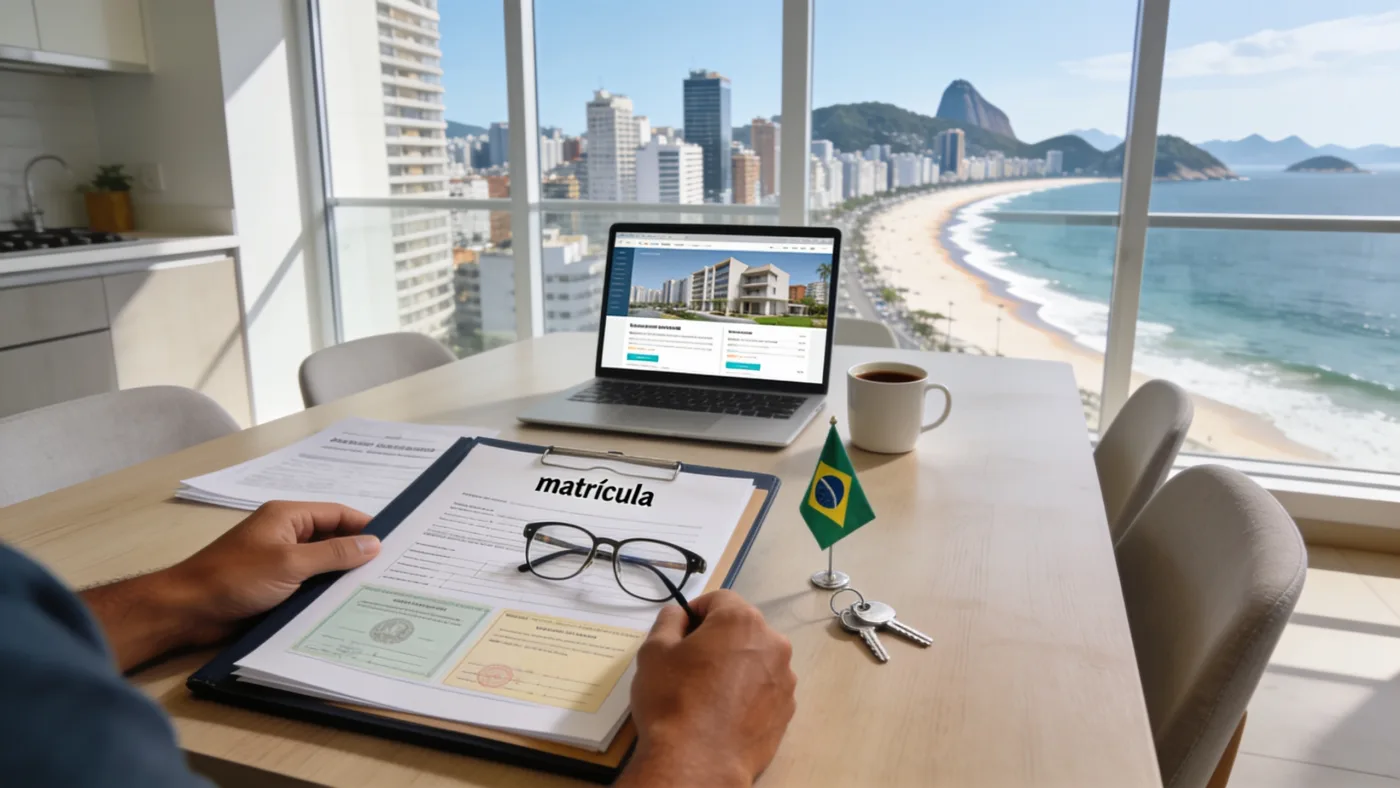
- Matrícula atualizada (updated registry extract) issued within 30 days by the Real Estate Registry Office
- Municipal property tax (IPTU) certificate showing no debts
- Condominium debt clearance declaration
- Seller’s identity and tax documents, plus certificates confirming no lawsuits or enforcement actions against the seller
Heads up: The bank will refuse to finance a property with defects in the chain of title, and its own analysis protects the bank, not you. That review looks at the collateral, not at whether you are buying into a family inheritance dispute. You still need independent due diligence.
If you are still assembling your basic Brazilian identity documents, our step-by-step guide on how to get a CPF in Brazil covers the embassy, online and in-person routes.
What Are the Real Costs and Fees on a Financed Purchase?
Budget 4% to 6% of the property value in closing costs on top of the down payment. On a R$ 500,000 purchase that is roughly R$ 20,000 to R$ 30,000 (about US$ 3,900 to US$ 5,900), driven mainly by ITBI transfer tax of 2% to 3% charged by the municipality and registry fees set by each state’s official fee schedule.
| Item | Typical amount on a R$ 500,000 purchase | Who sets it |
|---|---|---|
| ITBI transfer tax | R$ 10,000 to R$ 15,000 (2% to 3%) | Municipality |
| Property appraisal and file analysis fee | R$ 2,500 to R$ 4,000 | Bank |
| Registration of the purchase at the registry | R$ 4,000 to R$ 6,000 | State fee schedule |
| Registration of the fiduciary mortgage | R$ 1,250 to R$ 2,500 | State fee schedule |
| Monthly insurance (MIP + DFI) | R$ 100 to R$ 300 inside the instalment | Insurer |
| Monthly administration fee | R$ 25 to R$ 50 | Bank |
There is one genuine saving in financing. Under the housing finance system rules, a bank financing contract carries the force of a public deed, so you do not pay for a separate escritura pública (public deed) at the notary. On a R$ 500,000 purchase that can save several thousand reais compared with a cash deal. For a full breakdown of the tax and registry side, see our article on property taxes, ITBI and cartório fees in Brazil.
Common mistake: Assuming ITBI is calculated on your purchase price. Most municipalities use the higher of the declared price and their own valuation reference, so the bill can exceed your estimate. Request the municipal guia de ITBI before you sign, not after.
What Changed in 2026 for Foreign Mortgage Applicants?
No new statute restricted foreign borrowing in 2026. What changed is enforcement: banks tightened source-of-funds documentation under anti-money-laundering rules, and now routinely question down payments wired from abroad that were not registered as foreign capital with the Banco Central’s exchange registration system.
Three practical consequences for 2026 buyers:
- Money must arrive through the formal exchange market. Bring your down payment in via a licensed institution with a proper exchange contract naming you and stating the purpose. Cash carried in a suitcase, or funds routed through a friend’s Brazilian account, will stall the file and can block your ability to repatriate proceeds later when you sell.
- Residency documents are checked against Federal Police records. An expired CRNM or a pending renewal protocol triggers additional review. Keep your registration current with the Polícia Federal (Federal Police).
- Foreign income needs a Brazilian paper trail. If you earn abroad, declaring that income on a Brazilian tax return (as tax residents must) converts invisible money into bankable income. This is the single most effective thing a long-term expat can do to become financeable.
Worth knowing: Some investors skip the mortgage problem entirely by qualifying for residency through investment, which also strengthens later credit applications. See our guide to the Brazil investor visa and its R$ 500,000 residency rules.
Step-by-Step: How Do You Apply for a Mortgage in Brazil?
From first simulation to signed contract, plan on 45 to 90 days for a foreign applicant, longer if documents need sworn translation or a residency renewal is pending. Bank credit approval itself takes 5 to 20 business days once the file is complete; property and title analysis adds another two to four weeks.
- Step 1. Get your CPF and, if you do not already hold it, your CRNM. Nothing else can proceed without both.
- Step 2. Open a Brazilian checking account and let salary or income credits run through it for at least six months. This is the least glamorous and most decisive step.
- Step 3. Run online simulations on the lenders’ own simulador de financiamento tools (Caixa, Banco do Brasil, Itaú, Bradesco and Santander all publish them). Note the maximum LTV and term each one offers you.
- Step 4. Submit the credit file at a branch and request written pre-approval. Ask explicitly whether the bank accepts CRNM holders and, if applicable, temporary residency.
- Step 5. Only then sign a purchase agreement, and insist on a financing condition clause allowing you to withdraw with your deposit returned if credit is denied.
- Step 6. Have a lawyer run independent due diligence on the matrícula, the seller and the condominium, in parallel with the bank’s appraisal.
- Step 7. Sign the financing contract, then take it to the Real Estate Registry Office for registration. Ownership transfers only on registration, not on signature. Brazil is a civil law country, and the registry entry is what makes you the owner.
- Step 8. Confirm the bank released funds to the seller and collect the registered matrícula showing your name and the fiduciary mortgage.
In practice: A client with a CRNM and a R$ 12,000 monthly salary signed a purchase agreement before pre-approval. The bank capped financing at 55% instead of the 70% he assumed, leaving a R$ 75,000 gap two weeks before closing. A financing condition clause would have protected his deposit. Sequence matters more than optimism.
Frequently Asked Questions About Mortgages in Brazil for Foreigners
Can I get a Brazilian mortgage with only a CPF and no residency?
Almost never with a retail bank. A CPF lets you buy, register and pay taxes on property, but it is a tax number, not proof of residency or income. Non-resident buyers typically pay cash, use developer instalment plans (common in new-build projects, with 30% to 40% during construction), or borrow abroad against foreign assets. Our article on what you can and cannot do without a CPF explains the limits of the number itself.
Can I use income earned abroad to qualify?
Only if it appears in Brazilian documents. Banks rarely accept foreign payslips, even translated and apostilled, because they cannot verify them. The workaround used by successful applicants is to become a Brazilian tax resident, declare worldwide income on the annual return filed with the Receita Federal, and present two filed returns. That converts foreign earnings into income the credit system recognises. Expect the bank to apply a haircut to non-salary income.
Do I need a Brazilian co-signer or guarantor?
Not for a standard mortgage, because the property itself is the collateral under the fiduciary transfer structure. Some banks ask temporary residents for a Brazilian co-borrower (composição de renda) to strengthen the income side. This is different from renting, where a guarantor is routine. If you are renting first, our guide on renting in Brazil without a fiador covers the alternatives.
Can I buy through a Brazilian company to improve my chances?
Sometimes, but it changes the product. A company purchase is financed as commercial credit, usually with higher rates, shorter terms and lower LTV, and it loses access to the subsidised SFH system and to certain individual capital gains exemptions on sale. It can make sense for rental portfolios. Note that opening a CNPJ requires a registered fiscal address in Brazil, which Ribeiro Cavalcante provides. Compare the total cost before restructuring.
Can a bank legally refuse me because I am a foreigner?
A bank may decline credit on risk grounds, which is lawful. Refusing purely on nationality, against a legal resident, conflicts with the equality guarantee in Article 4 of the Migration Law and the constitutional equality rule. The practical remedy is rarely litigation. It is asking for the denial reason in writing, escalating above branch level, and resubmitting a file that addresses the stated risk with a larger down payment or income composition.
Can I pay off a Brazilian mortgage early?
Yes. Brazilian consumer protection rules give borrowers the right to prepay with proportional reduction of interest and charges, and banks cannot impose a prepayment penalty on housing loans. You choose whether the prepayment reduces the instalment or shortens the term. Shortening the term saves more interest. Always request the updated payoff statement and, after the final payment, the release document to remove the mortgage from the property registry.
Applying for a Mortgage in Brazil as a Foreigner? Get Your File Reviewed First
Most foreign mortgage refusals in Brazil are not about the borrower’s money. They are about missing residency documents, income that exists but is not documented in Brazil, funds that arrived outside the formal exchange market, or a purchase agreement signed before pre-approval. All four are fixable before you apply, and expensive to fix afterwards.
Our bilingual team, registered with the OAB (Brazilian Bar Association), reviews foreign buyers’ credit files, drafts the financing condition clause that protects your deposit, and runs independent title due diligence that the bank’s appraisal will not do for you. The next concrete step is simple: send us your residency status, your income source and the property’s matrícula number, and we will tell you which banks are realistic for your profile and what is missing from your file.
Talk to a specialist lawyer now
Talk to a Lawyer on WhatsApp