You found the apartment, you have the money, and now you are afraid that some office in Brazil will simply say no. That fear is reasonable, and the answer is yes, it has a solution. Let us start with the exception rather than the rule, because the exception is where foreign buyers actually lose money.
Here is the exception: a foreigner can be perfectly entitled to buy, can sign a valid public deed at a Brazilian notary office, can pay every cent of the price, and still not become the owner. It happens when the Land Registry (Registro de Imóveis) returns the deed with a formal rejection note. At that moment the seller is still the legal owner, your money is already gone, and you are holding a piece of paper instead of a property.
Now the rule: under Brazilian law, foreigners buying urban property have the same rights as Brazilians. No visa, no residency, no minimum stay, no cap on the number or value of properties. The only practical requirements are a valid CPF (Brazilian taxpayer number) and documents that a Brazilian registrar will accept without objection.
So the real question in 2026 is not “may I buy?” It is “where exactly do these purchases get blocked, and how do I get through each of those points?” This guide walks the entire transaction in order, from CPF to registered title, and flags every checkpoint where foreign buyers are most often turned away.
On this page
Where Does a Foreign Buyer’s Purchase Actually Get Blocked?
Foreign purchases in Brazil are rarely blocked by nationality. They are blocked at four checkpoints: the CPF, the paperwork coming from abroad (apostille and sworn translation), the bank’s compliance review of the incoming funds, and the Land Registry’s qualification of the deed. Under Article 1.245 of the Brazilian Civil Code, you own nothing until registration is completed.
Each checkpoint has its own gatekeeper, and none of them talks to the others:
- Receita Federal (Brazilian IRS): issues the CPF. A CPF with a mismatched name, spelling or date of birth against your passport will stop the deed.
- Consulate or foreign notary plus cartório: your power of attorney, marriage certificate or company documents must be apostilled abroad and translated by a sworn translator in Brazil.
- Your bank and the receiving Brazilian bank: they must document the origin and purpose of the funds under Brazil’s foreign exchange framework.
- Tabelionato de Notas (notary office) and Registro de Imóveis (Land Registry): the notary drafts and signs the public deed; the registrar decides whether the title enters the property record.
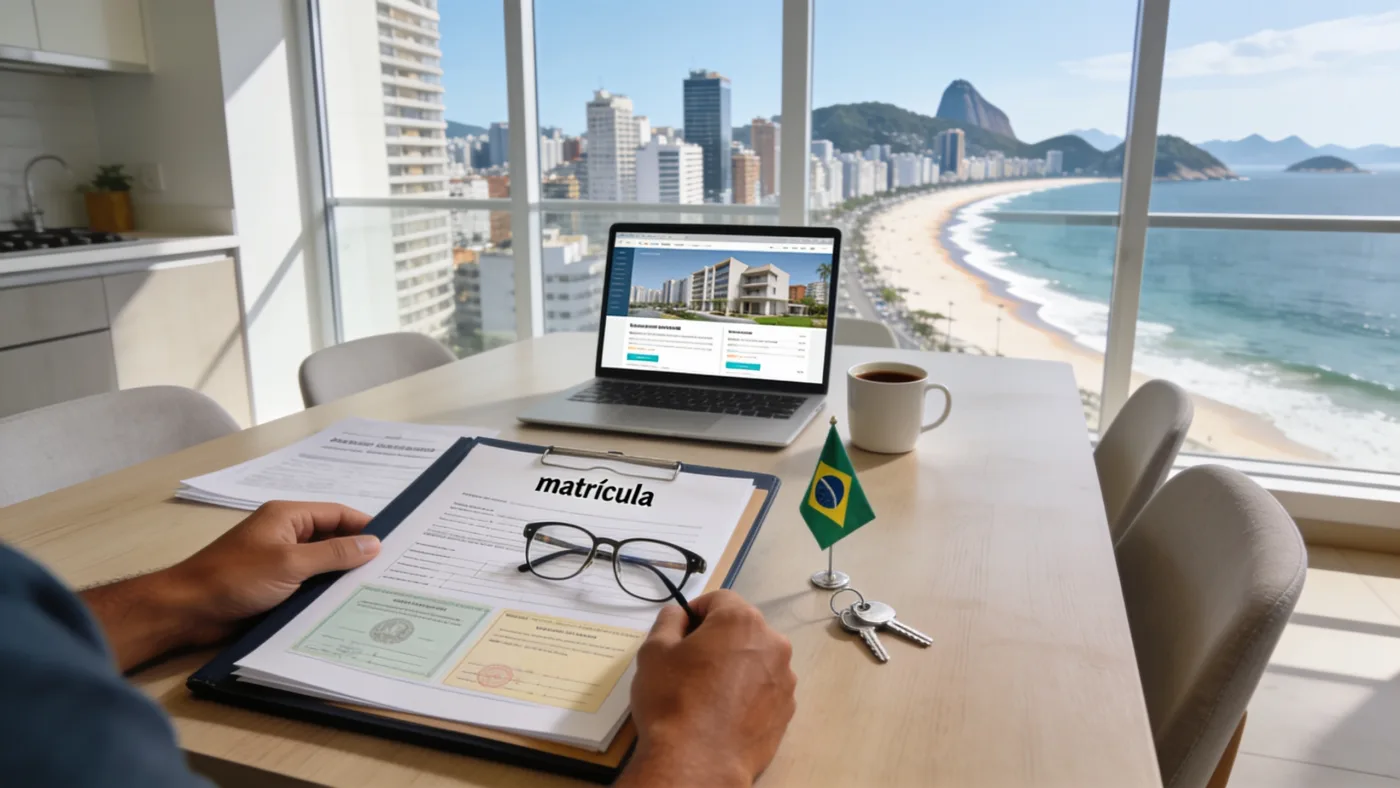
The registrar is the hardest gate, because rejection there comes after you have paid. The rejection is issued as a nota de devolução (return note) listing formal defects: a missing tax clearance, a spouse who did not sign, an unregistered power of attorney, an ITBI receipt in the wrong name, a property description that does not match the matrícula (the property’s registry record).
Heads up: a rejection note is not the end of the deal. Most defects are fixable within 15-45 days. What kills transactions is discovering the defect after the seller has spent the money and stopped answering messages.
Why Is the Brazilian Process So Formal in the First Place?
Brazil is a Civil Law country, not Common Law. There is no title insurance market to absorb mistakes, so the state pushes verification to the front of the transaction. The Civil Code requires a public deed for any property sale above 30 monthly minimum wages, which in practice covers virtually every real purchase.
In the United States, England or Australia, an escrow agent or title company checks the chain of title and issues a policy. If something was missed, the insurer pays. Brazil replaced that private safety net with two public officers who carry personal liability: the notary who drafts the deed and the registrar who admits it into the record.
That is why the registrar reads your paperwork with hostile eyes. It is not bureaucratic malice. It is a legal duty called qualificação registral (registry qualification), and the registrar answers personally for a defective registration.
The consequence for you is concrete. In your home country the closing may be a one-day event. In Brazil, the closing is a sequence: verify the property, sign a binding preliminary contract, pay the municipal transfer tax, sign the deed, then register. Ownership arrives only at the last step. The full text of the Brazilian Civil Code is published by the Presidency of the Republic, and Article 1.245 is unambiguous: until the transfer title is registered, the seller is still treated as the owner.
How Do You Get a CPF and Sign the Deed Without Flying to Brazil?
You can complete an entire purchase without setting foot in Brazil. Two documents make that possible: a CPF, which Receita Federal issues to non-residents free of charge through Brazilian consulates, and a procuração pública (public power of attorney) that is apostilled, translated by a sworn translator and registered at a Brazilian notary office.
Step one: the CPF
The CPF is not optional. Receita Federal requires any person who owns real estate in Brazil to hold one, resident or not. You can apply online through the Receita Federal CPF service and then confirm your identity at a Brazilian consulate abroad, or in person at a Receita Federal, Banco do Brasil or Correios unit in Brazil. Consular processing typically takes 5-15 business days.
Get the spelling exactly right. If your passport reads “John Michael O’Connor” and the CPF database shows “John Michael Oconnor”, the notary will notice, and so will the registrar. Fixing a CPF record from abroad can add 30 days to your timeline. There is more on what this number unlocks in our guide on what you can and cannot do in Brazil without a CPF.
Step two: the power of attorney
A power of attorney for a property purchase must be a public instrument, not a signature on a printed form. Signed abroad, it goes through the notary in your country, then an Apostille under the Hague Convention, then a sworn translation in Brazil, then registration at a Registro de Títulos e Documentos. The powers must be specific: buy, sign the deed, pay taxes, sign for the specific property.
Common mistake: a power of attorney that says “to represent me in all matters in Brazil” is often refused for property deeds. It must describe the property and the authority to acquire it. Our apostille checklist for Brazil shows which documents need which layer of certification.
Marriage matters too. If you are married, Brazilian notaries will ask about your marital property regime, and often require an apostilled and translated marriage certificate. If your regime allows it, your spouse may need to consent to the purchase or the future sale. Signing without resolving this is a classic source of registry rejection.
What Are the Actual Steps to Buy Property in Brazil as a Foreigner?
A cash purchase by a foreigner realistically takes 45-90 days from accepted offer to registered title, and 60-120 days with bank financing. The sequence is fixed: verification, preliminary contract, municipal transfer tax (ITBI), public deed, registration. Skipping or reordering steps is what produces the rejection note at the end.
- 1. Pull the documents (7-15 days). Request an updated matrícula from the Land Registry plus clearance certificates for the seller and the property. Never rely on documents the seller hands you.
- 2. Sign a preliminary contract (1-5 days). The contrato de promessa de compra e venda (purchase promise) sets the price, deadlines, penalties and conditions. Register it on the matrícula if there is any gap before the deed.
- 3. Bring the funds in (5-20 days). The international transfer must be executed through a Brazilian bank with a documented exchange contract naming the purpose.
- 4. Pay ITBI (2-7 days). The municipal transfer tax, generally 2% to 3% of the assessed value, is paid to the city hall before the deed. Most notaries will not sign without the receipt.
- 5. Sign the public deed (1 day). At the Tabelionato de Notas, in person or through your attorney-in-fact.
- 6. Register the deed (10-30 days). The Land Registry qualifies the title and, if approved, records the transfer. Only now do you own the property.
In practice: on a R$ 800,000 apartment in São Paulo, budget roughly R$ 24,000 for ITBI at 3%, around R$ 4,000 for the notarial deed, about R$ 6,400 for registration, and R$ 8,000 or so for legal representation. That is close to R$ 42,000, about 5.2% of the price, on top of the purchase amount. Municipal rates and cartório tables vary, and our breakdown of ITBI and cartório fees explains how to check the numbers for your city.
Registering the purchase promise is the single most underrated step. Under the Civil Code, a registered promise creates a real right in your favour, which means you can compel the seller to convey the property if he changes his mind. An unregistered private contract leaves you with a claim for damages against a person who may have no assets.
How Do You Get the Money Into Brazil Legally, and Out Again?
Money must enter Brazil through a licensed institution with an exchange contract that states the purpose of the transfer, under the foreign exchange framework of Law 14.286/2021 supervised by the Banco Central do Brasil. That contract is your proof of foreign capital, and without it, repatriating sale proceeds later becomes slow and expensive.
This is the checkpoint where the strongest argument runs against you, so let us state it fairly. The bank’s compliance department will say: we are legally obliged to know the origin of funds and the identity of the beneficial owner. A non-resident with no Brazilian tax history, wiring six figures to buy real estate, is a textbook money laundering typology under Brazilian anti-money-laundering rules. The bank has no duty to accept your transfer, faces regulatory sanctions if it gets it wrong, and can freeze the operation for as long as it needs to be satisfied.
That argument is correct, and it is also answerable. The bank is not asking you to prove innocence. It is asking for a document trail. When you present a CPF, a signed purchase promise identifying the property and price, the property’s matrícula, and evidence of where your money came from (payslips, sale of another property, business distributions, inheritance documents), the file stops looking anomalous and starts looking ordinary. Transfers that get blocked are almost always the ones sent with no contract, no stated purpose, or through a third party’s account.
Warning: never send the purchase money to a real estate agent’s personal account, a lawyer’s personal account, or a foreign account controlled by the seller. Payments must go to the seller identified in the contract, in Brazil, with traceable proof. Recovering funds sent outside that path is a lawsuit, not a phone call.
Keep every exchange contract. When you eventually sell, you will need to show how the capital came in to remit the proceeds abroad, and Receita Federal will look at the difference between the two amounts to assess capital gains tax. Official information on foreign exchange rules is published by the Banco Central do Brasil.
Can a Foreigner Get a Mortgage in Brazil in 2026?
Yes, but conditions differ from those offered to Brazilians. Major banks such as Caixa Econômica Federal, Banco do Brasil, Bradesco and Santander offer terms up to 35 years, and in practice they require permanent or long-term residency, a CRNM (National Immigration Registration Card), verifiable income in Brazil, and a larger down payment than a Brazilian buyer would face.
Where mortgage applications get denied is predictable:
- No Brazilian residency. A tourist or a non-resident investor is almost always refused by retail banks. Purchase in cash, or negotiate direct seller financing with the debt secured on the matrícula.
- Income earned abroad. Most credit models cannot read foreign payslips. Income declared in a Brazilian tax return, or an employment contract with a Brazilian company, changes the analysis.
- Short visa validity. A residence permit expiring in 18 months against a 30-year loan raises an obvious objection.
- Thin credit history. No CPF history means no score. Six to twelve months of Brazilian banking activity helps materially.
Worth knowing: a bank-financed purchase using alienação fiduciária (fiduciary lien) does not need a separate notarial deed, because the bank’s contract has deed force under Brazil’s fiduciary lien statute. It still must be registered at the Land Registry, and the bank’s own legal department will perform verification that is often stricter than what a cash buyer does voluntarily.
Which Purchase Route Fits Your Situation?
There are four common routes: cash purchase as a non-resident, cash purchase as a resident, bank-financed purchase, and purchase through a Brazilian company. Each has a different document load, a different timeline and a different failure point. Non-resident cash purchases are the fastest, typically 45-60 days, and the most exposed to bank compliance delays.
| Route | Main requirement | Typical timeline | Where it usually gets blocked |
|---|---|---|---|
| Cash, non-resident, no travel to Brazil | CPF plus apostilled and registered power of attorney | 45-75 days | Defective power of attorney; blocked international transfer |
| Cash, resident foreigner | CPF plus CRNM and proof of address | 45-60 days | Missing tax clearances; spouse consent |
| Bank financing | Residency, Brazilian income, credit analysis | 60-120 days | Credit denial; bank appraisal below the agreed price |
| Through a Brazilian company (CNPJ) | CNPJ, registered fiscal address, corporate documents | 75-150 days | Corporate documents from abroad without apostille or translation |
| Rural land or land within 150 km of a border | INCRA authorization or National Defence Council consent | 6 months and up, often longer | Statutory area limits; missing federal authorization |
Buying through a Brazilian company can make sense for multiple properties or rental operations, though it adds accounting obligations. A CNPJ cannot be opened without a valid registered address, and a fiscal address in Brazil is one way non-residents satisfy that requirement.
Rural land and the border strip are governed by separate statutes, principally Law 5.709/1971 for rural property acquired by foreigners. Those limits do not apply to urban houses, apartments, urban lots or commercial units, and the boundary between the two categories is explained in our article on what foreigners can and cannot buy in Brazil.
What Changed for Foreign Buyers in 2026?
The core rules did not change in 2026: urban property remains open to foreigners with no visa or residency condition. What changed is procedural. Electronic registry services are now the norm in most states, digital matrícula extracts are issued in 1-3 business days in the largest capitals, and remote deed signing with digital certificates has expanded considerably.
Three practical developments matter for foreign buyers this year:
- Electronic registry access. State electronic registry platforms let your lawyer order certificates and follow the registration of your deed online, which shortens verification and makes the rejection note visible immediately rather than by post.
- Extrajudicial adjudication. Since the 2022 reform of the Public Registries Law, a buyer holding a registered purchase promise who has paid in full can, in many cases, obtain title directly at the Land Registry instead of suing. This is the most useful tool a foreign buyer has against a seller who stalls.
- Tighter beneficial ownership scrutiny. Banks and notaries are applying stricter identification of beneficial owners in transactions involving offshore structures. Buying through a foreign holding company now requires more documentation than buying in your own name.
Investor residency also remains available and is frequently misunderstood. Buying property does not grant you residency by itself. Under the National Immigration Council rules, a real estate investment of R$ 1,000,000, or R$ 700,000 in the North and Northeast regions, can support an application for an investor residence permit. Below those thresholds, ownership gives you rights over the property, not the right to live in Brazil.
What If the Seller Stalls or the Registry Refuses? The Judicial Path
Two different remedies exist. Against a registry rejection, your lawyer files a dúvida (doubt procedure), decided by the state court’s registry oversight body, usually in 60-180 days. Against a seller who refuses to sign the deed, you file for adjudicação compulsória (compulsory conveyance), which in court can take 2-4 years.
Costs are worth planning for. State court filing fees generally run between 1% and 2% of the value in dispute, plus attorney fees, and the losing party pays court-awarded fees of typically 10% to 20% of the claim value. On a R$ 800,000 property, litigation is a meaningful expense, which is why the extrajudicial route through the Land Registry is usually attempted first when the purchase promise was properly registered.
Deadlines matter and they are shorter than most foreigners expect. Under the Civil Code, a claim to annul a contract for defects of consent such as fraud, error or duress must be brought within 4 years. Contractual penalty claims are governed by the contract itself and often carry notice deadlines of 15 or 30 days. Silence is expensive.
Heads up: a lawsuit in Brazil requires a lawyer registered with the OAB (Brazilian Bar Association), and litigation from abroad requires an apostilled power of attorney with specific litigation powers. If you plan to be away, arrange that document while the deal is still friendly, not after it breaks down. You can verify any professional’s standing using our guide on checking an English speaking lawyer’s OAB registration.
Which Mistakes Cause Most Foreign Purchases to Fail?
The most damaging mistake is paying substantial amounts before any contract is registered, which happens in a large share of the disputes we see. The others are predictable: relying on the seller’s paperwork, using the wrong power of attorney, ignoring the marital regime, and treating the deed as the end of the process rather than the second-to-last step.
- Signing a private “contrato de gaveta” (drawer contract) that is never registered, and then discovering the property was sold again or seized for the seller’s debts.
- Paying a “reservation fee” in cash to an agent with no written terms on refundability.
- Accepting certificates older than 30 days. Liens and lawsuits appear quickly; a two-month-old clearance certificate proves little.
- Not checking condominium arrears. Unpaid condominium fees follow the property, not the seller, and can be enforced against you as the new owner.
- Forgetting the deed is not the title. Leaving a signed deed unregistered for months means the seller remains the registered owner in the eyes of the law.
- Buying without visiting or appointing an independent representative. An agent paid by the seller is not your representative.
If your plan is to rent the property out, the terms of your lease deserve the same scrutiny as the purchase. Our guides on rental contract clauses in Brazil and what the Brazilian rental law guarantees tenants explain the obligations you inherit as a landlord.
Frequently Asked Questions About Buying Property in Brazil as a Foreigner
Do I need a visa or residency to buy property in Brazil?
No. For urban houses, apartments, land plots and commercial units, there is no visa, residency or minimum stay requirement, and no limit on the number or value of properties you may own. What you do need is a regularized CPF issued by Receita Federal and documents acceptable to the notary and Land Registry. Tourists and non-residents who have never entered Brazil buy property regularly, usually through a properly drafted power of attorney.
Do I need a lawyer, or is the notary enough?
A lawyer is not legally mandatory for a purchase, but the notary’s role is narrow. The notary confirms identities and formalities of the deed; the notary does not verify whether the seller has debts, whether the building is licensed, or whether your contract protects you. Independent legal review typically costs 1% to 2% of the purchase price and is the cheapest insurance available in a market with no title insurance. All Brazilian lawyers must be registered with the OAB.
How long does it take to register the property in my name?
Registration at the Land Registry usually takes 10-30 business days after the deed is filed, depending on the state and the office’s workload. If the registrar issues a return note listing defects, add 15-45 days to correct and refile. Counting from an accepted offer, plan on 45-90 days for a cash purchase and 60-120 days with bank financing. Documents that must be apostilled abroad are the most common cause of extra delay.
What taxes will I pay as a foreign owner?
At purchase, ITBI (municipal transfer tax) of generally 2% to 3% of the assessed value, plus notary and registry fees. Every year, IPTU (municipal property tax), which varies widely by city and property value. On rental income, Brazilian income tax applies, with withholding rules for non-residents. On sale, capital gains tax on the difference between purchase and sale values, calculated in reais. Non-resident owners also have reporting duties to Receita Federal.
What happens to my Brazilian property if I die abroad?
Real estate located in Brazil is subject to Brazilian succession jurisdiction, regardless of your nationality or country of residence. Your heirs must open an inventory proceeding in Brazil, represented by a Brazilian lawyer, with foreign documents apostilled and translated by a sworn translator. State inheritance tax (ITCMD) applies. A foreign will does not bypass this, which is why owners with heirs abroad should plan the succession structure at the time of purchase, not later.
Can I send money to Brazil through a currency exchange app?
You can use licensed institutions, but the transfer must be documented as an exchange operation identifying the purpose, so that the capital can later be repatriated and the capital gain correctly calculated. Peer-to-peer transfers, third-party accounts and informal exchanges leave no usable record and create serious problems at resale. Consular and general service information for foreigners is available through the Itamaraty consular portal.
Buy Property in Brazil as a Foreigner With Your Title Secured
The Brazilian system is formal, but it is not arbitrary. Almost every foreign purchase that fails, fails at a point that was visible in advance: a CPF that did not match the passport, a power of attorney drafted too generically, a wire sent without a contract behind it, a deed signed and then left unregistered. Handled in the right order, the same system gives you a registered title that is very hard to challenge.
Your concrete next step: before you transfer any money or sign anything, send us the property’s matrícula number and the seller’s name, and have the title, debts and contract reviewed by a bilingual Brazilian real estate lawyer. That review takes days. Undoing a bad purchase takes years.
Talk to our team in English, Portuguese or Spanish, and get a clear answer on where your specific transaction stands.
Talk to a specialist lawyer now
Talk to a Lawyer on WhatsApp