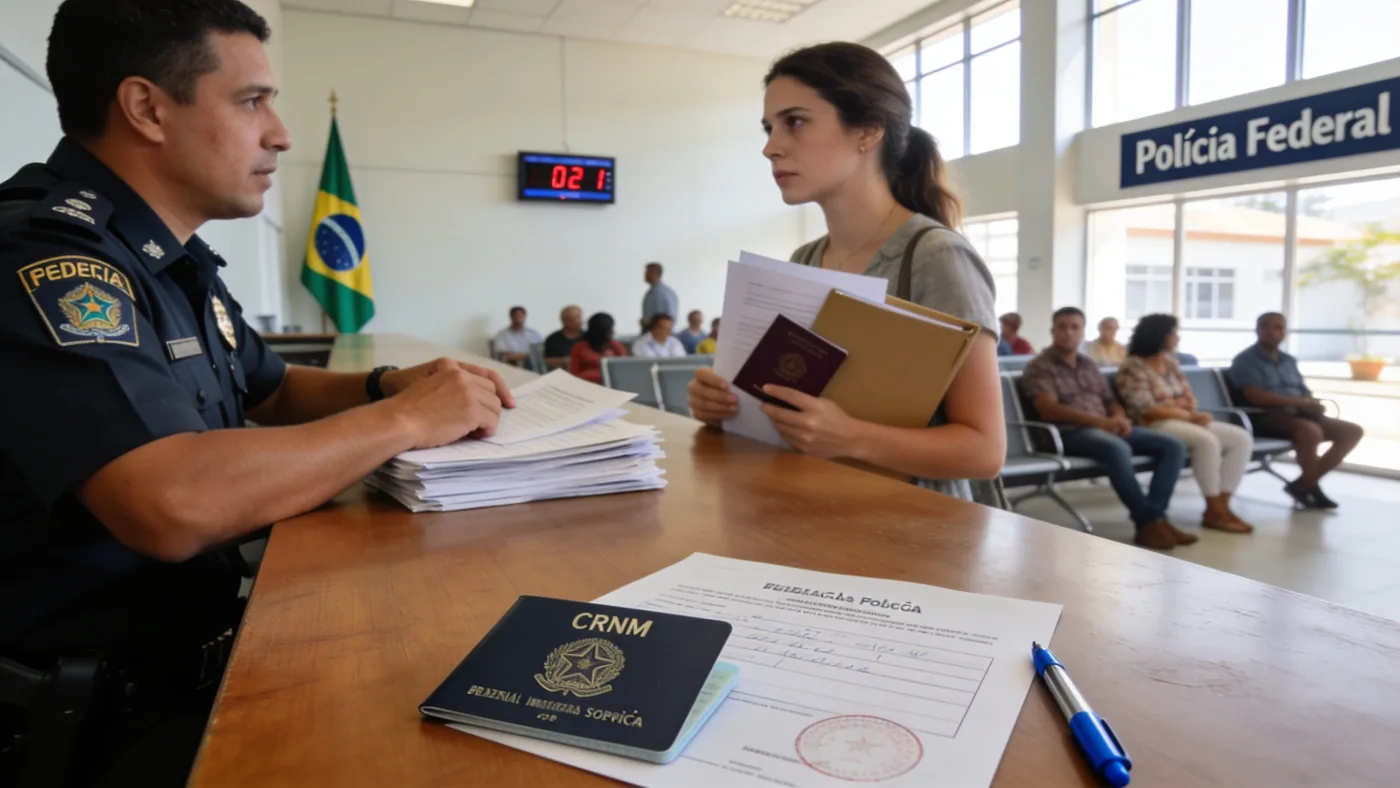
You just received your residence authorization in Brazil and now you keep reading the same acronym everywhere: CRNM. What is it, why does everyone say you need it, and what happens if you miss the deadline? You are not alone. Thousands of foreigners land in Brazil each year and get stuck at exactly this step.
Here is the short answer. The CRNM (Carteira de Registro Nacional Migratório, or National Migratory Registry Card) is your official ID as a foreign resident in Brazil. You must apply for it at the Polícia Federal (Federal Police) within 90 days of your residence authorization being published. Without it, you cannot legally work, sign a rental contract, open a full bank account, or prove your legal status.
The good news: the process is mostly bureaucratic, not legally complex. If you bring the right documents and pay the correct fees, you can complete your registration in a single Federal Police appointment. This guide walks you through every step, the real costs in 2026, the deadlines that trap people, and the mistakes that cost foreigners weeks of delay. It is part of our wider guide to Brazil immigration law, visas and residency.
On this page
What Is the CRNM and Who Needs One?
The CRNM is the official identity document for every foreigner holding residence in Brazil, temporary or permanent. It is issued by the Federal Police under Lei nº 13.445/2017 (the Brazilian Migration Law). If you hold any residence authorization, you are legally required to register and obtain it within 90 days.
The CRNM replaced the old RNE (Registro Nacional de Estrangeiro, or National Foreigner Registry) when the Migration Law took effect in November 2017. That change was not just cosmetic. The old Estatuto do Estrangeiro (Foreigner Statute) treated immigration as a national security issue. The new Migration Law shifted to a human-rights based approach, giving foreigners clearer rights and a more predictable process.
You need a CRNM if you fall into any of these groups:
- Holders of a work visa such as the VITEM V work visa
- Investors who entered through the Brazil investor visa route
- Family reunion residents (spouse, partner, children of Brazilians or legal residents)
- Retirees, digital nomads and students with temporary residence
- Mercosur residents and humanitarian/refugee status holders
If you are only in Brazil on a tourist stamp, you do not need a CRNM. It applies only once you have an approved residence authorization.
Important: The CRNM is not your visa. The visa or residence authorization gives you the right to live in Brazil. The CRNM is the physical proof of that right. You still must register even if your residence was already approved abroad at a consulate.How Much Does the CRNM Cost in 2026?
The CRNM involves two federal fees in 2026: a registration processing fee of around R$ 168.13 and a card issuance fee of R$ 204.77, totaling roughly R$ 372.90 (about US$ 68 or €62), according to the Federal Ministry of Justice fee table. Both are paid via GRU before your Federal Police appointment.
Many foreigners get confused because they read different numbers online. The reason is simple: there are two separate slips. One covers the registration act itself, the other covers printing the physical card. You pay both through a GRU (Guia de Recolhimento da União, a federal payment slip) generated on the Federal Police portal, then paid at any bank or through online banking.
| Item | Fee (2026) | Approx. USD/EUR |
|---|---|---|
| CRNM registration processing (GRU) | R$ 168.13 | ~US$ 31 / €29 |
| CRNM card issuance (first card) | R$ 204.77 | ~US$ 38 / €35 |
| CRNM renewal (issuance) | R$ 204.77 | ~US$ 38 / €35 |
| CRNM 2nd copy (lost/stolen/damaged) | R$ 204.77 | ~US$ 38 / €35 |
| CPF (tax ID, prerequisite) | Free in Brazil / ~R$ 7 abroad | Free / ~US$ 1 |
| Total for first registration | ~R$ 372.90 | ~US$ 68 / €62 |
Note that the card fee is set by Federal Police rules (Portaria nº 232/2020) and adjusted periodically. Some visa categories carry pre-arrival costs, such as consular fees for family reunion visas, but those are separate from the CRNM and paid at the embassy before you travel.
What Documents Do You Need for CRNM Registration?
For CRNM registration you need your valid passport, proof of your residence authorization, a CPF (Brazilian tax ID), proof of address in Brazil, a passport photo, and the two paid GRU slips. Extra documents depend on your visa category, per Decreto nº 9.199/2017 and Federal Police rules.
Here is the core checklist that applies to almost every applicant:
- Valid passport (original and a copy of the ID pages)
- Proof that your residence was granted (publication in the Diário Oficial, or the consular visa in your passport)
- CPF (Cadastro de Pessoas Físicas), your Brazilian tax number, obtained free at Receita Federal
- Proof of residence in Brazil (utility bill, rental contract, or a declaration)
- One recent passport-size photo (3×4), some units take it on site
- Both GRU payment receipts (R$ 168.13 and R$ 204.77)
- Completed registration form from the Federal Police portal
When you need translation and apostille: Crnm brazil
If your residence category was based on foreign documents (marriage certificate, birth certificate, work contract), those documents usually must be legalized. For countries in the Hague Apostille Convention, that means an apostille from your home country. For others, consular legalization applies.
Any document not in Portuguese must be translated by a tradutor juramentado (sworn public translator) registered in Brazil. A regular translation is not accepted. Sworn translation costs vary, but budget roughly R$ 60 to R$ 120 per page in 2026 based on translator association price surveys.
Tip: Get your CPF before your appointment, not on the same day. The Federal Police system often requires the CPF to already be linked to your registration. Doing it in advance at a Banco do Brasil, Correios, or online avoids a wasted trip.What Trips Up Most Foreigners During CRNM Registration?
The most common problems are missing the 90-day deadline, arriving without a CPF, paying the wrong GRU, and not booking the appointment in the correct city. According to Federal Police procedures, registration must happen at the unit in the city where you live, except in the specific cases listed in article 67 of Decreto nº 9.199/2017.
Let us break down the traps that cause the most delays.
Missing the 90-day window: Crnm brazil
You have 90 days from the date your residence authorization is published or from your entry into Brazil (depending on your route) to register. Miss it and you can face a fine per day of delay, though registration is still possible. The fine is administrative and does not usually cancel your residence, but it complicates everything and delays your card.
Booking in the wrong Federal Police unit
Scheduling is done only through the Federal Police website. Your appointment must be at the unit serving the city where you actually live. Foreigners sometimes book in a big city like São Paulo for convenience, then get turned away because their address is in another state.
Paying only one GRU
Because there are two fees, applicants frequently pay just the R$ 204.77 card fee and forget the R$ 168.13 processing fee, or vice versa. Federal Police staff will not complete your registration until both are settled. Generate both slips on the portal and confirm each payment cleared before you go.
Untranslated or unlegalized documents
Bringing a foreign marriage certificate without apostille and sworn translation is a guaranteed rejection. This single mistake sends people home to rebook weeks later. If your case depends on foreign civil documents, prepare the apostille and translation before anything else.
Note: Under Lei nº 10.048/2000, priority service applies to people over 60, pregnant women, and people with disabilities. If you qualify, mention it when scheduling so you get faster handling at the Federal Police counter.How Long Is the CRNM Valid and When Do You Renew?
The CRNM validity depends on your residence type. Temporary residents usually get a card valid for the duration of their authorization (commonly up to 2 years for some categories, longer for others). Permanent residents typically receive a card valid for 9 years, or with no expiry for holders aged 60 or above, under Federal Police rules.
Renewal is not automatic. You must apply again before the card expires, following the same online scheduling and GRU payment process. The renewal fee is the same R$ 204.77 card issuance fee.
- Temporary residents: renew when your residence authorization is renewed or converted
- Permanent residents under 60: renew the physical card roughly every 9 years, even though your residence status does not expire
- Permanent residents 60 or older: the card may be issued with indefinite validity
What If Your CRNM Is Lost, Stolen or Damaged?
If your CRNM is lost, stolen, or damaged, you request a second copy (segunda via) through the Federal Police portal. The fee is R$ 204.77, the same as a new card, per the 2026 Ministry of Justice fee table. If it was stolen, file a police report (boletim de ocorrência) first and bring it to your appointment.
The process mirrors first registration but is simpler because your data is already in the system. You will:
- Generate and pay the R$ 204.77 GRU for a second copy
- Schedule an appointment on the Federal Police website
- Bring your passport, CPF, proof of address, and the police report if stolen
- Receive a new protocol receipt while the replacement card is printed
A damaged card (cracked, illegible, water-damaged) also justifies a second copy. Bring the damaged card with you so it can be cancelled and replaced. As with a first registration, the physical replacement can take from 1 to 6 months, and the protocol serves as your temporary proof of legal residence in the meantime.
Caution: If your name, marital status, or address changed, do not just request a second copy. A data change (retificação) may require different documents such as an updated marriage certificate. Requesting the wrong procedure means paying again and rebooking.What Changed for the CRNM in 2026?
As of 2026, the core CRNM framework under Lei nº 13.445/2017 and Decreto nº 9.199/2017 remains stable, but the Federal Police continues to expand digital services and adjust fees periodically. The confirmed 2026 figures are R$ 168.13 for processing and R$ 204.77 for card issuance, per the Ministry of Justice fee table.
The main practical shifts affecting applicants this year:
- Fully online scheduling: all appointments now go through the gov.br and Federal Police portals. Walk-in service has essentially disappeared.
- Digital protocol: the protocol receipt you get after registering increasingly works as a digital document, useful for banks and employers while the card prints.
- Migration Law consolidation: nearly a decade after the 2017 reform, courts and the Federal Police apply the human-rights based approach more consistently, reducing arbitrary rejections seen under the old regime.
- Consumer service standards: Lei nº 13.460/2017 (the public service users’ rights law) reinforces your right to clear information and reasonable waiting times at Federal Police units.
Because Federal Police internal rules (portarias and instruções normativas) change without much notice, always confirm current fees and document lists on the official portal before your appointment. This is a YMYL area where outdated blog posts cause real harm.
Step-by-Step: How to Register Your CRNM Online in 2026
To register your CRNM in 2026, create a gov.br account, generate and pay both GRU fees (R$ 168.13 and R$ 204.77), fill the registration form, schedule your Federal Police appointment online, and attend in person with all documents. Registration is completed at the appointment; the card follows by mail.
Step 1: Get your CPF first
Obtain your CPF (tax ID) from Receita Federal before anything else. It is free in Brazil at Banco do Brasil, Correios, or Caixa, and required to link your registration. Foreigners abroad can request it through a Brazilian consulate.
Step 2: Generate and pay the two GRUs
On the Federal Police portal, generate the GRU for the R$ 168.13 processing fee and the GRU for the R$ 204.77 card fee. Pay both at any bank or by online banking. Keep both receipts. Registration cannot be finalized without proof of payment.
Step 3: Fill out the registration request form
Complete the online request form on the Federal Police website. Enter your data exactly as it appears in your passport and residence authorization. Small mismatches (accents, name order) cause rejections later.
Step 4: Schedule your appointment
Book, reschedule, consult, or cancel your appointment through the portal. Choose the unit in the city where you live. Appointments in large cities can be scarce, so book as early as possible within your 90-day window.
Step 5: Attend in person with your documents
Go to the Federal Police unit on your appointment date with all originals and copies. Your fingerprints and photo are usually collected there. You leave with a protocol receipt confirming your registration.
Step 6: Wait for your card and track it
The physical CRNM is printed and delivered over roughly 1 to 6 months. Use the protocol receipt as valid proof of residence in the meantime. Track status through the Federal Police portal.
Tip: Keep every protocol number and payment receipt for at least 5 years. Banks, employers, and even a future renewal may ask for them, and reprinting them later is far harder than storing a photo on your phone.Frequently Asked Questions About the CRNM
How long does the CRNM card take to arrive?
The physical CRNM typically takes 1 to 6 months to be printed and delivered after your Federal Police appointment, depending on the unit and demand. During this wait, the protocol receipt you receive at registration serves as legal proof of your residence in Brazil. You can use it to work, open bank accounts, and sign contracts. Track the card status through the Federal Police portal, and keep the protocol safe, because you may need to present it to banks and employers before the card arrives.
Can I work in Brazil while waiting for the CRNM card?
Yes. Once you complete your registration at the Federal Police, the protocol receipt legally proves your resident status while the card is printed. With your CPF and this protocol, you can sign an employment contract, register on the CTPS (work card) system, and open a bank account. Employers who understand immigration rules accept the protocol. If one refuses, it is a knowledge gap, not a legal barrier. A brief letter from a lawyer explaining the protocol’s validity under the Migration Law usually resolves the issue quickly.
What happens if I miss the 90-day deadline?
Missing the 90-day registration deadline triggers an administrative fine calculated per day of delay under the Migration Law and Decreto nº 9.199/2017. It does not automatically cancel your residence authorization, and you can still register. However, the fine adds cost and paperwork, and repeated non-compliance can complicate future renewals or reentry. If you already missed the window, register as soon as possible and keep proof of the reason for delay. A lawyer can help contest an excessive fine in some situations.
Do I need a lawyer to get my CRNM?
No, the CRNM registration itself does not legally require a lawyer, and many foreigners complete it alone. However, a lawyer registered with the OAB (Brazilian Bar Association) is valuable when your case involves foreign documents needing apostille and sworn translation, a missed deadline, a data correction, or a complex visa category. Brazil uses a civil law system with strict document formalities, so a small paperwork error can cost weeks. Legal help is most cost-effective for investors, families, and anyone whose residence depends on documents issued abroad.
Is the CRNM the same as permanent residency?
No. The CRNM is the identity card that proves your residence, not the residence status itself. You can hold a CRNM as a temporary resident (for example, a student or work visa holder) or as a permanent resident. Your underlying authorization, granted under the Migration Law, determines your rights and how long you can stay. The card simply documents that status. When your residence type changes, for example from temporary to permanent, you update or renew the CRNM accordingly.
Can I open a company in Brazil with a CRNM?
Yes. A foreigner with a valid CRNM and CPF can open a Brazilian company (CNPJ) and act as partner or administrator, subject to the rules of their residence category. To register a CNPJ you also need a valid registered business address in Brazil. Ribeiro Cavalcante offers a fiscal address in Brazil service that satisfies this requirement. Some visa categories, such as the investor route, are specifically designed around business activity, so confirm your permissions before signing corporate documents.
Get Your CRNM Right the First Time with a Bilingual Brazilian Lawyer
Navigating the Federal Police, GRU payments, apostilles, and 90-day deadlines in a second language is stressful, and one wrong document can send you back to the start. You do not have to figure it out alone. Our bilingual legal team guides foreigners through CRNM registration, renewals, second copies, and every residence category from work visas to investor and family routes, so you avoid fines and delays.
Whether you are just arriving or racing against your deadline, we can review your case, prepare your documents, and handle the process end to end. Reach out today and get clear, practical answers from lawyers who speak your language.
Talk to a specialist lawyer now
Talk to a Lawyer on WhatsApp