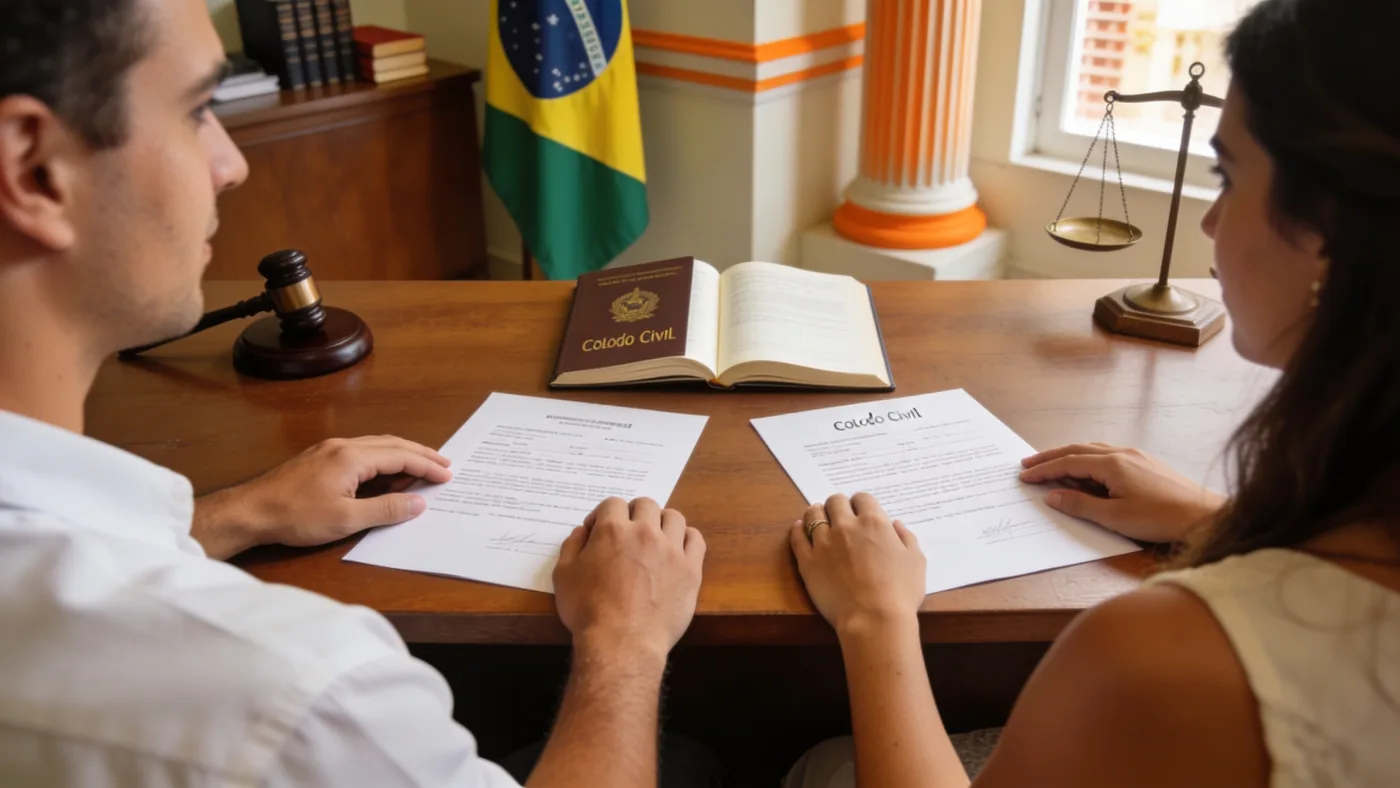
The good news: Brazil has one of the most straightforward divorce frameworks in Latin America. Since Constitutional Amendment 66/2010, the country operates a true no-fault divorce system. You do not need to prove adultery, abandonment, or any other grounds. You do not need to be separated for a minimum period. You simply need to want the divorce — and have the right documents in order.
That said, “simple” in Brazilian law rarely means “fast.” Brazil uses Civil Law (the Roman-Germanic tradition), not Common Law. Processes are document-heavy, cartório (notary office) steps are mandatory, and bureaucracy moves at its own pace. If assets, children, or international elements are involved, complexity rises quickly.
This guide walks you through the legal framework, the two types of divorce available to you, realistic costs and timelines for 2026, and what you need to do step by step — whether you’re filing from inside Brazil or from abroad. If you’re also researching how the marriage itself works under Brazilian law, our article on Marriage in Brazil for Foreigners: Rules & Documents covers the foundational rules.
On this page
Who Can File for Divorce Against a Brazilian Spouse in Brazil?
Any person legally married to a Brazilian national can file for divorce in Brazil, regardless of their own nationality. Under Article 226, §6º of the Brazilian Federal Constitution (as amended by EC 66/2010), divorce is an unconditional right — no waiting period, no fault requirement, no minimum separation time. Either spouse can initiate the process at any time after the marriage.
Jurisdiction is the first question to resolve. Brazilian courts have jurisdiction over your divorce if:
- The marriage was registered in Brazil (at a Brazilian cartório de registro civil)
- Either spouse currently lives in Brazil
- The couple’s shared assets are located in Brazil
- The Brazilian spouse is domiciled in Brazil (even if you, the foreign spouse, live abroad)
If your marriage was performed abroad but registered in Brazil — which is required for it to have legal effect here — Brazilian courts can still handle the divorce. Conversely, if you obtained a divorce abroad, that foreign judgment must be recognized by the Superior Court of Justice (STJ — Superior Tribunal de Justiça) through a process called homologação de sentença estrangeira (recognition of foreign judgment) before it has any legal effect in Brazil. This is a critical point many foreigners overlook.
You do not need to be physically present in Brazil to file, provided you grant a procuração (power of attorney) to a Brazilian-licensed attorney. That attorney can represent you throughout the entire process. All lawyers practicing in Brazil must be registered with the OAB (Ordem dos Advogados do Brasil — Brazilian Bar Association).
What Are the Two Main Types of Divorce in Brazil?
Brazilian law offers two divorce pathways: consensual (divórcio consensual) and litigious (divórcio litigioso). The right choice depends on whether both spouses agree on all terms. Consensual divorce can be completed at a cartório (notary office) in as little as 30 days; litigious divorce goes through court and typically takes 1 to 3 years.
Consensual Divorce (Divórcio Consensual)
This is the faster, cheaper, and far less stressful option. It is available when both spouses agree on all terms: the divorce itself, asset division, child custody arrangements (if applicable), alimony, and use of the family home.
If there are no minor or legally incapable children involved, the consensual divorce can be processed entirely outside of court — at a cartório de notas (notary office). This is called divórcio extrajudicial (extrajudicial divorce), and it was made possible by Article 733 of the Brazilian Code of Civil Procedure (Law 13.105/2015).
If minor children are involved, the divorce must go through a judge — even if both spouses agree on everything. A judge and the Ministério Público (Public Prosecutor’s Office) must review and approve the custody and child support arrangements to protect the children’s interests. However, if both parties agree, this judicial process is still significantly faster than a contested divorce.
Typical costs for consensual extrajudicial divorce in 2026:
- Cartório fees (emolumentos): R$ 500 to R$ 2,000 (approximately US$ 90 to US$ 360), varying by state
- Attorney fees: from R$ 4,500 for simple cases, per OAB minimum table guidelines
- Sworn translation (tradução juramentada) of foreign documents: R$ 100 to R$ 300 per page
- Asset transfer taxes (ITCMD or ITBI) if applicable: 2% to 8% of asset value, depending on state and type of transfer
Litigious Divorce (Divórcio Litigioso)
When spouses cannot agree — on asset division, custody, alimony, or the divorce itself — the process becomes litigious. One spouse files a petition (petição inicial) in court, and a judge decides the unresolved matters.
Brazil’s no-fault rule still applies: neither spouse needs to prove wrongdoing to obtain the divorce decree. However, if fault is alleged (for example, domestic violence or abandonment), it can influence the judge’s decisions on alimony and asset division — though proving fault is difficult and adds time and cost.
Under the Brazilian Code of Civil Procedure, courts are now required to schedule a mandatory mediation or conciliation hearing (audiência de mediação) before the case proceeds to full litigation, per Article 334 of Law 13.105/2015. This step can sometimes resolve disputes and convert the case into a consensual process.
Typical costs for litigious divorce in 2026:
- Court fees (custas judiciais): typically 1% to 2% of total asset value, subject to state caps
- Attorney fees: R$ 15,000 to R$ 30,000 or more for complex cases involving asset division or child custody disputes
- Expert appraisals (laudos periciais) for property valuation: R$ 2,000 to R$ 5,000 per asset
- Additional sworn translations and apostilled documents if international evidence is involved
How Long Does Divorce From a Brazilian Spouse Actually Take?
Realistic timelines depend entirely on the type of divorce and the complexity of the case. A consensual extrajudicial divorce with no children and no real estate can be completed in 30 to 60 days. A contested judicial divorce involving property, children, and international assets can take 2 to 4 years in Brazilian courts.

Here is a realistic breakdown of timelines by scenario:
| Scenario | Type | Realistic Timeline | Estimated Cost (2026) |
|---|---|---|---|
| Both agree, no children, no real estate | Extrajudicial (cartório) | 30–60 days | R$ 5,000–R$ 8,000 |
| Both agree, minor children, agreed custody | Consensual judicial | 3–6 months | R$ 8,000–R$ 15,000 |
| Disputed assets, both in Brazil | Litigious judicial | 1–2 years | R$ 20,000–R$ 50,000+ |
| Disputed custody and assets | Litigious judicial | 2–4 years | R$ 30,000–R$ 80,000+ |
| One spouse abroad, power of attorney used | Extrajudicial or judicial | Add 30–90 days for document logistics | Add R$ 1,500–R$ 3,000 for apostille/translation |
Be honest with yourself about Brazilian bureaucracy: even “simple” cases face delays. Cartório queues, document corrections, and court scheduling can all add weeks. Build buffer time into any plan that depends on having the divorce finalized by a specific date — such as a visa renewal, property purchase, or relocation.
What Changed for International Divorce in Brazil in 2026?
The most significant shift in 2026 is the accelerating digitalization of extrajudicial divorce procedures. More cartórios across Brazil now offer hybrid or fully digital workflows for consensual divorces, allowing spouses in different cities — or different countries — to sign documents electronically via certified platforms, reducing the need for in-person appearances.
This is particularly relevant for foreigners. Previously, if you lived abroad and needed to sign the escritura pública de divórcio (public divorce deed) at a cartório, you either had to travel to Brazil or grant a very specific power of attorney. Now, many cartórios accept digital signatures authenticated through the Brazilian government’s Gov.br digital signature platform, provided the documents meet the legal requirements.
However, this does not eliminate all in-person steps. Foreign documents — such as a foreign marriage certificate or a foreign court order — still require:
- Apostille under the Hague Convention (Brazil has been a signatory since 2016), if the document comes from a country that is also a signatory
- Sworn translation (tradução juramentada) by a translator registered with the local Junta Comercial (Commercial Registry)
- Consular legalization for documents from non-Hague countries
Another important 2026 development: Brazilian courts have been increasingly consistent in applying the 10-year statute of limitations for asset division claims (per Article 205 of the Brazilian Civil Code), counted from the date the divorce decree becomes final (trânsito em julgado). If you divorce but do not formally divide assets at the time, you have up to 10 years to return to court and request the division — but waiting creates practical complications and risks.
There are no major legislative changes to the divorce law itself in 2026. The framework established by EC 66/2010 and the 2015 Code of Civil Procedure remains in force. What is evolving is practice — digital tools, court efficiency programs, and growing judicial familiarity with cross-border family law cases.
Step-by-Step Practical Guide to Divorcing a Brazilian Spouse
Whether you are in Brazil or abroad, the process follows a predictable sequence. Here is a practical roadmap for 2026, covering both the extrajudicial and judicial routes.
Step 1: Gather Your Core Documents
This is the step that takes longest for foreigners and should start immediately. You will need:
- Certidão de casamento (marriage certificate) — the Brazilian version, issued by the cartório where the marriage was registered. If married abroad, the foreign certificate must be apostilled and sworn-translated
- RG or CNH (Brazilian ID or driver’s license) — for the Brazilian spouse
- CPF (Brazilian tax registration number) — required for both spouses, including the foreigner. If you do not have a CPF, you must obtain one before proceeding
- CRNM (Carteira de Registro Nacional Migratório — National Immigration Registration Card) — if you are a registered foreign resident in Brazil
- Passport — for the foreign spouse
- Comprovante de residência (proof of address) — utility bill or bank statement, dated within 90 days
- Documents for all assets to be divided: property deeds (escrituras), vehicle registration (CRLVs), bank statements, investment account statements
- Certidão de nascimento (birth certificate) of any children
Step 2: Hire a Brazilian-Licensed Attorney
Even for extrajudicial consensual divorces, having an OAB-registered attorney is strongly recommended — and for judicial divorces, it is mandatory. If you are abroad, grant a procuração pública (public power of attorney) at a Brazilian consulate in your country. The consulate will notarize it; you then apostille it and have it sworn-translated before sending it to your Brazilian lawyer.
Consulate appointment wait times vary significantly. In some countries, Brazilian consulate appointments for notarial acts take 30 to 90 days. Factor this into your timeline.
Step 3: Choose Your Route — Cartório or Court
Your attorney will advise you on which route applies. If you have minor children or any unresolved dispute, you go to court. If both spouses agree on everything and there are no minor children, you go to the cartório de notas.
Step 4: Extrajudicial Route — Cartório Appointment
For extrajudicial divorces, your attorney drafts the minuta da escritura (draft of the public deed), which includes all agreed terms. Both spouses (or their attorneys with power of attorney) sign before the notary. The cartório issues the escritura pública de divórcio. This deed is then used to update all records: the marriage certificate registry, property deeds, vehicle registrations, and so on. Each update may require a separate cartório visit or government portal submission.
Step 5: Judicial Route — Court Filing and Hearings
For judicial divorces, your attorney files the petition with the Vara de Família (Family Court) in the jurisdiction where the couple last lived together, or where the defendant lives. The court schedules a mandatory mediation hearing (Article 334, Law 13.105/2015) within 30 days of service of process. If mediation fails, the case proceeds to full litigation, with evidence exchange, expert appraisals, and a final hearing before a judge.
Step 6: Register the Final Decree
Once the divorce is granted — whether by cartório deed or court order — it must be registered at the Cartório de Registro Civil (Civil Registry Office) where the original marriage was recorded. This registration is what officially changes your marital status in Brazilian records. Do not skip this step: without it, Brazilian databases will still show you as married.

Step 7: Update Your Immigration Status (If Applicable)
If your Brazilian residency or visa was based on your marriage to a Brazilian national, a divorce may affect your immigration status. Under Brazil’s Migration Law (Law 13.445/2017), a family-based residence permit does not automatically end upon divorce, but you may need to apply for a different permit category. Consult your attorney before the divorce is finalized to plan this transition.
Frequently Asked Questions About Divorcing a Brazilian Spouse
Can I divorce my Brazilian spouse from outside Brazil?
Yes. You can file for divorce in Brazil without being physically present, provided you grant a procuração pública (public power of attorney) to a Brazilian-licensed attorney. This power of attorney must be signed at a Brazilian consulate in your country, apostilled, and sworn-translated into Portuguese. Your attorney then acts on your behalf throughout the entire process. Add 30 to 90 days to your timeline for consulate appointments and document logistics.
Do I need to prove grounds for divorce in Brazil?
No. Since Constitutional Amendment 66/2010 amended Article 226, §6º of the Brazilian Federal Constitution, Brazil operates a pure no-fault divorce system. You do not need to prove adultery, abandonment, or any other grounds. Either spouse can request a divorce at any time, for any reason or no stated reason. However, if you allege fault (such as domestic violence), a judge may consider it when deciding alimony or asset division — but proving fault is difficult and not required to obtain the divorce itself.
What happens to assets and property when divorcing a Brazilian spouse?
Asset division depends on the regime de bens (matrimonial property regime) chosen at marriage. The default in Brazil is comunhão parcial de bens (partial community of property), under which assets acquired during the marriage are split equally. Assets owned before marriage remain individual property. If the regime was comunhão universal (full community), nearly everything is shared. Under separação total (full separation), each spouse keeps their own assets. If you did not sign a pacto antenupcial (prenuptial agreement), the default regime applies.
Will my Brazilian divorce be recognized in my home country?
Generally yes, but the process varies by country. Most countries recognize foreign divorce decrees, but you will likely need to register the Brazilian divorce with your home country’s civil registry or vital statistics authority. You will need an official copy of the Brazilian divorce decree (escritura pública or court order), apostilled and translated. Some countries require additional steps. Consult a lawyer in your home country alongside your Brazilian attorney to ensure the divorce is recognized everywhere it needs to be.
Can a foreigner get free legal aid (gratuidade de justiça) in Brazil for divorce?
Yes, in principle. Under Article 98 of the Brazilian Code of Civil Procedure (Law 13.105/2015), any person — including foreigners — who cannot afford legal fees without harming their subsistence can request gratuidade de justiça (judicial fee waiver). You must declare financial insufficiency, and the court may request proof. This waiver covers court fees but does not provide a free attorney; for that, you would need to access the Defensoria Pública (Public Defender’s Office), which serves those who meet income criteria.
How does child custody work when one parent is a foreigner?
Brazilian courts apply the best interest of the child standard, regardless of the parents’ nationalities. If both parents agree, guarda compartilhada (shared custody) is the legal default under Law 13.058/2014. If one parent plans to relocate abroad with the child, this requires either the other parent’s written consent or a court order authorizing the move. Removing a child from Brazil without authorization constitutes international parental abduction under the Hague Convention on Child Abduction, to which Brazil is a signatory. This is one of the most sensitive areas in international family law — get legal advice before making any move.
What if my spouse refuses to sign the divorce papers?
If your spouse refuses to cooperate, the extrajudicial (cartório) route is not available. You must file a litigious divorce petition in court. Since Brazil has no-fault divorce, your spouse’s refusal does not prevent the divorce — a judge will grant it regardless. The contested process takes longer (typically 1 to 3 years) and costs more, but the outcome — a legal divorce — is the same. Your spouse cannot legally block a divorce in Brazil.
Divorcing a Brazilian Spouse: Take the Next Step With Confidence
Divorcing a Brazilian spouse as a foreigner is manageable — but it requires the right guidance from the start. Choosing the wrong route, missing a document, or misunderstanding your property regime can cost you months and thousands of reais. The stakes are higher when children, real estate, or cross-border assets are involved.
At Ribeiro Cavalcante Advocacia, our bilingual legal team works with expats, digital nomads, and international families navigating exactly these situations. We handle everything from the power of attorney logistics to the final registry update — so you can focus on moving forward, not on decoding Brazilian bureaucracy.
Talk to a specialist lawyer now
Talk to a Lawyer on WhatsApp