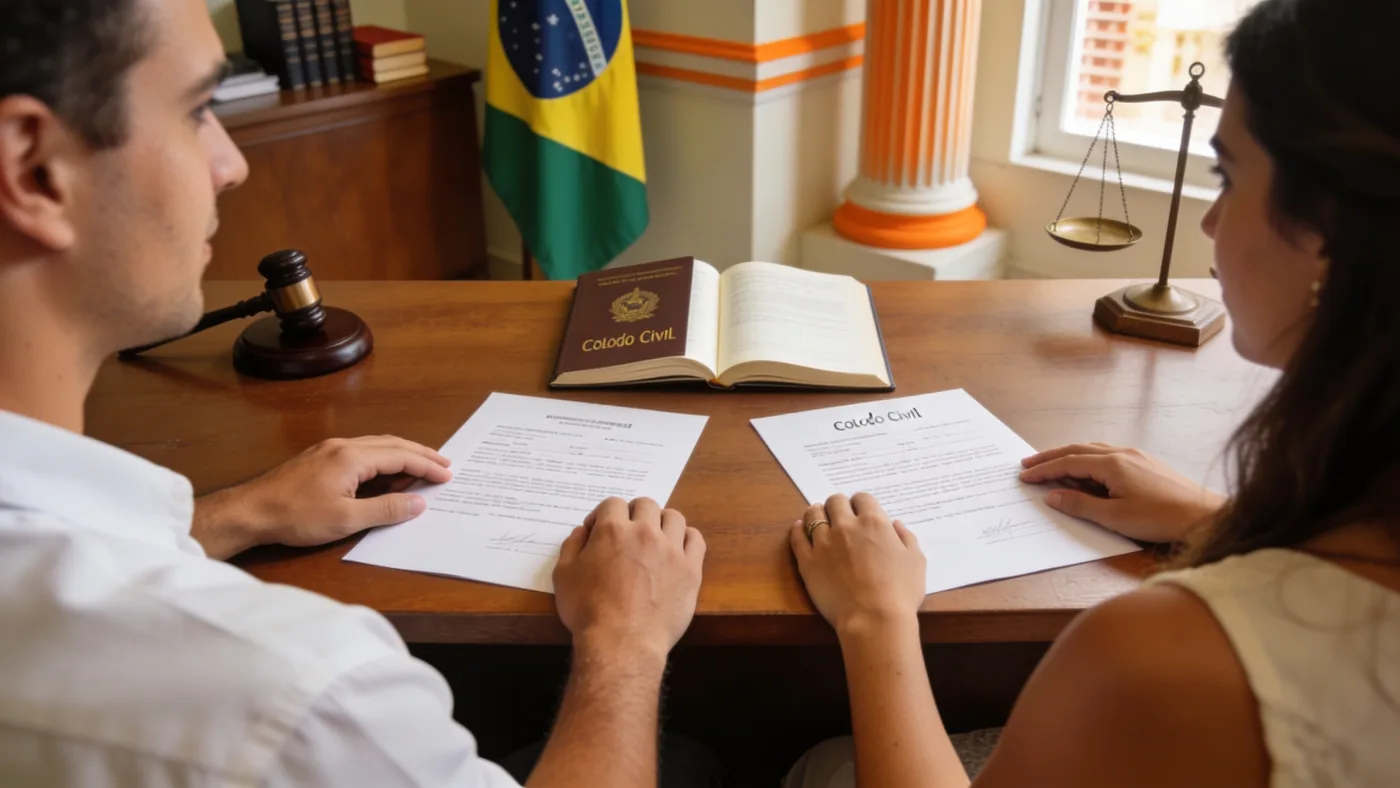

A relative died and left an apartment in Rio, a bank account in São Paulo, or a farm in Bahia. You live in Lisbon, Miami or Berlin. Now you are staring at words like inventário, legítima and ITCMD, and nobody can tell you the one thing you actually want to know: do you inherit, how much, and how long will it take?
Here is the short answer. Under the Brazilian Civil Code (Law 10.406/2002), assets located in Brazil are always divided under Brazilian succession law, in a Brazilian probate proceeding, no matter where the deceased lived or what passport anyone holds. Your nationality does not reduce your rights. Article 5 of the Brazilian Constitution guarantees foreigners resident in the country the same civil rights as Brazilians, and in practice courts and notary offices apply that equality to non-resident heirs too. A foreign child inherits exactly the same share as a Brazilian child.
The second thing to understand is that Brazil is a Civil Law country with forced heirship. If the deceased had children, parents or a spouse, half the estate is legally reserved for them. A will cannot take that away. This surprises heirs from the United States, the United Kingdom and Australia, where testamentary freedom is almost absolute.
The third thing is timing. Brazilian states impose a fine on estates that are not opened within 60 days of the death, and the inheritance tax return has its own deadlines. Waiting “until things calm down” is expensive. This guide walks you through the succession ladder, the rights of foreign heirs, the documents you need from abroad, the real costs in reais, and the mistakes that turn a six-month case into a six-year one.
On this page
Who Inherits First in Brazil? The Mandatory Succession Ladder
Brazilian law ranks heirs in a fixed order set by Article 1.829 of the Civil Code: first descendants together with the surviving spouse, then ascendants together with the spouse, then the spouse alone, then collateral relatives up to the fourth degree. Only if none exist does the estate go to the State. Half the estate (the legítima) is always reserved for these mandatory heirs.
The ladder is exclusionary. If there is one living child, the deceased’s parents and siblings inherit nothing, even if they were closer to the deceased in life. Grandchildren only inherit if their own parent died first, stepping into that parent’s place (representation).
The mandatory heirs (herdeiros necessários) under Article 1.845 of the Civil Code are descendants, ascendants and the spouse. Their protected half cannot be removed by will except in extreme cases of legally listed misconduct against the deceased. The remaining 50 percent is the parte disponível (disposable portion), which the deceased may leave to anyone: a partner, a friend, a charity, a foreign trust.
- Descendants: all children inherit equally. Children born outside marriage, adopted children and children from a previous foreign marriage have identical rights. The Constitution prohibits any distinction.
- Spouse: whether the spouse competes with the children depends on the marriage property regime, explained below.
- Stable union partner: since the Supreme Court decision in RE 851.108, partners in a união estável are treated on the same footing as spouses for succession purposes.
- Ascendants: parents inherit only when there are no descendants.
- Collaterals: siblings, nephews, uncles and cousins, only when there is no descendant, ascendant or spouse.
Why the marriage property regime changes everything
Foreign heirs constantly confuse two different things: meação (the surviving spouse’s own half of the marital property, which is not inheritance at all) and the inheritance share. A widow married under full community of property already owns half the assets. Only the deceased’s half is divided among heirs.
Example: A German man married a Brazilian under the default regime of comunhão parcial (partial community) and they bought an apartment in Florianópolis worth R$ 1,500,000 during the marriage. He also owned a São Paulo apartment worth R$ 500,000 before the marriage. On his death, the widow keeps R$ 750,000 as meação from the first property. The estate to be divided is R$ 750,000 plus R$ 500,000. On the pre-marriage property she also inherits as an heir alongside the two children, so that R$ 500,000 is split three ways.
If you are planning a binational marriage, the regime you choose today determines who inherits tomorrow. Our guide on marriage in Brazil for foreigners, rules and documents explains how to select and register a property regime at the Brazilian civil registry, including the prenuptial deed (pacto antenupcial) required for anything other than the default regime.
What Rights Do Foreign Heirs Have Under Brazilian Law?
Foreign heirs have full and equal inheritance rights over assets located in Brazil. There is no nationality restriction, no residency requirement and no reduced share. You do not need a Brazilian visa or a CRNM to inherit. You do, however, need a Brazilian CPF (taxpayer number), which any foreigner can obtain free of charge through Receita Federal or a Brazilian consulate.
The legal foundation is twofold. Article 5 of the Constitution guarantees equality before the law, and the Brazilian Law of Introduction to the Rules of Brazilian Law (Decreto-Lei 4.657/1942) states that succession of assets located in Brazil is governed by Brazilian law, with one heir-friendly exception: when the deceased was a foreigner and the heirs are the Brazilian spouse or Brazilian children, the more favourable law between Brazilian law and the deceased’s national law applies to them.
Important: Brazilian courts have exclusive jurisdiction over probate and partition of assets located in Brazil. The Superior Court of Justice confirmed this in REsp 1.447.246/RS, when analysing the recognition of a foreign decision. A US probate order, a Portuguese habilitação de herdeiros or an English grant of probate cannot transfer a Brazilian apartment by itself.
What this means in practice for you:
- You can participate in the entire Brazilian probate from abroad, through a Brazilian lawyer holding a power of attorney (procuração) signed at a Brazilian consulate or apostilled abroad.
- You never have to travel to Brazil, unless the case involves a judicial dispute requiring your testimony.
- You may receive your share in cash after a sale, and remit it abroad through a bank following Banco Central rules on international transfers, declaring the origin as inheritance.
- You can renounce the inheritance, but only by a formal public deed or court filing, never informally, and never partially.
Non-resident heirs must register the received assets with Receita Federal if they later become Brazilian tax residents, and remittances abroad are reported to the Banco Central do Brasil by the intermediating bank. Keep the probate decision (formal de partilha) as proof of legal origin. Foreign banks will ask for it.
Does a Foreign Will Work in Brazil, or Does Brazilian Law Override It?
A foreign will can be used in Brazil, but only within limits. Brazilian courts respect the disposable half of the estate and generally accept a validly executed foreign will over that portion. They will not enforce any clause that invades the 50 percent legítima reserved to descendants, ascendants or spouse under Article 1.846 of the Civil Code.
So a Californian living trust leaving “everything to my second wife” will be partially reduced in Brazil if the deceased had children. The children can file an ação de redução (reduction claim) to restore their protected half of the Brazilian assets.
To use a foreign will in a Brazilian probate you normally need it translated by a sworn public translator (tradutor juramentado), apostilled under the Hague Apostille Convention, and, when it was subject to a foreign court proceeding, recognised by the Superior Court of Justice through the homologação de sentença estrangeira procedure described on the STJ website. That recognition process alone typically takes 6-18 months.
Assets abroad are not counted in the Brazilian estate
This is one of the most consequential rules for international families, and it was reinforced recently. In REsp 2.080.842/SP, judged on 18 June 2024, the Third Panel of the Superior Court of Justice held that Brazilian law does not apply to the succession of assets located abroad, not even for the purpose of compensating the legítima. The court reaffirmed the principle of plurality of succession proceedings: each country governs the assets in its own territory.

The Supreme Court had already pointed the same way in RE 99.230/RS (1984), stating that assets divided abroad under the local succession law cannot be computed by Brazilian courts in the hereditary share divided in Brazil. And on 23 July 2024 the 1st Chamber of Private Law of the São Paulo Court of Justice refused to include foreign assets in a Brazilian probate, aligning with the STJ, as reported by the Brazilian Institute of Family Law (IBDFAM).
Warning: If one sibling received the family’s Portuguese apartment and another received the Brazilian one, do not assume a Brazilian judge will “even things out”. Under the current STJ position, the foreign asset is simply outside the Brazilian case. Cross-border fairness must be arranged by agreement between the heirs, not by a Brazilian court order.
How Do You Claim an Inheritance in Brazil From Abroad?
You claim it through a Brazilian probate called inventário. There are two pathways: extrajudicial (at a notary office, possible when all heirs are adults, in agreement, and there is no contested will) or judicial. The Civil Procedure Code sets a 2-month deadline from the death to open the proceeding, and states charge a tax surcharge for late filing.
Step 1: Gather and legalise your documents
Every foreign document must be apostilled in the country of origin and translated into Portuguese by a sworn translator registered in Brazil. Documents issued in countries outside the Hague Convention require consular legalisation instead.
- Death certificate of the deceased (apostilled and translated if issued abroad)
- Marriage certificate or proof of stable union, plus the prenuptial deed if one exists
- Birth certificates of all children, proving the family link
- Passport and CPF of each heir (CPF can be requested online via Receita Federal or at a consulate)
- Property deeds and updated matrícula certificates from the real estate registry
- Bank, brokerage and company holdings statements as of the date of death
- Original will, or a certificate from the Central Notarial Registry (CENSEC) confirming none exists
- Power of attorney with specific succession powers, signed before a Brazilian consulate or apostilled
Tip: Ask your lawyer for a model procuração in Portuguese before you go to the consulate. Powers of attorney drafted abroad in generic terms are frequently rejected by notary offices because they lack the specific powers to accept inheritance, sign the partition deed and sell property.
Step 2: Choose the probate pathway
The extrajudicial route at a cartório (notary office with legal registration powers, not just a signature witness) is far faster. All heirs must be adults, capable, in full agreement, and represented by a lawyer. Realistic timeline: 60-120 days once documents and taxes are ready.
Judicial probate is mandatory when there are minor heirs, incapable heirs, or a dispute. Realistic timeline: 1-3 years in most state courts, longer where a will must first be recognised by the STJ or where an heir cannot be located.
Step 3: Pay the ITCMD and transfer the assets
ITCMD is the state inheritance and gift tax. Rates are set by each state and currently range from 2 to 8 percent of the transferred value, according to the state finance departments. São Paulo applies 4 percent; Rio de Janeiro uses progressive brackets up to 8 percent. The tax must be assessed and paid before the partition is registered.
Once ITCMD is paid and the partition deed or court decision (formal de partilha) is issued, the document is taken to the real estate registry to transfer titles, and to the banks to release funds. Only at that point are you legally the owner.
What Will an Inheritance in Brazil Actually Cost You?
Budget roughly 8-15 percent of the estate value in total costs. The main items are ITCMD (2-8 percent depending on the state), notary and registry fees (typically 1-2 percent), sworn translations (around R$ 80-150 per page in 2026 market rates), and legal fees, which for extrajudicial probate commonly range from 3 to 6 percent of the estate.
Example: An Italian heir inherits, together with a sibling, a São Paulo apartment valued at R$ 500,000. ITCMD at 4 percent is R$ 20,000. Notary and registry fees are roughly R$ 6,000. Sworn translation and apostille of foreign documents cost around R$ 3,000. Legal fees at 5 percent are R$ 25,000. Total outlay: about R$ 54,000, leaving each sibling with roughly R$ 223,000 in value.
| Scenario | Pathway | Realistic timeline | Typical total cost |
|---|---|---|---|
| Adult heirs, all in agreement, no will, one property | Extrajudicial at cartório | 60-120 days | 8-12% of estate |
| Minor or incapable heir involved | Judicial, mandatory | 12-30 months | 10-15% of estate |
| Heirs in dispute over shares | Judicial, contested | 2-5 years | 15%+ of estate |
| Foreign will requiring STJ recognition | STJ recognition, then probate | 18-36 months | 12-18% of estate |
| Estate opened more than 60 days after death | Either pathway | Same, plus assessment | Add state late-filing surcharge on ITCMD |
Important: ITCMD is generally calculated on the market value assessed by the state tax authority, not on the old purchase price in the deed. An apartment bought for R$ 200,000 in 2005 may be assessed at R$ 900,000 today. Get a preliminary valuation before you estimate the tax bill.
What Changed in 2026 for Foreign Heirs?
The forced heirship rules of the Civil Code were not amended in 2026: the 50 percent legítima and the succession order of Article 1.829 remain unchanged. What is moving is tax and jurisdiction. The 2023 constitutional tax reform made ITCMD progressive across all states, and states are still implementing progressive brackets, pushing effective rates towards the 8 percent constitutional ceiling.
Three developments matter most to international families this year:
- ITCMD on foreign-linked estates. The constitutional reform authorised states to tax inheritances involving assets or deceased persons abroad, an area previously blocked for lack of a federal complementary law. Expect assessments in cases that escaped taxation until recently.
- Progressive state rates. States that historically charged a flat rate are migrating to brackets. If the estate is large, the difference between filing this year and next can be tens of thousands of reais.
- Consolidated case law on foreign assets. The 2024 STJ decision in REsp 2.080.842/SP and the July 2024 TJSP ruling have made it much harder to argue that overseas property should be compensated inside a Brazilian partition.
There is also a broader reform debate. Proposals to soften forced heirship, giving Brazilians more testamentary freedom, circulate in Congress and in the ongoing Civil Code revision discussions. Nothing has been approved. Plan on the current 50 percent rule, not on a hoped-for change. The full text of the Civil Code is available at planalto.gov.br.
What Are the Mistakes That Cost Foreign Heirs the Most Money?
The most expensive mistake is delay. Most states impose a surcharge on ITCMD when probate is not opened within 60 days of the death, and the property continues to generate IPTU (municipal property tax), condominium fees and maintenance costs that heirs must fund from their own pockets until the estate is settled.
Other errors we see repeatedly in international estates:
- Assuming a foreign probate is enough. It is not. Brazilian assets need a Brazilian proceeding, as the STJ confirmed in REsp 1.447.246/RS.
- Signing a generic power of attorney. Notary offices reject POAs without express powers to accept the inheritance and sign the partition. Redoing it at a consulate costs months.
- Selling before the transfer. You cannot sell an inherited property until the partition is registered, unless the court authorises a sale within the probate (alvará judicial).
- Ignoring the surviving partner. An undeclared união estável can surface later and reopen the division. Since RE 851.108, that partner ranks with a spouse.
- Forgetting the divorce that never finished. If the deceased separated but never legally divorced, the estranged spouse may still hold rights. Our guides on divorce in Brazil for foreigners and property division rules in a Brazilian divorce explain why an unfinished divorce is a succession problem.
- Hiring an unlicensed adviser. Only lawyers registered with the OAB (Brazilian Bar Association) can represent you in probate. Consultants who are not lawyers cannot sign the notarial deed.
Tip: Before spending anything, ask your lawyer for a written “estate map”: which assets are in Brazil, which are abroad, which heirs exist, which pathway applies and what the estimated ITCMD will be. A two-week diagnostic often saves a year of wrong-track litigation.
Frequently Asked Questions About Inheritance for Foreigners in Brazil
Can a foreigner inherit property in Brazil without living there?
Yes. There is no residency or visa requirement to inherit Brazilian property. A non-resident foreigner can inherit an apartment, land, shares or bank funds and hold them indefinitely. You will need a CPF (Brazilian taxpayer number), which is free and can be requested through Receita Federal online or at a Brazilian consulate abroad. The only meaningful restrictions in Brazilian law concern rural land near international borders and large rural properties, where foreign ownership is limited by specific legislation, so if the estate includes a farm, ask your lawyer to check the property’s classification early.
Do I have to travel to Brazil to receive my inheritance?
Usually not. The entire extrajudicial probate can be handled by a Brazilian lawyer under a power of attorney signed at a Brazilian consulate in your country, or signed before a local notary and apostilled. That document must expressly grant powers to accept the inheritance, represent you in the probate, sign the partition deed and, if you wish, sell your share. Travel becomes necessary mainly in contested judicial cases where a judge requires personal testimony, or when banks demand in-person identity confirmation, which a lawyer can often resolve by correspondence.
Can my parent disinherit me in a Brazilian will?
Almost never. Under the Civil Code, descendants, ascendants and the spouse are mandatory heirs entitled to 50 percent of the estate. A will can only dispose of the other half. Disinheritance is possible only in narrow situations expressly listed in the Civil Code, involving serious misconduct against the deceased, and it must be declared in the will with the cause stated and later proved in court. If a foreign will ignores the reserved half, Brazilian heirs can file a reduction claim to restore their share of the Brazilian assets.
Does my inheritance in Brazil get taxed again in my home country?
It depends on your country. Brazil charges ITCMD at the state level, from 2 to 8 percent. Brazil has very few inheritance tax treaties, so relief usually depends on your own country’s rules. The United States taxes the estate rather than the heir and often does not tax inheritances received from abroad by a US person, though Form 3520 reporting may apply above certain thresholds. Portugal, the UK and Germany each apply different rules. Always consult a tax adviser in your country of residence before remitting funds.
How long does an inventário take when heirs live abroad?
Realistically, 4-8 months for an uncontested extrajudicial probate, because apostilles, sworn translations and consular powers of attorney add 30-90 days before the case can even be filed. Judicial probate with heirs abroad typically runs 12-30 months, and longer if an heir must be formally summoned overseas through diplomatic channels. The single biggest accelerator is having all foreign documents apostilled and translated before the first notary appointment, rather than one by one as requests arrive.
What happens if one heir refuses to cooperate?
The extrajudicial route closes and the case must go to court. Any single heir, or the estate administrator (inventariante), can file a judicial probate and the judge will summon the others. A refusing heir cannot block the process indefinitely: the court can appoint an administrator, order the sale of indivisible assets and deposit the uncooperative heir’s share. It is slower and more expensive, which is why a negotiated settlement, even at some cost, is usually the better financial outcome for everyone.
Does a stable union partner inherit like a spouse?
Yes. After the Supreme Court’s decision in RE 851.108, the succession rights of partners in a união estável are equated to those of married spouses. The practical difficulty is proof: unlike marriage, a stable union may not be registered anywhere. Partners can prove it with a declaratory deed signed at a notary office, joint accounts, shared leases, dependants listed on health plans or a court recognition action. Foreign partners should register the union formally while both are alive, precisely to avoid a contested succession later.
Protect Your Inheritance Rights in Brazil With a Bilingual Lawyer
Losing a family member is hard enough without a foreign legal system, sworn translations and a tax authority you have never dealt with. The good news is that Brazilian succession law is predictable: the shares are defined by statute, foreign heirs have the same rights as Brazilians, and most estates can be settled at a notary office in a few months if the paperwork is right from day one.
Our bilingual team at Ribeiro Cavalcante Advocacia represents heirs living in Europe, North America and Asia in Brazilian probate proceedings, handles ITCMD planning, prepares consular powers of attorney and coordinates with your foreign lawyer so nothing falls between two jurisdictions. Send us the death certificate and a list of assets, and we will tell you exactly where you stand.
Talk to a specialist lawyer now
Talk to a Lawyer on WhatsApp