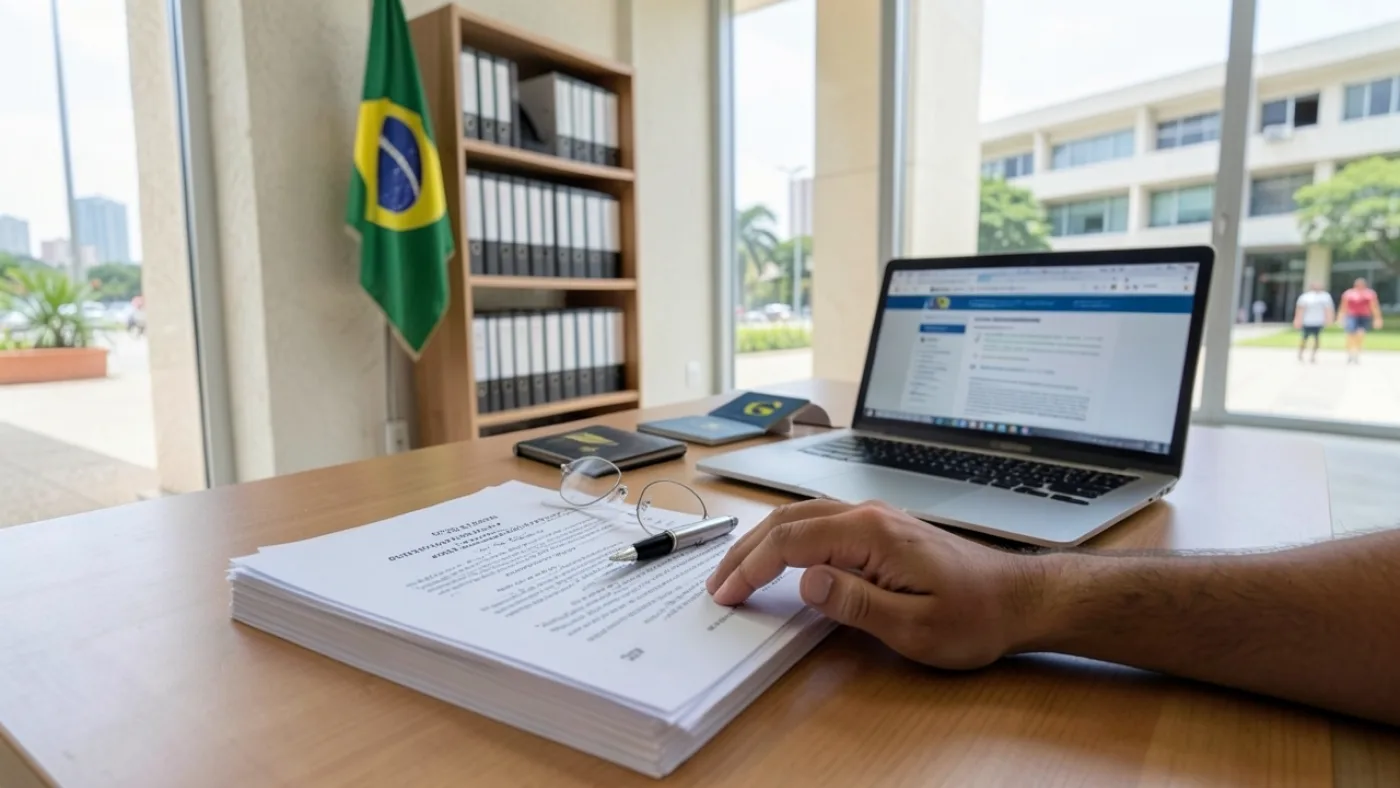
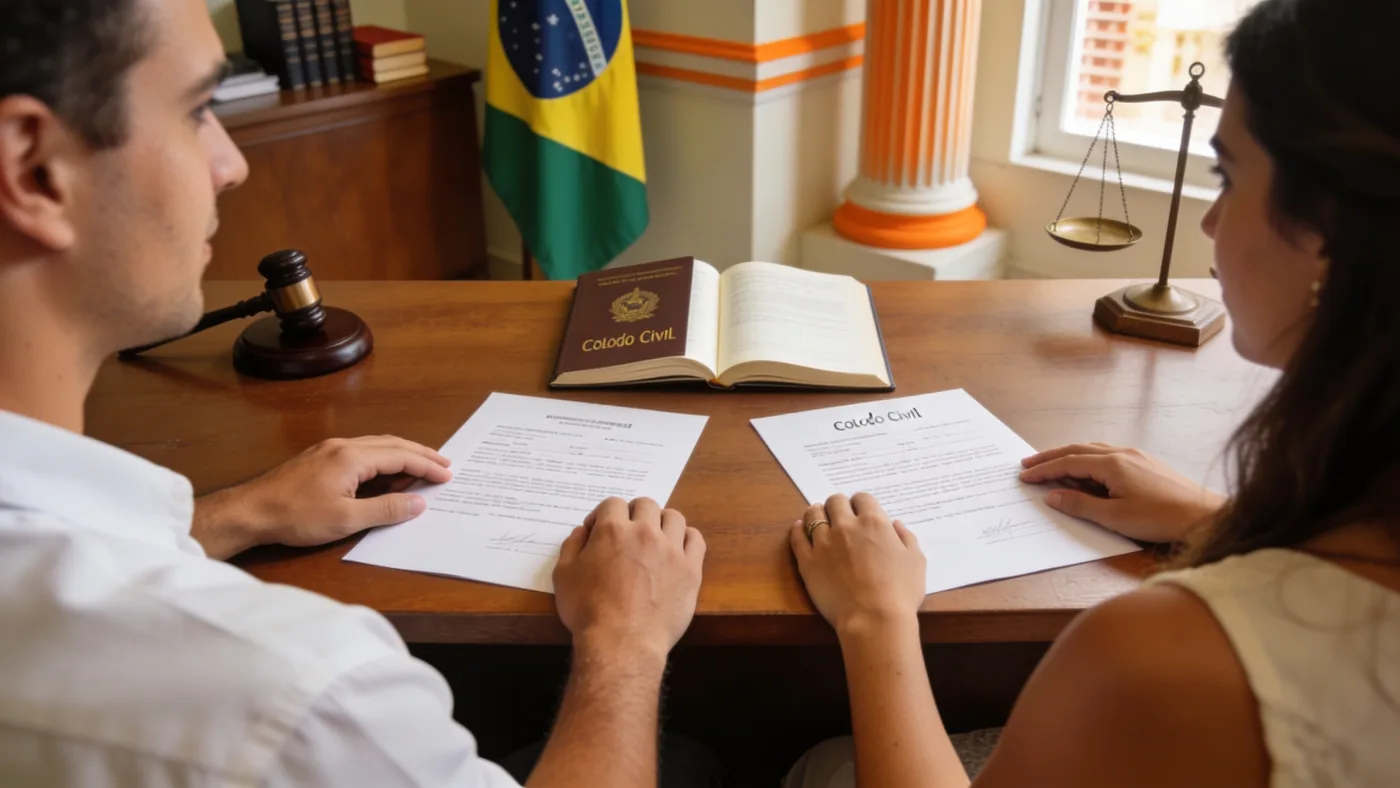
Brazil is home to millions of foreigners, binational couples, and mixed families. Whether you are marrying a Brazilian, divorcing across borders, fighting for custody of a child, or inheriting property from a deceased relative, Brazilian family law will affect you in ways that frequently surprise people from Common Law countries.
This is the pillar guide to the entire topic. We will explain the documents you must bring to the altar, the property regimes that can save or cost you everything, the quickest path to divorce, and how Brazilian courts handle international custody disputes. By the end, you will understand your legal position — and know exactly when to call a bilingual lawyer.
Critical context: Brazil follows the Civil Law tradition (Roman-Germanic), not Common Law. There is no “common-law marriage” in the American sense, judges apply written codes strictly, and the cartório (notary/registry office) is the center of nearly every life event — birth, marriage, property, and death.
On this page
The Legal Framework You Need to Know
Brazilian family and succession law rests on a handful of key statutes. Each one has practical consequences for foreigners living, marrying, or owning property in Brazil.
- Código Civil (Lei 10.406/2002): The master code, governing marriage, stable union, divorce, custody, and inheritance.
- LINDB, Article 7: The law of the person’s domicile governs marriage, family relations, and legal capacity.
- LINDB, Article 13: Rules on proof and validity of acts performed abroad and the application of foreign law in Brazilian proceedings.
- LINDB, Article 10: Succession is governed by the law of the deceased’s last domicile — but Brazilian law applies when it is more favorable to a Brazilian spouse or children and the assets are located in Brazil.
- Lei 13.445/2017 (Migration Law): A Brazilian spouse or child can reduce naturalization time to just one year.
- Constituição Federal, Art. 226 §3: Recognizes the stable union (união estável), granting cohabiting couples near-marriage rights.
- Hague Apostille Convention (in force since 2016): Your foreign documents need an apostille, not consular legalization.
- Hague Child Abduction Convention (Decreto 3.413/2000): Governs the return of children wrongfully removed to or from Brazil.
Practical takeaway: Two doctrines dominate everything. First, domicile law decides marriage validity and family relations. Second, for inheritance, Brazilian forced heirship protects spouses and children regardless of any will — you cannot simply disinherit them.
Marriage in Brazil for Foreigners
Who Can Get Married in Brazil as a Foreigner?
Any foreigner who is legally in Brazil can marry. You do not need to be a resident or hold a permanent visa. Even a tourist can marry, provided you follow the bureaucratic steps. The marriage is celebrated at a Cartório de Registro Civil (Civil Registry Office) and has full legal effect under Brazilian law — and, once apostilled, abroad.
The key procedure is the habilitação — the pre-marriage authorization. You must file your intent to marry at the cartório in the municipality where one of you resides. The registry verifies that both parties are legally free to marry, publishes the announcement (the proclamas), and issues the certificate of authorization, valid for 90 days.
Documents Required for a Foreigner: Marriage in brazil for foreigners
Cartórios are strict, and a single missing document can delay your wedding by weeks. Foreigners should generally prepare:
- Valid passport (and your visa or migration registration, if applicable);
- Birth certificate, apostilled and sworn-translated into Portuguese;
- Certificate of no impediment / single-status certificate from your home country, apostilled and translated;
- If previously married: divorce decree or death certificate of the former spouse, apostilled and translated;
- CPF (Brazilian taxpayer number) — increasingly required even for tourists;
- Two witnesses with valid ID (an RG or passport).
Sworn translations (tradução juramentada) and apostilles add cost and time. Budget roughly R$ 300 to R$ 500 per document for translation, depending on length, plus apostille fees in your home country.
The Prenuptial Agreement (Pacto Antenupcial)
If you want any property regime other than the legal default, you must sign a pacto antenupcial (prenuptial agreement) before the wedding. This is a public deed drawn up at a Tabelionato de Notas (notary office) and then registered. Skip this step, and Brazilian law automatically imposes the default regime — a costly surprise for many foreigners with significant pre-marital wealth.
The prenup is especially important for entrepreneurs. If you own a company (with its own CNPJ), or expect to build one during the marriage, the agreement defines how that asset is treated on divorce or death. Drafting a robust prenup typically costs between R$ 2.000 and R$ 3.000 in legal and notary fees — a fraction of what an unplanned division can cost.
What Are the Legal Property Regimes for Marriage in Brazil?
Brazil offers four property regimes. Understanding them is essential, because the wrong choice can decide who keeps a R$ 1.000.000 apartment after a split.

- Comunhão parcial de bens (Partial Community) — the default. Everything you acquire during the marriage becomes joint property, divided 50/50 upon divorce. Inheritances and assets owned before marriage stay separate.
- Comunhão universal de bens (Universal Community). Almost everything — including pre-marital assets and most inheritances — is pooled and shared. Requires a prenup.
- Separação total de bens (Total Separation). Each spouse keeps full ownership and control of their own assets. Popular among wealthy or older couples and business owners. Requires a prenup (unless legally mandatory).
- Participação final nos aquestos. A hybrid: separate during the marriage, with a calculated sharing of gains at the end. Rare and complex.
Under partial community, you divide what was built during the marriage: bank accounts opened after the wedding, the car bought jointly, the house with a mortgage taken together — even if the down payment came from one spouse. Debts are shared too. But if you sold an inherited property worth, say, R$ 800.000 and reinvested the money in marital assets, the tracing of that money becomes a legal battleground.
How Does Divorce Work for Foreigners in Brazil?
Brazilian divorce is far simpler than in many countries: there is no waiting period and no requirement to prove fault. If one spouse wants out, the marriage ends. There are two paths, depending on whether you agree and whether minor children are involved.
Talk to a specialist lawyer now
Talk to a Lawyer on WhatsAppExtrajudicial Divorce (Cartório)
If both spouses agree on everything — property division, support, and there are no minor or incapacitated children — you can divorce directly at a cartório. With both parties and their lawyer present, this can be concluded in a single session, sometimes the same day. It is fast, private, and comparatively cheap. Cartório fees scale with the assets being divided but commonly fall in the range of a few thousand reais.
For a deeper walkthrough of cross-border scenarios, see our complete guide to international divorce involving Brazilians in 2026.
Judicial Divorce
A court divorce is mandatory when there are minor children, or when the spouses cannot agree on terms. A judge will then rule on custody, child support, and asset division. Contested cases can take from several months to a couple of years, depending on the complexity and the assets in dispute. Even here, the divorce itself can be granted quickly while financial disputes are litigated separately.
US citizens in particular should review our dedicated guides on divorce in Brazil with an American spouse and on how US citizens get a Brazilian divorce recognized at home.
Property Division in Practice
This is where theory meets pain. Suppose a couple married under partial community accumulated R$ 1.000.000 in joint assets. Each spouse is, in principle, entitled to R$ 500.000. But the picture distorts quickly when one spouse claims part of the funds came from a pre-marital inheritance, or when assets sit overseas.
Foreign assets are a recurring complication. Brazilian courts can divide property located abroad as part of the marital estate, but enforcing that division in another country requires recognition there. This is why documentation — bank statements, a clear paper trail, and any prenuptial contrato — is decisive. Even modest accounts of R$ 32.000 can become contested if records are missing.
Recognizing a foreign divorce in Brazil is now straightforward for uncontested cases: it can be done directly at the cartório with the apostilled and translated foreign decree, without going to the STJ, provided there is no dispute over assets or custody. Our complete divorce guide for foreigners covers the recognition procedure step by step.
Child Custody in Brazil: Joint Custody as the Default
Brazilian law strongly favors guarda compartilhada (joint custody) as the default. Both parents share decisions about the child’s life — schooling, health, religion — even when the child physically lives mainly with one parent. The driving principle is always the best interests of the child, not the preferences of the parents.
For foreign parents, two issues dominate. First, international relocation: a parent cannot simply take a child to live abroad without the other parent’s consent or a court order. Second, child support (pensão alimentícia), calculated according to the child’s needs and the paying parent’s income. Courts can also order documentation such as a sworn declaração of income when a parent’s earnings are unclear or located abroad.
International Child Abduction: How the Hague Convention Protects Your Child
One of the most painful scenarios in international families is when one parent takes a child abroad — or refuses to return one to Brazil — without consent. Brazil is a signatory to the Hague Convention on the Civil Aspects of International Child Abduction (Decreto 3.413/2000).
The Convention’s core mechanism is the prompt return of a child wrongfully removed from their country of habitual residence. The merits of custody are then decided by the courts of that habitual-residence country — not by whichever country the child was taken to. Brazil’s Central Authority processes these requests, but cases are notoriously slow and emotionally charged. Acting fast and with a specialized lawyer is critical: delay can be interpreted as the child “settling” into the new environment, which weakens a return claim.
Inheritance and Succession for International Families
Inheritance is where foreigners are most often blindsided. Brazil applies forced heirship (legítima): at least 50% of a deceased person’s estate is automatically reserved for “necessary heirs” — descendants, ascendants, and the surviving spouse. You cannot freely will away that protected half, no matter what your home country allows.
Under LINDB Article 10, succession generally follows the law of the deceased’s last domicile. However, when assets are located in Brazil and Brazilian law is more favorable to a Brazilian spouse or children, Brazilian law prevails for those assets. The result is that estates frequently split across two jurisdictions, each applying its own rules.
The Brazilian probate process — the inventário — can be extrajudicial (at a cartório, when heirs agree and there are no minors) or judicial. State inheritance tax (ITCMD) typically ranges from 2% to 8% of the estate’s value. On an estate valued at R$ 157.000, the tax burden alone can run into several thousand reais before any distribution. Probate also requires apostilled foreign documents and, often, a Brazilian-based representative for overseas heirs.
If you own property in Brazil or expect to inherit here, do not improvise. Read our detailed guide to inheritance for foreigners in Brazil in 2026, then build a coordinated cross-border estate plan with a lawyer.
Stable Union (União Estável): The “Invisible Marriage”
Many foreigners are shocked to learn that you can have marriage-level legal obligations without ever marrying. Under Article 226 §3 of the Constitution, a união estável arises when a couple lives together publicly, continuously, and with the intention of forming a family.

The practical consequence: a stable union carries the same default property regime as marriage (partial community), inheritance rights, and support obligations. A long-term cohabiting partner can claim half of the assets built during the relationship — even if nothing was ever signed. To control this, couples can sign a contrato de convivência (cohabitation agreement) defining the property regime, much like a prenup.
Frequently Asked Questions
Can I marry in Brazil on a tourist visa?
Yes. Any foreigner legally present in Brazil — including tourists — can marry, provided they complete the habilitação and present apostilled, translated documents.
Does marrying a Brazilian give me residency?
Marriage (or a registered stable union) with a Brazilian gives you a clear path to residency and reduces the naturalization timeline to roughly one year of residence, under the 2017 Migration Law.
Will my foreign prenup be valid in Brazil?
Not automatically. A foreign prenup may be recognized, but to govern assets located in Brazil it is far safer to register a Brazilian pacto antenupcial. Conflicting documents create exactly the litigation you want to avoid.
Can a Brazilian court divide my assets located abroad?
It can determine your entitlement, but enforcing the division in another country requires recognition there. Coordinated legal action in both jurisdictions is usually necessary.
Can I disinherit my children or spouse under Brazilian law?
No. Forced heirship reserves at least half the estate for necessary heirs. Disinheritance is possible only in narrow, statutorily defined situations of serious misconduct.
The Bottom Line
Brazilian international family law rewards planning and punishes improvisation. The default rules — partial community of property, joint custody, forced heirship — apply automatically the moment you marry, cohabit, or own assets here. Foreigners who understand these rules before a marriage, divorce, or death can protect millions of reais and years of stress.
Because every cross-border case involves at least two legal systems, a bilingual, internationally experienced lawyer is not a luxury — it is the difference between a clean outcome and a decade of litigation. At Ribeiro Cavalcante Advocacia, we guide expats, investors, and binational families through marriage, divorce, custody, and inheritance in Brazil. If your situation touches any of the topics above, talk to us before you sign — not after.
This article is for general information only and does not constitute legal advice. Laws and procedures may change; always consult a qualified Brazilian attorney about your specific case.
Guia completo: artigos desta série
- Divorce in Brazil for Foreigners: Process & Timeline 2026
- Divorce Brazil Foreign Spouse: Property Division Rules
- International Child Abduction Brazil: Hague Rules 2026
- Foreign Divorce in Brazil: STJ Recognition and Costs 2026
- Inheritance in Brazil for Foreigners: Who Inherits First
- Uniao Estavel Brazil: Rights, Visa and Proof 2026
- Foreign Marriage Brazil: How to Register It in 2026
- International Child Support Brazil: Enforce Payments