
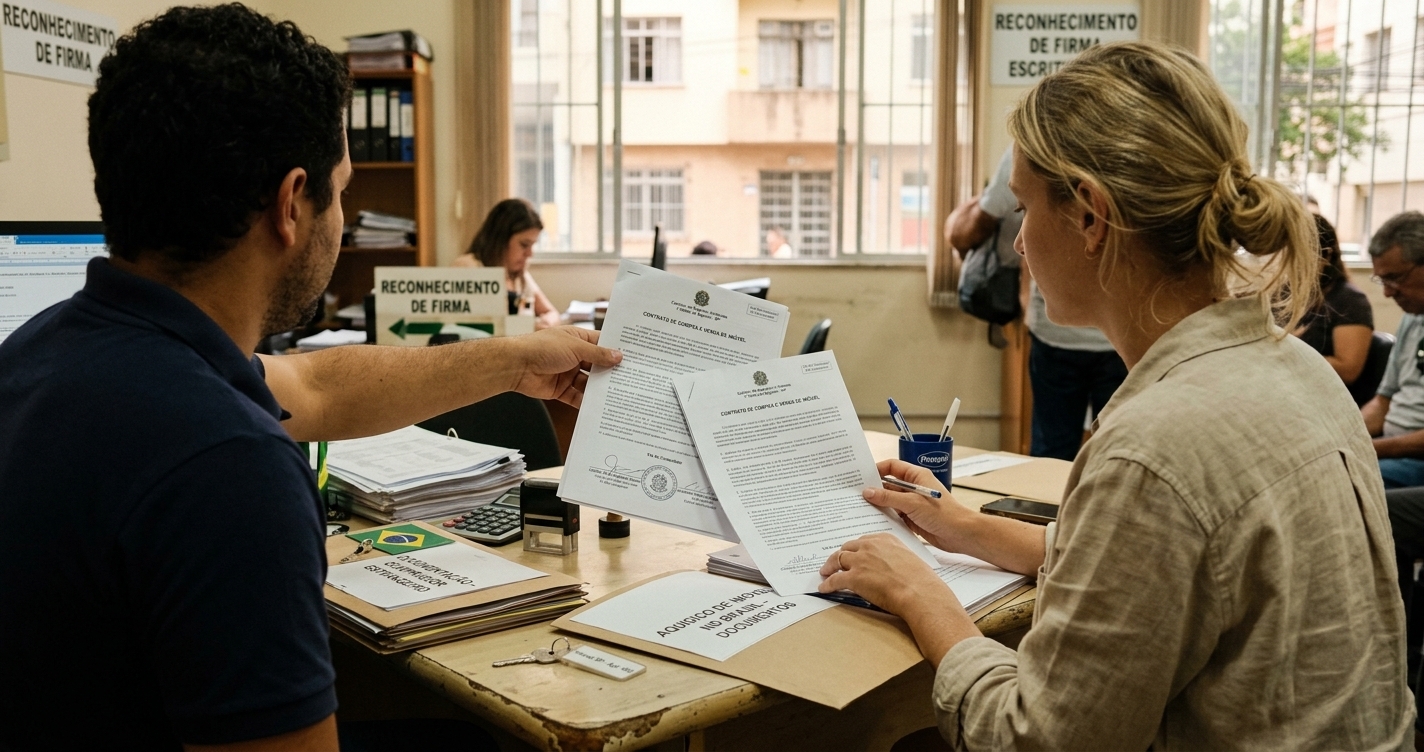
Yes, you can buy property in Brazil as a foreigner, with no visa, no residency and no Brazilian partner. But the thing that decides whether your money is safe is not the purchase contract you signed. It is whether that purchase was registered at the correct Registro de Imóveis (Land Registry).
Brazil runs on Civil Law, not Common Law. There is no title insurance industry to rescue a flawed closing, no escrow agent holding your funds by default, and no title company guaranteeing the chain of ownership. In Brazil, the registry is the title. Under the Brazilian Civil Code, ownership of real estate passes only when the deed is registered on the property’s record (matrícula), not when you sign, not when you pay, not when you receive the keys.
That single difference explains almost every horror story involving a foreign buyer in Brazil: the apartment sold twice, the beach lot that turned out to be federal land, the farm that a foreigner legally could not own, the R$ 1.2 million transfer that the bank later refused to send back abroad.
This guide compares the three realistic ways to hold Brazilian real estate as a foreigner (your own name, a Brazilian company, or a fund/offshore structure), with 2026 costs, tax rates and timelines, and it tells you exactly what the registry, the tax authority and the bank will argue against you.
On this page
What Is the Costliest Mistake Foreign Buyers Make in Brazil?
The costliest mistake is paying the full price against a private contract (contrato de compra e venda) that never reaches the Land Registry. Under the Brazilian Civil Code (Law 10.406/2002), ownership transfers only upon registration at the Registro de Imóveis, so an unregistered buyer is legally a creditor, not an owner.
Why does this happen so often? Because the sequence feels familiar. A broker sends a contract, a developer offers an instalment plan, you wire the money, you get keys. In most of Europe and North America, a notary or closing agent would not release funds without clearing title. In Brazil, nobody is contractually obliged to protect you unless you hire someone to do it.
The Civil Code text on Planalto is blunt about it, and Brazilian courts, including the Superior Court of Justice (STJ), consistently treat the registry record as the source of ownership rather than the private agreement.
Practical example: A Dutch buyer paid R$ 850,000 for a Florianópolis apartment under a private contract in 2023 and never registered the deed. In 2025 the seller’s unpaid tax debts triggered enforcement proceedings, and the apartment was still legally the seller’s asset. The buyer spent two years and over R$ 60,000 in litigation to be recognised, money that a R$ 12,000 due diligence would have saved.
Rebuild the rule from that mistake and everything else falls into place. Before you transfer a cent, you need three documents: a current certidão de matrícula (updated property record, issued within the last 30 days), the seller’s certidões negativas (clearance certificates for tax, labour and civil claims in every jurisdiction where the seller operates), and proof the municipal IPTU (property tax) and condominium fees are current. Debts on a Brazilian property follow the property, not the previous owner.
Warning: Off-plan purchases from developers add a fourth check: the memorial de incorporação must be registered on the matrícula. If the development was never registered, the units legally do not exist yet, and your instalments are funding a project with no registered guarantee.
Option A: How Does Buying in Your Own Name as a Non-Resident Work?
Buying personally is the fastest route: you need only a CPF (Brazilian tax ID), which Receita Federal issues free of charge (around R$ 7.00 if requested through Correios or a Brazilian consulate abroad), plus a public deed and registration. No company, no CNPJ, no Brazilian bank account strictly required.
How it works in practice: you (or your attorney-in-fact under a notarised and apostilled power of attorney) sign the escritura pública before a Tabelionato de Notas (notary office), the ITBI transfer tax is paid first, then the deed goes to the Land Registry for the registro. Only after that final step is the property yours.
- Requirements: valid passport, CPF, marital status proof (sworn-translated and apostilled), proof of funds origin
- Rental income tax: 15% withheld on gross rent paid to a non-resident, per Receita Federal rules
- Capital gains on sale: progressive rates of 15% up to R$ 5 million of gain, 17.5%, 20%, and 22.5% above R$ 30 million
- Liability: unlimited, the asset sits in your personal estate
- Succession: on death, Brazilian inheritance proceedings (inventário) apply to the Brazilian property, plus state ITCMD inheritance tax of up to 8%
Pros: cheapest to set up, no accounting obligations, no monthly compliance, and you can buy from abroad without ever entering Brazil. Cons: no deduction of renovation or management costs against the 15% withholding, no asset protection, and heirs face a Brazilian court process that commonly takes 12-24 months.
Important: A non-resident needs a Brazilian-resident legal representative (procurador) registered with Receita Federal to receive rent, pay taxes and respond to the tax authority. Appointing nobody is the fastest way to accumulate penalties you only discover when you try to sell.
Option B: How Does Buying Through a Brazilian LTDA Work?
A Brazilian Limitada (LTDA) can be 100% foreign-owned and holds the property in its own name. Expect 2-6 weeks to incorporate and roughly R$ 1,500-4,000 in registration costs, plus monthly accounting from about R$ 400-1,200. The foreign capital must be registered with the Central Bank within 30 days of inflow.
This route exists for investors building a portfolio, not for one holiday apartment. The economics only work when there is rental revenue to shelter, deductible costs to use, or multiple assets to segregate from personal risk.
Under the Lucro Presumido (presumed profit) regime commonly used by rental companies, the tax base is 32% of gross rental revenue, and the combined IRPJ and CSLL rate of 34% applies to that base, producing an effective burden of roughly 10.88% on gross rent, before PIS and COFINS. That is clearly better than 15% on gross, until the profits leave Brazil.
From 2026, Brazil’s income tax reform introduced a 10% withholding on dividends paid abroad. Combine the two layers and the company route on simple rental income lands near 19-20% total, which is why structure choice has to be run with numbers, not instinct. We break the remittance mechanics down in our guide on how to remit profits from Brazil under the 10% dividend tax, and the entity choice itself in LTDA vs S/A: the best company type in Brazil.
Practical requirements: a CNPJ (company tax number), at least one resident administrator or a legal representative with powers, and a registered fiscal address in Brazil, which cannot be a simple mailbox. Ribeiro Cavalcante provides a compliant fiscal address in Brazil for investors who do not yet have premises.
Pros: limited liability, deductible expenses, easier share transfers (you sell quotas, not the building, often avoiding a new ITBI), cleaner succession. Cons: ongoing accounting, Central Bank and Receita Federal filings, and a second tax layer on distributions.
Option C: Does a Foreign Holding or a Real Estate Fund Make Sense?
Two alternatives exist: a foreign company owning the Brazilian property directly, or buying quotas of a Brazilian listed real estate fund (FII). The FII route needs no deed, no ITBI and no notary, and FII distributions to non-residents are taxed at a reduced rate under the foreign portfolio investment regime, typically 15% on income, with gains on quota sales taxed when realised.
A foreign holding company can hold Brazilian real estate directly, but it must obtain a CNPJ, appoint a Brazilian legal representative and register its investment with the Central Bank. Deeds and registry filings then require apostilled, sworn-translated corporate documents for every single transaction, which adds weeks and cost to each purchase.
Where the offshore holding earns its keep is succession and confidentiality: shares abroad transfer under foreign law, avoiding Brazilian inventário. Where it hurts is scrutiny. Brazilian notaries and banks apply enhanced anti-money-laundering checks to entities from low-tax jurisdictions, and Receita Federal treats income from certain jurisdictions less favourably.
Tip: If your real goal is exposure to Brazilian property yields rather than owning a specific building, compare an FII against direct ownership before you spend anything. An FII position can be built in days through a registered non-resident investment account and sold in minutes, while a R$ 800,000 apartment takes 60-90 days to buy and often six months to sell.
How Do the Three Routes Compare on Cost, Tax and Timeline?
On a R$ 1,000,000 apartment, closing costs run roughly 4-6% of the price in every route except the FII, which has none. The difference between structures shows up in tax on rent, tax on exit, and compliance cost, not in the purchase itself. Here is the side-by-side.
| Criterion | A. Own name (non-resident) | B. Brazilian LTDA | C. Offshore holding / FII |
|---|---|---|---|
| Minimum documents | Passport, CPF, apostilled marital status proof | CPF for partners, CNPJ, articles of association, fiscal address | Apostilled corporate docs, CNPJ, legal representative (FII: investor registration only) |
| Setup time | 1-5 business days (CPF) | 2-6 weeks | 4-10 weeks (holding); days (FII) |
| Setup cost | Around R$ 7 for CPF via Correios/consulate | R$ 1,500-4,000 plus accounting from R$ 400/month | R$ 8,000+ in translations, apostilles and filings |
| Closing costs on R$ 1M | ITBI 2-3%, registry about 1%, deed fees | Same, paid by the company | Same (holding); none (FII) |
| Tax on rental income | 15% withheld on gross rent | About 10.88% effective under Lucro Presumido, plus 10% on dividends abroad | 15% (holding); reduced rates for FII distributions |
| Tax on sale gain | 15% to 22.5% progressive | Corporate rates on the gain, plus distribution tax | Varies; quota sales taxed on realised gain |
| Liability | Unlimited personal | Limited to capital | Limited |
| Succession on death | Brazilian inventário plus ITCMD up to 8% | Quota transfer, still Brazilian probate | Transfer abroad, avoids Brazilian inventário |
| Best for | One or two properties, personal use | Portfolio, rental business, renovations | Estate planning or passive yield exposure |
Practical example: On that R$ 1,000,000 apartment in a city charging 3% ITBI, budget roughly R$ 30,000 ITBI, R$ 9,000-12,000 in registry fees, R$ 4,000-7,000 for the deed, R$ 1,000-2,000 in sworn translations and apostilles, and legal due diligence. Total out-of-pocket: around R$ 55,000-70,000 beyond the price.
Which Properties Can a Foreigner Legally Not Buy?
Urban real estate is fully open to foreigners. Three categories are restricted: rural land (Law 5.709/1971 caps area and requires INCRA and, above certain sizes, Congressional authorisation), land within the 150 km border strip (Law 6.634/1979), and federal coastal land (terrenos de marinha), where you acquire occupancy rights and pay laudêmio on transfer.
Rural land is the trap that catches investors chasing agribusiness or eco-tourism. Law 5.709/1971 restricts acquisition of rural property by foreign individuals and by Brazilian companies controlled by foreigners. A notary who ignores it creates a deed that the registry can refuse, or that can be annulled later.
The coastal issue is subtler. Much of Brazil’s most desirable beachfront sits on terreno de marinha, federal land administered by the Union. You can buy and register the domínio útil (useful domain), but you remain subject to annual foro and a laudêmio payment on each transfer, typically 5% of the transaction value for the Union’s share. Many foreign buyers discover this only at resale.
Important: Buying property in Brazil does not grant you a visa, residency or any immigration benefit. Brazil has an investor residency route tied to qualifying investments, with thresholds set by the National Immigration Council, but it is a separate application with its own requirements. A deed is not an immigration document.
What Will the Tax Authority and the Bank Argue Against You?
Their strongest argument is this: if your money entered Brazil without a properly documented foreign exchange operation identifying the purpose, you have no registered foreign capital, and you therefore have no right to repatriate the original principal through the official market. On exit, the bank can hold the transfer and Receita Federal can tax the full sale price as if your cost basis were zero.
That is not a strawman. It is the most common reason a clean property sale turns into a frozen remittance. The Banco Central do Brasil regulates foreign capital flows, and banks executing an outbound transfer must document the economic substance behind it. A compliance officer looking at your file asks one question: what evidence shows this capital legitimately entered Brazil and what evidence shows the tax on the gain was paid?
The answer is documentary, and it is built at entry, not at exit. You need the contrato de câmbio (foreign exchange contract) for every inbound remittance, naming you as the remitter and the acquisition as the purpose. You need the funds to arrive in your own name, not a friend’s account, not cash, not crypto converted informally. You need the declared deed value to match the paid value. And where the investment flows through a Brazilian company, you need the Central Bank foreign direct investment registration completed within 30 days, as explained in our guide to BACEN registration for foreign investment in Brazil.
Warning: Declaring a lower price on the deed to cut ITBI is still common advice from informal brokers. It creates two liabilities at once: an artificially low cost basis that inflates your taxable gain on resale, and exposure to tax fraud allegations. The 2-3% you save becomes a 15-22.5% problem later.
Non-resident sellers also face withholding at source. The buyer or the appointed representative is responsible for retaining and paying the capital gains tax, which means a buyer’s lawyer who finds no proof of your original remittance will simply withhold on the gross amount. Your paperwork is your defence.
What Changed for Foreign Property Buyers in 2026?
Three changes matter in 2026: the 10% withholding tax on dividends remitted abroad under Brazil’s income tax reform, which affects anyone holding property through a Brazilian company; the consolidation of fully remote notarial acts through the national e-Notariado platform; and the continued tightening of beneficial ownership disclosure for foreign-controlled entities at Receita Federal.
The dividend change is the one that rewrites spreadsheets. Structures designed in 2022 on the assumption of tax-free dividend distributions now carry an extra layer, so single-asset LTDAs created purely for rental income often lose their advantage over direct ownership.
The remote notarisation infrastructure cuts the other way, in your favour. Electronic deeds and electronic powers of attorney signed via video conference with a Brazilian notary are now routine, which means a buyer in Lisbon or Miami can complete a purchase without flying in. You still need a digital certificate or notary-validated identity, and the property’s registry must accept the electronic title, which most now do.
On the CPF side, Receita Federal now processes most non-resident CPF applications digitally through its portal or a Brazilian consulate, with issuance typically in 1-5 business days once documents are accepted.
Which Route Should You Choose for Your Situation?
If you are buying one or two properties worth under about R$ 2 million for personal use or occasional rental, buy in your own name. The 15% withholding on gross rent costs less than years of accounting fees, and you avoid the 10% dividend layer entirely.
If you plan three or more properties, significant renovation spending, short-term rental operations with staff and management costs, or you want liability separated from your personal estate, incorporate a Brazilian LTDA. Deductible expenses and the ability to sell quotas rather than buildings justify the compliance burden.
If your dominant concern is succession for heirs in multiple countries, or if you simply want Brazilian property yield without owning Brazilian property, look at an offshore holding or an FII respectively. Both avoid Brazilian probate, and the FII avoids ITBI, notaries and registries completely.
Tip: Run the decision on your actual numbers before incorporating anything. On R$ 120,000 of annual gross rent, the own-name route costs R$ 18,000 in tax. The LTDA route costs about R$ 13,050 in corporate tax plus roughly R$ 10,700 when R$ 107,000 is distributed abroad, plus R$ 6,000-14,000 in accounting. The company only wins when real deductible costs exist.
How Do You Complete the Purchase, Step by Step?
A standard foreign purchase takes 45-90 days from signed offer to registered deed. Four steps are mandatory in every scenario: obtain a CPF, conduct registry and seller due diligence, pay ITBI and sign the public deed, then register the deed at the competent Land Registry. Only step four makes you the owner.
- Step 1 (1-5 days): Apply for your CPF with Receita Federal online or through a Brazilian consulate. Cost: free, or around R$ 7.00 via Correios.
- Step 2 (7-20 days): Due diligence. Pull the updated matrícula, seller clearance certificates, IPTU and condominium statements, and confirm the land is not rural, border strip or terreno de marinha.
- Step 3 (optional, 2-6 weeks): Incorporate the LTDA and obtain CNPJ, state and municipal registrations, plus Central Bank registration of the inbound capital.
- Step 4 (3-10 days): Remit funds through a bank, with the exchange contract naming the real estate acquisition as the purpose. Keep every contract.
- Step 5 (5-15 days): Pay ITBI at the municipality, then sign the escritura pública at the notary (in person or via e-Notariado).
- Step 6 (10-30 days): File the deed at the Land Registry. Collect the updated matrícula showing you as owner. This is your title.
- Step 7 (ongoing): Update IPTU records, utilities and condominium registration; appoint a tax representative if you are non-resident.
Documents from abroad must be apostilled under the Hague Convention (in force in Brazil since 2016) and translated by a sworn translator registered with the state Junta Comercial. Powers of attorney for property purchases must be in public form, meaning a notarised and apostilled POA from your home country, or an electronic POA issued by a Brazilian notary.
Frequently Asked Questions About Buying Brazilian Real Estate as a Foreigner
Do I need a Brazilian visa or residency to buy property in Brazil?
No. A non-resident foreigner with a valid passport and a CPF can buy, own, rent out and sell urban real estate in Brazil on the same terms as a Brazilian citizen. You do not need a visa, residency, a local partner or even to visit Brazil, since a Brazilian notary can issue an electronic power of attorney for your representative. The reverse is also true: buying property gives you no immigration right. Investor residency is a separate application before the immigration authorities with its own investment thresholds and documentation.
Do I need a lawyer to buy property in Brazil?
Legally, no. Practically, yes. Brazilian notaries authenticate the act but do not investigate whether the seller has hidden debts, whether the building was legally registered, or whether the land is restricted. There is no title insurance to fall back on and debts attach to the property itself. A lawyer registered with the OAB (Brazilian Bar Association) runs registry and judicial searches, verifies the chain of title, drafts protective payment conditions, and confirms your structure survives Central Bank and tax scrutiny on exit.
How much tax will I pay on rental income as a non-resident?
Rental income paid to a non-resident individual is subject to 15% withholding at source on the gross rent, per Receita Federal rules, with the withholding handled by your Brazilian legal representative or rental manager. Unlike a resident, you generally cannot offset the tax with progressive deductions. Through a Brazilian company under Lucro Presumido, the effective corporate burden is around 10.88% of gross rent, but distributions abroad now face an additional 10% withholding in 2026, so the combined cost is similar.
Can a foreigner buy a farm or rural land in Brazil?
Only within limits. Law 5.709/1971 restricts the acquisition of rural property by foreign individuals and by Brazilian companies under foreign control, imposing area caps measured in módulos, INCRA authorisation requirements, and Congressional approval for large areas. Properties inside the 150 km border strip face additional national security restrictions under Law 6.634/1979. A deed signed in breach of these rules can be refused by the registry or annulled, so rural acquisitions require a feasibility opinion before any payment.
Can I send the sale proceeds back to my home country?
Yes, provided the original inflow was properly documented. Brazil has no capital controls blocking legitimate repatriation, but your bank must document how the capital entered and that taxes on the gain were settled. Keep every contrato de câmbio, the deed, the ITBI receipt and the capital gains payment proof. Where the investment was made through a Brazilian company, the Central Bank foreign direct investment registration must be current, since an unregistered investment is the single most common cause of blocked remittances.
Buying Brazilian Real Estate as a Foreigner: Get Your Structure Right Before You Pay
Brazilian property can be an excellent investment, and the law genuinely treats you like a local buyer. What it does not do is protect you from a bad closing. Nearly every dispute we handle for foreign clients traces back to a step skipped before the money moved: no registry search, no documented exchange contract, no registered deed.
Your concrete next step: send us the property’s matrícula number (or the listing link) and tell us whether you are buying for personal use, rental income or portfolio growth. Our bilingual team will tell you which of the three structures fits, what the real closing cost will be on that specific property, and whether anything on the registry record should stop the deal.
Talk to a specialist lawyer now
Talk to a Lawyer on WhatsApp