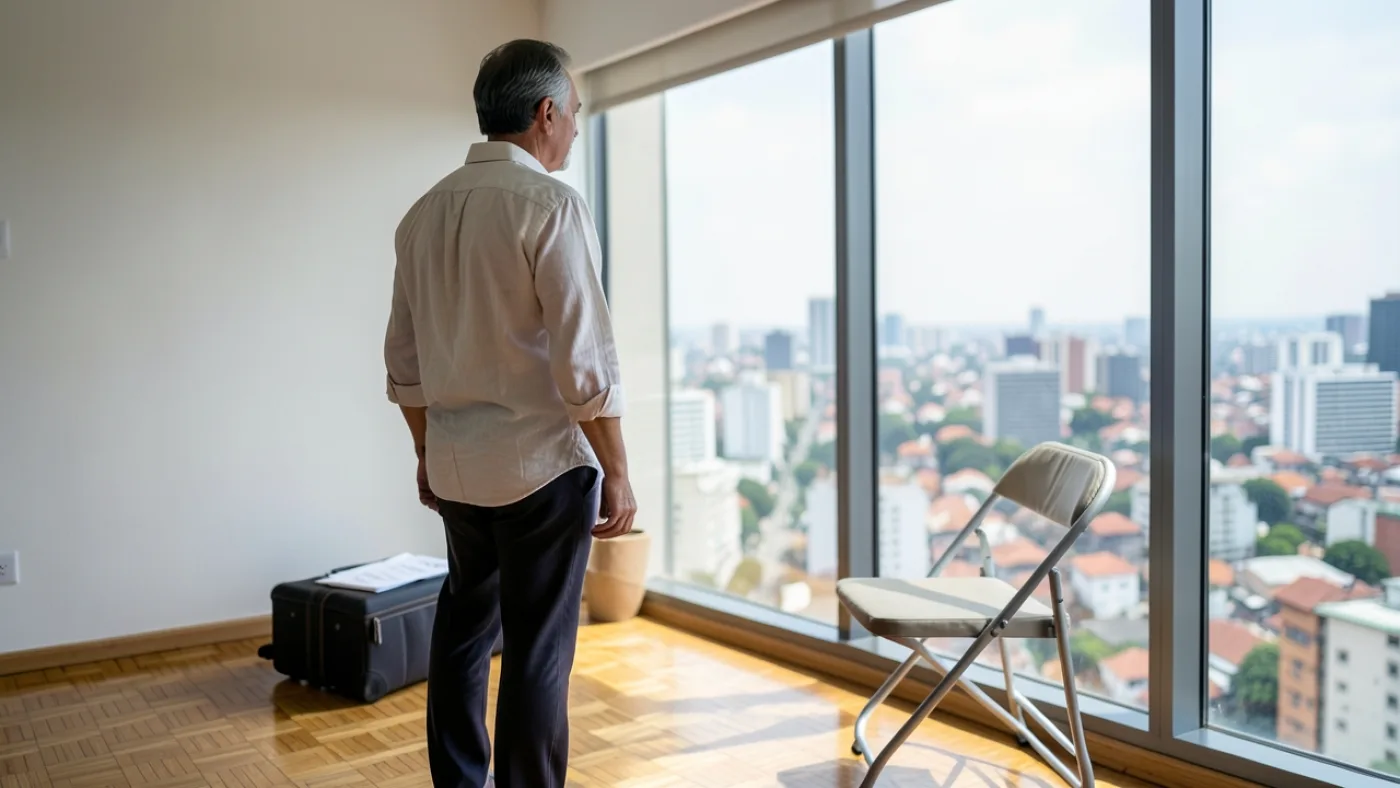
You are afraid Brazil will turn a simple decision into a two-year bureaucratic ordeal. It doesn’t have to, but only if you sequence the steps in the right order from day one. Brazil sells no product called a “Golden Visa”, yet it operates three investment-residency routes that behave exactly like one: real estate, direct investment in a Brazilian company, and the company manager route.
Here is what almost nobody tells wealthy applicants before they wire the money: the rule itself is generous and stable. Residency granted on investment grounds converts into permanent status, and after four years of legal residence you can apply for Brazilian naturalization, with Brazil fully accepting dual nationality. The thresholds are modest by international standards. Compared with Portugal, Greece or the Caribbean, Brazil is cheap.
And yet a striking number of high-net-worth applicants lose this right without ever being told they lost it. Not because they failed a requirement they knew about, but because of a registration they skipped, a currency transfer they routed through the wrong channel, or a permit they let expire while living comfortably in São Paulo. This article gives you the rule first, then spends the second half on exactly where the rule stops protecting you.
On this page
What Does Brazil Actually Offer High-Net-Worth Individuals?
Brazil offers residency by investment under the Migration Law (Lei 13.445/2017) and its regulating decree, through resolutions of the National Immigration Council (CNIg). The three main routes require R$ 1,000,000 in urban real estate, R$ 500,000 in a Brazilian company, or R$ 600,000 to enter as a company director. There is no separate “golden visa” statute.
The legal architecture matters because Brazil is a Civil Law country. Your rights come from written statutes and administrative resolutions, not from precedent or from what an official tells you at a counter. If the resolution says the capital must be registered with the Central Bank, no amount of good faith or goodwill will substitute for that registration. Conversely, if you meet the written criteria, the authority has very limited discretion to refuse you.
The Brazilian Migration Law replaced the old Foreigner Statute in 2017 and reframed migration as a matter of rights rather than national security. In practice this means an investor residence permit is not a favour granted by the state. It is an entitlement triggered by objective conditions, and that is precisely why the paperwork proving those conditions is everything.
For most wealthy applicants, the decision is not “can I qualify” but “which route leaves the least friction with my existing tax structure”. A Dubai-based family office, a retired US executive and a European fund manager will each find a different route optimal. The residency outcome is identical; the compliance burden is not.
Worth knowing: Brazil permits dual (and multiple) nationality. Naturalising as a Brazilian does not require you to renounce your current passport, and Brazil does not report your naturalisation to your home country.
How Much Do You Need to Invest in 2026?
The 2026 thresholds are unchanged: R$ 1,000,000 for urban real estate (R$ 700,000 in the North and Northeast regions), R$ 500,000 for direct investment in a Brazilian company, R$ 150,000 for innovation and startup investment, and R$ 600,000 per executive for the company manager route, per the CNIg normative resolutions in force.
Because the thresholds are fixed in reais and not indexed to the dollar, the real cost to a foreign investor moves with the exchange rate. At mid-2026 levels, R$ 1,000,000 sits in the region of US$ 180,000-190,000, and the R$ 700,000 regional threshold lands around US$ 125,000-135,000. That makes Brazilian investment residency one of the least expensive in the world in hard-currency terms.
| Route | Minimum investment | Typical timeline | Best suited to |
|---|---|---|---|
| Urban real estate | R$ 1,000,000 | 60-120 days after purchase | Passive investors, family relocation |
| Urban real estate, North/Northeast | R$ 700,000 | 60-120 days after purchase | Buyers in Bahia, Ceará, Pernambuco, Amazonas |
| Investment in a Brazilian company | R$ 500,000 | 90-150 days | Entrepreneurs, operating businesses |
| Innovation, R&D, startups | R$ 150,000 | 90-150 days | Tech founders, venture investors |
| Company manager / director | R$ 600,000 per executive | 90-180 days | Group expansion into Brazil |
| Manager, reduced threshold | R$ 150,000 + 10 jobs in 2 years | 90-180 days | Labour-intensive operations |
| Retiree / private income | Stable monthly transfer (historically US$ 2,000) | 60-120 days | Retirees with pensions or rental income |
| Digital nomad | US$ 1,500/month or US$ 18,000 balance | 30-90 days | Testing Brazil before committing capital |
In practice: A German investor buying a R$ 720,000 beachfront apartment in Fortaleza qualifies under the R$ 700,000 Northeast threshold. The identical apartment priced at R$ 720,000 in Florianópolis (South region) does not qualify, because the South falls under the R$ 1,000,000 rule. Same money, different outcome, purely because of geography.
Government fees are trivial next to the investment. First registration of the CRNM (Carteira de Registro Nacional Migratório, the National Migration Registration Card) costs R$ 204.77, roughly US$ 40 or €38, per the Federal Police fee schedule. The residence authorisation request itself carries a separate administrative fee in the region of R$ 168. Your real costs sit elsewhere: property transfer tax (ITBI, typically 2-3% of the property value), cartório (notary office) deed and registry fees of roughly 1-1.5%, sworn translations, apostilles and legal fees.
Budget realistically. On a R$ 1,000,000 apartment, closing costs plus the immigration file commonly add R$ 45,000-70,000 (about US$ 8,000-13,000) before you hold the deed and the permit. For a comparison of the two most popular paths, see our breakdown of Brazil investor visa vs real estate residency.
Who Qualifies, and How Fast Does It Lead to Citizenship?
Any foreign national with a clean criminal record, valid passport and the required capital qualifies. Under the Migration Law, ordinary naturalisation requires four years of residence in Brazil, reduced to one year for applicants with a Brazilian spouse or child. Age, nationality and language ability at entry are not barriers to the residence permit itself.
- Valid passport with at least six months’ validity
- CPF (Cadastro de Pessoa Física, the Brazilian taxpayer number), obtainable at a Brazilian consulate abroad or a Receita Federal office in Brazil
- Criminal record certificates from your country of nationality and from any country where you lived in the last five years, apostilled
- Proof that the capital entered Brazil from abroad through the official foreign exchange system
- Registration of the foreign capital with the Central Bank of Brazil (RDE-IED for company investment)
- Registered property deed (matrícula) for the real estate route, showing you as owner
- Business plan and proof of economic activity for the company and manager routes
Spouses, partners in a stable union and dependent children are included through family reunion, which is granted alongside the principal applicant’s permit rather than as a separate qualification exercise. The rules for bringing dependents are set out in our guide on the R$ 500,000 investor visa and family visas.
The citizenship timeline is where Brazil quietly outperforms most competitors. Four years is shorter than Portugal’s current requirement, shorter than Spain’s ten years, and dramatically shorter than most of Northern Europe. Naturalisation requires demonstrating you can communicate in Portuguese, no criminal convictions, and continuous residence. Brazilian citizenship also carries a rarely discussed constitutional advantage: naturalised Brazilians cannot be extradited for crimes committed after naturalisation, and Brazilian-born children of foreign residents acquire citizenship automatically at birth.
Heads up: The four-year clock runs from the date your residence is registered with the Federal Police, not from the date you bought the property or wired the money. A six-month gap between purchase and registration is six months lost from your citizenship timeline.
What Changed in 2026?
The investment thresholds did not change in 2026: R$ 1,000,000, R$ 700,000, R$ 500,000 and R$ 150,000 remain in force. What changed materially for high-net-worth applicants is tax. Since the offshore taxation reform that took effect in 2024, Brazilian tax residents are taxed on profits of controlled offshore companies and trusts on an accrual basis at a flat 15%.
This is the single most under-discussed feature of Brazilian residency for wealthy applicants. Immigration and taxation are separate systems, and nothing in the residence process warns you about the second. You become a Brazilian tax resident by spending more than 183 days in Brazil within a 12-month period, or immediately upon obtaining a permanent residence permit with intent to reside. From that moment, Receita Federal taxes your worldwide income.
Before 2024, income accumulated inside a BVI or Cayman holding company could be deferred indefinitely until distribution. That deferral is gone. Profits are now taxed annually whether or not you distribute them. For a family with a US$ 20 million offshore portfolio generating 5% a year, that is roughly US$ 1 million of annual accrued income taxed at 15%, around US$ 150,000 per year, irrespective of whether a single dollar reaches Brazil.
The good news for planners: 15% is a flat, predictable rate, materially below Brazil’s 27.5% top rate on ordinary income and below the effective rates in most Western European countries. Brazil also has no wealth tax, no inheritance tax at federal level (state ITCMD rates typically run 4-8%), and no exit tax in the punitive sense used by the United States. Structured properly, Brazil can be a low-tax jurisdiction for a global family. Structured carelessly, it is expensive.
Common mistake: Applicants complete the immigration file first and speak to a tax adviser afterwards. By then the residence permit is registered, the tax residency date is fixed, and restructuring options that were available three months earlier have closed.
How Do You Apply, Step by Step?
The process runs through the Ministry of Justice’s Migrante Web portal and ends at the Federal Police. Expect 60-180 days from complete filing to CRNM issuance, depending on route and on the backlog at your chosen Federal Police unit. The sequence matters more than the speed: doing step three before step two is the most common cause of refusal.
- Get your CPF first. Apply at a Brazilian consulate abroad or a Receita Federal office in Brazil. Without a CPF you cannot buy property, open a bank account or register capital. This takes days, not months.
- Open a Brazilian bank account and register the inbound capital. The funds must enter through a licensed Brazilian bank as a foreign exchange operation with the correct nature code, and be registered with the Central Bank of Brazil. For company investment, this is the RDE-IED registration.
- Complete the investment. For real estate, sign the escritura pública (public deed) at a cartório and register it on the property’s matrícula at the Registro de Imóveis. Ownership only exists after registration, not after signing. For company routes, incorporate the entity, register the capital and start operations. A Brazilian company also needs a valid registered address; if you have no physical office yet, a fiscal address in Brazil satisfies the CNPJ registration requirement.
- File the residence authorisation. Submit through the Migrante Web system of the Ministry of Justice, attaching apostilled and sworn-translated documents. Analysis typically takes 30-90 days.
- Publication and Federal Police appointment. Once approved, the decision is published in the Diário Oficial da União. You then book an appointment with the Federal Police, provide biometrics, pay R$ 204.77 and receive your CRNM protocol immediately, with the physical card following in 30-90 days.
- Convert and maintain. Investment-based authorisations often issue with a defined term. Track the expiry date and file for conversion to indefinite residence well before it lapses.
Documents from abroad need an apostille under the Hague Convention and a sworn translation by a tradutor público juramentado registered in Brazil. Consular legalisation applies instead for the handful of countries outside the Convention. Sworn translation typically costs R$ 60-120 per page, and a full HNWI file with corporate documents can run 40-80 pages.
Why Do So Many Investors Lose This Right Without Knowing It?
Because the rule protects the investment, not the money. If the capital did not enter Brazil from abroad through a registered foreign exchange operation, the Federal Police and CNIg can treat a R$ 1,200,000 property purchase as legally irrelevant for immigration purposes. Every year, buyers with genuine assets in Brazil are refused on this exact point.
Here is the immigration authority’s strongest argument, stated fairly, because it deserves to be. The purpose of investment residency is to attract new foreign capital into the Brazilian economy. A person who already held reais in Brazil, or who borrowed from a Brazilian bank, or who received funds from a relative resident in Brazil, has brought in nothing new. Granting them residency rewards a transaction the country would have had anyway. Since the resolutions expressly require registered foreign capital, refusing such a file is not bureaucratic obstruction; it is applying the statute as written, and any other reading would let anyone with a domestic mortgage buy a residence permit.
That argument is correct on its own terms, and it is why the response is never “the official was unreasonable”. The response is documentary. You must be able to show a clean chain: funds leaving your foreign account, entering a Brazilian bank as a foreign exchange contract with the proper nature code, and being applied to the specific investment. Where part of the price came from local sources, the file should be built on the foreign-sourced portion and structured so that portion alone clears the threshold. Where a mortgage was used, the equity contribution must independently meet the minimum. This is a planning problem, and it is solvable before the money moves. It is rarely solvable afterwards.
Common mistake: Transferring funds through a currency exchange app, a crypto off-ramp or a friend’s account because the rate was better. You may save 1.5% on the spread and lose the entire immigration case, because there is no foreign exchange contract in your name to attach to the file.
When Does the Rule Not Apply to You?
There are at least six scenarios where an investor who meets the headline threshold still does not qualify, or later loses the status. None involve wrongdoing. All involve a structural detail that sits outside the number most people focus on: the R$ 1,000,000 or R$ 500,000 figure everyone quotes.
Off-plan and unregistered property
A signed purchase contract for a unit still under construction is not ownership. Under Brazilian property law, title transfers only on registration at the Registro de Imóveis. If the building is not yet completed and individualised, there is no matrícula in your name and no qualifying investment yet. Buyers who paid R$ 1,500,000 for a pre-launch penthouse regularly discover they must wait two or three years for the immigration file to become viable. Purchases of an under-construction unit can still work, but the timing and documentation must be planned around delivery, not around payment.
Rural land and border zones
The R$ 1,000,000 and R$ 700,000 thresholds apply to urban real estate. Rural property acquisition by foreigners is separately restricted by Brazilian law, with area limits and, in some cases, requirements for INCRA authorisation or congressional approval. Land within the 150 km border strip (faixa de fronteira) is subject to national security restrictions. A farm purchase can be an excellent investment and a useless immigration file at the same time.
Purchases through a Brazilian company
Many advisers recommend buying property through a Brazilian holding company for succession and ITCMD reasons. That structure is often sound for tax, and fatal for the real estate route, because the owner on the matrícula is the company, not you. If the plan is residency, either buy in your own name or build the file on the company investment route instead, with the capital registered as foreign direct investment.
Dormant companies on the manager route
The manager and company investment routes are conditional. Authorities can and do request evidence, at renewal, that the business is operating: payroll filings, invoices, tax returns, job creation. On the reduced R$ 150,000 threshold with a commitment to create 10 jobs in 2 years, failure to create the jobs is a direct ground for non-renewal. A shell CNPJ that files zero-revenue returns for three years is a visible red flag.
Selling the asset too soon
The investment must be maintained. Selling the qualifying property or exiting the company shortly after obtaining residency can be treated as removing the basis of the authorisation, exposing the permit to cancellation. If you intend to trade in and out of Brazilian assets, plan the sale for after conversion to indefinite residence, and take advice on timing.
Absence from Brazil
This is the quietest killer. Brazilian residence can lapse through prolonged absence, and naturalisation requires genuine, continuous residence. An investor who obtains a CRNM, then lives in Dubai for three years and visits Brazil twice a year, has a card in their wallet and no realistic path to citizenship. The four-year clock does not run on paper alone.
Heads up: Keep every foreign exchange contract, SWIFT confirmation, Central Bank registration number, cartório receipt and Federal Police protocol for at least five years. When an authority questions your file three years from now, the burden of proof will be yours, not theirs.
Frequently Asked Questions
Does Brazil have a Golden Visa?
Not under that name. Brazil has no citizenship-by-investment programme and no branded golden visa. What it has are residence authorisations for investors, regulated by CNIg resolutions under the Migration Law, requiring R$ 1,000,000 in urban real estate, R$ 500,000 in a company or R$ 150,000 in innovation. Functionally the result is the same: legal residence, family inclusion, and eligibility for naturalisation after four years. The difference is that Brazil grants residence, never citizenship, in exchange for capital.
Can I get Brazilian residency without living in Brazil?
You can obtain it, but you cannot keep it indefinitely without presence, and you will never naturalise. Brazilian residence permits assume actual residence. Extended absence can lead to loss of status, and naturalisation requires four years of genuine residence plus the ability to communicate in Portuguese. If your goal is a backup residence you visit twice a year, the CRNM will exist but the citizenship path will not. Plan your physical presence deliberately from year one.
Will I be taxed on my worldwide income?
Yes, once you become a Brazilian tax resident. Receita Federal taxes residents on worldwide income, and since the 2024 offshore reform, profits of controlled foreign companies and trusts are taxed annually on an accrual basis at a flat 15%, whether or not distributed. Ordinary income is taxed at progressive rates up to 27.5%. Brazil has no wealth tax and no federal inheritance tax. Restructure before your residency is registered, not after.
Can my spouse and children come with me?
Yes. Spouses, registered stable-union partners and dependent children are admitted through family reunion, filed alongside or after the principal applicant. They receive their own CRNM at R$ 204.77 each, hold full work and study rights, and their naturalisation clocks run independently. Marriage and birth certificates must be apostilled and sworn-translated. Children born in Brazil are Brazilian citizens at birth, which also reduces the parents’ naturalisation requirement from four years to one.
How long until I hold a Brazilian passport?
Realistically five to six years from your first transfer. Four years of legal residence, plus naturalisation processing that commonly takes 12-24 months at the Ministry of Justice, plus passport issuance. With a Brazilian spouse or a Brazilian-born child, the residence requirement drops to one year, making a three-year total realistic. Brazil accepts dual nationality, so you keep your existing passport. Portuguese language ability is assessed at the naturalisation stage.
Which route should a high-net-worth family choose?
Real estate if you want simplicity and a passive asset, with the R$ 700,000 Northeast threshold offering the lowest entry point. The company route if you have an operating business or want a Brazilian corporate base, since R$ 500,000 is lower and the asset is productive. The manager route if a foreign group is expanding into Brazil. Compare the mechanics in detail in our guide to the R$ 700k real estate residency rule.
Secure Your Brazil Residency as a High-Net-Worth Investor
The investors who lose this right are almost never the ones who failed a requirement. They are the ones who moved money first and asked questions second. Our bilingual team at Ribeiro Cavalcante Advocacia, registered with the OAB (Brazilian Bar Association), structures the sequence before a single real crosses the border: CPF, banking channel, Central Bank registration, investment, immigration file, and the tax position that will govern your family for the next decade.
Send us the two facts that determine everything: the amount you intend to invest and the country your funds will leave from. We will tell you which route fits, what your realistic timeline to citizenship looks like, and what to fix before you transfer.
Talk to a specialist lawyer now
Talk to a Lawyer on WhatsApp