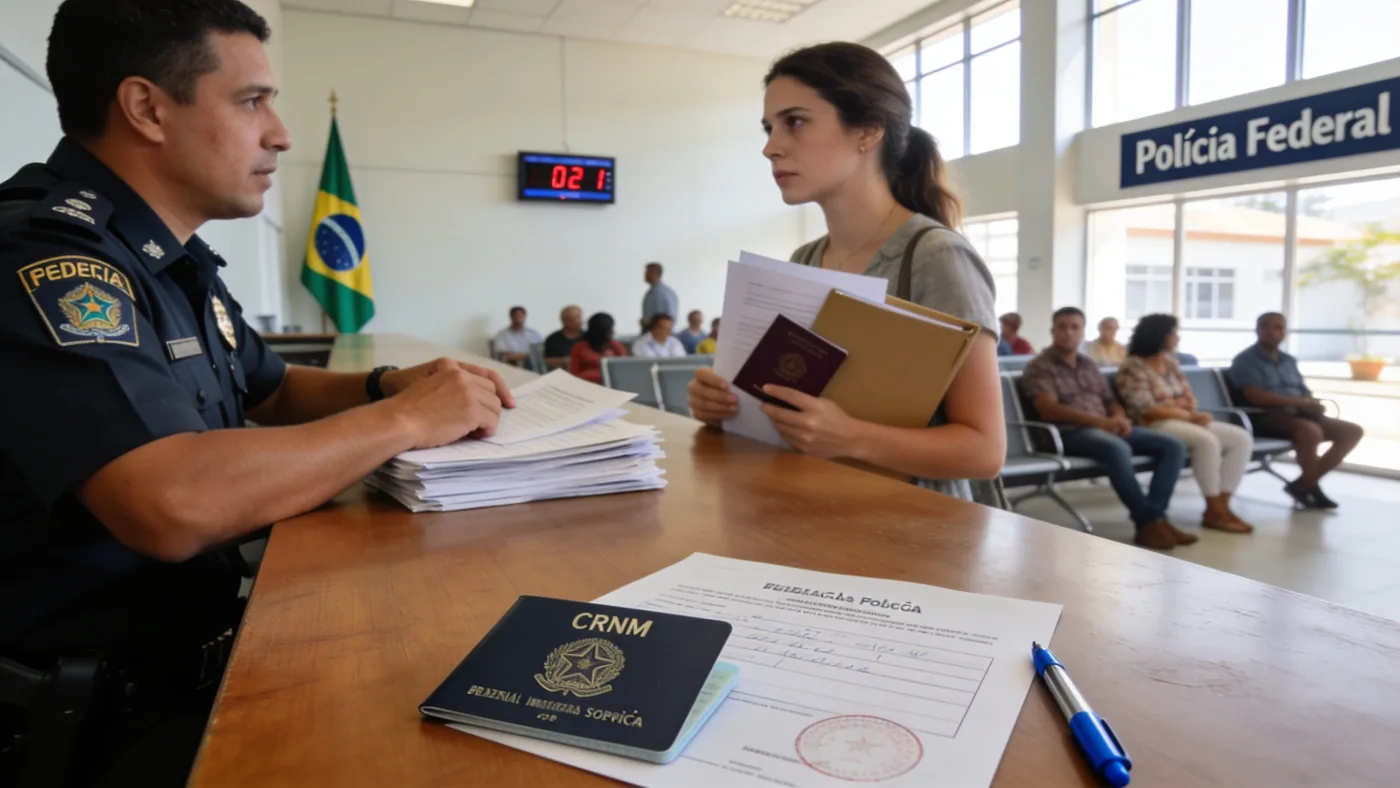
You opened an envelope from the Polícia Federal (Federal Police) and the word “deportação” is printed on it. Or an officer at the airport told you that you will not be allowed to stay. Your first thought is probably the same one we hear on the phone every week: “Am I about to lose everything I built in Brazil?”
Here is the short answer: a deportation notice in Brazil is not a plane ticket. It is the opening of an administrative procedure, and you have legal rights inside that procedure. Under Law 13.445/2017 (the Brazilian Migration Law), the Federal Police must notify you personally, state exactly which irregularity they found, and give you a period of no less than 60 days to regularize your status, a period that can be extended once for the same length of time. You may respond in person or through a lawyer holding a power of attorney.
Most foreigners lose these cases not because the law is against them, but because they do nothing during the window when the law is on their side. They ignore the notice, they move without updating their address, they assume “immigration will understand”, or they pay a fixer instead of filing a defense. Then, months later, the case reaches the removal stage and the options shrink to emergency court filings.
This guide explains, in plain English, what the Brazilian State can and cannot do to remove you, which arguments actually work, how the administrative appeal runs, and when you need a federal judge instead of a police protocol. Brazil follows the Civil Law tradition, so written statutes and documented evidence drive the outcome far more than oral persuasion.
On this page
What Does a Deportation Order in Brazil Actually Mean?
Deportation (deportação) is the administrative removal of a foreigner who entered or stayed in Brazil irregularly, and under Law 13.445/2017 it can only happen after you receive personal written notice and a minimum 60-day window to fix your status. It is not a punishment, it is not permanent, and it does not automatically ban you from returning.
Brazilian law separates four very different measures, and knowing which one applies to you changes your entire strategy:
- Repatriação (repatriation): immediate return of someone denied entry at the border or airport, before formal admission into the country.
- Deportação (deportation): removal for irregular status, such as overstaying a tourist stamp or working without authorization, after the regularization period expires.
- Expulsão (expulsion): the serious one, reserved for foreigners convicted of certain crimes. It carries a re-entry ban proportional to the sentence and is decided by the Ministry of Justice.
- Extradição (extradition): surrender to another country at its request, judged by the Supreme Federal Court (STF), a completely separate procedure.
The Migration Law was a deliberate break from the old 1980 Foreigner Statute, which treated migrants as a national security issue. The current statute, which you can read in Portuguese on the official Planalto website, is built on human rights, family reunification and non-criminalization of migration. Decree 9.199/2017 regulates the details, including how the Federal Police must document each step.
Why does this matter in practice? Because deportation for overstay can often be defeated simply by regularizing your residence. If you qualify for a residence permit on family, work or investment grounds, the irregularity that triggered the case disappears. That is a defense based on documents, not on mercy.
Important: A deportation notice never removes your right to be heard. The Migration Law guarantees ampla defesa (full defense) and contraditório (the right to contest the evidence) in every removal procedure, and any decision issued without proper notice is vulnerable to annulment in Federal Court.
Who Cannot Be Deported or Expelled From Brazil?
Brazilian law contains absolute bars to removal. Under Law 13.445/2017, expulsion cannot proceed against a foreigner who has a Brazilian child under their guardianship or economic dependence, a Brazilian spouse or partner, who entered Brazil before turning 12 and lived here since, or who is over 70 and has resided in Brazil for more than 10 years.
These are not soft arguments. When properly documented, they are legal impediments. The Superior Court of Justice (STJ) has repeatedly ordered the annulment of expulsion decrees when the foreigner proved a genuine family bond in Brazil, and its case law on the subject is searchable on the STJ official portal. The courts weigh the socio-affective family bond, not just the paperwork.
Additional protections apply across all removal categories:
- Non-refoulement: nobody may be removed to a country where their life, freedom or physical integrity is at risk. This applies to asylum seekers with a pending CONARE application under Refugee Law 9.474/1997.
- Statelessness: stateless persons have a specific protective procedure.
- Removal disguised as extradition: if the removal would achieve an extradition that a Brazilian court already refused, it is unlawful.
- Pending residence application: if you filed a residence request before the notice, the Federal Police must analyze it before proceeding.
Example: A German consultant overstayed 14 months while working remotely. He received a deportation notice, but his daughter was born in São Paulo and registered at the cartório (notary office) with his name on the birth certificate. With the certified birth certificate, proof of shared address and school enrollment, his lawyer converted the case into a residence application based on family reunion. The deportation file was closed and he paid the overstay fine of R$ 10,000, the legal maximum.
Documentation is everything. A statement that “my wife is Brazilian” carries no weight. A marriage certificate issued by a cartório, joint bank statements, a lease with both names and photographs over time build a case that survives review.
What Blocks a Deportation Defense From Succeeding?
The most common cause of failure is not a weak legal argument, it is a procedural one: missing the 60-day regularization window set by Law 13.445/2017. Once that period lapses without a response or a residence application, the Federal Police can formalize the deportation and the case moves from negotiable to litigated.
From our casework with foreign clients, these are the obstacles that actually sink files:
- Outdated address. The Federal Police sends notices to the address in your record. If you moved and never updated it, notice is considered served and deadlines run without you knowing.
- Unpaid overstay fines. According to the Migration Law framework, the overstay penalty in 2026 stands at R$ 100 per day of irregular stay, capped at R$ 10,000. Regularization is generally blocked until the debt is settled or formally challenged.
- Documents without legalization. Foreign documents need apostille (for Hague Convention countries) or consular legalization, plus a sworn translation by a tradutor público. Uncertified copies are routinely rejected.
- No CPF or no proof of residence. Without a CPF (taxpayer number) and a utility bill or notarized lease, most residence pathways stall.
- Criminal record disclosure gaps. Omitting a conviction that later appears in a background check destroys credibility and can escalate a deportation case into an expulsion review.
Warning: Never leave Brazil “to fix things from abroad” while a deportation file is open, unless a lawyer confirms it is safe. Departure with a pending record can be logged as a removal, and re-entry may then be refused at the border by an officer with no authority to reopen your case.
A second blocker is choosing the wrong pathway. Some foreigners file a residence request on grounds they cannot prove, burning months. If you have a job offer, the correct route may be a Brazil work visa (VITEM V) authorization. If you have capital to invest, an investor visa based on a qualified investment may be far stronger. Picking the pathway you can document today beats the one that sounds better.
Deportation brazil: How Does the Administrative Appeal Actually Work?
The administrative phase runs inside the Federal Police and, for expulsion, the Ministry of Justice. For deportation you file a written defense or a regularization request within the 60-day window. For expulsion, the Migration Law allows a request for reconsideration within 10 days of being notified of the decision.
The sequence in a deportation file usually looks like this:
- Notification. Personal service by the Federal Police, listing the irregularities found and the deadline.
- Defense or regularization. You either contest the facts (for example, prove your stay was authorized) or cure the irregularity by applying for residence.
- Analysis. The Federal Police reviews documents and may request additional evidence (exigência). Missing an exigência deadline is treated as abandonment.
- Decision. Either the file is closed, or a deportation order is issued with a departure deadline.
- Reconsideration and hierarchical appeal. A negative decision can be challenged internally, and in expulsion cases the reconsideration request goes to the authority that issued the decree.
Realistically, expect the administrative defense phase to take 3 to 6 months from filing your response, depending on the backlog of the local Federal Police unit and, when applicable, the Ministry of Justice. Regional variation is significant: units in São Paulo and Rio de Janeiro are slower than mid-sized cities. Protocols and status updates are handled through the Federal Police services portal, though in-person appointments for biometrics and document delivery remain mandatory.
Tip: Save the protocol number of every filing, plus a PDF of every receipt and payment (GRU). If the administrative record later contradicts your version, your protocol trail is the evidence a federal judge will read first. Keep these files for at least five years.
One structural advantage of the administrative route: it is cheap. There is no separate appeal fee. Your main costs are the overstay fine, if applicable, and the CRNM (National Immigration Registration Card) issuance fee of R$ 204.77 once your residence is granted. The expensive stage is litigation, which is exactly why the administrative phase deserves your best effort.
What Does the Federal Police Argue Against You?
The State’s case is usually built on three points: documented irregular stay, absence of a legal basis for residence, and lack of proven ties to Brazil. Each has a documentary counter. Because Brazil is a Civil Law country, rebuttals must be filed in writing with attached evidence, not argued informally at the counter.
Here is how the typical allegations play out and what defeats them:
- “The foreigner overstayed X days.” Verify the entry and exit records. Errors happen: unregistered exits, mis-scanned passports, or stays legally extended by a pending application. Ask for the migration record (registro de movimento migratório) and compare it against your stamps and boarding passes.
- “There is no legal basis for residence.” Answer with a filed application, not a promise. A protocol for family reunion, work authorization, Mercosur residence or humanitarian grounds changes the file’s posture immediately.
- “There are no effective family ties.” Counter with certificates from the cartório, dependents declared in your income tax return, school records, health insurance listing dependents, and sworn witness statements.
- “The foreigner worked without authorization.” If the activity was remote work for a foreign client, document the contract, the payer’s location and the receiving account. Characterization matters.
- “Public order requires removal.” In expulsion files, the proportionality test applies. Courts weigh the seriousness of the offense against the time in Brazil, the family situation and the sentence already served.
A recurring and costly mistake: submitting an emotional letter with no annexes. Officers process files against checklists. A two-page legal defense with 40 pages of certified exhibits will outperform a ten-page personal story every time. If you need the broader picture of statuses and pathways, our guide to Brazil immigration law, visas, residency and the CRNM maps which category fits your situation.
Deportation brazil: When Should You Go to Federal Court Instead?
Go to court when the administrative path is exhausted, when the deadline is being ignored, or when your liberty is at immediate risk. Because the Union is the defendant, removal cases are heard by the Justiça Federal (Federal Courts). An urgent injunction (liminar) can be decided within 24 to 72 hours, while a full first-instance judgment commonly takes 12 to 24 months.
The three main judicial remedies:
- Habeas corpus. The fastest tool when you are detained at a Federal Police post or an airport and removal is imminent. It challenges the lawfulness of the detention or seeks to suspend the removal until a pending appeal is decided.
- Mandado de segurança (writ of mandamus). Used against a clear illegality by an authority, for example a deportation decided without the mandatory notice or before the 60-day period expired. It must be filed within 120 days of the act.
- Ordinary action with urgent relief. The route for annulling an expulsion decree or compelling a decision on a residence application that has been sitting untouched for over a year.
If you cannot afford private counsel, the Defensoria Pública da União (Federal Public Defender’s Office) represents foreigners in removal cases at no cost, and you can locate the nearest unit through the DPU official website. Low-income litigants may also request gratuidade de justiça (free justice), which waives court costs.
Caution: Filing in court does not automatically suspend removal. You must expressly request the suspensive relief and prove urgency with evidence, such as a scheduled flight or a detention record. A well-drafted petition filed at 9 a.m. can stop a 6 p.m. flight, but only if the judge sees documented urgency.
Always confirm your lawyer’s OAB (Brazilian Bar Association) registration. Only OAB-registered lawyers may file these actions, and immigration “consultants” without a license cannot represent you before a judge.
How Do the Removal Types Compare in Cost and Timeline?
Deportation is the cheapest and most reversible measure, expulsion the most severe. The overstay fine in 2026 is R$ 100 per day capped at R$ 10,000 under the Migration Law framework, and the CRNM issuance fee once you regularize is R$ 204.77. There is no fee for the administrative appeal itself.
| Measure | Trigger | Defense deadline | Re-entry ban | Typical total timeline |
|---|---|---|---|---|
| Repatriation | Entry denied at border | Immediate, hours | No, but entry refused | Same day |
| Deportation | Irregular stay or unauthorized work | Minimum 60 days to regularize, extendable once | No, once fines are settled | 3-6 months administrative |
| Expulsion | Criminal conviction | 10 days for reconsideration | Yes, proportional to sentence | 1-3 years including court review |
| Judicial review (any measure) | Illegality or exhausted appeals | 120 days for mandamus; anytime for habeas corpus | Depends on ruling | Injunction in 24-72h; merits 12-24 months |
Example: A Canadian digital nomad overstayed 40 days. The fine is 40 x R$ 100 = R$ 4,000, roughly USD 730 at 2026 exchange rates. She filed a residence application based on her Brazilian partner, paid the fine, and paid R$ 204.77 for the CRNM. Total official cost: about R$ 4,205, with no re-entry ban.
Private legal fees vary with complexity. A documented administrative defense is a fraction of the cost of an emergency habeas corpus followed by a multi-year annulment action. That economic gap is the strongest argument for acting in week one instead of month six.
What Changed for Deportation Defense in 2026?
No major legislative reform altered the core appeal rights in 2026. Law 13.445/2017 and Decree 9.199/2017 remain the governing framework, including the minimum 60-day regularization period and the 10-day reconsideration request in expulsion cases. What is shifting is judicial interpretation and internal Federal Police practice.
Three developments worth tracking:
- Legal aid for foreigners in administrative proceedings. An extraordinary appeal before the Supreme Federal Court (reported as RE 1.333.000) addresses the extent of guaranteed legal assistance for foreigners facing administrative removal. A favorable outcome would strengthen annulment arguments where the foreigner defended themselves without counsel. You can follow case progress on the STF official portal.
- Proportionality in expulsion. The STJ continues to consolidate the requirement that authorities weigh family and social ties against the offense, rather than applying removal mechanically after a conviction.
- Digitalization of filings. More Federal Police procedures now run through gov.br protocols, which is good for evidence trails but harsh on deadlines, since electronic notice starts the clock even if you never open the message.
Remember: If you have a gov.br account linked to your immigration file, check it weekly. Electronic notices are legally valid, and “I did not see the message” is not a recognized defense for a missed deadline.
What Should You Do in the First 72 Hours After a Notice?
Act within 72 hours. The first step is reading the notice for two data points: the exact irregularity alleged and the deadline. Under the Migration Law you should have at least 60 days for deportation, but only 10 days to request reconsideration of an expulsion decision. Confusing the two is the most expensive mistake in this field.
Step-by-step action plan
- Step 1. Photograph or scan the entire notice, including the envelope and the service date. That date defines every deadline.
- Step 2. Identify the procedure type: repatriation, deportation or expulsion. Never assume.
- Step 3. Request your full administrative file from the Federal Police, plus your migration movement record.
- Step 4. Assess a residence pathway: family reunion, work authorization, investment, Mercosur nationality, study, humanitarian or asylum.
- Step 5. Gather and legalize documents (apostille or consular legalization, plus sworn translation).
- Step 6. Sign a procuração (power of attorney) for an OAB-registered lawyer so filings can proceed even if you are traveling or detained.
- Step 7. File the defense or the residence application within the deadline and save the protocol.
- Step 8. Calculate and pay any overstay fine, or formally challenge it if the day count is wrong.
- Step 9. Monitor exigências (document requests) and respond immediately.
- Step 10. If the decision is negative or the process stalls, escalate to Federal Court with an urgent relief request.
Core document checklist
- Valid passport plus copies of all pages with Brazilian stamps
- CPF (Brazilian taxpayer number)
- Proof of address: utility bill, notarized lease or residence declaration
- Family documents: marriage or birth certificates from the cartório, apostilled if foreign
- Police clearance certificates from Brazil and your country of residence for the last five years
- Proof of ties: employment contract, tax returns, bank statements, school enrollment for children
- Payment receipts (GRU) for fines and fees
Budget realistic buffer time. Apostilles and sworn translations alone often consume 10-20 business days, and Federal Police appointment slots in large cities can be booked 30 days out.
Frequently Asked Questions About Fighting Deportation in Brazil
Can I be deported from Brazil if I have a Brazilian child?
Having a Brazilian child under your guardianship or economic dependence is one of the situations Law 13.445/2017 lists as a bar to expulsion, and it is also a strong basis for residence based on family reunion, which cures the irregularity behind a deportation. However, the protection is not automatic. You must prove the bond with the birth certificate from the cartório, evidence of cohabitation or support (school records, medical plan, transfers) and updated address. The STJ has annulled removal decisions where authorities ignored documented family ties, but the burden of producing that documentation is yours.
How long does a deportation appeal take in Brazil?
Plan for 3 to 6 months in the administrative phase after you file your defense or residence application, depending on the workload of your local Federal Police unit and whether the Ministry of Justice is involved. If the case moves to Federal Court, an urgent injunction can be granted in 24 to 72 hours, while a first-instance ruling on the merits typically takes 12 to 24 months, and appeals can extend that further. Responding to document requests (exigências) on the same week they are issued is the single most effective way to avoid delay.
Do I have to pay a fine to fight deportation?
There is no separate fee to file an administrative appeal. However, you generally must settle outstanding overstay fines before regularization is approved. In 2026 the overstay penalty stands at R$ 100 per day, capped at R$ 10,000 under the Migration Law framework. A 40-day overstay therefore costs R$ 4,000, roughly USD 730. If your residence is granted, add the CRNM issuance fee of R$ 204.77. If the day count in the notice is wrong, challenge it with your entry and exit records instead of paying automatically.
Will a deportation stop me from returning to Brazil later?
Deportation for irregular stay does not, by itself, create a permanent re-entry ban. Under the Migration Law, once the debts and fines connected to your irregular stay are settled, you can apply for a visa or authorization again. Expulsion is different: it carries an express prohibition on re-entry for a period proportional to the criminal sentence, and re-entering during that period is itself a crime. This is why correctly classifying your procedure at the start is critical, and why fighting an expulsion decree deserves professional representation.
Can I file a habeas corpus if I am detained at the airport?
Yes. Habeas corpus is the appropriate emergency remedy when you are held at a Federal Police post or airport and removal is imminent. It can argue that the detention lacks legal basis or that a pending appeal should suspend the removal. It is filed with the Federal Court and, in urgent cases, judges rule within hours. Because the window can be a matter of hours, you should have a lawyer’s contact and a signed power of attorney prepared in advance if you know your status is contested.
Can I regularize my status while a deportation file is open?
Yes, and it is usually the best defense. The 60-day period the Migration Law grants exists precisely so you can fix the irregularity. Filing a valid residence application, based on family reunion, work authorization, investment, Mercosur nationality, study or humanitarian grounds, requires the Federal Police to analyze that request before proceeding with removal. The application must be genuinely supported by documents. A weak filing made only to buy time is quickly rejected and can damage your credibility in the file and in later court proceedings.
Fighting Deportation in Brazil: Take the Next Step With Confidence
Facing a removal order in a country where you do not speak the legal language is frightening, especially when your family, your job and your home are here. But you are not powerless. Brazilian law, for all its bureaucracy, offers real remedies: administrative defenses, residence pathways that erase the irregularity, reconsideration requests, and judicial review with urgent relief. Family-tie arguments and procedural challenges have kept thousands of foreigners in Brazil.
What decides these cases is speed and documentation. Every day you wait shrinks your options and raises your costs. Our bilingual team at Ribeiro Cavalcante Advocacia reviews your notice, identifies the correct procedure, builds the evidence file and files within the deadline, whether that means a Federal Police defense or an emergency petition in Federal Court.
Send us the notice you received and the date you were served. We will tell you exactly what your deadline is and what your realistic options are.
Talk to a specialist lawyer now
Talk to a Lawyer on WhatsApp