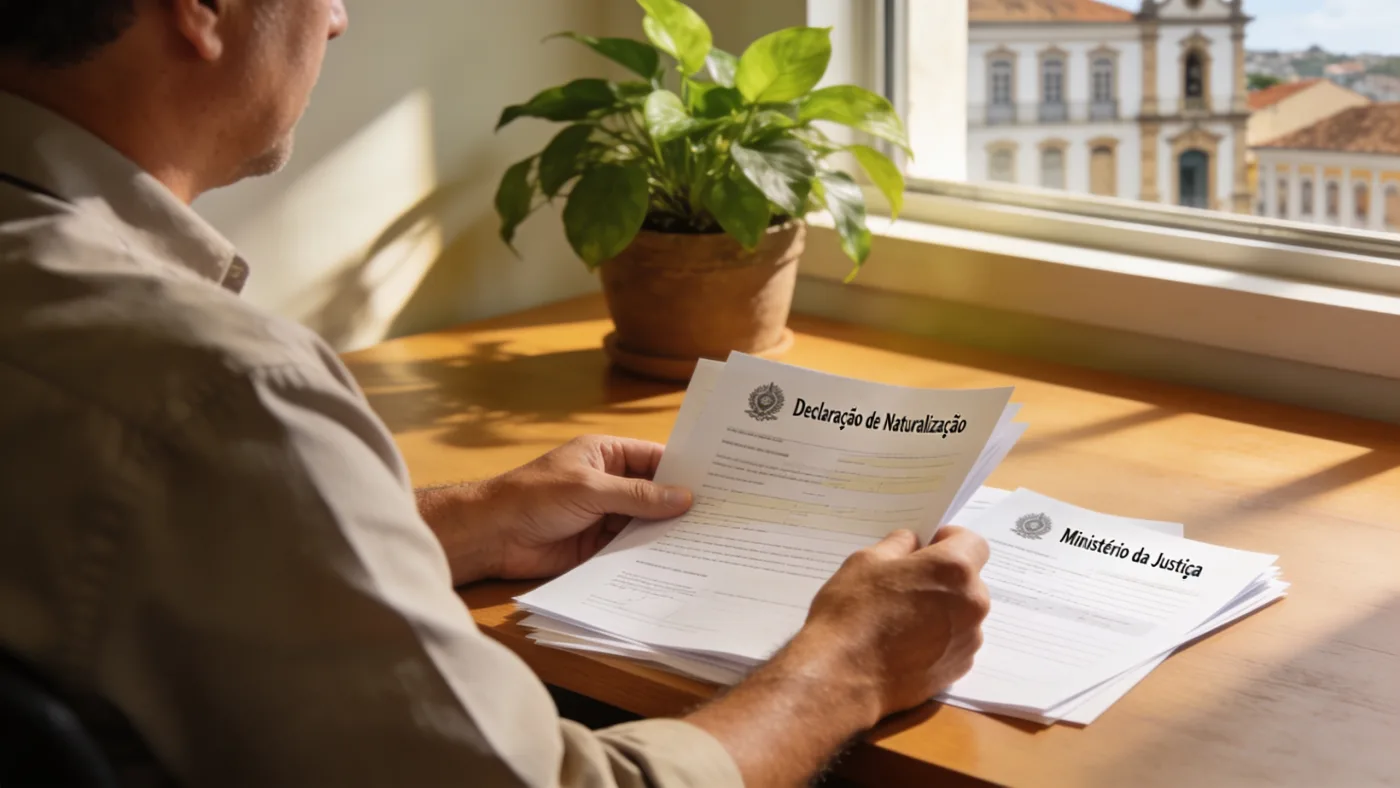
You are staring at three different checklists that all say something slightly different, and you no longer know which one to trust. That confusion is normal, and yes, it has a solution. Most people struggle with naturalization documents not because the list is long, but because they gather the wrong version of the documents for their specific path.
Here is the twist most guides get wrong. The document list is not universal. A Portuguese citizen married to a Brazilian submits a very different package from a retiree who has lived here quietly for 15 years. Start from the exception (your specific situation) and only then apply the general rule, and you avoid the single most common reason applications get rejected at the counter: missing or mismatched documents.
This article gives you the complete 2026 document checklist, organized by who you actually are, with real costs, apostille rules, and the exact points where the Ministry of Justice (Ministério da Justiça e Segurança Pública) tends to push back. Brazil uses a Civil Law system, so paperwork and formal proof matter far more than argument. Let’s get your file right the first time.
On this page
Why Does the Document List Change Depending on Your Situation?
Because Brazilian law defines four distinct naturalization types, each with its own proof requirements under Law 13.445/2017 (the Migration Law). The core identity and criminal documents are the same for everyone, but the residency proof, the required time, and the extra supporting documents shift depending on whether you qualify through marriage, ancestry, long residency, or the standard four-year path.
Think of it as one shared base plus one situation-specific layer. If you gather a generic checklist you found online, you risk collecting documents you do not need while missing the one document that actually unlocks your reduced timeline.
- Ordinary naturalization: 4 years of residency plus Portuguese proficiency
- Reduced ordinary: 1 year, for spouses/children of Brazilians or citizens of Portuguese-speaking countries
- Extraordinary: 15+ years of uninterrupted residency, no criminal conviction
- Provisional: for children who entered Brazil before age 10
If you are still unsure which category fits, our guide on who qualifies for Brazilian naturalization in 2026 breaks down each path in detail. Confirm your category before you spend a single real on translations.
Common mistake: Applicants gather documents for the ordinary 4-year path, then discover mid-process they qualified for the 1-year reduced path all along. They wasted months proving residency they did not need.
What Are the Core Documents Every Applicant Must Submit?
Every naturalization applicant, regardless of path, must submit five core categories: a valid CRNM (immigration card), CPF (tax ID), birth certificate, criminal background certificates from Brazil and your home country, and proof of residency. Under Article 66 of Law 13.445/2017, these documents must accompany the application filed with the Ministry of Justice.
Identity and Civil Status Documents
- CRNM (Carteira de Registro Nacional Migratório): your National Immigration Registration Card, proving legal permanent residency. The 2026 renewal fee, per the Federal Police, is R$ 204.77 (roughly US$ 38-42). It must be valid on the day you file.
- CPF (Cadastro de Pessoa Física): the tax ID. Free at Receita Federal, or about R$ 7.00 if issued at Correios or a consulate abroad.
- Birth certificate: issued in your home country, apostilled and translated by a sworn translator (tradutor juramentado).
- Marriage certificate: only if you are applying through a Brazilian spouse.
- Recent passport-style photo and a valid passport copy.
Criminal Background Documents
You need a clean record from both countries. In Brazil, request a federal criminal certificate (certidão de antecedentes criminais) from the Federal Police and a judicial certificate (certidão de distribuição criminal) from the federal and state courts where you have lived. From your home country, obtain a national criminal record certificate covering the period before you arrived in Brazil.
Heads up: Brazilian criminal certificates are often valid for only 90 days. Request them last, after your foreign documents are already apostilled and translated, so they do not expire while you wait.
Residency Proof and Language
Residency proof depends on your path (more below), but usually includes your CRNM issue date, tax returns, utility bills, employment records, or a formal residency history statement. For ordinary naturalization, you also need proof of Portuguese proficiency, typically the Celpe-Bras certificate or a diploma from a Brazilian educational institution.
Worth knowing: Not every path requires the Celpe-Bras exam. Extraordinary naturalization (15+ years) does not demand a formal language certificate, because your decades of residency are treated as sufficient integration.
What Extra Documents Do Spouses and Portuguese Citizens Need?
Spouses and children of Brazilians, plus citizens of Portuguese-speaking countries, can naturalize after just 1 year of residency under the reduced ordinary path. Beyond the core documents, they must add specific proof of the qualifying relationship or nationality: a Brazilian marriage or birth certificate, or a passport from a lusophone country.
If You Are the Spouse or Parent of a Brazilian (1-Year Path)
- Brazilian marriage certificate registered at a Brazilian cartório (notary office), or proof of stable union (união estável) formalized before a cartório or court
- Your Brazilian spouse’s RG (national ID) and CPF
- If applying as parent of a Brazilian child: the child’s Brazilian birth certificate
- Proof of at least 1 year of permanent residency in Brazil
Important: The marriage or stable union must be genuine and current. The Ministry of Justice can request additional evidence (joint bank accounts, shared address, photos) if it suspects a marriage of convenience. Keep documentation that shows a real shared life.

If You Are a Portuguese or Lusophone Citizen (1-Year Path)
- Valid passport from Portugal, Angola, Mozambique, Cape Verde, Guinea-Bissau, São Tomé and Príncipe, or East Timor
- Proof of at least 1 year of uninterrupted residency
- The same core criminal and civil documents required of all applicants
Note that Portuguese citizens also have an alternative under the Brazil-Portugal Equality Treaty, which grants many civil rights without full naturalization. Weigh both routes before committing. Our article on the requirements and process for Brazilian naturalization compares these options.
What Documents Prove 15 Years for Extraordinary Naturalization?
Extraordinary naturalization requires proving 15+ years of uninterrupted residency, with no formal language exam and no criminal conviction, under Article 67 of Law 13.445/2017. The key challenge is documentary continuity: you must show a paper trail across those years, not just at the start and end.
- CRNM or older residency documents showing your original entry date
- Tax returns (declaração de Imposto de Renda) across multiple years
- Employment records (CTPS, the work card) or CNPJ registration if self-employed
- Utility bills, rental contracts, or property deeds spanning the period
- School enrollment records for children, if applicable
- A clean criminal record (no conviction, per the constitutional basis in Article 12 of the Federal Constitution)
Common mistake: Applicants assume one old visa stamp plus a recent bill proves 15 years. It does not. The Ministry looks for continuity. Gaps in your paper trail invite a demand for more evidence and can delay approval by months.
For a deeper look at what counts as uninterrupted residency and how long approval takes, see our Brazilian naturalization timeline for 2026.
How Must Foreign Documents Be Apostilled and Translated?
Every foreign document must be apostilled in the country of origin and then translated by a sworn translator (tradutor juramentado) registered with a Brazilian state commercial board (Junta Comercial). Apostille costs roughly R$ 50-150 per document abroad, and sworn translations run about R$ 60-120 per page in 2026.
The apostille is a certification under the Hague Apostille Convention, which Brazil joined in 2016. It replaces the older, slower consular legalization for member countries. If your home country is not part of the Convention, you will need consular legalization at a Brazilian consulate instead, which takes longer.
The correct order matters. Apostille first, in your home country, then translate in Brazil. The sworn translation must cover both the document and the apostille stamp itself.
In practice: A US applicant apostilles a birth certificate in their home state (about US$ 20-40), ships it to Brazil, then pays a sworn translator around R$ 100 for the page plus R$ 60 for the apostille text. Total: roughly R$ 160 for one document, fully ready to file.
Tip: Only sworn translators registered with a Brazilian Junta Comercial produce legally valid translations. A bilingual friend or a foreign translation office will not be accepted. Confirm the translator’s registration before paying.
How Much Does the Full Document Package Cost in 2026?
The government fee is small. The naturalization application costs R$ 204.77 via the federal payment slip (GRU), the same fee structure as CRNM registration, according to Federal Police fee tables. The real spending is on translations, apostilles, and certified copies, pushing most applicants into a total range of R$ 800 to R$ 2,500.
| Item | Cost (2026) | Notes |
|---|---|---|
| Naturalization application (GRU) | R$ 204.77 | ≈ US$ 38 / €35 |
| CPF (tax ID) | Free / R$ 7.00 | Free at Receita Federal |
| Sworn translation | R$ 60-120 per page | Set by state Junta Comercial |
| Apostille (abroad) | R$ 50-150 per doc | Done in home country |
| Certified copies at cartório | R$ 5-15 each | Notary/registry office |
| Foreign criminal certificate | Varies | Often free or low-cost |
Example: A single applicant on the ordinary path with a birth certificate and one foreign criminal record to apostille and translate typically spends about R$ 500-900 total, including the R$ 204.77 government fee. A married applicant with more documents lands closer to R$ 1,500.
What Will the Ministry of Justice Argue Against Your File?
The strongest objection the Ministry of Justice raises is that your file fails to prove the specific legal requirement for your chosen path: insufficient residency continuity, an unverified marriage, or an incomplete criminal record. Under Article 66 of Law 13.445/2017, the burden of proof sits with you, the applicant, not the State.
Put fairly, the authority’s position is reasonable. Naturalization confers full citizenship, including voting rights and protection from extradition. The State has a legitimate interest in confirming that applicants genuinely reside in Brazil, have integrated, and carry no serious criminal history. A thin or inconsistent file is, from their view, a red flag worth pausing over.
So how do you answer that argument before it is even raised? You over-document the exact element your path hinges on. If you claim 4 years, show continuous residency across all four with tax returns and address proof. If you claim marriage, show a real shared life, not just a certificate. If you claim 15 years, close every gap in the timeline.
A well-built file does not just meet the minimum. It removes the reason for the objection in advance. This is where a bilingual lawyer earns their fee: anticipating the demand (exigência) and satisfying it before it lands in your process.
What Is the Step-by-Step Filing Process in 2026?
Naturalization is filed digitally through the government portal and processed by the Ministry of Justice, not the Federal Police, though the Federal Police collects your biometric data. The process runs entirely online after an initial document upload, and approval is published in the official gazette (Diário Oficial da União).

- Step 1: Confirm your naturalization category and eligibility.
- Step 2: Gather core documents plus your situation-specific layer.
- Step 3: Apostille foreign documents abroad, then translate in Brazil.
- Step 4: Pay the R$ 204.77 GRU fee and generate the receipt.
- Step 5: Submit the application through the gov.br portal.
- Step 6: Attend biometric collection at the Federal Police when summoned.
- Step 7: Respond promptly to any exigência (demand for more documents).
- Step 8: Await publication in the Diário Oficial, then swear the oath and request your new documents.
Tip: Save every protocol number and payment receipt in a dedicated folder. If the Ministry issues a demand, you often have a strict window (commonly 30 days) to respond, and losing time hunting for a receipt can stall the whole file.
Realistic timelines vary. Simple ordinary files can conclude in 6-12 months, while extraordinary cases with heavy documentation may take longer, especially if the Ministry issues demands.
Which Checklist Should You Follow Based on Your Situation?
Match your situation to the right layer so you gather only what you need. All paths share the same core (CRNM, CPF, birth certificate, criminal records), then add one specific set.
- If you have lived in Brazil 4+ years with no shortcut, follow the ordinary path and prioritize the Celpe-Bras language certificate plus continuous residency proof.
- If you are married to or have a child with a Brazilian, follow the 1-year reduced path and lead with the Brazilian civil registry documents.
- If you hold a passport from a Portuguese-speaking country, use the 1-year reduced path and skip the separate language exam.
- If you have lived here 15+ years, use extraordinary naturalization, skip the language exam, and focus everything on documentary continuity.
If you also run a business here or plan to, note that opening a CNPJ requires a registered fiscal address in Brazil, which can also strengthen your residency paper trail for the extraordinary path.
Frequently Asked Questions About Naturalization Documents
Do I need my documents translated even if they are in English?
Yes. Any document in a language other than Portuguese, including English, must be translated by a sworn translator (tradutor juramentado) registered with a Brazilian Junta Comercial. English documents are not exempt. The translation must also cover the apostille stamp. A translation done abroad or by a non-sworn translator will be rejected at submission, so budget roughly R$ 60-120 per page and use only a registered Brazilian professional.
How long are Brazilian criminal certificates valid?
Brazilian criminal background certificates are typically valid for 90 days from issue. Because of this short window, request them last, after your foreign documents are already apostilled and translated. If your certificates expire before the Ministry of Justice reviews your file, you may be asked to reissue them, causing avoidable delays. Order the Federal Police federal certificate and the state judicial certificates close to your submission date.
Can I apply for naturalization while my CRNM is expired?
No. Your CRNM (National Immigration Registration Card) must be valid on the day you file. It is the primary proof of your legal permanent residency, and an expired card breaks the legal basis for your application. Renew it first through the Federal Police, paying the 2026 fee of R$ 204.77, then proceed. Applying with an expired card almost guarantees a demand or outright rejection.
Do children need separate documents?
Yes. Minor children have their own path (provisional naturalization for those who entered before age 10) and their own document set, including their birth certificate, CRNM, and proof of entry date. A parent’s naturalization does not automatically transfer citizenship to a child already living in Brazil, though it can affect the process. Each child’s file is assessed on its own facts, so prepare individual document packages.
What happens if the Ministry asks for more documents?
The Ministry issues an exigência (formal demand) listing exactly what is missing, and you usually have a limited window, commonly 30 days, to respond through the portal. Missing the deadline can lead to your file being archived. This is why keeping every protocol number and monitoring the portal matters. A prompt, complete response usually keeps your process moving without needing to restart.
Get Your Brazilian Naturalization Documents Right the First Time
Gathering the right documents for the right path is the difference between a file that sails through and one that stalls for months on a technicality. You have already done the hard part by living, working, and building a life in Brazil. The paperwork should not be what holds you back.
Our bilingual legal team reviews your situation, identifies your correct naturalization category, and builds a document package designed to answer the Ministry of Justice’s objections before they arise. The concrete next step: send us a message describing your residency situation and how long you have lived in Brazil, and we will tell you exactly which checklist applies to you.
Talk to a specialist lawyer now
Talk to a Lawyer on WhatsApp