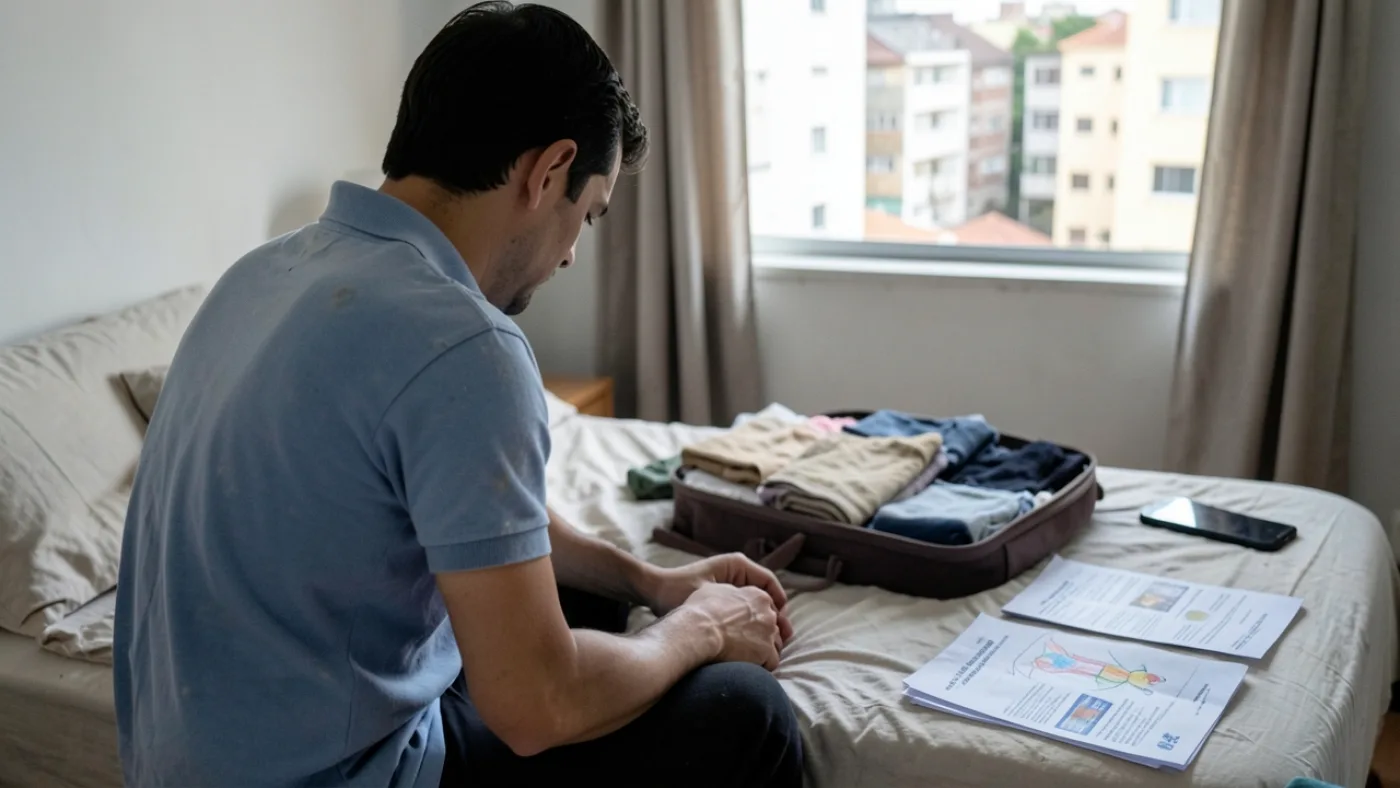

Yes, you can plan your Brazilian estate from abroad, and yes, a foreign will can matter here. But it almost certainly will not transfer the apartment in Rio, the farm in Bahia, or the quotas of your Brazilian company to the people you named.
That single gap is why international families end up in a Brazilian courtroom. A Canadian father dies in Toronto with a perfectly drafted will, a living trust, and a beach apartment in Florianópolis. The trust controls the Canadian assets in weeks. The Brazilian apartment sits frozen for three years while the heirs, none of whom speak Portuguese, hire a lawyer, translate documents, chase a CPF (Brazilian taxpayer number) for each beneficiary, and discover that under Brazilian law the second wife is a forced heir alongside the children from the first marriage.
Estate planning for international families with assets in Brazil is not about writing one more document. It is about building a structure that survives contact with three adversaries: the state tax authority that wants ITCMD (Brazilian inheritance and gift tax) paid before anything moves, the forced heir who was left out and has a lawyer, and the Brazilian notary or judge who will refuse to register a transfer that does not fit Brazilian formalities.
This article is written from the opposite direction of most estate planning content. Instead of telling you what to sign, it asks what the other side will argue when you are no longer here to explain, and what you can put in place now that answers it.
On this page
Can Your Foreign Will or Trust Control Your Brazilian Assets?
Partially, and only for some asset classes. Under Article 10 of the LINDB (Brazil’s law on the application of legal rules), succession follows the law of the deceased’s last domicile. But Brazilian courts hold exclusive jurisdiction over the inventory of assets located in Brazil, so no foreign probate order can, by itself, transfer a Brazilian property title.
Start with the exception, because it is where the real planning happens. If your last domicile is Portugal, Florida or Japan, Portuguese, Florida or Japanese succession law can in principle govern the substance of your estate, including who inherits what share. That choice-of-law rule in the LINDB (Decreto-Lei 4.657/1942) is real, and Brazilian courts apply it.
Now the two limits that swallow most of that exception.
- Procedure is always Brazilian. Even if foreign law decides the shares, a Brazilian inventory (probate) must be opened in Brazil to change the registry entry at the Registro de Imóveis (real estate registry) or the corporate books. The Civil Procedure Code requires the inventory to be opened within two months of death, with a target of twelve months to conclude.
- Brazilian spouse and children get a floor. The Federal Constitution and the LINDB protect a Brazilian spouse and Brazilian children of a foreign decedent: Brazilian law applies to assets situated in Brazil in their favour, unless the foreign law is more favourable to them.
Important: A trust is not a recognised legal entity under Brazilian law. Brazil is a civil law country, not common law. A Brazilian registry office will not accept “the trustee” as the new owner of an apartment. If Brazilian real estate is inside your trust structure on paper, assume it is outside it in practice.
The practical rule for international families: use your foreign instruments for foreign assets, and build a separate, Brazil-specific layer for Brazilian assets. Two coordinated plans, not one global document. If you also need to establish your marital status here, see our guide on registering a foreign marriage in Brazil, because an unregistered marriage creates a factual dispute your heirs will have to litigate.
Why Does Brazilian Law Limit What You Can Give Away?
Because Brazil uses forced heirship. Under the Brazilian Civil Code (Lei 10.406/2002), descendants, ascendants and the surviving spouse are “herdeiros necessários” (compulsory heirs) and are entitled to the legítima, which is 50% of the estate. A will can only freely dispose of the other 50%, the parte disponível.
This is the root cause of nearly every international estate dispute we see. Clients from the United States, the UK, Australia and much of Asia are used to testamentary freedom: you can leave everything to your second spouse, or to a charity, or to one child. Brazil’s Civil Code treats family property as partly pre-allocated by law.
Three consequences that catch foreigners off guard:
- Your marital property regime is doing half the work. Most Brazilian marriages default to comunhão parcial de bens (partial community property): assets acquired during the marriage are 50% the spouse’s already, before inheritance is even calculated. If you married abroad and bought the Brazilian property afterwards, expect that argument.
- Children from all relationships rank equally. There is no distinction between children of a first marriage, a second marriage, or a non-marital relationship.
- A stable union counts. A união estável (recognised stable partnership) can create inheritance rights even without a marriage certificate. Long-term partners in Brazil are not invisible to succession law.
Practical example: A German investor owns an R$ 800,000 apartment in São Paulo bought during his marriage, plus a Brazilian bank account. He wants everything to go to his son from his first marriage. In practice, his wife may claim 50% as her share of the community property (R$ 400,000), and of the remaining R$ 400,000, half is legítima split between wife and son. His “free portion” is closer to R$ 200,000 than to R$ 800,000. A will that ignores this will be reduced by a judge.
For a deeper breakdown of the ranking order, our article on who inherits first in Brazil maps each scenario.
Which Estate Planning Tools Actually Work in Brazil?
Four tools do real work for international families: a Brazilian public will (testamento público), a holding patrimonial (family holding company), a lifetime donation with reserved usufruct, and life insurance. Notary costs for a public will typically run R$ 500-2,000 depending on the state’s official fee schedule, versus R$ 300-800 for a sealed private will.
The Brazilian public will (testamento público)
Signed before a notary (cartório de notas, a notary office with legal registration powers) with two witnesses, and permanently archived. It cannot be lost, destroyed or challenged for a broken seal, which is exactly why it beats the cheaper private will for cross-border families.
What it can do: allocate specific assets inside your 50% free portion (“my free portion shall consist of my Florianópolis apartment, which I leave to my sister”), name a testamentary executor, nominate a guardian for minor children, and state your wishes clearly enough to prevent a factual fight. What it cannot do: disinherit compulsory heirs or shrink the legítima.
The holding patrimonial (family holding company)
You transfer the Brazilian real estate into a Brazilian company, then donate or gradually transfer quotas to your heirs while keeping control through voting rights, a well-drafted articles of association and usufruct over the quotas. When you die, there is no real estate inventory: there are quotas, already largely distributed.
Typical setup cost for a foreigner-owned holding runs R$ 8,000-25,000 in legal and registry fees, plus ITBI (municipal property transfer tax) considerations on contributing real estate. A Brazilian company also needs a registered fiscal address in Brazil to obtain its CNPJ (corporate taxpayer number), which is a common stumbling block for non-resident founders.
Donation with reserved usufruct (doação com reserva de usufruto)
You donate the bare ownership of the property to your children now, but keep the usufruct: the right to live in it, rent it and collect the income for life. ITCMD is paid on the donation at today’s value and today’s rate. On death, the usufruct simply extinguishes and the children consolidate full ownership, usually with no new inventory.
Tip: Donations to compulsory heirs are presumed to be an advance on their inheritance (adiantamento da legítima) unless the deed expressly states the donation comes out of the free portion. One sentence in the notarial deed decides whether a sibling can later demand equalisation. Make sure it is there.
Life insurance
Life insurance proceeds are not treated as part of the estate under the Brazilian Civil Code and go directly to the named beneficiary, outside the inventory. It is the cleanest way to give liquidity to a spouse or to fund the ITCMD bill so heirs are not forced to sell the property at a discount.
How Much Does Each Structure Cost, and What Does It Save?
ITCMD is a state tax capped at 8% by Federal Senate resolution. São Paulo charges a flat 4%; Rio de Janeiro applies progressive rates up to 8%. On an R$ 800,000 São Paulo apartment, that is R$ 32,000 in tax alone, before lawyer fees of roughly 6-10% and court or notary costs.
| Structure | Typical setup cost | When ITCMD is paid | Overrides forced heirship? | Best for |
|---|---|---|---|---|
| No plan (judicial inventory) | R$ 0 now; 10-20% of estate later | After death, before transfer | No | Nobody |
| Brazilian public will | R$ 500-2,000 | After death | No, but directs the free 50% | Clarity, guardianship, avoiding factual disputes |
| Donation with usufruct | R$ 3,000-8,000 plus ITCMD now | Now, at today’s rate and value | No, but fixes shares early | One or two properties, adult heirs |
| Holding patrimonial | R$ 8,000-25,000 | On quota donations, in stages | No, but controls governance | Multiple properties, rental income, blended families |
| Life insurance | Premiums only | Not applicable (outside estate) | Yes, proceeds are not estate assets | Liquidity to pay ITCMD and support a spouse |
Run the numbers on a realistic international family. Estate: an R$ 1,000,000 apartment in São Paulo plus R$ 500,000 in a Brazilian bank account. Heirs live in Ireland and the United States.
- No planning: ITCMD at 4% on R$ 1.5 million = R$ 60,000. Judicial inventory with two non-resident heirs and translated documents: legal fees around R$ 90,000-120,000, court costs and expert appraisals on top. Timeline realistically 2-4 years. Total friction cost frequently exceeds R$ 157,000.
- Planned: holding company set up for R$ 18,000, quotas donated in tranches with usufruct reserved, ITCMD paid progressively on donated quota value, life insurance covering the tax. Post-death process: a corporate book entry, not a lawsuit.
ITCMD rates and the very real risk of being taxed twice deserve their own analysis, which we cover in our article on Brazil inheritance tax and double taxation, since Brazil has no inheritance tax treaty with the United States, the UK or Canada.
What Is the Strongest Argument Against Your Plan?
The strongest attack is not “the paperwork was wrong.” It is this: the holding company and the donations were a simulation designed to defraud the legítima and evade ITCMD, so they should be declared void and the assets returned to the estate. Brazilian courts can and do annul sham transfers.
Put in its strongest form, the excluded heir’s or tax authority’s case sounds like this. The decedent created a company months before death with no business activity, no employees, no bank movement and no separate accounting. He contributed his only real estate at a declared value far below market. He donated 99% of the quotas to one child while retaining all voting rights, all income and possession of the property. Nothing in his actual life changed. Therefore the company was never a company: it was a costume worn by an inheritance, engineered so that the other child and the state tax authority would receive less than the law entitles them to.
That is a good argument. It wins when the facts support it. Here is what answers it.
- Timing and health. Structures built years before death, while the owner was healthy and demonstrably capable, are far harder to attack than deathbed reorganisations. Keep a dated medical capacity statement from the time of signing.
- Real substance. The holding must actually operate: its own CNPJ, its own bank account, rental contracts in the company’s name, rent received by the company, annual accounting and tax filings with the Receita Federal (Brazilian IRS).
- Honest valuation. Contribute the property at a defensible value supported by a professional appraisal, not at an artificially low book value. Undervaluation is the single fact that turns a legitimate plan into evidence of fraud.
- Respect the legítima, do not hide from it. Distribute quotas in proportions that honour the compulsory shares and use the free 50% for the differentiated treatment you want. A plan that complies is unattackable; a plan that evades is a lawsuit waiting to be filed.
- Disclosure to the heirs. Excluded heirs sue because they are surprised. Heirs who signed the donation deed, or who were informed in writing, rarely prevail later.
Warning: Do not use a foreign company to hold Brazilian real estate purely to dodge ITCMD. Brazilian registries, the Receita Federal and the Banco Central all trace beneficial ownership, and non-resident structures trigger their own reporting duties. Opacity is not a plan; it is a delay with interest and penalties attached.
What Changed in 2026 for International Estate Planning in Brazil?
Two shifts matter. First, Brazil’s tax reform pushes ITCMD toward mandatory progressive rates in every state, with the 8% ceiling still in force, which raises the cost of waiting in states currently charging 4%. Second, the Supreme Court’s decision in RE 851.108 restricted states from taxing inheritances and donations originating abroad without federal complementary legislation.
The Supremo Tribunal Federal ruling in RE 851.108 is genuinely useful for international families: it confirmed that state laws alone cannot reach assets or donors located outside Brazil. The federal framework has since been moving to close that gap, so families who currently benefit from the gap should treat it as temporary rather than permanent.
On the domestic side, the direction of travel is clear: states that charge 4% today are under pressure to adopt progressive brackets reaching 8%. On an R$ 2 million Brazilian portfolio, moving from 4% to 8% is the difference between R$ 80,000 and R$ 160,000 of tax.
Important: Lifetime donations are generally taxed at the rate in force on the date of the donation. Families planning to transfer Brazilian assets to the next generation anyway have a concrete reason to act while their state’s rate is still low, provided the transfer makes sense on its own merits and not only for tax reasons.
Procedurally, there is better news. Extrajudicial inventories and divisions at a cartório have expanded considerably under National Council of Justice rules, and are now viable in more situations, including many cases where a will exists, as long as all heirs are adults, capable and in agreement, and are represented by a lawyer.
How Do You Build the Plan, Step by Step?
A complete structure for an international family usually takes 60-120 days. The gating item is documentation: every heir needs a CPF, and every foreign civil document needs an apostille plus a sworn translation by a tradutor público (public sworn translator) before any cartório will accept it.
- Step 1: Map the assets by jurisdiction. List every Brazilian asset, its registry number, current market value and how it is titled. Separate real estate (Brazilian procedure mandatory) from movable assets (bank accounts, quotas, investments).
- Step 2: Fix your marital status on paper. Register your foreign marriage, or formalise a união estável, or register a foreign divorce. A recognition proceeding for a foreign divorce at the STJ can take 6-12 months and must be done before, not after, a death.
- Step 3: Identify the compulsory heirs. All children, the spouse or partner, and ascendants if there are no descendants. Calculate the legítima and see what is actually inside your free 50%.
- Step 4: Get CPFs for every heir. Non-residents can apply through a Brazilian consulate or online via the Receita Federal. This is free and takes 5-15 days, and without it your heirs cannot sign anything. See what is possible and impossible without a CPF in Brazil.
- Step 5: Choose the structure. Will only, donation with usufruct, holding company, or a combination. Match the tool to the asset: a single apartment rarely justifies a holding; three rental properties usually do.
- Step 6: Execute at the cartório. Public will, donation deeds, company incorporation, articles of association with succession clauses. Bring your passport, CPF, proof of address, apostilled marriage or birth certificates with sworn translations, and property registry certificates (certidões de matrícula) issued within the last 30 days.
- Step 7: Coordinate with your foreign counsel. Your foreign will should expressly acknowledge the Brazilian instruments rather than contradict them. Two documents that fight each other are worse than one document with a gap.
- Step 8: Review every 3 years, and immediately after any birth, marriage, divorce, death or change of tax residence.
What Mistakes Destroy International Estate Plans in Brazil?
The most expensive mistake is missing the two-month deadline to open the inventory after death, which triggers ITCMD penalties in most states, commonly 10% of the tax due, rising to 20% after a longer delay. On R$ 60,000 of tax, that is R$ 6,000-12,000 lost to inaction alone.
- Assuming a trust or a foreign beneficiary designation reaches Brazilian real estate. It does not.
- Holding Brazilian property in joint names with “right of survivorship.” That common law concept has no effect in Brazil. The deceased’s share goes to inventory.
- Buying property in a child’s name without a written deed of donation and usufruct clause. You lose control and create a gift you cannot prove or reverse.
- Never registering the marriage or stable union. Your partner may spend years proving a relationship that a single registration would have settled.
- Leaving the property with unpaid IPTU (municipal property tax) or an unregistered construction. Irregularities must be cleared before any transfer, and heirs abroad often cannot resolve them quickly.
- Using a non-Brazilian lawyer for Brazilian documents. Only lawyers registered with the OAB (Brazilian Bar Association) can act in Brazilian proceedings.
Frequently Asked Questions
Can I disinherit a child in my Brazilian will if my home country allows it?
Almost never for assets in Brazil. Children are compulsory heirs under the Brazilian Civil Code and are entitled to a share of the legítima, which is 50% of the estate. Disinheritance (exclusão por indignidade or deserdação) is possible only in narrow, serious situations listed in the Civil Code, such as an attempt on the life of the deceased, and must be stated in the will and proven in court. What you can lawfully do is concentrate your free 50% on other beneficiaries, which achieves much of the same effect legally.
Do my heirs need to come to Brazil to settle the estate?
Usually not. Heirs abroad can act through a procuração pública (notarised power of attorney) granted before a Brazilian consulate, or executed locally with an apostille and sworn translation. They will each need a CPF. Bank transfers of inheritance proceeds abroad must follow Banco Central foreign exchange rules and require proof that ITCMD was paid and the inventory concluded. Plan the power of attorney wording carefully: a document that omits the power to sign the final division deed will force a second, delaying round of paperwork.
Is a holding company worth it for a single apartment?
Rarely. With setup costs of R$ 8,000-25,000 plus ongoing accounting of roughly R$ 300-800 per month and annual filings, a holding usually pays off with multiple properties, meaningful rental income, or a blended family where governance matters more than tax. For a single R$ 800,000 apartment with two harmonious adult heirs, a public will plus a donation with reserved usufruct typically achieves the same result for under R$ 10,000 in fees, plus the ITCMD you would owe anyway.
Will Brazil tax assets I hold outside Brazil when I die?
It depends on residence and on pending legislation. Following the Supreme Court decision in RE 851.108, states cannot levy ITCMD on inheritances and donations originating abroad without federal complementary law. That protection is being narrowed as the federal framework evolves, so if you are a Brazilian tax resident with foreign assets, or a foreigner whose heirs are Brazilian residents, assume the exposure will grow. Get a current opinion rather than relying on the situation as it stood a year ago.
How long does a Brazilian inventory take with heirs living abroad?
An extrajudicial inventory at a cartório, with all heirs adult, capable and in agreement, commonly concludes in 60-180 days once documents are gathered. A judicial inventory with minors, a dispute, or missing documentation from abroad routinely takes 2-4 years, and longer in busy state courts. Document collection is the main variable: apostilles, sworn translations and consular powers of attorney can add 2-3 months on their own. Preparing those documents before they are needed is the cheapest planning step available.
Protect Your Brazilian Assets: Get an Estate Structure Review
Cross-border estate planning is uncomfortable work, because it asks you to imagine your family arguing in a language you may not speak, in a legal system that does not share your assumptions. Our bilingual team does this every week for families in the United States, Europe and Asia who own property, companies or investments in Brazil.
Here is the concrete next step: send us a one-page list of your Brazilian assets, how each one is titled, your marital status and the names and nationalities of your compulsory heirs. From that list we can tell you what your free portion actually is, what ITCMD would cost today in the relevant state, and whether a will, a donation with usufruct or a holding company is the right instrument. That answer takes one meeting, not one year.
You can also read our broader overview of inheritance for foreigners in Brazil in 2026 before that conversation.
Talk to a specialist lawyer now
Talk to a Lawyer on WhatsApp