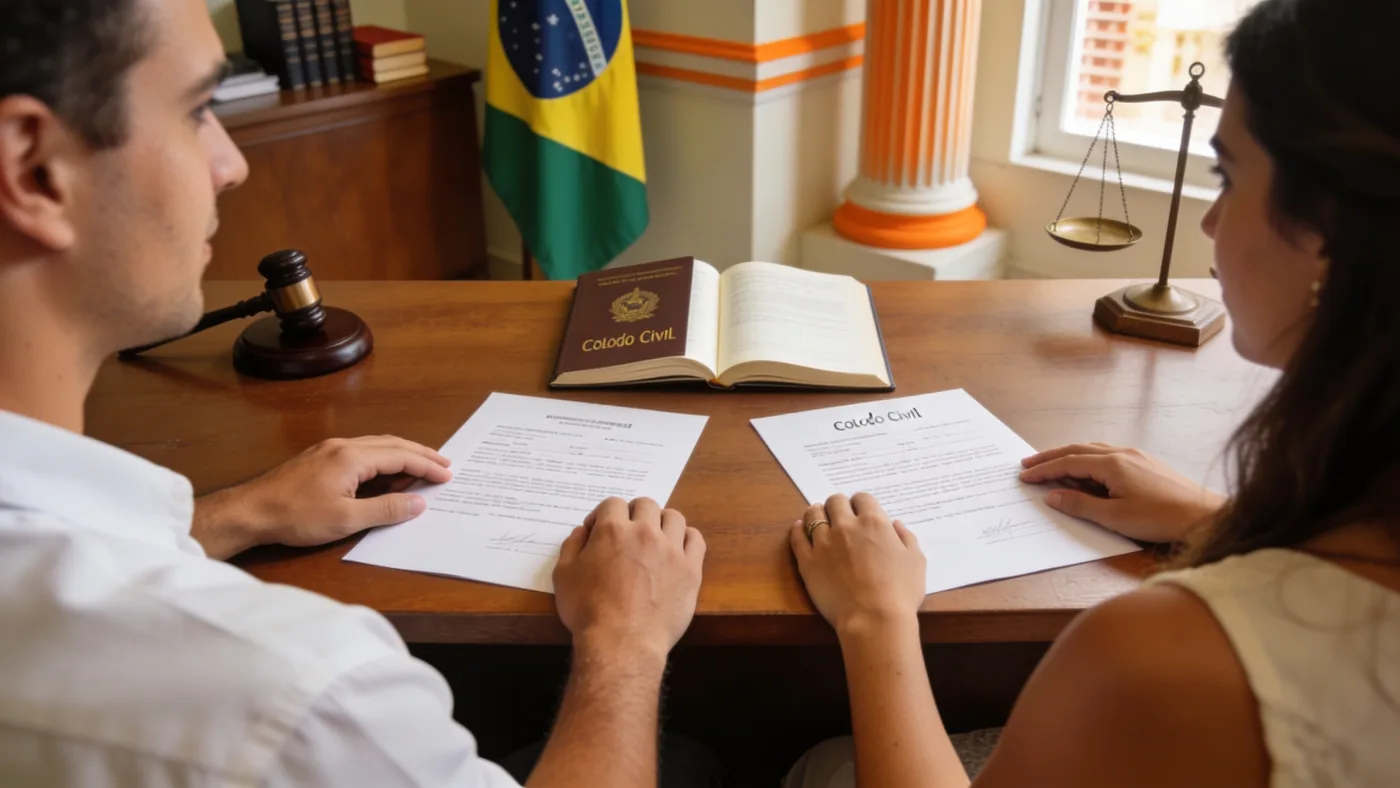
Your foreign marriage is already valid in Brazil. That is exactly why nobody at the counter will accept it.
It sounds absurd until you live it. You married in Lisbon, Miami, Berlin or Buenos Aires. You arrive in Brazil, hand your marriage certificate to the Federal Police for a family reunion residence permit, or to a bank to open a joint account, or to a notary to buy an apartment together. And you hear the same sentence: “this document has no effect here.”
Nobody is questioning that you are married. Brazilian law recognizes marriages celebrated abroad under the law of the place of celebration. The problem is different and purely practical: Brazil has no record of your marriage. Brazilian institutions do not read foreign certificates. They read the Brazilian civil registry. Until your marriage exists inside that registry, you are, for bureaucratic purposes, two unrelated people who happen to live together.
The fix is called traslado (transcription) of the foreign marriage into the Brazilian civil registry, and the result is a Certidão de Casamento (Brazilian marriage certificate) that replaces your foreign one for every domestic purpose. In most cases it costs between R$ 150 and R$ 500 in notary fees and takes 10-30 days.
In some cases it costs R$ 5,000 to R$ 12,000 and requires a lawsuit. Below is the exact map of which path applies to you, what the registrar will argue against you, and how to answer it.
On this page
When Does a Cartório Refuse to Register a Foreign Marriage?
A cartório (notary and civil registry office) refuses transcription in a narrow set of situations: neither spouse is Brazilian, a prior divorce has no effect in Brazil, the foreign act was religious-only without civil effect, the apostille or sworn translation is defective, or the foreign certificate is silent on a fact Brazilian registry rules require. Each refusal has a specific cure.
Start with the exceptions, because that is where money and time are lost. The five real refusal grounds, in order of frequency:
- No Brazilian spouse. The direct transcription route exists primarily for acts involving Brazilian nationals. If you are a German married to an Italian and both of you now live in São Paulo, the civil registry generally has no legal hook to transcribe your marriage. This is the single most common refusal for expat couples.
- A previous divorce without effect in Brazil. If either spouse was divorced abroad and that divorce has not been recognized in Brazil, the registrar sees a person who is still legally married. Registering the new marriage would create a bigamous record.
- Religious marriage without civil registration. A church, mosque or synagogue ceremony that was never registered with the foreign state’s civil authority is not a civil marriage anywhere, including Brazil.
- Documentary defects. Missing apostille, apostille issued by the wrong authority, translation by someone who is not a sworn translator, certificate too abbreviated to show the legal regime or the parents’ names.
- Public policy conflicts. Polygamous marriages, or marriages involving a minor below the Brazilian threshold, hit the ordem pública (public policy) barrier and will not be transcribed.
Warning: Do not assume a refusal is final because a clerk said no at the counter. Brazilian registry law lets you demand that the registrar submit the refusal in writing to the supervising judge, a procedure called dúvida registral. That written refusal is also what a lawyer needs to choose the right judicial remedy.
What Is the Actual Rule on Foreign Marriage Recognition in Brazil?
Under the Brazilian Introductory Law to the Norms of Brazilian Law (Decreto-Lei 4.657/1942, known as LINDB), a marriage is valid in form and substance if it complied with the law of the country where it was celebrated. No Brazilian court needs to approve it. Unlike a foreign divorce judgment, a foreign marriage requires no STJ homologation.
That distinction is the heart of the confusion. A foreign judgment (divorce, custody, adoption) is an act of another state’s judicial power, so Brazil filters it through the Superior Court of Justice. A foreign marriage is a civil status fact, not a judgment. The LINDB simply accepts it.
So you are married in Brazil from day one. What the Public Records Act (Lei 6.015/1973) adds is the registry layer: acts of civil status that occurred abroad and need to produce effects in Brazil must be transcribed into the Brazilian civil registry, at the registry of the couple’s Brazilian domicile or, where there is no known domicile, at the 1st Registry Office of the Federal District.
Two consequences follow, and they are both counterintuitive:
- Your marriage does not expire or weaken because you never registered it. There is no deadline that invalidates it. A couple married in Canada in 2008 can transcribe in 2026 with no penalty.
- But without transcription, Brazilian institutions can lawfully treat you as unmarried for operational purposes: property regime, inheritance, surname change, joint CPF-linked filings, even some Federal Police applications.
Important: If you are applying for residency based on the marriage, the Federal Police will usually accept a properly apostilled and translated foreign certificate for a family reunion request. Transcription becomes essential for property, inheritance and civil status matters. Check current documentary lists on the Federal Police portal before you file, as requirements vary by regional office.
How Does Direct Registration at the Cartório Work (Option A)?
Direct transcription happens at a Registro Civil das Pessoas Naturais (Civil Registry of Natural Persons), typically the 1st Ofício of the couple’s Brazilian domicile. It applies when at least one spouse is Brazilian. Notary fees in 2026 run from roughly R$ 150 to R$ 500 depending on each state’s official fee table, and the act is normally concluded in 10-30 days.
This is the path you want. It is administrative, there is no judge, no hearing and no litigation. You walk in with a file, the registrar checks it, and your Brazilian marriage certificate is issued.
Documents you need
- Original foreign marriage certificate, in long form (not an abbreviated extract), bearing an Apostille under the Hague Apostille Convention, in force in Brazil since 2016. If the country is not a member, consular legalization at the Brazilian consulate replaces the apostille.
- Sworn translation (tradução juramentada) of the certificate and of the apostille, done by a public translator registered with a Brazilian Junta Comercial (Board of Trade). Expect R$ 100 to R$ 250 per page in 2026.
- Identity documents of both spouses: RG or passport, plus CPF (Brazilian taxpayer number) for each spouse, including the foreign one. A foreigner can obtain a CPF online through the Receita Federal or at a Brazilian consulate.
- Proof of Brazilian domicile (utility bill, lease, declaration).
- If either spouse was previously married: documentation closing that marriage, with effect in Brazil.
- A procuração (power of attorney) if a lawyer or representative will file on your behalf. If signed abroad, it must be notarized and apostilled, or signed at a Brazilian consulate.
Practical example: Marcos (Brazilian) and Hannah (British) married in London in 2019 and moved to Belo Horizonte in 2025. Their file cost them R$ 230 in registry fees, R$ 380 in sworn translation of a two-page certificate plus apostille, and £35 for the UK apostille through the Foreign Office. Total under R$ 900, concluded in 18 days. Hannah then used the Brazilian certificate to add her husband’s surname and to sign as spouse on an apartment purchase.
One detail that trips people up: the property regime. If your foreign certificate is silent on the matrimonial property regime, the registrar will apply Brazilian conflict rules, which generally look to the first common domicile of the couple. If you signed a prenuptial agreement abroad, bring it, apostilled and translated. Getting this wrong now creates expensive problems later, in divorce or in probate, as we explain in our guide on how foreign heirs claim an inheritance in Brazil.
When Do You Need a Court Case Instead (Option B)?
You need the judicial path when the cartório formally refuses, when neither spouse is Brazilian, when a prior foreign divorce requires STJ homologation, or when the foreign certificate is impossible to obtain. Total costs, including court fees, lawyer fees and incidentals, typically range from R$ 5,000 to R$ 12,000 in 2026 for straightforward cases.
There are three different judicial routes, and they are not interchangeable:
- Suscitação de dúvida / judicial order to register. When the registrar refuses but you believe the refusal is wrong, a state court judge supervising the registry decides. This is usually the cheapest and fastest judicial option: 3-8 months in most state courts.
- Homologation of a foreign divorce at the STJ. Needed when a spouse’s earlier contested divorce abroad has never been recognized in Brazil. Note the exception that saves many couples: the Civil Procedure Code provides that a consensual foreign divorce produces effects in Brazil without STJ homologation, and can be noted directly at the registry. See our breakdown of STJ recognition rules for foreign divorces. Contested cases do go to the STJ, with timelines of 8-24 months.
- Ação de registro tardio / declaratory action. When the foreign record is lost, destroyed, or the country of celebration cannot issue a usable certificate (war, archive loss, non-functioning registry). You prove the marriage by other evidence: witnesses, photographs, immigration records, joint tax filings.
Realistic budget breakdown for the dúvida route: court filing costs from R$ 400 to R$ 1,200 depending on the state, lawyer fees commonly between R$ 4,000 and R$ 8,000, plus R$ 500 to R$ 1,200 in translations, certified copies and registry acts after the decision.
Tip: Before paying for any lawsuit, ask your lawyer to test the administrative route at two different registry offices. Registrars interpret documentary requirements with real variation, and a file rejected in one state has been accepted in another with identical documents.
Can You Register at a Brazilian Consulate Instead (Option C)?
Yes, if at least one spouse is Brazilian and you are still living abroad. Brazilian consulates maintain their own civil registry books and can register a marriage celebrated in their jurisdiction. Consular registration of civil status acts is free of charge according to Itamaraty’s consular service rules, and usually takes 15-45 days.
This is the smartest move if you married abroad and have no immediate plan to move to Brazil. The consulate issues a Brazilian consular marriage record. You still eventually transcribe that consular record into a Brazilian registry when the marriage needs to produce effects in Brazil, but the hard part (apostille, translation, documentary vetting) is already done, and the consular act normally does not require an apostille of the local certificate because the consulate verifies it directly.
Procedures, appointment booking and document lists are published per consulate on the Itamaraty consular services portal. Appointment availability is the real bottleneck: in high-demand posts such as Lisbon, Boston and Tokyo, slots have been running 4-10 weeks out.
Remember: Consular registration is available only while you are resident in that consular district. Once you are living in Brazil, that door closes and your route becomes Option A or Option B.
Which Path Should You Take?
Choose by nationality and by where you live. If one spouse is Brazilian and you are in Brazil, Option A (cartório transcription) applies, at R$ 150-500 and 10-30 days. If you are abroad, Option C (consulate) is free. If neither spouse is Brazilian or the registrar refuses, Option B (court) applies, at R$ 5,000-12,000.
| Factor | Option A: Cartório | Option B: Court | Option C: Consulate |
|---|---|---|---|
| Who qualifies | At least one Brazilian spouse, residing in Brazil | Refused files, two foreign spouses, prior divorce issues, lost records | At least one Brazilian spouse, residing abroad |
| Cost in 2026 | R$ 150-500 in registry fees, plus translations | R$ 5,000-12,000 total | No consular fee for the civil status act |
| Realistic timeline | 10-30 days | 3-8 months (dúvida); 8-24 months (STJ) | 15-45 days plus appointment wait |
| Lawyer required | No, but useful for document vetting | Yes, mandatory | No |
| Apostille needed | Yes | Yes | Usually not |
| Output document | Brazilian marriage certificate | Court order, then Brazilian certificate | Consular record, transcribable later |
Couples where neither spouse is Brazilian often ask what they should do instead. Two practical answers: formalize a união estável (stable union) in Brazil as a parallel civil status, which is far simpler and produces most of the same domestic effects, or use the foreign certificate document by document (apostilled and translated) for each specific institution. Which is better depends on whether you own property in Brazil and on your inheritance planning, a question we unpack in our overview of binational family rights in Brazil.
What Will the Registrar Argue Against Your Marriage, and Does It Hold?
The strongest objection is not bureaucratic, it is substantive: that registering your marriage would create a bigamous record. If a spouse’s earlier divorce has no effect in Brazil, then under Brazilian law that person was still married on the wedding day, and the registrar is legally obliged to refuse. This objection is correct, and it is defeated by sequence, not by argument.
Put it in its strongest form. The registrar says: “I am not questioning your foreign ceremony. I am applying Brazilian law to the civil status of this spouse. Brazil has no record that his first marriage ever ended. Brazilian conflict rules do not let me treat a foreign divorce as automatically effective here when it was contested and never homologated. If I transcribe this marriage, I enter into a Brazilian public register a second simultaneous marriage for the same person. That is a defect I would be personally responsible for.”
That reasoning is sound. The answer is procedural:
- If the prior divorce was consensual, invoke the Civil Procedure Code rule that a consensual foreign divorce produces effects in Brazil without STJ homologation. Present the apostilled and translated decree and ask for direct annotation. This resolves the majority of cases.
- If the prior divorce was contested, you must homologate it at the STJ first, then return to the registry. The marriage transcription then goes through on documents alone.
- If the first marriage was itself never registered in Brazil and the spouse is foreign, argue that there is no Brazilian civil status record to contradict, and that the governing status is that of the person’s nationality and domicile at the time.
The second strongest objection is about documents, not law: your apostille was issued by a competent authority that the registrar cannot verify, or your translation came from a certified translator abroad rather than a Brazilian sworn translator. There is no clever reply to this one. Redo the document correctly. Arguing costs more than complying.
What Changed in 2026 for Foreign Marriage Recognition?
The main change is digital verification. Brazil’s National Council of Justice (CNJ) has been expanding electronic apostille verification across civil registry offices, so that by the end of 2026 most registrars can confirm a foreign apostille electronically instead of inspecting the paper. In practice this cuts rejection rates for formally valid documents.
Three other developments matter for binational couples this year:
- Consolidated national notarial rules. The CNJ’s unified code of notarial and registry norms continues to reduce state-by-state divergence in documentary requirements. Published guidance is available at the CNJ portal. You can now point a hesitant registrar to a national rule rather than to local custom.
- Electronic registry filing. More registry offices accept remote submission and digital signatures through the national civil registry platform, which means a spouse abroad can often sign with a certified digital signature instead of flying in.
- Faster STJ homologation flow. Fully digital processing at the STJ has shortened uncontested homologation cases, with many concluding closer to 6-10 months than the historical 18-24.
Heads up: Digital verification does not replace the sworn translation. The apostille can be checked electronically; the content of your certificate still needs a Brazilian public translator.
How Do You Register Your Foreign Marriage Step by Step?
Six steps, start to finish, assuming the administrative route: obtain a long-form certificate, apostille it, get a sworn translation, secure CPF numbers for both spouses, file at the registry of your Brazilian domicile, and collect the Brazilian certificate in 10-30 days. Budget 6-10 weeks overall, including document gathering abroad.
- Step 1: Order a fresh long-form certificate from the foreign registry. Many registrars reject certificates older than 12 months and almost all reject abbreviated extracts. Allow 2-4 weeks.
- Step 2: Apostille it in the country of origin, through that country’s designated competent authority (Secretary of State offices in the US, the FCDO in the UK, courts or prefectures elsewhere). Cost typically USD 20-60.
- Step 3: Sworn translation in Brazil of certificate and apostille. R$ 100-250 per page. Use a translator listed by a Junta Comercial, not a foreign certified translator.
- Step 4: CPF for the foreign spouse, if not already obtained, through Receita Federal online or a Brazilian consulate. Free.
- Step 5: File at the Civil Registry of your Brazilian domicile, with identity documents, proof of address, prior-marriage documents if applicable, and a power of attorney if a lawyer files for you. Pay R$ 150-500 in state fees.
- Step 6: Collect the Certidão de Casamento and request two or three certified copies at once. You will need them for the Federal Police, banks, Receita Federal and any property transaction.
If any step returns a refusal, request it in writing immediately. That written refusal is the entry ticket to the judicial route and it also narrows the problem to a single curable defect.
Which Mistakes Send Couples to Court Unnecessarily?
Most avoidable litigation in this area comes from four errors: translating abroad instead of in Brazil, using an abbreviated certificate, skipping the prior-divorce question, and signing a power of attorney that was never apostilled. Each one adds weeks; together they can turn a R$ 700 administrative act into a R$ 8,000 lawsuit.
- Translating in the wrong country. A translation certified in New York or Lisbon has no standing in a Brazilian registry. Only a Brazilian public translator works.
- Hiding a prior marriage. Registrars cross-check. Disclose it and plan the sequence instead of hoping it goes unnoticed.
- Assuming the Federal Police and the cartório want the same file. They do not. Residency applications and registry transcription have separate documentary logic, and immigration deadlines (such as the 90-day CRNM registration window after arrival) run independently of your registry timeline.
- Letting the property regime default by accident. If you had a prenuptial agreement abroad and never present it, Brazil may apply a different regime to assets located here.
- Using a non-apostilled power of attorney. A procuração signed abroad needs notarization plus apostille, or signature at a Brazilian consulate.
Frequently Asked Questions
Is my foreign marriage valid in Brazil if I never register it?
Yes. Under the LINDB, a marriage validly celebrated abroad is valid in Brazil without any registration or court approval. Registration does not create the marriage, it creates the Brazilian record of it. The practical consequence of not registering is that Brazilian institutions (banks, notaries, probate courts, some immigration offices) will not treat you as married for their own procedures, because they rely on the national civil registry rather than on foreign documents.
Can two foreigners register their marriage in Brazil?
Usually not through the direct administrative route, which is built around acts involving Brazilian nationals. Two foreign spouses living in Brazil have two realistic alternatives: use the apostilled and sworn-translated foreign certificate institution by institution, or formalize a união estável (stable union) at a Brazilian notary, which produces most domestic effects. A judicial declaratory action is possible but costs R$ 5,000-12,000 and is rarely worth it unless property or inheritance issues demand a Brazilian registry entry.
Do I need a lawyer to transcribe a foreign marriage in Brazil?
Not legally for the administrative path. A lawyer registered with the OAB (Brazilian Bar Association) becomes necessary when the registrar refuses, when a foreign divorce needs STJ homologation, or when one spouse cannot travel to Brazil and the filing must run on a power of attorney. In practice, most couples hire a lawyer for document vetting rather than for filing, because a single defective document is what turns a 20-day process into a 6-month one.
How long does registration take, realistically?
The registry act itself takes 10-30 days once your file is complete. The honest total is 6-10 weeks, because ordering a fresh long-form certificate abroad takes 2-4 weeks, apostille adds 1-2 weeks, and sworn translation adds 3-7 days. Consular registration abroad takes 15-45 days plus an appointment wait that has been running 4-10 weeks in busy posts. Judicial routes take 3-8 months, or 8-24 months when STJ homologation is involved.
Does registering my marriage change my property or inheritance rights in Brazil?
It fixes which regime applies to your Brazilian assets, which is why the step matters more than it looks. Once transcribed, the matrimonial property regime appears on the Brazilian record and governs purchases, sales and succession of property located in Brazil. Brazilian succession law applies to assets situated here regardless of your nationality, and spousal rights depend on the registered regime. Present any foreign prenuptial agreement at the time of transcription, not years later.
What if my spouse cannot travel to Brazil for the registration?
A power of attorney solves it. Your spouse signs a procuração before a notary abroad, has it apostilled and sworn-translated in Brazil, or signs it directly at a Brazilian consulate, which avoids the apostille step. Many registry offices now also accept filings with Brazilian certified digital signatures through the national civil registry platform. Confirm the accepted format with the specific registry office before paying for notarization abroad.
Get Your Foreign Marriage Recognized in Brazil with Bilingual Legal Support
Recognizing a marriage you already have should not feel like proving it from scratch. Most of the frustration comes down to one or two document details that nobody warned you about, and those are fixable before you ever set foot in a cartório. Our bilingual team reviews binational family files daily and can tell you within one reading whether yours goes the administrative route or needs a judge.
Your concrete next step: gather your marriage certificate, the apostille (if you already have it) and, if either spouse was previously married, the divorce decree. Send those three documents to us on WhatsApp and ask for a path assessment.
Talk to a specialist lawyer now
Talk to a Lawyer on WhatsApp