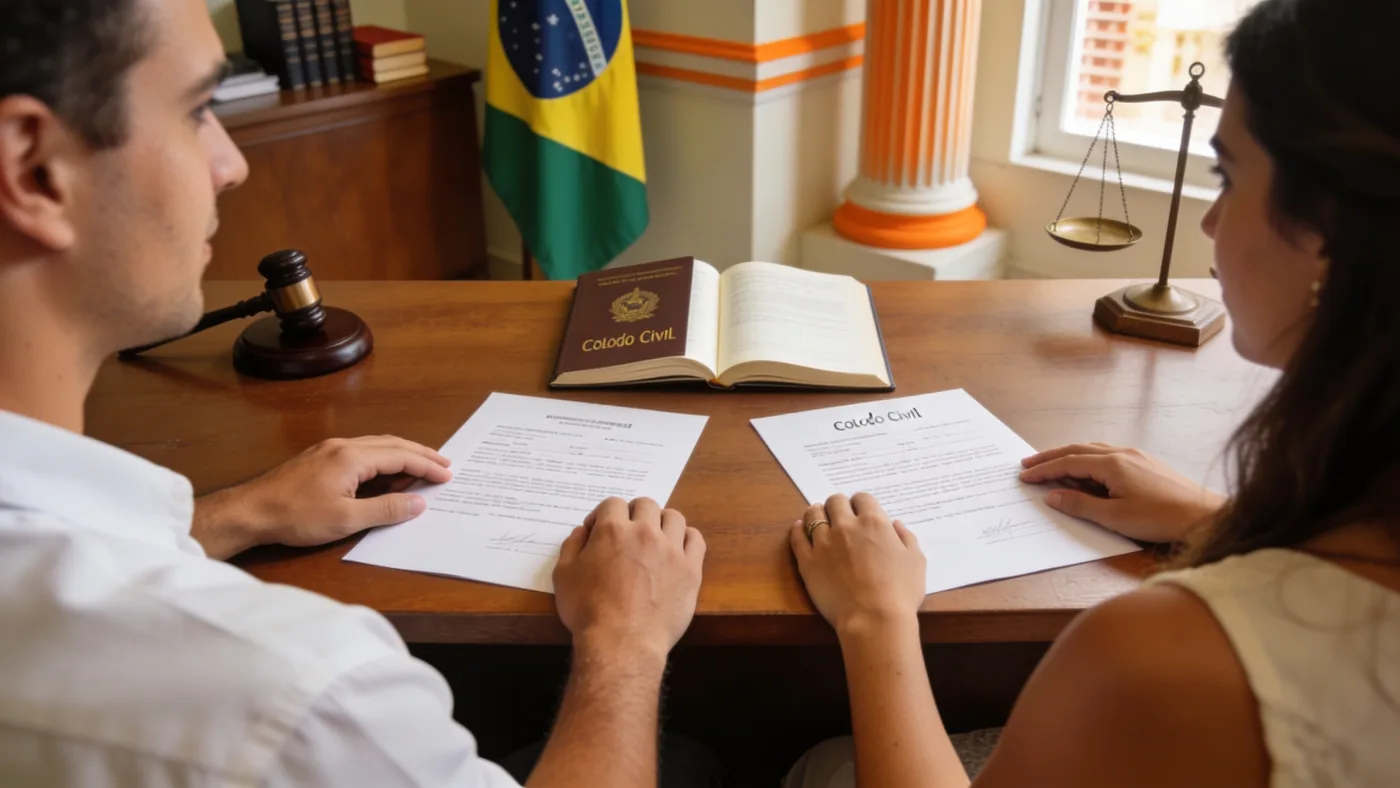
The most expensive mistake binational couples make in Brazil is walking into a cartório (notary office), signing a one-page declaration of união estável on a Tuesday, and filing for residency at the Federal Police on the Thursday. The application gets denied, or worse, it sits in “diligência” (request for further evidence) while the foreign partner’s legal stay expires. Suddenly you are overstaying, paying daily fines, and rebuilding an application from scratch.
Why does this happen? Because Brazilian authorities do not treat a união estável (stable union, Brazil’s common-law partnership) as something you create by signing paper. Under Brazilian law it is a factual situation that either exists or does not. The paper is only evidence of it. A declaration signed last week, with no shared address, no joint account, no photos, no witnesses, proves almost nothing.
The fix is not complicated, but it has to happen in the right order: build the evidence file first, formalize second, file third. This guide explains exactly what a união estável is, who qualifies, what the Federal Police will argue against you and how to answer it, what the union does to your property and inheritance rights, and what the whole thing costs in 2026.
On this page
When Does a União Estável Not Get You Residency in Brazil?
A união estável fails to produce residency in four situations: one partner is still legally married elsewhere without a separation of fact, the couple cannot document a shared life, the “union” was formalized only days before filing, or the documents from abroad lack apostille and sworn translation. Residence for family reunion under Law 13.445/2017 depends on proof, not on a signature.
Start with the exceptions, because that is where cases die. The rule is generous. The exceptions are where foreigners lose months.
- Existing marriage abroad that was never dissolved. Brazilian law allows a união estável if one partner is separated in fact, but the Federal Police and notaries will ask for proof of that separation. If you are still living with a spouse in Lisbon while claiming a union in São Paulo, the file collapses. If you divorced abroad, you will usually need that foreign divorce recognized in Brazil before certain acts, which is a separate procedure explained in our guide on foreign divorce recognition by the STJ.
- A relationship that is real but undocumented. Long-distance couples, couples who kept finances entirely separate, and couples who never shared an address struggle. The relationship may be genuine and still be unprovable.
- A declaration signed on the eve of the application. Notaries in most states will happily register whatever date you declare. The Federal Police reads the deed’s registration date and looks for corroboration covering that period.
- Foreign documents without apostille. A birth certificate from a Hague Apostille country needs an apostille; from a non-member country, consular legalization. Then a sworn translation by a Brazilian tradutor público (public sworn translator). Plain translations are rejected.
Watch out: If your legal stay in Brazil is running out while your file is incomplete, do not let it lapse in silence. Filing the residency request before your stay expires generally protects your status while the Federal Police analyses it. Filing after it expires converts a bureaucratic problem into a fines-and-overstay problem.
What Is a União Estável Under Brazilian Law?
A união estável is a legally recognized family entity between two people living in a public, continuous and lasting relationship with the intention of building a family. It is protected by Article 226, paragraph 3 of the Brazilian Constitution and regulated by the 2002 Civil Code. There is no minimum duration and no ceremony requirement. It exists the moment those elements exist.
Now the rule. Brazil is a civil law country, so the definition comes from statute, not from judicial precedent as in the United States or the United Kingdom. The Brazilian Civil Code requires four elements: the relationship must be public (not secret), continuous, lasting, and aimed at forming a family. Notice what is absent: a wedding, a registry, a fixed number of years.
This is why the union is sometimes discovered retroactively, in court, after a separation or a death. A foreigner who lived with a Brazilian partner for six years without signing anything may have had a união estável the entire time, with all the property consequences that follow.
Key point: You do not need to live under the same roof. Súmula 382 of the Supreme Federal Court (STF) states that cohabitation under the same roof is not indispensable to characterize the relationship. Courts apply the same logic to união estável, which matters enormously for couples separated by work, visas or borders.
Same-sex couples have identical rights. In 2011 the STF, in ADI 4277 together with ADPF 132, extended união estável to same-sex couples, and CNJ Resolution 175/2013 obliged notaries nationwide to celebrate same-sex marriages and convert same-sex unions. A binational same-sex couple applies for family reunion residency on exactly the same legal basis as any other couple.
Who Qualifies for Family Reunion Residency as a Partner?
Under Article 37 of Law 13.445/2017, the Brazilian Migration Law, the companheiro (partner) of a Brazilian citizen or of a foreigner holding residency in Brazil qualifies for residence for family reunion, granted for an indefinite period. Nationality of the foreign partner is irrelevant, and there is no income or investment threshold.
- Your partner is a Brazilian national, or a foreigner with a valid residence permit in Brazil (temporary or permanent).
- Neither of you has a legal impediment to the union (for example, a subsisting marriage with ongoing cohabitation).
- Both of you are at least 18, or otherwise legally capable.
- The relationship is public, continuous, lasting and oriented toward family life, and you can document it.
- You hold a Brazilian CPF (taxpayer number) and, if already in Brazil, a valid entry stamp or current legal stay.
- Your foreign civil documents are apostilled or legalized, plus sworn-translated into Portuguese.
One practical point that surprises many applicants: the residency is granted for an indefinite period from the start, per the Federal Police migration service. You are not on a two-year probation like in several European systems. What you receive is a CRNM (National Migration Registration Card) that must be renewed as a physical document but reflects an indefinite authorization.
What Will the Federal Police Argue Against Your Union, and How Do You Answer It?
The strongest argument against you is not that your relationship is fake. It is that a união estável cannot be created by declaration, so a deed signed for immigration purposes proves only that two people went to a notary. Under Law 13.445/2017, residency obtained by fraud can be cancelled at any time, with no statute of limitations comfort.
Stated in its strongest form, the authority’s position runs like this: Brazilian notaries do not investigate. They register declarations made by the parties under their own responsibility. A public deed of união estável therefore has the evidentiary weight of a sworn statement, nothing more. Because family reunion residency is indefinite and leads to naturalization eligibility, it is one of the most valuable immigration benefits Brazil grants. It is rational for the administration to treat a bare declaration with scepticism, especially when the deed was signed within days of the application and the couple presents no independent trace of a shared life.
That argument is correct as far as it goes. The answer is not to dispute it, but to make it irrelevant by producing independent evidence that the union existed before and outside the notary’s office.
- Financial entanglement: joint bank account statements, a shared credit card, one partner listed as dependent on the other’s health plan, transfers between accounts with a consistent pattern.
- Shared address over time: utility bills, a lease with both names, correspondence from different institutions addressed to the same address across several months.
- Institutional recognition: partner named as beneficiary on an INSS record, private pension, life insurance or employer registration.
- Third-party statements: written declarations from two or three witnesses with full name, CPF, RG and signature, describing how and since when they know the couple.
- Timeline evidence: flight records, passport stamps, dated photographs, message history and social media showing continuity, not a single trip.
How it works: An analyst is asked one question: would a reasonable person, looking only at this folder, conclude these two built a life together? Three documents from three unrelated sources covering a two-year span do more than thirty screenshots from one week. Order the file chronologically and add a one-page index.
União Estável or Marriage: Which Is Better for an International Couple?
For Brazilian immigration purposes, both routes lead to the same result: residence for family reunion for an indefinite period under Law 13.445/2017. The differences are evidentiary and international. Marriage is easier to prove and easier to recognize abroad. União estável is faster to formalize and cheaper, typically R$ 300 to R$ 500 at a notary instead of a full marriage process.
| Aspect | União estável (stable union) | Casamento civil (civil marriage) |
|---|---|---|
| How it is created | By facts. A deed is evidence, not the act itself | By a formal act at the cartório, with notice period and witnesses |
| Proof burden with Federal Police | Higher. Deed plus supporting evidence file | Lower. Marriage certificate is usually sufficient |
| Default property regime | Comunhão parcial (partial community), unless a written contract says otherwise | Comunhão parcial, unless a pact before marriage says otherwise |
| Inheritance rights | Equal to spouse, per STF RE 878.694 (Tema 809, 2017) | Spouse is a necessary heir |
| INSS survivor’s pension | Yes, with proof of the union | Yes |
| Recognition abroad | Unpredictable. Many countries have no equivalent status | Generally recognized after apostille |
| How it ends | By a deed of dissolution or by court action if contested | Divorce, by deed if consensual and no minor children, or in court |
| Typical formalization cost | R$ 300 to R$ 500 (about USD 55 to USD 92) | R$ 400 to R$ 1,200 depending on the state table |
If you intend to move abroad later, marriage travels better. A Portuguese, German or American authority will understand a Brazilian marriage certificate. A Brazilian escritura de união estável frequently requires legal explanation and sometimes a court decision in the destination country. If you intend to stay in Brazil and want the lightest possible process, união estável is the efficient choice. Notably, the Constitution itself says the law shall facilitate conversion of a stable union into marriage, and most notaries handle that conversion in a single visit.
What Happens to Your Property and Inheritance in a União Estável?
Unless you sign a written property contract, the default regime is comunhão parcial de bens: everything acquired during the union is split 50/50 on separation or death, regardless of whose name is on the title. Since the STF decision in RE 878.694 (Tema 809, 2017), the surviving partner inherits on the same footing as a spouse.
This is where foreigners lose real money, and it has nothing to do with immigration. Assets you owned before the union stay yours. Inheritances and gifts received by one partner individually stay individual. Everything else acquired onerously during the union is common property, including an apartment in Florianópolis bought only in the Brazilian partner’s name with money wired from abroad.
Example: A Canadian consultant lives with her Brazilian partner in Rio from 2020. In 2023 she buys a R$ 1.2 million apartment in her own name. They separate in 2026 with no written contract. Because the purchase happened during the union, the presumption is that R$ 600,000 of value belongs to her partner. To defeat that presumption she would need to trace the funds to pre-union assets, document by document.
The prevention is a contrato de convivência (cohabitation contract), signed as a public deed, electing separação total de bens (full separation of assets) or any hybrid you agree on. It costs a few hundred reais and takes one appointment. On the succession side, the surviving partner is an heir alongside descendants, which means probate cannot ignore them. If the deceased owned assets in Brazil and heirs live abroad, see our guide on how foreign heirs claim inheritance in Brazil, and note that state inheritance tax (ITCMD) applies separately, as explained in our analysis of Brazilian inheritance tax and double taxation.
How Do You Formalize Your União Estável Step by Step in 2026?
The sequence is: gather personal documents, build the evidence file, sign a public deed at a cartório, then file the family reunion residency request with the Federal Police through the gov.br migration portal. Realistic total timeline is 60 to 150 days, with the Federal Police analysis being the variable part.
Step 1: Get your Brazilian and foreign personal documents in order
The foreign partner needs a valid passport, a CPF (issued free of charge by Receita Federal, online or at a consulate), and a birth certificate apostilled and sworn-translated. If previously married, add the divorce decree or death certificate of the former spouse, also apostilled and translated. The Brazilian partner needs RG, CPF and an up-to-date certidão de nascimento or certidão de casamento with annotations (issued within 90 days is the safe standard).
Step 2: Build the evidence file before you sign anything
Collect the items listed earlier: joint account statements, lease or utility bills, health plan dependency, dated photographs, two or three witness declarations with signature and CPF. Aim for coverage across the entire claimed duration of the union, not just the most recent month. Scan everything into a single indexed PDF.
Step 3: Sign the escritura pública declaratória de união estável
Book an appointment at any Tabelionato de Notas. Both partners attend with original documents. You declare the start date of the union and choose the property regime. A simpler alternative exists (a private declaration with notarized signatures, around R$ 90 to R$ 150), but the public deed is stronger evidence and is what the Federal Police expects. Many notaries now offer remote signing through the e-Notariado platform of the Colégio Notarial do Brasil, useful when one partner is abroad.
Step 4: File the residency request with the Federal Police
Register on gov.br, access the Migração service, complete the family reunion application, upload the deed, the evidence file, the personal documents and the proof of fee payment (GRU). Book the in-person appointment for biometrics and document verification at a Federal Police unit. Bring originals.
Step 5: Receive the protocol, then the CRNM
After biometrics you receive a protocol that serves as proof of legal stay. The CRNM card generally arrives in 60 to 120 days, though some units take longer. With the protocol you can already open a bank account, sign a work contract and enrol in the health system in most situations.
Quick recap: Evidence first, deed second, Federal Police third. Couples who reverse that order are the ones who end up in diligência, resubmitting a file while their legal stay quietly runs out.
What Does It Cost in 2026?
Budget R$ 1,200 to R$ 2,500 (roughly USD 220 to USD 460) for a straightforward case handled yourself, with federal fees fixed by the Federal Police at R$ 168.13 for processing the residence authorization and R$ 204.77 for issuing the CRNM. Notary costs vary because each Brazilian state sets its own table of fees.
| Item | 2026 cost in R$ | Approx. USD / EUR | Source |
|---|---|---|---|
| Residence authorization processing fee | R$ 168.13 | USD 31 / EUR 28 | Federal Police fee schedule |
| CRNM issuance fee | R$ 204.77 | USD 38 / EUR 35 | Federal Police fee schedule |
| Public deed of união estável | R$ 300 to R$ 500 | USD 55 to 92 | State notary fee tables (estimate) |
| Private declaration with notarized signatures | R$ 90 to R$ 150 | USD 17 to 28 | State notary fee tables (estimate) |
| Sworn translation, per page | R$ 90 to R$ 160 | USD 17 to 30 | Market estimate, sworn translators |
| Apostille abroad | Varies by country | USD 10 to 60 | Hague Apostille authorities |
| Cohabitation contract with property regime | R$ 400 to R$ 800 | USD 74 to 148 | State notary fee tables (estimate) |
| Lawyer fees, uncontested case | R$ 2,500 to R$ 8,000 | USD 460 to 1,480 | Market estimate |
Conversion at roughly R$ 5.40 per USD and R$ 5.90 per EUR. Check current rates with the Banco Central do Brasil. A realistic self-managed scenario: deed R$ 400, two sworn translations R$ 220, federal fees R$ 372.90, certificates and copies R$ 120, for a total near R$ 1,113 (about USD 206). Add legal representation if there is a prior marriage abroad, a contested property situation, or a tight stay deadline.
What Changed for União Estável in 2026?
No new statute rewrote união estável in 2026. The governing rules remain the 2002 Civil Code and Article 226 of the Constitution, with the 2017 STF decision in RE 878.694 (Tema 809) still the key precedent on inheritance equality. What changed is practice, not law: notaries handle binational deeds far more routinely, and remote electronic signing has become standard.
Three practical shifts matter for international couples this year. First, e-Notariado video-conference deeds are now widely accepted, which lets a partner sign from abroad with a digital certificate instead of flying in. Second, Federal Police units have largely moved intake to the gov.br portal, so incomplete uploads are flagged earlier, which is good news if you respond fast and bad news if you ignore the notification. Third, evidence expectations have hardened. Analysts increasingly want financial and institutional documents, not photo albums.
Key point: Because the law itself did not change, old advice from 2019 or 2021 about the legal test is still valid. What is outdated is procedural advice about where and how you file. Verify the current procedure on the official portal before booking anything, and read the text of Law 13.445/2017 if you want the statutory basis in Portuguese.
Frequently Asked Questions About União Estável for Foreigners
Can I apply for residency through união estável if I entered Brazil as a tourist?
Yes. Family reunion residency under Law 13.445/2017 can be requested from inside Brazil, and you do not have to leave and return with a different visa. The critical condition is that you file while your stay is still legal. If your 90-day tourist period is expiring, file first and complete documents afterwards if necessary, because the protocol preserves your status while the Federal Police analyses the case.
How long do we have to be together before we can register a união estável?
Brazilian law sets no minimum duration. The Civil Code requires a public, continuous, lasting relationship with the intention of building a family, which is assessed by facts rather than a calendar. In practice, however, the shorter the relationship the heavier your evidence must be. Couples together under a year should expect closer scrutiny and should present financial and institutional proof, not only photographs and travel records.
Do we need to live in the same house to prove the union?
No. Súmula 382 of the Supreme Federal Court establishes that living under the same roof is not indispensable to characterize this kind of relationship, and courts apply that reasoning to união estável. For binational couples separated by visas or work, this is decisive. You will still need to prove continuity and family intent through transfers, communication records, repeated visits documented by passport stamps, and witness statements.
What happens to my residency if we break up?
Residency granted for family reunion is indefinite, so it does not evaporate automatically on separation, but the Federal Police can review the basis of the permit. If you have built independent ties in Brazil, such as employment, a business or Brazilian children, converting to another residency basis is usually possible. Dissolve the union formally by deed or court action rather than leaving it undefined, because an undissolved union keeps property consequences alive.
Will my Brazilian união estável be recognized in my home country?
Sometimes, and rarely automatically. Countries with registered partnerships may accept an apostilled Brazilian deed, while countries that recognize only marriage often will not. For immigration, tax or inheritance purposes abroad, check with local counsel before relying on it. If you need certainty, converting the union into civil marriage at a Brazilian cartório produces a document that travels internationally with far less friction.
Can we register a união estável if one of us is still married abroad?
Possibly, if that marriage is separated in fact, which Brazilian law accepts. You must document the separation with evidence such as separate addresses, a filed divorce petition or a separation agreement. Notaries differ in strictness, and the Federal Police will look closely. If the foreign divorce is already final, recognition of that decree in Brazil is often the cleaner path, especially before any property or inheritance issue arises.
Formalize Your União Estável in Brazil With a Bilingual Legal Team
Binational couples rarely fail because their relationship is weak. They fail because the file was assembled in the wrong order, a document arrived without an apostille, or nobody flagged the property regime until an apartment was already bought. Getting it right the first time costs a fraction of fixing it later. If you are dealing with children, custody or cross-border enforcement alongside the union, our overview of binational family law rights and custody in Brazil covers the wider picture.
The concrete next step: list the documents you already have that cover your relationship from its start date to today, and send that list to an OAB-registered lawyer for review before you book the notary appointment.
Talk to a specialist lawyer now
Talk to a Lawyer on WhatsApp