You are afraid that one wrong word to an official will put you back on a plane. That fear is reasonable, and yes, the problem has a solution, because Brazilian law protects you from exactly that outcome. Under the Brazilian Refugee Law (Law 9.474/1997), applying for asylum in Brazil is free, requires no visa, requires no passport, and cannot be refused because you entered the country irregularly.
But there is a catch that costs people their protection every month: the right to asylum in Brazil is not applied automatically. It must be asked for, out loud, at the right door, at the right moment. Officials are not required to guess that you are fleeing persecution, and nobody at the airport will hand you a leaflet explaining your options.
This article is part of our guide: Brazil Immigration Law 2026: Visas, Residency & CRNM.
There are three practical routes into the system: asking for refuge at the point of entry (airport, port or land border), filing inland at a Federal Police unit after pre-registering in Sisconare, and being included as a family extension of a refugee who is already recognised. They are not interchangeable. This guide compares them so you pick the one that actually fits your situation in 2026.
On this page
What Is the Costliest Mistake Asylum Seekers Make in Brazil?
The costliest mistake is staying silent at the border. Under Article 8 of Law 9.474/1997, irregular entry cannot bar an asylum application, and Article 10 states that filing suspends any deportation or expulsion proceeding already in motion. But that shield only activates once you formally express the intention to seek refuge.
Here is how the loss happens in real life. A traveller arrives at Guarulhos airport with a passport the Federal Police consider suspicious, or no return ticket, or a story that does not satisfy the border officer. They are taken to secondary inspection. They answer questions about tourism, hotels and money, because that is what they are asked about. They are declared inadmissible and sent back on the next flight, sometimes within hours.
Legally, that person could have said one sentence: “Eu quero solicitar refúgio” (I want to apply for refuge). That sentence changes the legal framework entirely. Inadmissibility and return cannot be applied to someone who has requested asylum, because Article 7, paragraph 1, of the Refugee Law prohibits returning anyone to a territory where their life or freedom is at risk. This is the principle of non-refoulement, and it is binding on the Brazilian State.
Common mistake: Signing a “termo de desistência” (waiver form) or a voluntary return document at the airport because an official says it will be faster. Once you sign and board, you are outside Brazilian territory and the Refugee Law no longer reaches you. Ask to register your asylum request first, in writing, and ask for the protocol number.
Rebuild the whole rule from that mistake and it becomes simple: the law is generous, but it is triggered by your declaration, not by your circumstances. People lose this right because they do not know which words activate it, or because they assume someone will ask.
Option A: How Does Applying at the Airport or Border Work?
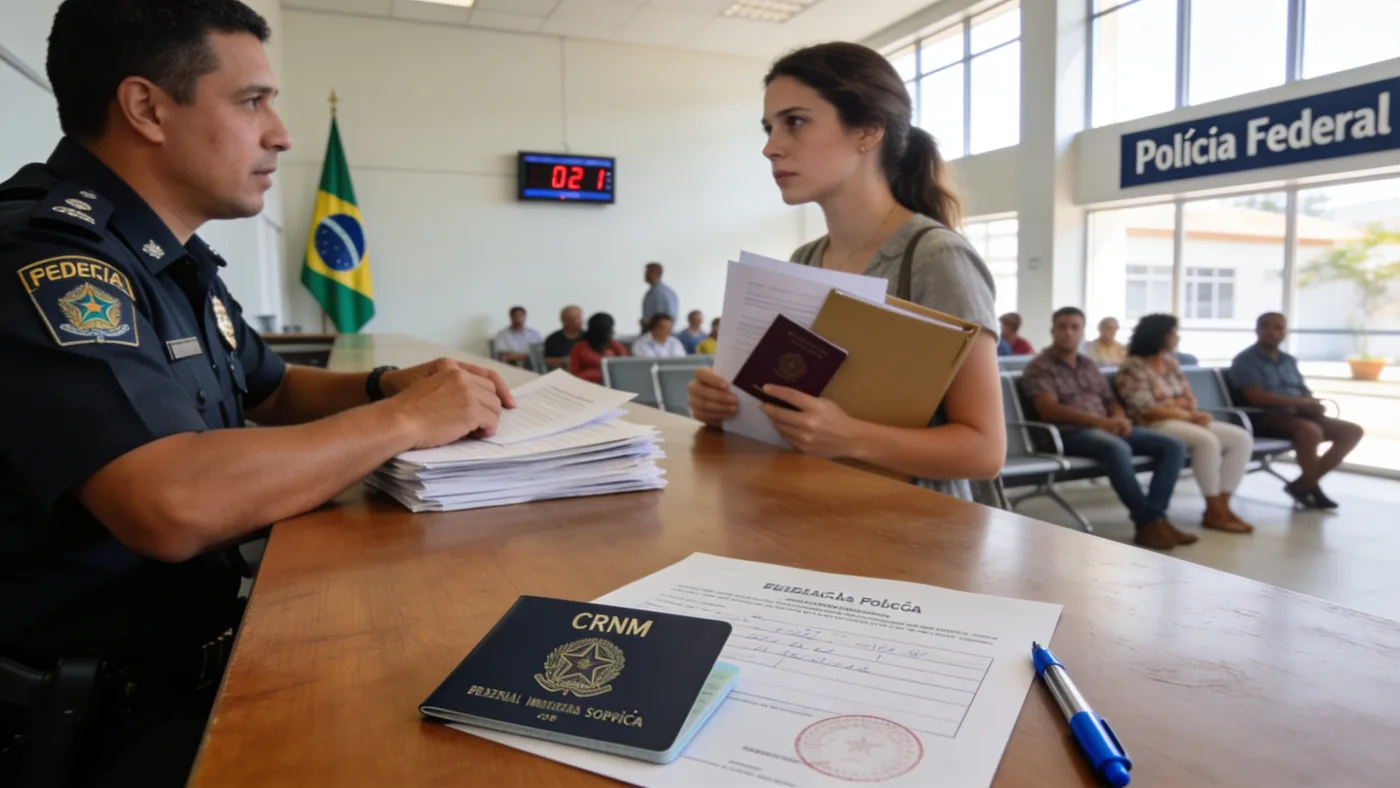
You declare your intention to seek refuge directly to the Federal Police officer at immigration control. There is no fee and no document requirement. The officer must register the request and cannot deny you entry or return you abroad, per Articles 7 and 8 of Law 9.474/1997. You are then released into Brazilian territory to continue the process.
In practical terms, the officer takes a statement (termo de declaração), fingerprints you, and gives you instructions to complete your registration in Sisconare, the CONARE online system available through the Ministry of Justice portal. In some airports you receive a paper notification with a deadline to appear at a Federal Police unit; in others the full registration is done on the spot.
Advantages
- It blocks inadmissibility and immediate return at the border.
- Your entry is documented from day one, which strengthens credibility later.
- It works even without a valid visa, without a passport, and without money.
Disadvantages
- You are speaking under pressure, often without an interpreter you trust and without a lawyer.
- Initial statements are kept in the file and inconsistencies between them and your later CONARE interview are used against you.
- You may be held in the international area for hours while the request is processed.
Heads up: At the border, say less, not more, but say the essential thing clearly. State that you are seeking refuge and why, in one or two sentences, and ask for an interpreter if you are not fluent in Portuguese. Detailed narratives belong in the written application and in the CONARE interview, where you can be precise.
Option B: How Does Applying Inland Through Sisconare Work?
You are already inside Brazil, whatever your status. You pre-register the asylum request in Sisconare, then attend a Federal Police unit to be fingerprinted and receive your provisional document. Cost: R$ 0.00. There is no legal deadline from the date of arrival, so a tourist visa that expired two years ago does not disqualify you.
This is the route the overwhelming majority of applicants use, including people who entered legally as tourists and only later realised they cannot go home, and people who crossed a land border on foot. The practical sequence in 2026 is:
- Create your account and fill in the refuge request in Sisconare (available in Portuguese, English, Spanish and French).
- Receive the automatic protocol and the appointment instructions.
- Attend the Federal Police unit assigned to you for biometrics and signature of the declaration.
- Receive the DPRNM (Documento Provisório de Registro Nacional Migratório), the provisional registration document that proves you are a lawful resident while the case runs.
- Apply for your CPF (taxpayer number) at Receita Federal and your CTPS (digital work card), both free.
- Renew the DPRNM before it expires, usually annually, for as long as the case is pending.
In practice: A Nigerian client who overstayed a tourist visa by 14 months was already facing a notification to leave the country. Filing the asylum request suspended that proceeding under Article 10 of the Refugee Law, and within three weeks he had a DPRNM, a CPF and a signed employment contract. The irregularity did not generate a fine or an entry ban.
The main weakness of Option B is the wait. Individual cases that are not decided by group determination realistically take 2 to 5 years at CONARE, and some older files exceed six years. We break down the decision stages in detail in our guide to the CONARE process in 2026. The second weakness is administrative: your DPRNM must be renewed on time and your address must be current in Sisconare, otherwise notifications are sent to an address where nobody receives them.
If you are already inside a deportation procedure, do not file blindly. Compare the asylum route against regularisation, explained in our article on the 60-day window to fix your immigration status, because an unfounded asylum claim used purely to delay deportation damages your credibility permanently.
Option C: When Is Family Extension the Faster Route?
Article 22 of Law 9.474/1997 extends refugee status to the spouse or partner, ascendants, descendants and other dependent relatives of a recognised refugee who are in Brazil. If your spouse or parent already holds refugee status, you do not need to prove your own persecution, which can turn years of waiting into months.
This is the single most underused provision in Brazilian refugee law, and it is where people silently lose years. Families arrive together, each adult files a separate individual claim, and all of them join the same multi-year queue. If one member has a stronger, better documented case, concentrating the evidence on that case and requesting family extension for the others is usually faster and safer.
What family extension requires
- The main applicant must already be recognised as a refugee by CONARE (not merely pending).
- The family member must be in Brazilian territory.
- Proof of the family link: marriage certificate, birth certificate, stable union declaration, translated and, where required, legalised or apostilled.
- Economic dependency must be demonstrated for relatives outside the nuclear family.
Worth knowing: Family extension does not work backwards for relatives still abroad. For those, the family reunion residence authorisation under the Migration Law (Law 13.445/2017) is the correct instrument, and a recognised refugee can sponsor it. Two different procedures, two different legal bases, frequently confused.
There is also a situation where asylum is simply the wrong tool. If you are leaving your country because of economic collapse, a natural disaster or a generalised crisis that does not fit the Refugee Law definitions, humanitarian residence may be quicker and more honest. We compare the eligibility criteria in our guide to the humanitarian visa in Brazil.
How Do the Three Routes Compare Side by Side?
All three routes are free of charge and all three produce the same provisional document and the same right to work. They differ in where you file, what you need to prove and how long you wait. The only paid step in the entire chain is the CRNM card issued after recognition, at R$ 204.77 according to the Federal Police fee schedule.
| Criterion | Option A: Point of entry | Option B: Inland via Sisconare | Option C: Family extension |
|---|---|---|---|
| Where you file | Airport, port or land border, to the Federal Police officer | Sisconare online, then Federal Police unit | Request to CONARE through Sisconare, attached to the recognised case |
| Documents required | None legally required | Any ID you have; none is mandatory | Proof of family link (certificates, translated) |
| Cost of the application | R$ 0.00 | R$ 0.00 | R$ 0.00 |
| Document you receive | Declaration plus DPRNM protocol | DPRNM protocol, renewable | Refugee status extended, then CRNM |
| Right to work | Yes, from the protocol | Yes, from the protocol | Yes, immediately |
| Realistic decision time | 2-5 years (individual analysis) | 2-5 years, faster for group determination nationalities | Months, once the main case is decided |
| Main risk | Statements made under pressure contradict later testimony | Expired protocol or outdated address kills notifications | Rejected if family link is not properly documented |
| Best for | Anyone at risk of inadmissibility or return at the border | Anyone already in Brazil, regular or irregular | Spouses, children and dependants of recognised refugees |
What Will the Federal Police or CONARE Argue Against You?
Their strongest argument is not xenophobia, it is system integrity. Because the protocol grants a work permit from day one and the Refugee Law imposes no filing deadline, the State argues that asylum has become a de facto migratory channel, and that this consumes interview capacity that genuine refugees need while backlogs stretch past five years.
Put at its strongest, the argument runs like this. Brazil already offers one of the broadest refugee definitions in the world, including the Cartagena clause in Article 1, II, which covers grave and generalised violation of human rights without proof of individual persecution. According to Ministry of Justice and CONARE figures, that clause allowed more than 50,000 Venezuelans to be recognised through prima facie group determination, without individual interviews. If a system that generous is also used by applicants who are plainly economic migrants, the cost is paid by the people with real fear who sit in the queue behind them.
That argument deserves a serious answer, not a dismissal. Here it is. First, the remedy chosen by the legislature was never to restrict access: it was to allow CONARE to decide and, where appropriate, to deny. The Refugee Law contains exclusion clauses (crimes against humanity, serious common crimes, acts contrary to the purposes of the United Nations) and an appeal procedure, so bad claims can be filtered without closing the door on good ones.
Second, the Migration Law created humanitarian residence precisely so that people who do not fit the refugee definition have another path, which is why pushing a weak claim through the asylum system helps no one, including you. Third, and decisively, access to the procedure is not a favour. The full text of Law 9.474/1997 on the Planalto portal states that the request suspends proceedings related to irregular entry and that no one may be returned to a place of risk. Those are obligations of the State, not discretionary concessions.
What this means for you in practice: expect scrutiny, and prepare for it. The claims that survive are the documented ones, with a coherent timeline, consistent statements and country-of-origin evidence attached.
What Changed for Asylum Applications in 2026?
No new refugee statute replaced Law 9.474/1997 in 2026. The changes are procedural: fuller digitalisation of Sisconare, continued use of group determination for specific nationalities, and stricter enforcement of renewal deadlines for the provisional document. The 15-day appeal window against a negative CONARE decision (Articles 29 to 31) remains unchanged.
Three practical shifts matter most this year:
- Digital notifications. Decisions and interview summons increasingly arrive through Sisconare and the registered email, not by post. If you change phone, email or address and do not update the system, the 15-day appeal clock can start and expire without you ever reading the decision.
- Interview scheduling by batches. CONARE continues to clear the backlog by nationality and by filing year, which means two people who filed the same week can be interviewed years apart. Nothing about this is personal, and nothing about it justifies paying an intermediary to “accelerate” your case.
- Documentation after recognition. Once recognised, you register as a permanent resident and request your CRNM, the national migration card, with the Federal Police fee of R$ 204.77. The process mirrors the standard registration described in our guide to CRNM registration and the R$ 204.77 fee.
Heads up: Brazil follows the Civil Law tradition, which means written procedure and documentary evidence carry enormous weight. An oral account that is compelling but unsupported by any document is the weakest possible position in a Brazilian administrative file. Collect what you can: police reports, medical records, threats by message, news articles, membership cards, court summonses.
Which Route Should You Choose in Your Situation?
The choice is dictated by where you physically are and whether a relative is already recognised. All three routes cost nothing and all three deliver work authorisation, so the decision turns on timing and risk, not on price. The wrong choice rarely destroys the claim, but it can add years.
- You are at the airport right now and may be refused entry: choose Option A. Request refuge before any waiver, any return form and any boarding. This is the only route that stops inadmissibility.
- You are already in Brazil, with or without valid status: choose Option B. Pre-register in Sisconare, then attend the Federal Police appointment. Do it before any deportation notice arrives, because filing earlier reads as protection and filing later reads as delay.
- Your spouse, parent or child already has refugee status: choose Option C. Document the family link properly and skip the individual queue entirely.
- You are fleeing economic collapse or disaster, not persecution: consider humanitarian residence instead, and have a lawyer assess the facts before you file anything.
- You were already denied once: the appeal must be filed within 15 days of notification, addressed to the Minister of Justice, and your rights continue during the appeal. After that, judicial review before the Federal Courts remains available.
In practice: A Syrian family of four filed four separate individual claims in 2022. By 2026 none had been interviewed. Restructuring the strategy around the father’s documented case, with family extension requested for the mother and two children, concentrated all the evidence in one file and removed three cases from the individual queue.
Frequently Asked Questions About Applying for Asylum in Brazil
Can I apply for asylum in Brazil without a passport?
Yes. Law 9.474/1997 imposes no document requirement to file, and Article 8 states expressly that irregular entry does not bar the application. The Federal Police register your request based on your declaration and your biometrics. Lacking a passport does not make your claim weaker, since refugees frequently cannot obtain documents from the authorities persecuting them. What matters is consistency: give the same name, dates and route every time you are asked.
Can I legally work while my asylum case is pending?
Yes, from the moment you hold the protocol. The Refugee Law grants applicants a provisional document and work authorisation, so you can sign a formal employment contract (carteira assinada), obtain the digital CTPS, get a CPF from Receita Federal, open a bank account and access the public health system (SUS). Employers sometimes refuse the DPRNM out of unfamiliarity. A short written legal explanation of the document’s validity usually resolves it.
Can I be deported while my asylum application is being analysed?
No. Article 10 of the Refugee Law suspends any administrative or criminal proceeding connected to irregular entry while the application is pending, and Article 7, paragraph 1, prohibits returning you to a territory where your life or freedom is at risk. This protection continues throughout the 15-day appeal period and during the appeal itself. It ends only after a final negative decision, which is when regularisation alternatives must be examined urgently.
How long does CONARE take to decide in 2026?
Realistically, 2 to 5 years for individual analysis, with some older files exceeding six years. Nationalities covered by prima facie group determination can be decided far faster because no individual interview is needed. There is no legal deadline binding CONARE, and no legitimate way to buy priority. Your protocol is renewable indefinitely until a decision, so the practical risk is not the wait itself but letting the document lapse.
Do I need a lawyer to apply for asylum in Brazil?
Legally, no. The procedure is free and designed to be accessible without representation, and no lawyer can charge you for access to it. A lawyer registered with the OAB (Brazilian Bar Association) becomes genuinely useful in three scenarios: structuring evidence for a contested individual claim, drafting the 15-day appeal after a denial, and comparing asylum against humanitarian residence or family-based residence when your facts do not clearly fit the refugee definition.
Apply for Asylum in Brazil With a Bilingual Legal Team Beside You
Explaining the worst period of your life to an official in a language you are still learning, with documents you may have left behind, is not a small thing. Brazilian law is on your side more than most systems, but it rewards people who ask for protection clearly, file in the right place and keep their file alive. Our bilingual team at Ribeiro Cavalcante Advocacia works with asylum seekers, refugees and families in exactly that position.
Your next step is concrete: gather every document you still have, note the exact dates of your entry into Brazil and of any notification you received, and send us a message so we can tell you which of the three routes applies to your case before you file anything.
Talk to a specialist lawyer now
Talk to a Lawyer on WhatsApp