You looked at your passport stamp and realized the date has passed. Maybe you fell in love with Brazil and lost track of time. Maybe a job offer, a relationship or simply the beach kept you here longer than your visa allowed. Now you are worried: will you be arrested? Banned? Hit with a massive fine at the airport?
Take a breath. Here is the direct answer: overstaying your visa in Brazil is not a crime. Under the Brazilian Migration Law (Lei nº 13.445/2017), being in an irregular immigration situation is an administrative infraction, resolved mainly through fines, not detention or automatic entry bans.
Overstaying results in a fine of R$ 100 per day, capped at R$ 10,000 total, no matter how long you stayed. You can regularize your status by paying the fine and applying from inside Brazil, or by benefiting from a government amnesty program that can waive penalties entirely.
This guide walks you through exactly what happens when you overstay, how much it costs, how to fix your status step by step, and what changed in 2026. Brazil takes a comparatively humane approach to migration, and in most good-faith cases the problem is very fixable.
On this page
What Happens If You Overstay Your Visa in Brazil?
If you overstay your visa in Brazil, you face an administrative fine of R$ 100 per day of irregular stay, capped at R$ 10,000 total, under Article 109 of the Brazilian Migration Law (Lei nº 13.445/2017). You are not arrested, and irregular status is not a criminal offense.
Brazil replaced its old, repressive Estatuto do Estrangeiro with the modern Migration Law (Lei nº 13.445/2017). This law decriminalized irregular status and guarantees that migrants keep basic rights (health, education, due process) regardless of their documentation.
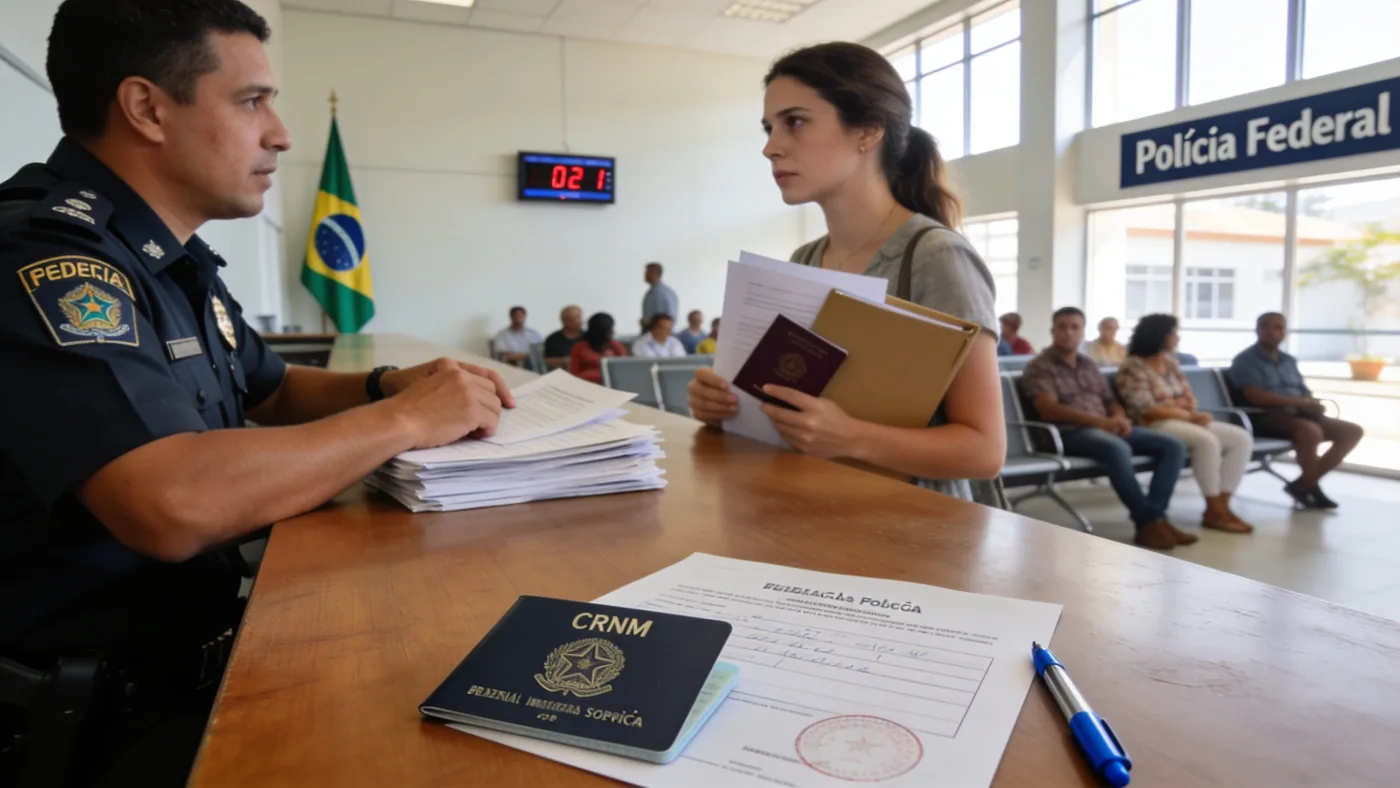
What this means in practice: you will not be handcuffed for an expired stamp. The Federal Police (Polícia Federal) handles overstays as an administrative matter. The consequences you may actually face include:
- A fine calculated at R$ 100 per day, capped at R$ 10,000 total.
- A note on your immigration record showing the overstay period.
- A formal notification to leave the country if you do not regularize (usually within 60 days, extendable), under Decreto nº 9.199/2017.
- Possible difficulty on future entries if the situation is left unresolved.
Important: Whether you overstay by 101 days or by three years, the maximum fine is the same: R$ 10,000 (roughly US$ 1,850 or €1,700 in 2026). The cap protects long-term overstayers from unlimited penalties.
There is also meaningful administrative discretion. Federal Police officers frequently reduce the fine toward the minimum for first-time, good-faith cases. The R$ 100 daily figure is a ceiling per day, not an automatic charge in every situation.
Warning: Do not simply ignore an expired stamp and hope no one notices. The overstay does not disappear on its own, and leaving the country without addressing it means the fine and the record follow you. Regularizing early is almost always cheaper and simpler.
How Much Does It Cost to Overstay and Regularize?
The core overstay fine is R$ 100 per day of irregular stay, capped at R$ 10,000 total, under Article 109 of the Migration Law. On top of that, expect the CRNM registration fee of R$ 204.77 in 2026, plus smaller costs for a CPF, sworn translations and possible apostilles.
Let us break down the real numbers so you can budget honestly. The fine itself is the biggest variable, but it is capped, which is good news for anyone who overstayed for a long time.
Example: If you overstayed by 45 days, your maximum fine is 45 × R$ 100 = R$ 4,500 (about US$ 830). If you overstayed by 300 days, the fine does not become R$ 30,000: it stops at the R$ 10,000 cap (about US$ 1,850).
Beyond the fine, here are the other typical costs you will encounter when regularizing. The CRNM (Carteira de Registro Nacional Migratório, the National Migration Registration Card) fee is set by the Federal Police.
| Item | Fee (2026) | Approx. USD |
|---|---|---|
| Overstay fine | R$ 100/day (max R$ 10,000) | up to ~US$ 1,850 |
| CRNM first registration | R$ 204.77 | ~US$ 40 |
| CRNM renewal | R$ 204.77 | ~US$ 40 |
| CPF at Receita Federal | Free | Free |
| CPF at Correios/consulate | R$ 7.00 | ~US$ 1.30 |
| Sworn translation (per page) | R$ 60-150+ | varies |
| Apostille (done abroad) | varies by country | varies |
The fine is paid through a guia de recolhimento (a government payment slip generated on the Federal Police portal). According to the Federal Police, fees are set in electronic collection guides (GRU) and paid at authorized banks or online.
Tip: Keep every receipt, protocol number and payment slip for at least 5 years. If a future entry or renewal is questioned, proof that you regularized and paid the fine is your strongest defense.
Overstay visa brazil: What Traps People When Trying to Regularize?
The most common problem is not the fine itself but assuming that paying it fixes everything. Regularization is not amnesty: paying the overstay fine settles the penalty, but you still need a legal basis (residence permit, work visa, family ties) to remain in Brazil. Without that basis, you may still be asked to leave.
Many foreigners lose time and money because of avoidable mistakes. Here are the pitfalls that most often derail a regularization process, based on what actually happens at Federal Police units.
- No legal basis to stay. Paying the fine does not grant residency. You need a qualifying pathway: work, family reunion, investment, study or another category under Article 30 of the Migration Law.
- Missing sworn translations. Foreign documents (birth certificates, marriage certificates, diplomas) must be translated by a tradutor juramentado (sworn translator) and, in most cases, apostilled abroad first.
- Expired documents from home. A police clearance certificate or civil document that is too old may be rejected. Check validity windows before you submit.
- Wrong assumption about deadlines. Some overstayers believe they must leave immediately. In reality, if you qualify to apply in-country, you can start the process without exiting.
- Ignoring the notification. If the Federal Police issues a formal notice to leave (notificação para retirada), ignoring it can escalate toward deportation proceedings under Decreto nº 9.199/2017.
Important: A quote widely repeated by immigration practitioners sums it up: “Regularization is not amnesty. You do not escape the fine, and the overstay remains on your record.” Only a formal amnesty program can waive the penalty entirely.
Because Brazil uses a Civil Law system (not Common Law), the exact wording of decrees and normative resolutions matters. Small documentary details can hold up an otherwise valid application, which is why many foreigners hire a lawyer registered with the OAB (Brazilian Bar Association) to review the file before submission.
How Do Brazilian Amnesty Programs Work?
Amnesty programs are special windows announced by the Ministry of Justice (Ministério da Justiça) that allow foreigners in irregular status to regularize without paying the overstay fine. When active, they offer a grace period to apply for residency directly, waiving penalties for those who qualify.
Brazil has historically run amnesty (anistia migratória) programs several times, most notably broad amnesties that regularized hundreds of thousands of undocumented migrants. These are not permanent: they open for a defined period, then close.
Key features of a typical amnesty program:
- A fixed application window (often a few months).
- Waiver of the overstay fine for eligible applicants.
- A simplified path to a residence permit and CRNM.
- Eligibility usually tied to having entered before a cutoff date.
In 2026, the Ministry of Justice signaled new amnesty measures aimed at giving foreigners a chance to regularize without financial penalties. Because these windows are time-limited, the practical advice is simple: monitor official announcements and act fast when one opens.
Tip: Do not wait indefinitely for an amnesty if you already qualify for a residence pathway. Amnesties are unpredictable. If you have a job offer, a Brazilian spouse or an investment, regularizing now (even with the fine) may be faster and more secure than betting on a future program.
For the full picture of visas and residency categories that can serve as your legal basis, see our pillar guide on Brazil Immigration Law 2026: Visas, Residency & CRNM.
What Are Your Options to Regularize After Overstaying?
You generally have three options after overstaying: apply for a new visa or residence permit from inside Brazil (paying the fine), wait for and use an amnesty program (fine waived), or leave the country voluntarily and re-enter properly later. The right choice depends on your ties to Brazil and how long you overstayed.
Option 1: In-country residence application
If you have a qualifying reason (a job offer, a Brazilian family member, an investment, marriage), you can request an autorização de residência (residence authorization) from within Brazil under Article 30 of the Migration Law. You pay the overstay fine and submit your application to the Federal Police.
Common qualifying pathways include family reunion, work authorization, and investment. If you are exploring the work route, our guide to the Brazil Work Visa (VITEM V): Requirements & Process 2026 explains the requirements in detail. Investors can review the Brazil Investor Visa requirements and costs.
Option 2: Amnesty program
When the Ministry of Justice opens an amnesty window, you apply during that period and the overstay fine is waived. This is the cheapest route, but it depends entirely on timing and eligibility.
Option 3: Voluntary departure
You can choose to leave Brazil voluntarily. Under Decreto nº 9.199/2017, voluntary departure is a favorable alternative to forced removal. You may still owe the overstay fine, but leaving on your own terms preserves a cleaner record and better future re-entry prospects than being deported.
Remember: Deportation in Brazil is not immediate. Under the Migration Law, the foreigner must first be formally notified and given a defined period (usually 60 days, extendable) to leave voluntarily or regularize. You have due process rights at every stage.
Step-by-Step Guide to Regularizing Your Visa in Brazil
To regularize after overstaying, you schedule an appointment with the Federal Police, gather your documents, generate and pay the fine slip (guia de recolhimento), submit your residence application, and register your CRNM (R$ 204.77 fee). Most in-country processes start online through the gov.br portal.
Here is the realistic sequence, with buffer time for Brazilian bureaucracy:
- Step 1: Get a CPF. The CPF (Cadastro de Pessoas Físicas, the Brazilian taxpayer ID) is required for almost everything. It is free at the Receita Federal, or R$ 7.00 at Correios or a consulate.
- Step 2: Identify your legal basis. Confirm which residence category applies to you (work, family, investment, study).
- Step 3: Prepare and translate documents. Apostille foreign documents abroad, then have them translated by a sworn translator in Brazil.
- Step 4: Schedule the Federal Police appointment. Use the Federal Police online system to book your slot for residence registration.
- Step 5: Generate and pay the fine. The GRU/guia de recolhimento is created online; pay it at an authorized bank or through internet banking.
- Step 6: Attend the appointment. Submit your application, fingerprints and documents. Keep your protocol number.
- Step 7: Register the CRNM. Once approved, pay the R$ 204.77 registration fee and collect your CRNM card.
Example: A digital nomad who overstayed a tourist stamp by 60 days and married a Brazilian would: pay a fine of up to R$ 6,000, gather the marriage certificate and CPF, apply for residence based on family reunion, then pay R$ 204.77 for the CRNM. Total official cost: roughly R$ 6,200 plus translation fees.
Timelines vary by Federal Police unit and city. Getting an appointment can take a few weeks, and the residence decision plus CRNM issuance can take several months. Plan for 3-6 months from start to card in hand, and longer in busy states like São Paulo.
What Documents Do You Need to Regularize Your Visa?
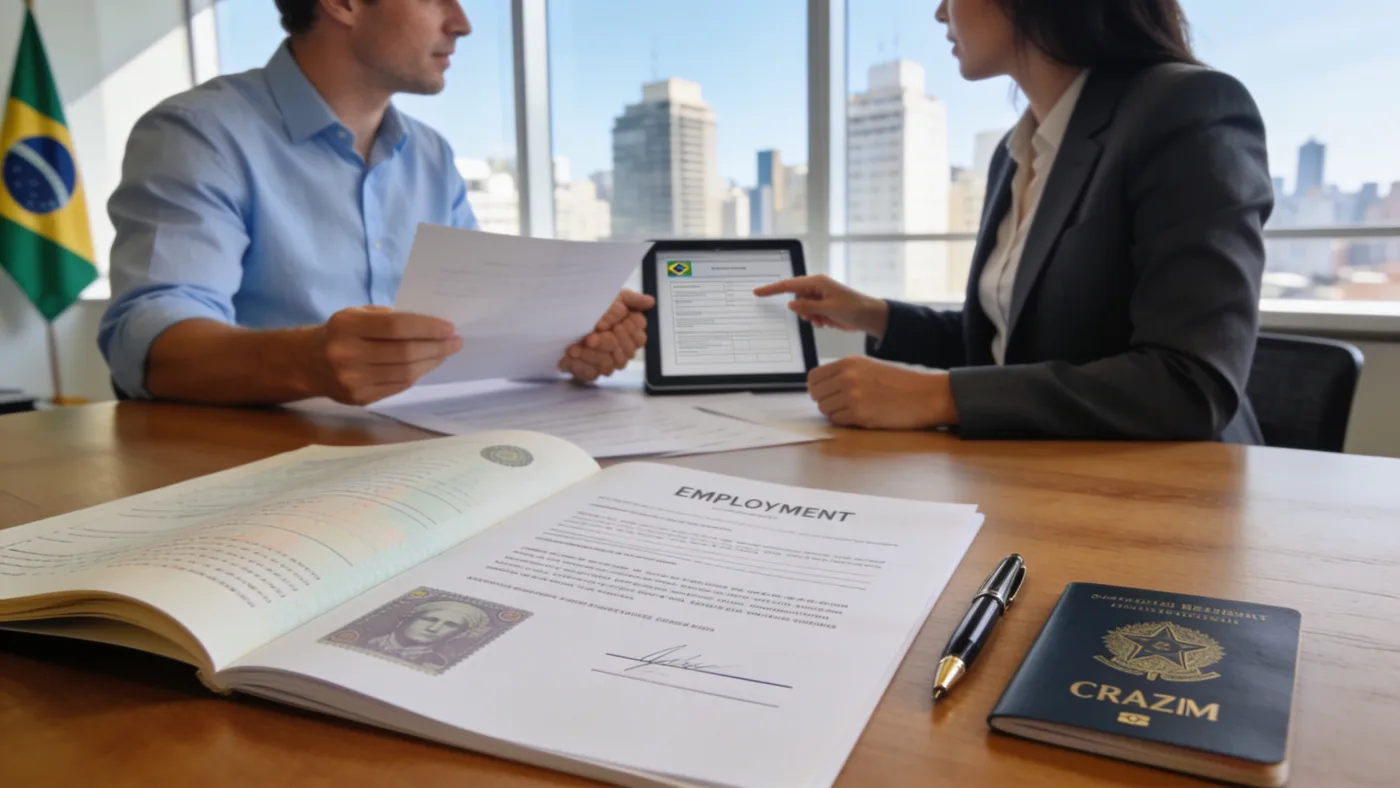
To regularize, you generally need a valid passport, a CPF, proof of your legal basis to stay (job contract, marriage certificate, investment proof), apostilled and sworn-translated foreign documents, a proof of address in Brazil, and the paid overstay fine slip. The exact list depends on your residence category.
The standard document set includes:
- Valid passport (plus copies of all used pages).
- CPF (Brazilian taxpayer number).
- Birth certificate, apostilled abroad and sworn-translated in Brazil.
- Marriage certificate (for family-based applications), apostilled and translated.
- Criminal background/police clearance certificate from your home country, apostilled and translated.
- Proof of Brazilian address (a recent utility bill or lease).
- Proof of your legal basis (work contract, investment documents, proof of relationship).
- Paid overstay fine slip (guia de recolhimento).
- Recent passport-style photo, where required.
If your regularization involves opening a business or registering as an entrepreneur, note that a valid registered address is required to open a CNPJ (the Brazilian company tax ID). Ribeiro Cavalcante can provide a fiscal address in Brazil for that purpose.
Caution: Documents apostilled or issued too far in the past may be rejected. Police clearance certificates in particular often have a short validity window. Confirm current requirements before booking your appointment, because a single outdated document can force you to reschedule.
What Changed in Brazilian Immigration Law in 2026?
In 2026, Brazil updated several overstay and regularization rules. The Federal Police launched improved online portals and apps to speed up regularization, the Ministry of Justice announced new amnesty measures, and fee figures were adjusted. The core R$ 100/day fine and R$ 10,000 cap under the Migration Law remain the reference framework.
The main developments foreigners should know about:
- Streamlined online processes. The Federal Police expanded digital appointment scheduling and application submission, reducing in-person steps (though biometrics still require attendance).
- New amnesty measures. The Ministry of Justice signaled amnesty windows offering a grace period to regularize without paying penalties.
- Updated fee figures. The CRNM registration fee stands at R$ 204.77 in 2026, per Federal Police schedules.
Different sources circulate slightly different fine figures (some cite escalating daily amounts for longer overstays). The safest reference remains the statutory framework in the Migration Law: R$ 100 per day, capped at R$ 10,000, with administrative discretion applied case by case. Always confirm the exact amount on your official payment slip.
Note: Brazilian courts, including the Superior Court of Justice (STJ), have consistently upheld the humane, due-process approach of the Migration Law, reinforcing that irregular migrants retain fundamental rights and cannot be summarily expelled.
Overstay Scenarios Compared: Overstay visa brazil
This table compares typical overstay situations so you can quickly see the likely fine and best path. Remember that the fine is capped at R$ 10,000 and that Federal Police discretion often reduces first-time penalties.
| Scenario | Overstay length | Max fine | Best path |
|---|---|---|---|
| Tourist lost track of dates | 20 days | ~R$ 2,000 | Pay fine, exit or apply if eligible |
| Digital nomad, job offer | 60 days | ~R$ 6,000 | In-country residence application |
| Married to Brazilian | 150 days | R$ 10,000 (capped) | Family reunion residence |
| Long-term undocumented | 2+ years | R$ 10,000 (capped) | Amnesty program if open, else residence |
Frequently Asked Questions About Overstaying in Brazil
Will I be banned from Brazil if I overstayed my visa?
Overstaying alone does not trigger an automatic entry ban. Under the Migration Law, it is an administrative infraction handled through a fine (R$ 100/day, capped at R$ 10,000), not a criminal offense. Bans are reserved for serious cases, such as ignoring formal deportation orders or committing crimes. If you pay the fine and either regularize or leave voluntarily, you generally preserve your ability to return. The key is not ignoring an official notification to leave. Voluntary departure keeps a much cleaner record than being formally deported after refusing to comply.
Can I pay the overstay fine at the airport when I leave?
Yes, in many cases the overstay fine is assessed by the Federal Police when you exit at the airport. They calculate the days and issue a payment slip. However, paying it at departure does not resolve any need for future regularization, and it does not grant residency. If your goal is to stay in Brazil legally, handle the fine as part of an in-country residence application rather than waiting for the airport. Keep all receipts, because proof of payment matters if your immigration status is ever reviewed on a later entry.
Does paying the fine mean I am now legal in Brazil?
No. Paying the overstay fine settles the penalty for the days you exceeded, but it does not by itself grant you the right to remain. To become legal, you need a valid legal basis: a residence permit under Article 30 of the Migration Law, based on work, family, investment or another qualifying category. Think of the fine and the residence application as two separate steps. Many foreigners assume paying clears everything, then discover they still lack authorization to stay. Always secure your legal basis alongside settling the fine.
How long does it take to regularize my status?
Realistically, plan for 3-6 months from starting the process to receiving your CRNM card, though it can be faster or slower depending on the Federal Police unit and your city. Getting an appointment can take a few weeks. Document preparation (apostilles abroad, sworn translations in Brazil) is often the slowest part and worth starting early. Busy states like São Paulo and Rio de Janeiro tend to have longer queues. If an amnesty program is open, timelines can be more predictable within the announced window. Build a buffer into any travel or work plans.
Do I need a lawyer to regularize an overstay?
Legally you can handle a straightforward regularization yourself, but a lawyer registered with the OAB (Brazilian Bar Association) is highly recommended for anything complex: long overstays, denied entries, family cases with foreign documents, or business-related residency. Because Brazil uses a Civil Law system, exact documentary and procedural requirements matter, and a single missing translation or expired certificate can force a restart. A bilingual lawyer confirms your legal basis, prepares the file correctly, and can represent you before the Federal Police, saving months of trial and error.
Fix Your Brazilian Visa Overstay With Confidence
Discovering you have overstayed your Brazilian visa is stressful, but it is rarely the disaster people fear. Brazil treats overstays as an administrative matter with capped fines and clear paths back to legal status. With the right documents, the correct legal basis and a well-prepared application, most foreigners regularize successfully and keep building their life here.
Our bilingual legal team at Ribeiro Cavalcante Advocacia helps expats, digital nomads, investors and international families navigate overstay fines, amnesty windows and residence applications from start to finish. We handle the bureaucracy so you can focus on your future in Brazil.
Reach out today for a clear, honest assessment of your situation and the fastest route to regularize.
Talk to a specialist lawyer now
Talk to a Lawyer on WhatsApp