You have built a life in Brazil. Maybe you married a Brazilian, had children here, or simply fell in love with the country and never left. Now you want more than a residency card. You want a Brazilian passport, the right to vote, and the security of knowing you can never be deported. That is what naturalization gives you.
The good news: you may qualify sooner than you think. Under the Brazilian Migration Law (Lei 13.445/2017), most foreigners can apply for ordinary naturalization after just 4 years of residency. That period drops to 1 year if you have a Brazilian spouse or child. And if you have lived here for 15 years or more, the extraordinary route is remarkably simple and does not even require a formal Portuguese exam.
The catch is the bureaucracy. The process runs through the Ministry of Justice and the Federal Police, involves specific documents, and can take many months. This guide walks you through every pathway, the real costs in reais, the documents you need, and how to apply online, in clear English.
On this page
What Is Ordinary Naturalization in Brazil After 4 Years?
Ordinary naturalization (naturalização ordinária) is the standard path to Brazilian citizenship. Under Article 65 of the Migration Law (Lei 13.445/2017), a foreigner who has held legal residency for at least 4 years, has civil capacity, can communicate in Portuguese, and has no unresolved criminal conviction may request Brazilian nationality.
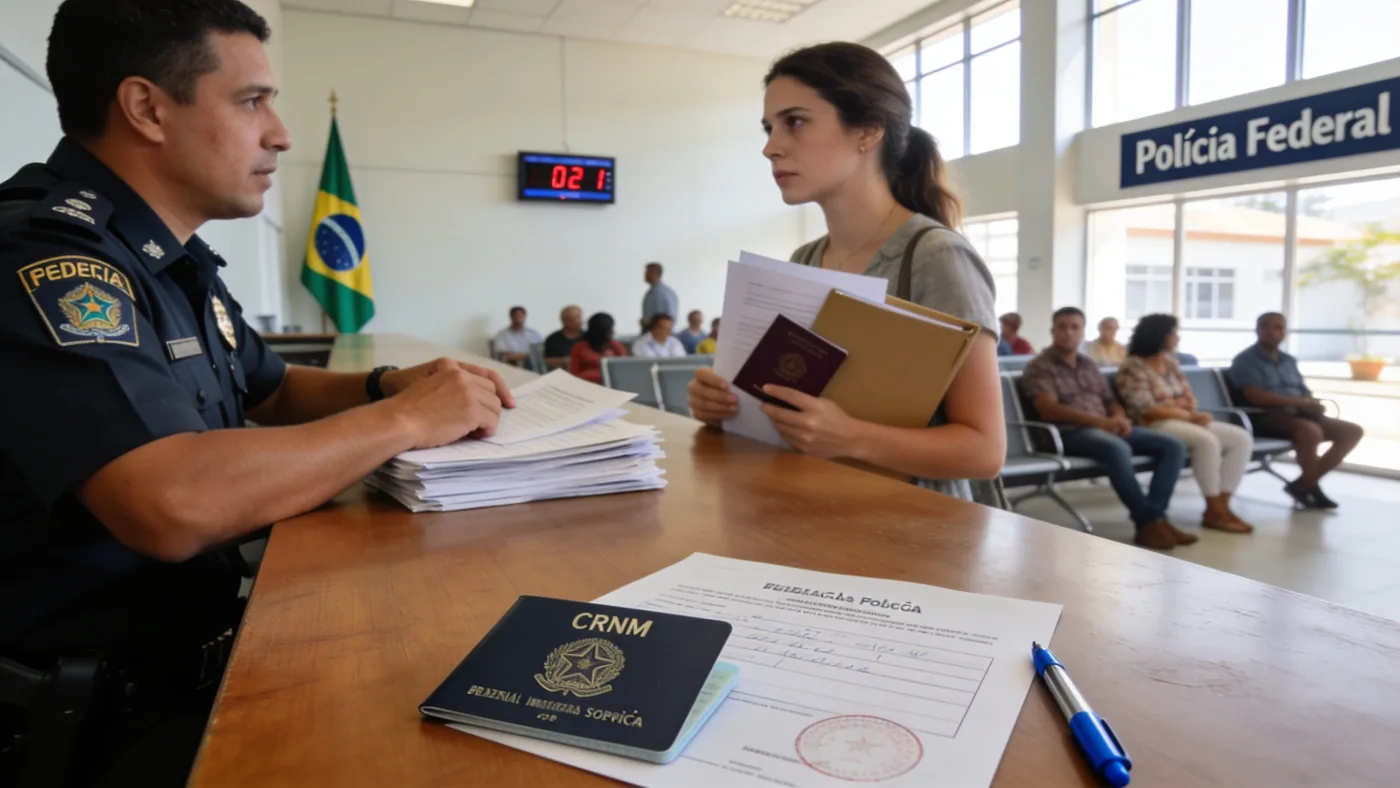
This is the route most expats will use. It applies to people who came to Brazil on a work visa, a family reunion visa, an investor visa, or any other long-term authorization that granted them a CRNM (National Migration Registration Card).
The 4 years counts from the date your residency was granted, not from your first entry as a tourist. Time spent in Brazil as a tourist or on a short-stay visa does not count toward the residency requirement.
The requirements under Article 65 are:
- Civil capacity under Brazilian law (generally 18 years or older).
- Residency in Brazil for at least 4 uninterrupted years.
- Ability to communicate in Portuguese (proven by document or interview).
- Absence of a criminal conviction, or full rehabilitation if you were convicted.
You can read the full text of the Migration Law on the official government site: Lei 13.445/2017 on planalto.gov.br. Articles 64 to 73 deal specifically with naturalization.
Important: Naturalization is different from permanent residency. A naturalized citizen holds a Brazilian passport, can vote, and, under the Constitution, cannot be extradited or deported for future acts. A permanent resident does not have those rights.
Who Exactly Qualifies for the 4-Year Ordinary Naturalization Path?
Any foreigner aged 18 or over who has held legal residency (with a valid CRNM) in Brazil for 4 continuous years, speaks Portuguese, and has a clean criminal record qualifies for ordinary naturalization under Article 65 of the Migration Law. Brief trips abroad do not automatically break the residency count.
In practice, this covers a wide range of people. Digital nomads who converted to permanent residency, professionals who arrived on a Brazil Work Visa (VITEM V), retirees, and investors all use this route once they hit the residency threshold.
On the “uninterrupted” residency point, the law is reasonable. Occasional travel for vacation, business, or family visits does not reset your count. Problems arise only if you effectively abandon your Brazilian residency for extended periods, which can lead the authorities to consider it interrupted.
The Portuguese requirement is not a formal, standardized state exam like some countries impose. Proficiency can be demonstrated through a diploma from a Brazilian institution, a Celpe-Bras certificate, or simply during your Federal Police interview, where the officer confirms you can communicate.
Tip: Start collecting proof of your continuous residency early. Utility bills, rental contracts, tax returns, and CRNM records all help demonstrate that your 4 years were genuinely uninterrupted.
One critical point confirmed by the courts: meeting the requirements does not create an automatic right to citizenship. In a 2023 decision, the Third Panel of the Federal Regional Court of the 3rd Region (TRF3) held that naturalization is a politically discretionary act of the State and cannot be granted by a judge in place of the government. You must satisfy the requirements, but the final grant is a sovereign act.
Are There Scenarios That Reduce the 4-Year Residency Requirement?
Yes. Under Article 66 of the Migration Law, the 4-year residency requirement drops to just 1 year in several situations, most notably if you have a Brazilian child or a Brazilian spouse or partner. This makes ordinary naturalization far faster for foreigners with Brazilian family ties.
The residency period is reduced to 1 year if you fall into any of these categories under Article 66:
- You have a Brazilian child.
- You have a Brazilian spouse or partner, and the marriage or stable union is not legally dissolved.
- You have provided or can provide relevant service to Brazil.
- You are recommended for your professional, scientific, or artistic ability.
Scenario A: Naturalization After 1 Year With a Brazilian Spouse or Child
This is the most common reduced-period case. If you married a Brazilian citizen and have lived legally in Brazil for at least 1 year, you can apply. The same applies if you have a Brazilian child, regardless of your marital status. You will need to prove the family relationship with a marriage certificate (certidão de casamento) or birth certificate.
Example: A Canadian who arrived in São Paulo, married a Brazilian in 2025, and obtained a family-reunion CRNM could apply for naturalization in 2026 after just 1 year of legal residency, instead of waiting the full 4 years.
Scenario B: The Portuguese-Language Countries Route
Citizens of Portuguese-speaking countries (Portugal, Angola, Mozambique, Cape Verde, and others) benefit from a special constitutional rule. Under Article 12, II of the Federal Constitution, they can naturalize with only 1 year of uninterrupted residency and good moral standing (idoneidade moral), a significantly lighter requirement.
Portuguese citizens have an additional, separate option. The Statute of Equality of Rights and Duties (Estatuto de Igualdade), established by the Treaty of Porto Seguro (Decreto 3.927/2000), grants Portuguese nationals living in Brazil almost all the rights of a Brazilian national. It can simplify your paperwork because your residency is already recognized.
Warning: The Estatuto does not give you a Brazilian passport or the right to vote. For those, you still need to formally naturalize. Also, Portuguese citizens who overstayed a tourist visa cannot apply for naturalization until they regularize their status first.
What Is Extraordinary Naturalization After 15 Years?
Extraordinary naturalization (naturalização extraordinária) is for foreigners who have lived in Brazil for 15 or more uninterrupted years. Under Article 12, II, “b” of the Federal Constitution, they can request citizenship with no criminal conviction, and, crucially, no formal Portuguese exam requirement is imposed. A simple request suffices.
This is the route for people who built their entire lives in Brazil but never got around to naturalizing. If you have been here legally for over 15 years, this is often the cleanest path, because it removes the language-proof hurdle and only asks that you have not been convicted of a crime (or that you have been rehabilitated).
The courts have reinforced that the government must actually process these requests. In a 2022 decision, the Sixth Panel of the TRF3 ordered the Federal Government to continue the naturalization process of a foreigner who had proven more than seven years of residency and the other legal requirements, recognizing the administration’s duty to move the request forward properly.
You can read that decision summary on the official court site: TRF3 on the duty to process naturalization.
How Much Does Naturalization Cost in Brazil in 2026?
The core government fee for the naturalization request is modest. The federal processing fee is paid through a guia de recolhimento (payment slip) and typically runs around R$ 204.77 (roughly USD 40), according to Ministry of Justice fee schedules. The larger costs are usually document translation, apostilles, and legal assistance.
Here is a realistic breakdown of what applicants tend to spend in 2026:
- Federal naturalization fee: approximately R$ 204.77.
- Sworn translation of foreign documents: roughly R$ 80 to R$ 300 per document.
- Certified copies and cartório (notary office) authentications: variable, often R$ 5 to R$ 50 per act.
- Criminal record certificates from your home country and Brazil: usually free to low cost, plus apostille fees abroad.
- Legal fees for a specialized immigration lawyer: varies by complexity.
Note: Unlike an investor visa, which may require investments of R$ 500,000 or more, naturalization itself has no minimum-investment requirement. It is about time, ties, and documents, not capital.
Comparison of the Main Naturalization Pathways
Each route has different residency requirements, language rules, and target profiles. The table below compares the four most relevant pathways for foreigners so you can quickly identify which one fits your situation before starting the process.
| Pathway | Residency Required | Portuguese Exam | Best For |
|---|---|---|---|
| Ordinary (standard) | 4 years | Yes (communication) | Most expats and residents |
| Ordinary (reduced) | 1 year | Yes (communication) | Brazilian spouse or child |
| Portuguese-speaking countries | 1 year | Not required (native) | Portugal, Angola, others |
| Extraordinary | 15 years | No formal exam | Long-term residents |
Because Brazil follows a Civil Law system (not Common Law), these categories are defined strictly by statute and the Constitution. There is little room for creative interpretation, so choosing the correct pathway from the start saves months of delay.
What Documents Do You Need to Apply for Naturalization?
The core documents include your CRNM, a valid identity document, your CPF (taxpayer number), proof of residency time, criminal record certificates from Brazil and your home country, and the paid guia de recolhimento (fee slip). Family-based applications also require a marriage or birth certificate.
A typical document checklist for ordinary naturalization includes:
- Valid CRNM (National Migration Registration Card).
- RG (identity card) if you have one, and CPF (individual taxpayer registry).
- Proof of the required residency period (CRNM issue date, tax records, contracts).
- Brazilian criminal background certificate (from Federal and State Police).
- Criminal background certificate from your country of origin, apostilled and translated.
- Marriage certificate (certidão de casamento) or child’s birth certificate, for reduced-period cases.
- Proof of Portuguese proficiency, where applicable.
- The paid federal fee slip (guia de recolhimento).
Tip: Foreign documents generally need an apostille (under the Hague Apostille Convention, which Brazil applies) and a sworn translation (tradução juramentada) by a translator registered in Brazil. Budget time for this, as it is often the slowest part.
What Is the Step-by-Step Process for Naturalization?
The process runs online through the Ministry of Justice system and typically takes several months. Official estimates point to around 6 months for analysis once the file is complete, though real-world timelines are often longer. The four core stages are eligibility, online submission, fee payment, and government analysis with a Federal Police check.
Step 1: Verify Eligibility and Gather Documents
Confirm which pathway you qualify for and assemble every document from the checklist above. This is the foundation. A single missing or wrongly translated document can send your application back and add months to the process. Order your criminal certificates and apostilles first, because they take the longest.
Step 2: Submit the Online Application
Naturalization requests are filed digitally through the Ministry of Justice platform, accessible via the federal gov.br portal. You create an account, complete the electronic form, and upload scanned copies of your documents. Everything is submitted electronically, so scan clearly and legibly.
Step 3: Pay the Fee and Await Your Protocol Number
Generate and pay the guia de recolhimento (around R$ 204.77). After payment, the system issues a protocol number confirming your request is officially registered. Keep this number safe, you will use it to track the status of your application throughout the process.
Important: Save your protocol number and every receipt. If your case stalls, the protocol number is what your lawyer uses to file an administrative follow-up or, if necessary, a judicial action to compel the government to move forward, exactly the kind of remedy the TRF3 granted in 2022.
Step 4: Ministry of Justice Analysis and Federal Police Interview
The Ministry of Justice reviews your file, and the Federal Police may summon you for an interview to confirm your identity, residency, and Portuguese communication. If everything is in order, the naturalization is published in the Diário Oficial (Official Gazette), and you can then request your Brazilian ID and passport.
For a broader view of how residency, the CRNM, and visas connect to citizenship, see our complete guide to Brazil Immigration Law 2026: Visas, Residency and CRNM.
What Changed for Naturalization in 2026?
No radical legislative changes to naturalization occurred in 2026. The Migration Law (Lei 13.445/2017) and its regulating Decreto 9.199/2017 remain the governing framework. The main developments are procedural: the process is now almost fully digital, filed online through the Ministry of Justice, reducing in-person steps.
One legal principle worth knowing remains firmly in place. The Federal Supreme Court (STF), in RMS 27840 (decided in 2013), established that a naturalization can only be annulled by a judicial decision, not by a simple administrative act of the Executive branch. In other words, once you are naturalized, the government cannot strip your citizenship by mere decree, it must go to court.
This offers real security. Combined with the constitutional protection against extradition and deportation, naturalization gives you a stable, hard-to-reverse legal status in Brazil.
Frequently Asked Questions About Brazilian Naturalization
Can I keep my original citizenship after naturalizing in Brazil?
Yes, in most cases. Brazil generally allows dual nationality, so becoming a naturalized Brazilian usually does not require you to renounce your original citizenship. However, whether you can keep both depends on the laws of your home country. Some nations automatically revoke citizenship when you acquire another. Before applying, check the rules of your country of origin. Many expats successfully hold both a Brazilian passport and their original one, enjoying the benefits of dual nationality, including visa-free travel options that neither passport offers alone.
How long does Brazilian naturalization actually take?
Official estimates suggest around 6 months for analysis once your complete file is submitted through the Ministry of Justice. In practice, timelines are often longer, sometimes 12 months or more, due to document verification, the Federal Police interview scheduling, and administrative backlogs. The single biggest cause of delay is incomplete or improperly translated documentation. If your case stalls unreasonably, a lawyer can file an administrative demand or a judicial action to compel the government to continue processing, a remedy Brazilian courts have granted.
Do I need to pass a formal Portuguese exam?
For ordinary naturalization, you must demonstrate the ability to communicate in Portuguese, but this is not always a standardized state test. Proficiency can be shown through a Brazilian diploma, a Celpe-Bras certificate, or during your Federal Police interview. For extraordinary naturalization (15+ years of residency), no formal Portuguese exam requirement is imposed as a condition. Citizens of Portuguese-speaking countries are naturally exempt, since Portuguese is already their language. When in doubt, prepare to demonstrate conversational Portuguese at your interview.
Can the government take away my citizenship after naturalization?
Not easily. The Federal Supreme Court (STF), in RMS 27840, confirmed that a naturalization can only be annulled by a judicial decision, never by a simple administrative act of the Executive. This means once you are naturalized, the government cannot revoke your citizenship by decree. It would have to prove fraud or a serious legal defect before a court. This judicial-only protection, combined with the constitutional ban on deporting or extraditing nationals for future acts, makes naturalized citizenship a very stable status.
Does time as a tourist count toward the residency requirement?
No. Only time spent as a legal resident holding a CRNM counts toward the 4-year (or reduced) residency requirement. Days you spent in Brazil on a tourist visa or short-stay entry are not included. The clock starts on the date your residency authorization was granted. This is why converting from a tourist or temporary situation into proper residency as early as possible matters: every year of recognized residency brings you closer to eligibility for naturalization.
Do I really need a lawyer to naturalize?
It is not legally mandatory, but it is highly advisable. Naturalization is a politically discretionary act, and Brazilian courts have confirmed there is no automatic right to it, so presenting a flawless application matters. A lawyer registered with the OAB (Brazilian Bar Association) ensures your documents, translations, and apostilles meet requirements, tracks your protocol, and can act if the process stalls. For reduced-period or complex cases, professional guidance often saves months and prevents rejections that would force you to start over.
Ready to Become a Brazilian Citizen? Get Expert Legal Help
Pursuing Brazilian naturalization can feel overwhelming, especially when you are dealing with apostilles, sworn translations, discretionary decisions, and long government timelines in a language and legal system that are not your own. You do not have to navigate it alone. Our bilingual legal team at Ribeiro Cavalcante Advocacia guides foreigners through every step, from confirming the right pathway to filing your application and following up until your citizenship is granted.
Whether you qualify through the 4-year ordinary route, the 1-year family path, the Portuguese-speaking countries rule, or the 15-year extraordinary route, we can help you build a clean, complete file and avoid the delays that trap so many applicants. Reach out today and take the next step toward your Brazilian passport with confidence.
Talk to a specialist lawyer now
Talk to a Lawyer on WhatsApp