You are in Brazil, or about to arrive, and you cannot safely go home. Maybe you fled war, political persecution, religious violence, threats because of who you are, or a country where the state has collapsed. Now you are staring at a Brazilian government website in Portuguese, and nobody has explained what “refúgio”, “asilo” and “acolhida humanitária” actually mean, or which one applies to you.
Here is the direct answer. What English speakers call “asylum” is, in Brazil, almost always refúgio (refugee status), regulated by Law 9.474/1997, the Brazilian Refugee Statute. You apply through the Federal Police (Polícia Federal) using the Sisconare online system, and the decision is made by CONARE, the National Committee for Refugees. The application is free. You do not need a visa. You do not need to have entered Brazil legally. And from the moment you file, you have the legal right to stay in Brazil, to work with a formal contract, to get a CPF (taxpayer number), to use the public health system (SUS) and to enroll your children in school.
The honest part: CONARE decisions can take years, not months. But that waiting period is not legal limbo. Your asylum-seeker document (Documento Provisório de Registro Nacional Migratório, or DPRNM) is a valid Brazilian ID that lets you build a life while you wait. This guide explains exactly how to file, what documents you need, what CONARE looks for, and when a different route (humanitarian residence or a work visa) is actually the smarter choice.
On this page
What Is the Difference Between Refugee Status, Political Asylum and Humanitarian Visa in Brazil?
Brazil has three separate legal instruments that English speakers all call “asylum”. Refugee status (refúgio) is governed by Law 9.474/1997 and decided by CONARE, and covers over 99% of cases. Political asylum (asilo político) is a discretionary act of the President under the Brazilian Migration Law (Law 13.445/2017) and is extremely rare. Humanitarian residence (acolhida humanitária) is granted by nationality group through interministerial ordinances.
Choosing the wrong instrument can cost you years. People arrive convinced they must “apply for political asylum”, spend months chasing the Ministry of Foreign Affairs (Itamaraty), and discover that political asylum is a state-to-state political gesture, usually reserved for high-profile individuals, and there is no form to fill in.
| Route | Legal basis | Who decides | Best for |
|---|---|---|---|
| Refúgio (refugee status) | Law 9.474/1997 | CONARE (Ministry of Justice) | Anyone with a fear of persecution or fleeing generalized human rights violations |
| Asilo político (political asylum) | Law 13.445/2017 | President / Itamaraty, discretionary | Individual, high-profile political figures. Not an application process |
| Acolhida humanitária (humanitarian residence) | Law 13.445/2017 + interministerial ordinances | Consulates abroad + Federal Police in Brazil | Nationals of countries covered by a current ordinance (historically Haiti, Syria, Afghanistan, Ukraine, Venezuela) |
| Apatridia (statelessness) | Law 13.445/2017 | Ministry of Justice | People no country recognizes as a national |
The Brazilian Refugee Statute is unusually generous compared to United States or European law. Under Article 1, item III, you qualify as a refugee not only if you personally fear persecution, but also if you fled a “grave and generalized violation of human rights” in your country. This is the so-called Cartagena clause, and it is the legal basis on which Brazil has recognized tens of thousands of Venezuelans and Syrians without requiring each person to prove individual persecution. You can read the full text of Law 9.474/1997 on the Planalto government portal (Portuguese only).
Important: Under Article 8 of the Refugee Statute, irregular entry does not disqualify you. Crossing the border without a visa, overstaying a tourist stamp or arriving with defective documents cannot, by itself, be used to reject your refugee claim.
Who Qualifies for Refugee Status Under Brazilian Law?
Under Article 1 of Law 9.474/1997, you qualify if you are outside your country of nationality because of a well-founded fear of persecution based on race, religion, nationality, political opinion or membership of a particular social group, or because your country is experiencing a grave and generalized violation of human rights. Brazilian practice also recognizes gender-based and sexual-orientation-based claims.
In practical terms, CONARE has recognized claims based on:
- Political opposition activity, journalism or human rights work that drew state retaliation
- Religious conversion or minority religious practice punished in the country of origin
- Ethnic or tribal persecution, including forced conscription and militia targeting
- Persecution for being LGBTQIA+, where the state criminalizes or fails to protect
- Gender-based violence, forced marriage and female genital mutilation
- Collapse of the state and generalized violence (the Cartagena clause), applied to entire nationalities
What does not qualify, on its own, is economic hardship. Wanting a better salary, escaping unemployment or fleeing a general crime wave that affects everyone equally is normally analysed as a migration case, not a refugee case. This is the single most common reason CONARE rejects applications. If your real situation is economic, filing a refugee claim can waste three years and end in a denial. A work-based route, such as the Brazil Work Visa (VITEM V) with its requirements and process for 2026, or an investment-based residence, may serve you far better.
Article 2 of the Refugee Statute provides for family extension (extensão dos efeitos da condição de refugiado). If you are recognized, your spouse, children, parents and economically dependent relatives who are in Brazil receive the same status, without having to prove their own persecution. This applies to your legal partner in a stable union (união estável), not only to formal marriage.
There are exclusion clauses. Refugee status is denied to people who have committed crimes against peace, war crimes, crimes against humanity, serious non-political crimes, or acts contrary to the purposes of the United Nations. A minor immigration violation is not in this category.
Warning: Never buy a “guaranteed refugee status” service. Only CONARE can grant refugee status, no lawyer, consultant or agency can promise a result, and paying for a fabricated persecution story is a criminal offence that will destroy any genuine claim you might have.
How Do You Actually File an Asylum Application in Brazil?
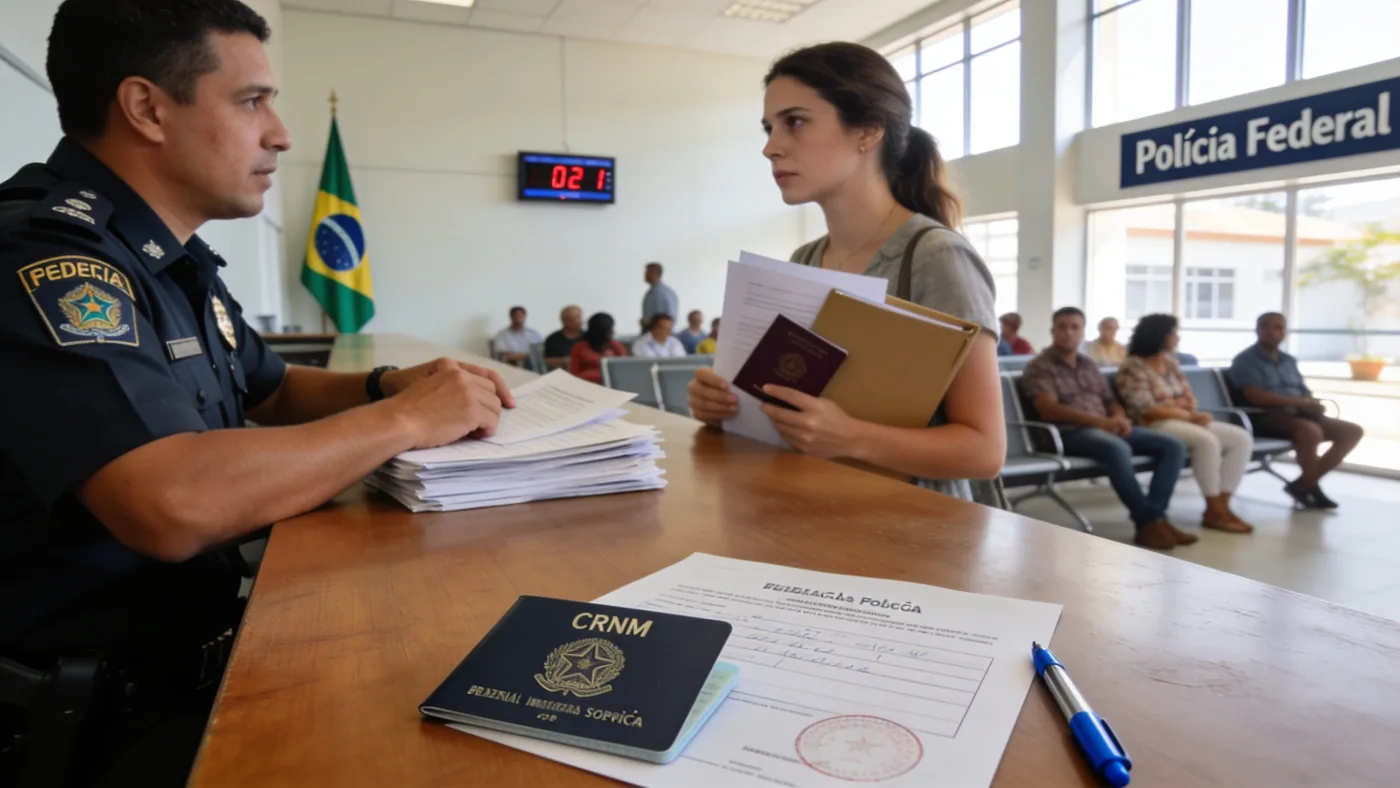
You file the refugee application (solicitação de reconhecimento da condição de refugiado) with the Federal Police, either at a border post, at an airport or at any Federal Police immigration unit inside Brazil, and then complete the questionnaire in Sisconare, CONARE’s online system. There is no government fee: the application is free under Law 9.474/1997.
The process runs in two connected stages.
Stage 1: Declaring your intention to seek refuge
You present yourself to the Federal Police and state that you wish to request refuge. This can be done in any language, with an interpreter if needed. The officer registers your declaration and you receive a protocol. Under Article 7, paragraph 1 of the Refugee Statute, the principle of non-refoulement (não devolução) means you cannot be returned to a territory where your life or liberty would be at risk. In practice, an officer at the airport cannot legally deport you once you have asked for refuge.
Stage 2: The Sisconare questionnaire and your document
You then create an account on the Ministry of Justice’s CONARE refugee page on gov.br and complete the Sisconare form. This is where you tell your story: dates, places, who threatened you, what happened, why you cannot return. Once the questionnaire is submitted and your biometrics are collected, the Federal Police issues your DPRNM (Documento Provisório de Registro Nacional Migratório), the provisional national migration registration document. This is your Brazilian ID as an asylum seeker.
Tip: Write your persecution account before you sit down at the computer, in your own language, with a timeline of dates. Sisconare sessions can time out, and inconsistencies between your first statement and your later interview are the most common reason claims fail.
With the DPRNM you can then obtain, at no cost or at low cost:
- CPF (taxpayer number) at Receita Federal, free for asylum seekers, needed for almost everything in Brazil
- Carteira de Trabalho Digital (digital work card), giving you the right to formal employment
- SUS card for free public healthcare
- School enrollment for your children in the public network, which cannot be refused for lack of documents
- Bank account, including at Caixa Econômica Federal and Banco do Brasil, which accept the DPRNM
Your DPRNM has an expiry date, usually one year. You must renew it at the Federal Police before it expires, throughout the entire period your case is pending. Letting it lapse creates documentary irregularity that can complicate employment and bank access, even though it does not extinguish your claim.
What Documents Do You Need, and What If You Have None?
The core requirement is your identity and your story. Under Law 9.474/1997, the absence of documents cannot prevent you from filing: the Federal Police must accept your declaration even if you arrived with nothing. Where you do have documents, sworn translation by a Brazilian public translator (tradutor público juramentado) is required for official use, typically costing R$ 90 to R$ 200 per page depending on the state’s official price table.
Bring whatever you have from this list:
- Passport or any national identity document, even expired
- Birth certificate and marriage certificate (essential for family extension)
- Entry stamp, boarding pass or bus ticket showing when you entered Brazil
- Proof of address in Brazil (a utility bill, a rental contract, or a written declaration of residence signed by whoever hosts you)
- Evidence supporting your claim: police reports, threats by message or email, medical reports, news articles about your region, party membership cards, court summons
- Photographs (the Federal Police normally takes biometrics on site)
Example: A Syrian family of four arriving in São Paulo with passports, two marriage certificates and children’s birth certificates would need roughly 6-8 pages of sworn translation. At an average of R$ 90 per page, that is about R$ 540 to R$ 720 (roughly USD 100-135). The refugee application itself remains free.
Note that sworn translation prices are set by state boards of trade (Juntas Comerciais), not by translators freely, so quotes should be similar across professionals in the same state. Documents in Arabic, Farsi, Russian or Ukrainian often carry a surcharge for non-Latin scripts.
If you have literally nothing, say so clearly in Sisconare and explain why (documents confiscated, home destroyed, fled at night). CONARE analysts are trained to work with testimony, and country-of-origin information is gathered by the committee itself. Fabricating a document, by contrast, is fatal to your credibility.
How Long Does the CONARE Process Take and What Happens at the Interview?
Realistically, expect 2-5 years from filing to a first-instance CONARE decision for an individual, non-prima-facie case. Group recognitions decided by CONARE plenary (such as Venezuelan claims processed under the simplified prima facie procedure) have been resolved in a matter of months. There is no legal deadline forcing CONARE to decide, and the Ministry of Justice has publicly acknowledged a backlog of tens of thousands of pending cases.
The steps after filing are:
- Eligibility interview (entrevista de elegibilidade) with a CONARE officer, in person or by video, with an interpreter provided free of charge if you need one. This is the heart of the case.
- Technical opinion (parecer) by the analyst, weighing your credibility against country-of-origin information.
- Plenary decision by CONARE, whose members include the Ministry of Justice, Foreign Affairs, Labour, Health, Education, the Federal Police, civil society and UNHCR (with a voice, but no vote).
- Notification through Sisconare and, if granted, registration with the Federal Police and issuance of your CRNM (National Migration Registration Card) as a recognized refugee.
The interview is not a cross-examination, but it is detailed. Expect questions about dates, geography, names, the sequence of events, and why you did not simply relocate inside your own country. Contradictions matter more than gaps: an honest “I don’t remember the exact date” is far safer than a guessed date that conflicts with your written statement.
Keep in mind: Waiting is not wasted time. Time spent in Brazil as an asylum seeker counts towards residence for other purposes, and asylum seekers may, in parallel, qualify for a residence permit on other grounds (family reunion, work, Mercosur nationality), which can be a faster route to permanent status.
If CONARE denies your claim, you have 15 days from notification to appeal to the Minister of Justice, whose decision is final in the administrative sphere. After that, judicial review is possible in the Federal Courts, and the courts have in some cases annulled decisions for lack of proper reasoning or failure to hold a proper interview. Appeal deadlines are strict, and this is the stage where legal representation matters most.
Is a Humanitarian Visa or Residence Permit a Better Option Than Refuge?
Often, yes. Humanitarian residence (acolhida humanitária) under the Brazilian Migration Law, Law 13.445/2017, is granted by nationality group through interministerial ordinances and generally produces a residence permit and CRNM in months rather than years. Brazil has issued such ordinances for nationals of Haiti, Syria, Afghanistan and Ukraine, among others, in response to specific crises.
The strategic differences matter:
| Feature | Refugee status (refúgio) | Humanitarian residence |
|---|---|---|
| Typical time to final document | 2-5 years (individual cases) | Months (subject to consular queues) |
| Cost | Free application; fees only for translations | Consular visa fee abroad, plus Federal Police registration fees in Brazil |
| Requires proof of persecution | Yes, unless prima facie group recognition | No, based on nationality/crisis |
| Can you travel to your home country? | No. Returning normally means losing refugee status | Yes, travel is generally allowed |
| Path to permanent residence | Yes, after recognition and time in Brazil | Yes, typically after the initial period |
| Document while pending | DPRNM, renewable yearly | Residence permit / CRNM |
The travel point is decisive for many people. A recognized refugee who returns voluntarily to the country they fled is treated as having ceased to need protection, and status can be revoked. A humanitarian resident can visit family abroad. If your fear is real but your family situation requires travel, discuss this with a lawyer before choosing.
Ordinances change. Some are renewed, some lapse, and eligibility can hinge on where you are when you apply (at a Brazilian consulate abroad or already inside Brazil). Check current visa categories through the Ministry of Foreign Affairs (Itamaraty) and your nearest Brazilian consulate before assuming a programme is still open. For the complete map of alternatives, including work, family and investment routes, see our guide on Brazil immigration law 2026, covering visas, residency and the CRNM. Investors from crisis-affected countries sometimes qualify for a wholly different path, such as the Brazil investor visa for Iraqi citizens, with its requirements and costs.
What Changed for Asylum Seekers in Brazil in 2026?
The legal framework itself is stable: Law 9.474/1997 and Law 13.445/2017 remain in force with no structural reform. What has changed is operational. CONARE continues to expand digital processing through Sisconare, prioritising remote interviews and electronic notification, while the Federal Police has pushed DPRNM renewals and appointment scheduling almost entirely onto its online scheduling platform.
Practical developments asylum seekers should be aware of:
- Digital-first procedures. Notifications arrive through Sisconare, not by post. If you stop checking the system or lose access to the email you registered, you can miss an interview summons or the 15-day appeal window.
- Federal Police appointments online. Renewals and registrations are scheduled through the Federal Police portal, and slots in São Paulo, Rio de Janeiro and border cities can be scarce. Book weeks in advance.
- Continued group recognitions. Brazil has maintained simplified prima facie recognition for nationalities where CONARE has formally acknowledged grave and generalized human rights violations, which dramatically shortens processing for those groups.
- Judicial pressure on delays. Federal courts have increasingly accepted actions to compel decisions in cases pending for unreasonable periods, applying the constitutional principle of reasonable duration of proceedings.
Alert: Update your address and phone number in Sisconare every time you move. Missing an eligibility interview because a notification went to an old email is one of the most common, and most avoidable, ways to lose a strong case.
Step-by-Step: How to Apply for Refugee Status in Brazil
The complete sequence has six steps and costs nothing in government fees. Realistically, budget 1-3 months to get from arrival to a fully documented life in Brazil (DPRNM, CPF and work card), then 2-5 years for the CONARE decision itself, per current Ministry of Justice processing patterns.
- Step 1, declare your request. Go to any Federal Police immigration unit, border post or airport office and say you are requesting refuge (solicitação de refúgio). Ask for an interpreter if you need one. Keep the protocol number.
- Step 2, register in Sisconare. Create your account, fill in the questionnaire, and upload whatever documents you have. Save a copy of everything you submit.
- Step 3, collect your DPRNM. Attend the biometrics appointment. Your provisional document is your legal ID and proof of your right to remain.
- Step 4, activate your rights. Get your CPF at Receita Federal, activate the Carteira de Trabalho Digital, register with SUS, enroll children in school, open a bank account.
- Step 5, renew on time. Schedule the DPRNM renewal online at least 30 days before expiry, every year, until the decision arrives.
- Step 6, prepare for the interview. Rehearse your timeline, gather any new evidence, and if the decision is negative, file the appeal to the Minister of Justice within 15 days.
Brazil is a Civil Law country, not Common Law. That means the written statute and formal procedure carry enormous weight, and a claim is judged largely on the record you build. It also means procedural mistakes (a missed deadline, an unsigned form, a document without sworn translation) can sink a substantively strong case.
Free support exists. The Defensoria Pública da União (Federal Public Defender’s Office) represents asylum seekers at no cost, and UNHCR partner organizations such as Caritas provide social and legal assistance in major cities. Every private lawyer you hire must be registered with the OAB (Brazilian Bar Association), and you can verify any registration number on the OAB website.
Frequently Asked Questions About Asylum in Brazil
Below are the questions foreigners most often search before filing a refugee claim in Brazil, answered directly.
Can I work in Brazil while my asylum application is pending?
Yes. Law 9.474/1997 guarantees asylum seekers the right to work. Once you hold your DPRNM (provisional migration document) and CPF, you can activate the Carteira de Trabalho Digital and be hired under a formal CLT contract, with the same labour rights as a Brazilian worker: minimum wage, 13th salary, FGTS deposits and paid vacation. You can also register as an individual microentrepreneur (MEI) in most cases. Employers occasionally hesitate because they do not recognize the document, so it helps to bring a printed explanation of what the DPRNM is and the fact that it authorizes employment.
How much does it cost to apply for refugee status in Brazil?
The application itself is free. There is no government fee to file a refugee claim, to receive your DPRNM, or to renew it while your case is pending. Your CPF is also free. Real costs are indirect: sworn translation of foreign documents, typically R$ 90 to R$ 200 per page under state price tables, plus travel to a Federal Police unit and, later, standard Federal Police fees if you are recognized and register for your CRNM. Compare this with humanitarian or work visas, which involve consular fees and registration charges from the start.
Can I be deported while my refugee application is being analysed?
No. The principle of non-refoulement (não devolução) in Article 7 of the Refugee Statute prohibits sending you to a territory where your life or liberty is at risk, and your pending claim gives you the right to remain in Brazil until a final decision. This protection applies even if you entered irregularly, since Article 8 states that irregular entry is not a bar to the claim. The exception is narrow: exclusion clauses for war crimes, crimes against humanity and serious non-political crimes. If you are ever threatened with removal while a claim is pending, contact the Defensoria Pública da União immediately.
Does refugee status in Brazil lead to permanent residence and citizenship?
Yes. Recognized refugees receive a CRNM (National Migration Registration Card) and can later apply for permanent residence, then for naturalization under the Brazilian Migration Law. Ordinary naturalization generally requires four years of residence, sufficient Portuguese and no disqualifying criminal record, and refugees benefit from reduced requirements in certain situations. Time as an asylum seeker is not wasted, since your presence in Brazil is lawful throughout. Having Brazilian children or a Brazilian spouse can also open a separate, faster family-based route worth examining in parallel.
What happens if CONARE rejects my application?
You have 15 days from notification to appeal to the Minister of Justice, whose decision closes the administrative stage. If that fails, you may seek judicial review in the Federal Courts, which have annulled CONARE decisions for inadequate reasoning or procedural defects. Importantly, a rejection does not automatically mean deportation: CONARE routinely refers denied applicants to alternative residence permits under the Migration Law, such as family reunion, work, Mercosur residence or humanitarian grounds. This is exactly the moment to get legal advice, because the deadline is short and the alternatives are technical.
Can I include my family in my asylum application?
Yes, through family extension (extensão dos efeitos da condição de refugiado) under Article 2 of the Refugee Statute. Your spouse or stable-union partner, children, parents and economically dependent relatives who are in Brazil can receive the same status you do, without proving individual persecution. You must declare them in Sisconare and provide marriage and birth certificates, sworn-translated. Relatives still abroad are handled differently, usually through family reunion visas requested at a Brazilian consulate, which is a separate procedure with its own documentation and timeline.
Applying for Asylum in Brazil: Get Bilingual Legal Support Before You File
Filing a refugee claim in Brazil is free, and you have the legal right to do it yourself. But the decisions that shape your future are made early: whether refuge or humanitarian residence fits your situation, how you tell your story in Sisconare, whether your documents are properly translated, and whether you catch a 15-day appeal deadline hidden in a digital notification. Those choices are hard to reverse three years later.
If you are unsure which route protects you best, or your claim has already been denied and you need to act quickly, our bilingual team at Ribeiro Cavalcante Advocacia can review your case, explain your options in plain English and represent you before CONARE, the Federal Police and the Federal Courts. You do not have to navigate Brazilian bureaucracy alone, and you do not have to guess.
Talk to a specialist lawyer now
Talk to a Lawyer on WhatsApp