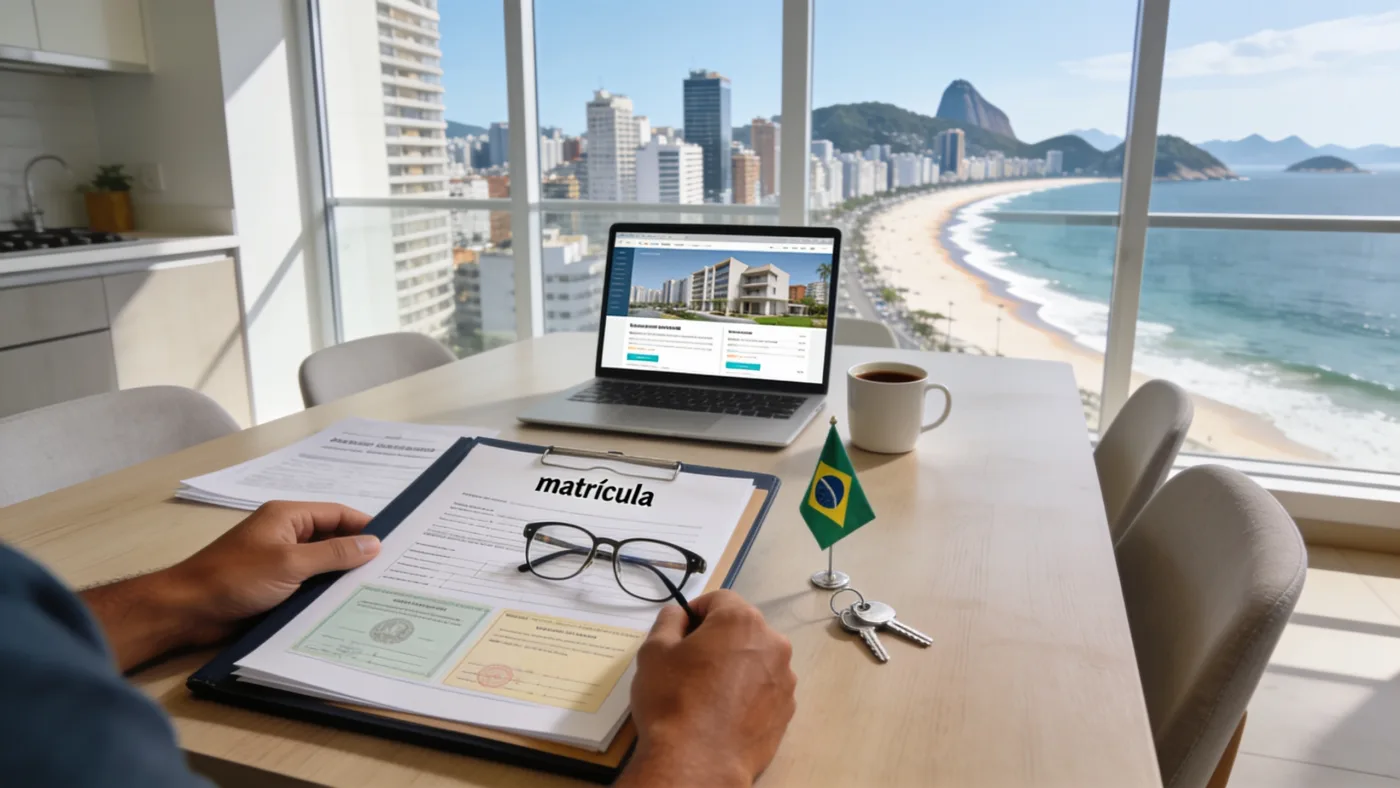
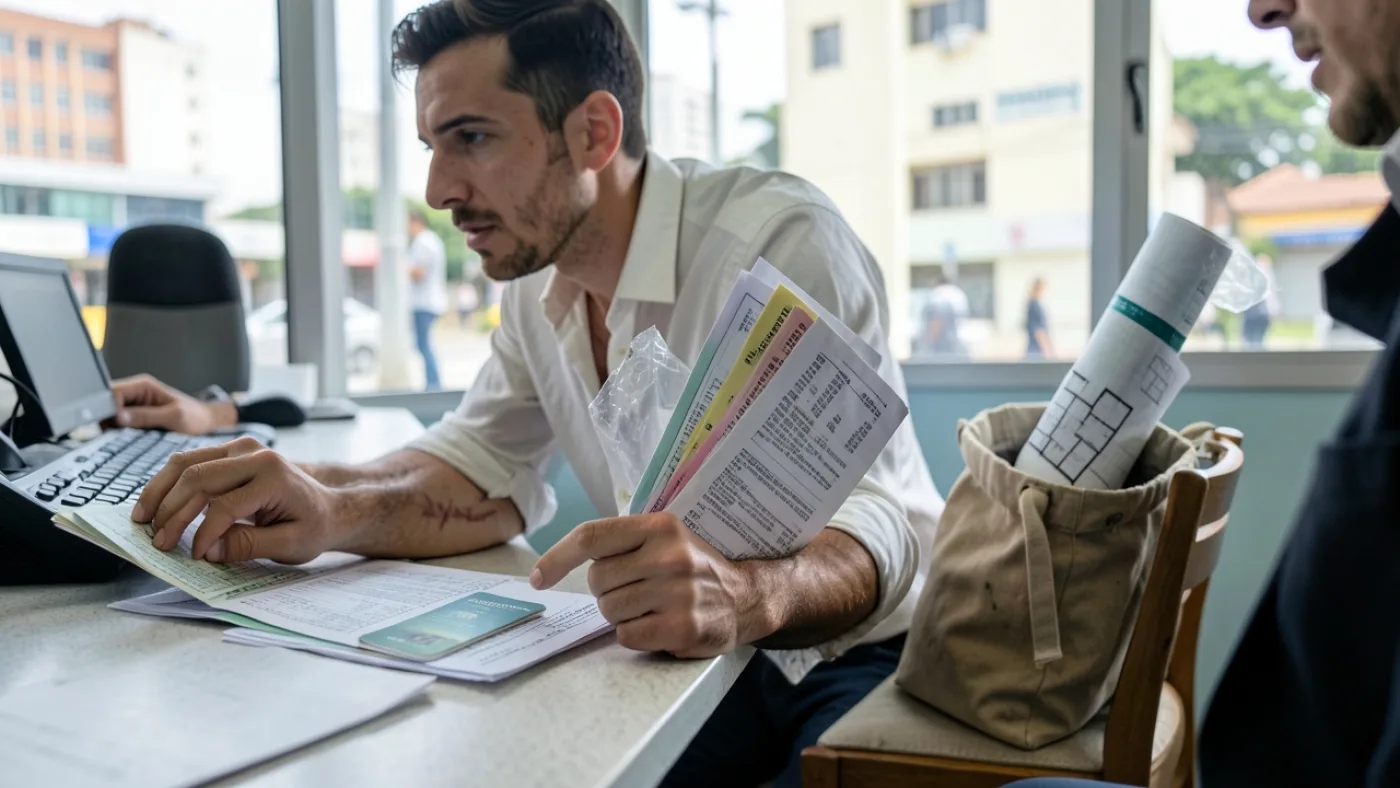
You found the apartment. The price works. Then the broker asks how you plan to pay, and you realize you have no idea whether a Brazilian bank will lend to someone holding a foreign passport. Can a foreigner actually get a mortgage in Brazil, or is cash the only realistic path?
The short answer: yes, foreigners can obtain property financing (financiamento imobiliário) in Brazil. There is no law prohibiting it. But approval depends far less on your nationality than on three things banks care about: your residency status, whether your income is generated in Brazil, and how long you have had a CPF and a banking relationship here.
If you hold permanent residency (CRNM) and receive a Brazilian salary, most banks will treat you almost exactly like a Brazilian borrower. If you hold a temporary residence permit with local income, financing is possible but with a bigger down payment and a shorter term. If you are a non-resident with no visa and no Brazilian income, mortgage financing from a Brazilian bank is extremely difficult, and the vast majority of buyers in that situation pay cash or finance abroad against assets in their home country.
Rates are the second shock. In 2026, Brazilian mortgage rates sit around 10.5% to 12.5% per year plus an index. That is not a penalty aimed at foreigners: it reflects the Central Bank’s SELIC rate and Brazil’s cost of credit. Below you will find which banks actually lend to non-Brazilians, the exact documents they ask for, realistic cost simulations, and the mistakes that kill applications before they reach a credit analyst.
On this page
Which Brazilian Banks Actually Lend to Foreigners?
Caixa Econômica Federal, Banco do Brasil, Itaú, Bradesco and Santander all finance property purchases by foreigners who hold a valid residence permit, a CPF and provable income. Caixa, the state-owned bank that dominates housing credit in Brazil, is generally the most accessible, with rates around 10.5% to 11.5% per year plus TR in 2026.
There is no federal rule barring a bank from lending to a foreign national for an urban residential property. What exists instead is internal credit policy, and each bank writes its own. That is why two applicants with identical profiles can be approved at one bank and rejected at another.
Public banks: usually the easiest door
Caixa Econômica Federal operates the bulk of Brazil’s housing finance under the SBPE system funded by savings deposits. It accepts foreign borrowers with a CRNM (National Immigration Registration Card) and Brazilian income. Permanent residents typically get near-standard treatment. Caixa also tends to accept a wider range of income proof, including self-employed profiles, than private competitors.
Banco do Brasil follows a similar logic, with rates typically in the 11% to 12% per year plus TR band. It is often a good option if you already receive your salary through a BB account, because internal relationship history carries real weight in credit scoring.
Private banks: faster, pickier, pricier
Itaú, Bradesco and Santander approve foreigners regularly, especially those with executive-level employment contracts at multinationals. Rates generally run from 11% to 12.5% per year plus TR, and foreigners are usually quoted at the upper end. The upside is speed: private banks often deliver a credit decision in 5-10 business days, while Caixa can take 15-30.
Santander has historically been the most receptive to international profiles, partly because of its European parent group and its private banking division serving high-net-worth non-residents. If you bank with Santander in Spain, Portugal or the UK, ask your relationship manager whether a cross-border referral is possible. It is not a formal product, but it opens doors.
Tip: Before you apply anywhere, open a Brazilian bank account and let it season for at least six months with regular deposits. Banks weigh relacionamento (relationship history) heavily, and a three-week-old account with no movement reads as a red flag to any credit analyst.
One structure worth knowing: buying through a Brazilian company. Some investors incorporate a Brazilian entity and apply for corporate real estate credit instead. This can work, but it requires a CNPJ, and a CNPJ requires a valid registered address. Firms like ours provide a fiscal address in Brazil for exactly this purpose. Be aware that corporate credit lines carry different rates and that transferring property later triggers additional tax.
What Documents and Requirements Do Banks Demand from Foreign Borrowers?
Every Brazilian bank will require a CPF (the individual taxpayer number issued by the Receita Federal), a valid identity document, proof of residence, and income documentation covering at least the last three to six months. Banks cap your monthly installment at roughly 30% of verified gross household income, a limit applied across the market.
The CPF is the foundation of everything. Without it you cannot buy property, register a deed, sign a long-term lease or open an account. It is free when requested directly from the Receita Federal (Brazilian IRS) and costs a small fee at Correios branches or through a Brazilian consulate abroad.
Standard document checklist: Brazil mortgage for foreigners
- CPF card or printed CPF confirmation from Receita Federal
- CRNM (National Immigration Registration Card) or valid passport with visa
- RNE/protocol from the Federal Police if the CRNM is still being processed
- Proof of address (comprovante de residência): utility bill in your name, no older than 90 days
- Last 3 payslips (holerites) or, if self-employed, 6 months of bank statements plus your accountant’s income statement (declaração de renda)
- Last income tax return filed in Brazil (Declaração de Imposto de Renda) with the receipt of delivery
- Marriage or divorce certificate, when applicable, registered at a cartório (notary office)
- Property documents: matrícula (title record) issued within 30 days, IPTU statement, seller’s certificates
Important: Foreign documents such as birth certificates, marriage certificates or overseas income statements must be apostilled under the Hague Apostille Convention and then translated by a tradutor público juramentado (sworn public translator) registered with a Brazilian commercial board. Sworn translations run roughly R$ 100-200 per page and take 3-7 business days.
The income rule that decides most applications
Banks apply a comprometimento de renda cap, usually 30% of gross monthly income. If your combined household income is R$ 20,000 per month, your maximum installment is around R$ 6,000. Work backwards from that number before you fall in love with a listing.
Example: A French engineer on a work visa earning R$ 25,000 gross per month qualifies for an installment ceiling near R$ 7,500. At roughly 11.5% per year over 20 years, that supports a financed amount of about R$ 700,000. With a 40% down payment required for a temporary resident, the target property price lands near R$ 1.17 million, and she still needs about R$ 55,000 in cash for ITBI, registry and notary fees.
Foreign-source income is the hardest hurdle. Most banks will not count a salary paid in euros into a foreign account, because they cannot verify it against Brazilian tax filings. If you are a digital nomad billing overseas clients, the practical fix is to declare that income in Brazil as a tax resident and build two years of filings, or to invoice through a Brazilian company.
Can You Get a Mortgage in Brazil Without Residency?
Realistically, no. Non-resident foreigners holding only a CPF and a tourist stamp are refused by virtually every retail bank in Brazil, because credit policies require a residence permit plus verifiable local income. Non-residents can legally buy urban property and register the deed, but they finance it with cash, developer installments or credit obtained abroad.

This surprises buyers from countries where non-resident mortgages are routine. Brazil’s housing credit system is funded mainly by domestic savings deposits and FGTS (the workers’ severance fund), both regulated by the Banco Central do Brasil. Those funds are channelled toward resident borrowers, so banks have little institutional appetite for cross-border credit risk.
What non-residents actually do instead: Brazil mortgage for foreigners
- Developer financing (financiamento direto com a construtora): the most common route. Developers of off-plan units routinely accept foreign buyers with 20-40% down and monthly installments through delivery, indexed to INCC (the construction cost index). Documentation demands are far lighter than a bank’s.
- Cash purchase with proper FX registration: funds must enter Brazil through a licensed institution and be registered with the Central Bank as foreign capital. Skip this and repatriating your sale proceeds later becomes a nightmare.
- Home-country borrowing: refinancing property abroad and wiring the proceeds is usually cheaper than 11% in Brazil.
- Seller financing: negotiated privately, secured by alienação fiduciária (fiduciary transfer of title) registered at the property registry.
Warning: Never bring purchase funds into Brazil informally, through a friend’s account or an unlicensed exchange operator. Without proper registration at the Central Bank, you may be unable to legally send the sale proceeds back out of the country, and you expose yourself to tax and anti-money-laundering scrutiny.
Rural land is a separate universe. On 23 April 2026, the Supreme Federal Court (STF), judging ADPF 342 and ACO 2463, unanimously upheld the restrictive regime of Law 5.709/1971 and Law 8.629/1993 governing the acquisition and leasing of rural property by foreigners and by Brazilian companies under foreign control. The Court kept in place the requirement of state authorization and area limits even when the acquisition results from enforcing a real guarantee such as a mortgage. Practical effect: banks are extremely reluctant to accept rural land as collateral from foreign-linked borrowers.
There is some judicial flexibility on enforcement. In case 2024029-90.2017.8.26.0000, decided in July 2018, the 23rd Chamber of Private Law of the São Paulo Court of Justice (TJSP) allowed a Brazilian financial institution treated as foreign-controlled to acquire rural property at auction in a mortgage foreclosure, despite Law 5.709/1971. Enforcing an existing guarantee is treated differently from acquiring land directly. For your purchase plan, the takeaway is simple: if you are a foreigner, finance urban property.
What Do Brazilian Mortgage Rates and Total Costs Look Like in 2026?
In 2026, Brazilian mortgage rates run roughly 10.5% to 12.5% per year plus TR (the reference rate) or an IPCA inflation index, depending on the bank and the funding line. Closing costs add another 5% to 7% of the purchase price, driven mainly by ITBI transfer tax of 2-3% charged by the municipality.
Understand why the number is high before you react. Brazilian credit prices off the SELIC base rate set by the Central Bank’s Monetary Policy Committee. A mortgage at 11% per year is normal market pricing here, not a foreigner surcharge. What foreigners genuinely face is a rate at the top of the band, a larger down payment and a shorter term.
| Borrower profile | Typical rate (2026) | Max financing | Typical term | Approval odds |
|---|---|---|---|---|
| Permanent resident (CRNM) with Brazilian salary | 10.5% – 11.5% + TR | Up to 80% | Up to 35 years | High |
| Temporary resident, work visa, local salary | 11% – 12.5% + TR | 50% – 70% | 10 – 20 years | Moderate |
| Self-employed foreign resident with Brazilian filings | 11.5% – 12.5% + TR | 50% – 60% | 10 – 20 years | Moderate to low |
| Non-resident, no Brazilian income | Not offered by retail banks | 0% | N/A | Very low |
| Brazilian company under foreign control (urban asset) | Corporate credit lines, negotiated | 50% – 70% | 10 – 15 years | Case by case |
Closing costs you cannot finance
Budget these separately in cash. On a R$ 800,000 apartment in São Paulo:
- ITBI (property transfer tax, paid to the city): 3% in São Paulo and Rio de Janeiro, 2% in many smaller cities, so R$ 16,000-24,000
- Registro de Imóveis (land registry fee): roughly 1% to 1.5%, so R$ 8,000-12,000
- Escritura (notarial deed at the cartório): R$ 3,000-8,000, though a bank-financed purchase usually uses a private contract instead of a public deed, cutting this cost
- Bank appraisal and administrative fees: roughly R$ 3,000-5,000
- Mandatory insurance (MIP and DFI): added monthly to the installment
In practice: On a R$ 500,000 loan at 11.5% per year over 20 years using the SAC amortization system, the first installment lands near R$ 6,900 and declines each month, while the Price system would hold it near R$ 5,300 flat but cost more in total interest. Ask every bank for the CET (Custo Efetivo Total, total effective cost), which by Central Bank rules must include insurance and administrative fees.
Note also that ITBI must be paid before the deed is registered at the Real Estate Registry Office. Until registration happens, you are not the legal owner. Brazil follows Civil Law, and under the Brazilian Civil Code ownership of real property transfers only upon registration of the title, not upon signature of the contract.
What Quietly Blocks a Foreigner’s Mortgage Application?
Most rejections have nothing to do with income. The three most frequent blockers are a CPF flagged as irregular or “pendente de regularização” at the Receita Federal, a bank account under six months old, and a property whose matrícula (title record) carries liens, unregistered construction or an unresolved inheritance.
Blocker 1: a CPF that is not in good standing
Many foreigners obtain a CPF at a consulate to open an investment account, then never file anything. If you become a Brazilian tax resident and skip the annual return, your CPF status can shift to irregular. Check yours on the Receita Federal portal before applying. Regularization typically takes 2-4 weeks once outstanding filings are submitted.
Blocker 2: the property itself fails due diligence
The bank finances the asset, not just you. Its legal department will pull the matrícula and reject the file if it finds an existing mortgage, a judicial attachment (penhora), an usufruto, a building extension never registered with the municipality, or a seller involved in ongoing litigation. Roughly speaking, the property clears or the deal dies, no matter how strong your income is.
Order the updated matrícula and the full set of seller certificates before you sign anything or pay a deposit. This is the single highest-value step in the whole process, and it is covered in detail in our guide on how to buy property in Brazil as a foreigner.
Blocker 3: a signed contract with no financing clause
Buyers routinely sign the preliminary purchase agreement (contrato de compromisso de compra e venda) and hand over a deposit before the bank has approved anything. If credit is then denied, the deposit may be forfeited under the contract’s penalty clause, often 10% of the price.
Caution: Always insist on a cláusula suspensiva making the contract conditional on mortgage approval, with full refund of any deposit if the bank refuses. Brazilian sellers accept this routinely when it is requested up front, and almost never once the contract is drafted.
Blocker 4: misunderstanding the guarantee
Brazilian housing loans no longer use the classic hipoteca (mortgage lien). They use alienação fiduciária, created by Law 9.514/1997, where the bank holds title until the loan is repaid. Repossession is administrative and fast: after formal notice and a cure period, the property goes to auction without a full court case. Default is far less forgiving here than in most of Europe or North America.
How Do You Apply for a Brazilian Mortgage, Step by Step?
Expect 45-90 days from first simulation to signed contract, assuming clean documents. Caixa and the major private banks all offer online pre-approval simulators, but every foreigner file ends up requiring at least one in-person branch visit for document validation and biometric signature collection.
Step 1: Get your CPF and open a bank account (weeks 1-4)
Request the CPF from the Receita Federal, free online for many nationalities, or at a Brazilian consulate abroad through the Itamaraty consular portal. Then open an account and start moving money through it.
Step 2: Regularize immigration status (parallel)
Register with the Federal Police and obtain your CRNM. Under the Brazilian Migration Law (Law 13.445/2017), holders of residence permits must complete registration within the deadline stated in their visa authorization. Banks want to see the physical card, not just a protocol.
Step 3: Run simulations and request pre-approval (weeks 5-7)
Apply to at least three banks in parallel. Pre-approval (carta de crédito aprovado) is typically valid for 30-90 days and turns you into a serious buyer in negotiations. Compare the CET, not the headline rate.

Step 4: Choose the property and run legal due diligence (weeks 8-10)
Your lawyer, registered with the OAB (Brazilian Bar Association), pulls the matrícula, the seller’s civil, labor, tax and bankruptcy certificates, IPTU clearance and condominium debt statement. Then you sign the preliminary contract with the financing condition clause.
Step 5: Bank appraisal and legal review (weeks 10-13)
The bank sends an engineer to value the property and its legal team audits the title. If the appraisal comes in below the agreed price, the bank lends against the lower figure and you cover the gap in cash.
Step 6: Sign, pay ITBI, register (weeks 13-16)
You sign the bank’s contract at the branch. Pay ITBI to the municipality, then register the contract at the competent Real Estate Registry Office. Registration takes 10-30 days. Only then are you the owner. For the complete legal framework, see our main guide on buying property in Brazil as a foreigner.
Frequently Asked Questions About Mortgages for Foreigners in Brazil
These are the questions foreign buyers ask most often before starting a financing application in Brazil.
Can I get a mortgage in Brazil on a tourist visa?
No. Retail banks require a valid residence permit and verifiable Brazilian income. On a tourist stamp you can still legally buy urban property with a CPF and register the deed in your name, but you will pay cash or negotiate installments directly with a developer. Developer financing for off-plan units is the realistic alternative and typically requires 20-40% down with installments indexed to the INCC construction index. Always register the incoming funds with the Central Bank so you can repatriate proceeds when you sell.
Do banks require a local employment contract?
Not necessarily a CLT employment contract, but they do require Brazilian-sourced income they can verify. Self-employed foreigners and business owners qualify by presenting six months of bank statements, an accountant-signed income declaration (declaração de renda) and at least one filed Brazilian income tax return. Caixa Econômica Federal tends to be the most flexible with self-employed profiles. Salaried applicants with a registered contract and a carteira de trabalho get better rates and higher loan-to-value ratios, so if you are about to formalize employment, apply after, not before.
How much down payment will I need as a foreigner?
Permanent residents with stable Brazilian salaries can sometimes reach 80% financing, meaning 20% down. Temporary residents are typically asked for 30% to 50%. On a R$ 800,000 apartment, that means R$ 240,000 to R$ 400,000 in cash, plus roughly R$ 40,000 to R$ 55,000 in ITBI, registry and administrative costs. Have the full amount liquid and traceable in a Brazilian account before you apply, because banks ask about the origin of funds under anti-money-laundering rules.
Can a foreigner finance rural land or a farm in Brazil?
Practically, no. In April 2026 the Supreme Federal Court, in ADPF 342 and ACO 2463, unanimously confirmed the restrictive regime of Law 5.709/1971 for acquisition and leasing of rural property by foreigners and foreign-controlled Brazilian companies, keeping state authorization requirements and area limits even where acquisition results from enforcing a mortgage. Because banks must be able to repossess collateral, they avoid rural land tied to foreign borrowers. Urban residential and commercial property faces no equivalent restriction, apart from coastal and border security zones.
Is it cheaper to borrow abroad and buy in cash in Brazil?
Very often, yes. At 11% to 12.5% per year in Brazil versus low single digits in much of Europe or North America, refinancing an asset at home can be dramatically cheaper. The trade-off is currency risk: your debt is in euros or dollars while your Brazilian asset and any rental income are in reais. Many investors accept that risk. Whatever route you choose, register the inbound funds as foreign capital with the Central Bank so future repatriation and capital gains reporting are clean.
Do I need a lawyer, or is the bank’s legal review enough?
The bank’s legal team protects the bank, not you. It verifies that the collateral is enforceable, not whether the contract terms are fair to you, whether the deposit is refundable, or whether your marital property regime affects the purchase. An independent lawyer registered with the OAB reviews the title chain, the seller’s certificates and the contract clauses. Legal fees for a straightforward residential purchase commonly range from R$ 4,000 to R$ 15,000 depending on complexity, a fraction of what a title defect can cost.
Financing Property in Brazil as a Foreigner: Talk to a Bilingual Lawyer First
Getting a mortgage in Brazil as a foreigner is entirely possible, but the system rewards preparation. The buyers who succeed are the ones who fixed their CPF status, seasoned a bank account, gathered apostilled documents and negotiated a financing condition clause before signing anything. The ones who struggle are the ones who found a property first and tried to solve the paperwork afterwards.
You should not have to decode Brazilian credit policy, sworn translations and registry law in a second language while a seller pressures you for a deposit. Our bilingual team at Ribeiro Cavalcante Advocacia handles the full path: CPF and residency issues, bank negotiation, title due diligence, contract drafting and registration. If you want to know exactly where you stand before approaching a bank, or you want to first confirm whether foreigners can buy the property you have in mind, send us a message and we will review your situation.
Talk to a specialist lawyer now
Talk to a Lawyer on WhatsApp